
August 4, 2026
When Equipment Sales Become Economic Signals: Decoding Caterpillar's Record Quarter
There is a well-established principle in industrial economics that the health of capital equipment manufacturers reveals far more about the trajectory of global resource investment than commodity price indices alone. When an OEM of Caterpillar's scale reports broad-based growth across every major operating segment simultaneously, it does not simply reflect a strong quarter for one company. It functions as a real-time measurement of committed capital across the entire mining and construction ecosystem.
The Caterpillar June quarter sales 20.5 billion figure that emerged from the company's most recent earnings report is precisely this kind of signal. It warrants examination not just as a corporate milestone, but as a window into the structural forces reshaping global mining investment at a critical juncture in the energy transition.
When big ASX news breaks, our subscribers know first
A Revenue Result That Rewrites Quarterly Benchmarks
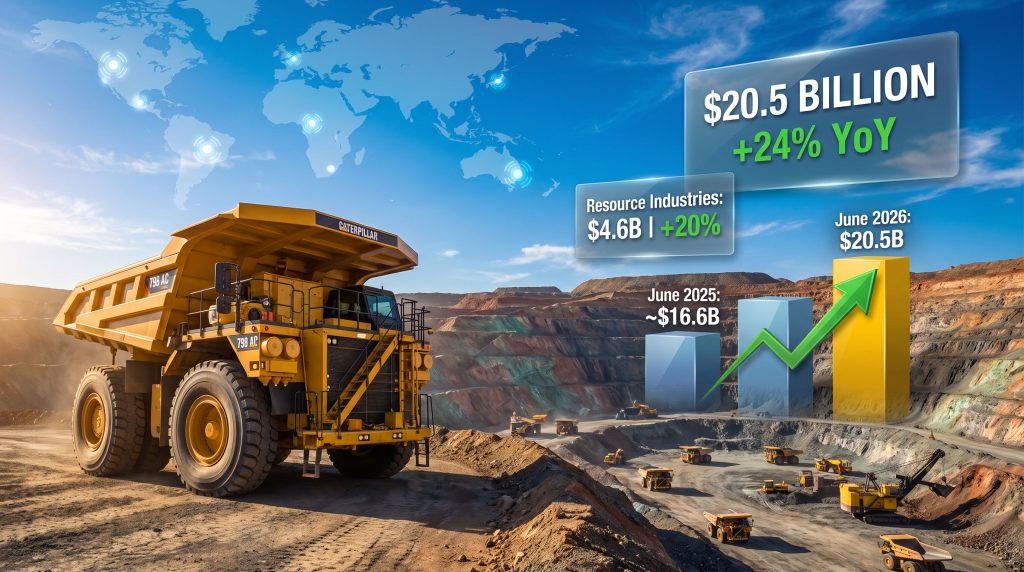
Caterpillar's consolidated sales and revenues for the quarter ending June 2026 reached US$20.5 billion, representing a 24% increase against the equivalent period in 2025, when the company recorded approximately $16.569 billion in quarterly revenue. The arithmetic is straightforward: a $3.9 billion uplift in a single year, generated across three major operating divisions, each of which posted double-digit percentage growth.
| Quarter | Reported Revenue | Year-on-Year Change |
|---|---|---|
| June 2025 | ~$16.6 billion | Baseline |
| June 2026 | ~$20.5 billion | +24% |
| Revenue Uplift | ~$3.9 billion | One-year increment |
What separates this result from typical cyclical recoveries is the simultaneous nature of the expansion. In most industrial cycles, one segment leads while others lag, reflecting uneven demand recovery across end markets. A situation in which every major division records double-digit growth at the same time points toward something more structural: multiple capital expenditure cycles converging across mining, construction, and energy infrastructure simultaneously.
In heavy industrial manufacturing, synchronised multi-segment growth of this magnitude is uncommon and historically has corresponded with periods of multi-year capex expansion, not short-term demand spikes.
Resource Industries: The Mining Engine Behind the Numbers
Caterpillar's Resource Industries segment, which encompasses surface mining trucks, underground machinery, draglines, large hydraulic shovels, and supporting technology platforms, grew sales by 20% to $4.6 billion in the June quarter. This division is the most direct barometer of global mining operator spending intentions, serving large-scale producers across coal, copper, iron ore, gold, and the expanding critical minerals sector.
To contextualise the $4.6 billion figure: this single quarterly segment result exceeds the total annual revenue of many mid-tier mining equipment manufacturers. It reflects not just volume, but a meaningful shift in the average transaction value of equipment orders, driven by three intersecting structural forces.
Force 1: Is the Critical Minerals Investment Cycle Generating Sustained Fleet Demand?
The electrification of transport and power systems globally requires copper, lithium, cobalt, nickel, and rare earth elements at scales that existing mine supply cannot meet without significant new capacity. Critical minerals demand from the International Energy Agency suggests these resources could increase by three to six times current levels by 2040 under accelerated energy transition scenarios.
Mining operators responding to this demand profile are committing to multi-year fleet expansion programmes involving large-format haul trucks, hydraulic shovels, and autonomous equipment systems — precisely the product categories where Caterpillar maintains dominant market positioning. Furthermore, the battery metals investment landscape is adding further momentum to these procurement cycles.
What is less widely understood is the lead time compression effect this creates. Mining operators who have secured project finance and received regulatory approvals are placing equipment orders 18 to 36 months before first ore production, meaning current OEM order books reflect investment decisions made as early as 2024. The June 2026 revenue result is, in part, the delivery phase of that earlier commitment wave.
Force 2: Fleet Replacement Pressure From the 2010–2015 Supercycle
A significant but often overlooked demand driver operating alongside new project investment is the ageing of the global surface mining fleet. Equipment deployed in large numbers during the commodity supercycle of roughly 2010 to 2015 is now reaching its practical end-of-life threshold, typically 12 to 15 years for large haul trucks operating in high-utilisation environments such as iron ore and copper pits.
Fleet replacement differs from new capacity investment in an important respect: it is non-discretionary. Operators cannot defer truck replacement indefinitely without accepting declining payload reliability, rising maintenance costs per tonne, and growing safety exposure. This creates a demand floor that is largely independent of commodity price fluctuations, providing OEM revenue stability that pure commodity price analysis fails to capture.
The coincidence of this replacement wave with a new investment cycle creates a compounding demand effect that is contributing materially to Caterpillar's current revenue trajectory.
Force 3: Autonomy and Technology Specifications Are Inflating Average Transaction Values
Perhaps the most structurally significant shift in mining equipment procurement over the past five years is the transition from standardised mechanical specifications to integrated technology platforms. Mining operators increasingly specify autonomous-ready truck configurations, onboard health monitoring systems, and fleet management software integration at the point of purchase, rather than retrofitting these capabilities after delivery.
This specification shift has a direct and measurable impact on revenue per unit. An autonomous-ready Caterpillar 797F haul truck — the world's largest mining truck with a 363-tonne payload capacity — carries a meaningfully higher capital cost than an equivalent non-autonomous configuration. When this premium is multiplied across fleet-scale orders of 20, 50, or 100 units, the segment revenue impact is substantial even if total unit volumes remain unchanged.
Mining automation trends have accelerated the adoption of platforms such as Caterpillar's Cat MineStar Command for hauling, which has been deployed across multiple Tier 1 iron ore, copper, and coal operations globally. This platform has accumulated over 5 billion tonnes of material moved autonomously across its installed fleet base as of recent reporting periods. As this technology matures from competitive differentiator to operational standard, it becomes embedded in baseline specifications rather than optional extras, permanently elevating average order values across the Resource Industries segment.
Competitive Positioning: How Caterpillar's Scale Compounds Its Advantage
| OEM | Primary Mining Segment Focus | Recent Trend Direction |
|---|---|---|
| Caterpillar | Surface, underground, full fleet | +24% total revenue, +20% resource industries |
| Komatsu | Surface mining, autonomous systems | Expanding automation partnerships |
| Terex | Processing and crushing equipment | Mobile crusher demand driving growth |
| Hitachi | Surface mining, innovation programmes | European innovation challenge launched |
The competitive dynamic that Caterpillar's scale creates is difficult to replicate. Operating at $20.5 billion in quarterly revenue enables cross-segment commercial structures that pure-play equipment manufacturers cannot match. A major mining operator purchasing a fleet of haul trucks from Caterpillar simultaneously accesses parts supply chains, financing structures through Cat Financial, digital monitoring subscriptions through MineStar, and long-term maintenance contracts — all within a single commercial relationship.
This bundling model significantly increases switching costs. When an operator standardises on Caterpillar across its fleet, the cost of transitioning to a competitor extends well beyond equipment purchase price. It encompasses retraining of operators and maintenance technicians, parts inventory rationalisation, and integration of new software platforms with existing mine management systems. These friction costs effectively lock in revenue relationships across multi-decade mine lifespans.
The integrated equipment-services-technology model transforms what might appear to be a capital goods business into something closer to a long-duration annuity structure, with recurring parts and service revenues providing earnings stability that equipment sales alone cannot deliver.
The After-Market Revenue Layer: Where Margins Are Actually Made
A dimension of Caterpillar's quarterly result that receives insufficient analytical attention is the after-market services component. Parts supply, planned maintenance contracts, component exchange programmes, and digital service subscriptions represent the highest-margin revenue stream within the company's total result, significantly exceeding the margins generated by original equipment sales.
The economic logic is compelling:
- A large haul truck operating in a high-utilisation iron ore environment may require tyre replacement every 6,000 to 12,000 hours of operation
- Ground engaging tools such as bucket teeth and cutting edges on hydraulic shovels are consumed continuously and represent high-volume, recurring parts demand
- Engine overhauls on large mining trucks typically occur at intervals of 20,000 to 25,000 hours, representing six-figure service events
- Digital monitoring subscriptions generate revenue continuously across the installed fleet base, independent of new equipment sales
Every strong equipment sales quarter like June 2026 expands the installed base that generates this after-market revenue stream over the subsequent decade. The compounding effect of sustained high equipment sales on future after-market revenue is a structural tailwind that is frequently underappreciated in short-term OEM revenue analysis.
Geographic Demand: Which Mining Regions Are Spending?
The revenue growth Caterpillar reported in the June quarter reflects demand concentration across several distinct geographic pockets, each driven by different commodity and project dynamics.
Americas: The Revenue Anchor
North and South America collectively represent Caterpillar's largest geographic revenue concentration. Chilean and Peruvian copper expansions, Canadian oil sands fleet renewals, and gold operations across multiple Latin American jurisdictions are all generating sustained large-format equipment demand. In the United States, infrastructure spending is driving construction equipment demand that supports Caterpillar's Construction Industries segment independently of mining cycles.
Asia-Pacific: Critical Minerals Projects Accelerating Procurement
Australian iron ore operations in the Pilbara region, where Rio Tinto, BHP, and Fortescue collectively operate some of the world's largest autonomous truck fleets, represent a concentrated and strategically important market for Caterpillar's largest equipment categories. Lithium operations across Western Australia's hard rock spodumene district are also generating equipment demand as project pipelines convert to operating mines. Indonesian nickel and coal operations represent a growing mid-range procurement market.
Africa and Emerging Markets: The Long-Duration Pipeline
The Democratic Republic of Congo copper-cobalt belt, West African gold developments, and Southern African platinum operations represent procurement pipelines with longer lead times but substantial scale. These markets are contributing to Caterpillar's order book visibility for the latter half of the decade, providing revenue predictability that extends well beyond current delivery schedules.
The next major ASX story will hit our subscribers first
The Electrification Transition: Disruption Risk or Upgrade Cycle Opportunity?
One of the more nuanced debates within the mining equipment sector concerns whether the electrification of surface mining haul trucks represents a platform disruption risk for incumbent OEMs or simply the next product upgrade cycle. The distinction matters significantly for long-duration revenue forecasting.
The speculative argument for disruption holds that battery-electric or hydrogen autonomous trucks could enable new entrants — potentially from the automotive sector — to challenge Caterpillar's market position with zero-emission platforms that bypass the incumbents' combustion engine expertise. This view has gained some traction given the pace of battery technology improvement in automotive applications.
The more widely held industry view, however, supported by the operational realities of large-format mining equipment, is considerably less disruptive. A 363-tonne payload haul truck operating continuously in a deep open-pit mine faces energy density, recharging infrastructure, and structural requirements that differ fundamentally from automotive applications. The engineering complexity of electrifying mining equipment at this scale plays to the strengths of OEMs with deep application expertise, not against them.
Caterpillar's development of zero-emission and hybrid-electric mining equipment variants positions the company to treat electrification as a new product generation rather than an existential threat. Critically, each electrification transition represents a new capital expenditure event for mining operators, meaning the transition cycle itself generates fresh equipment revenue regardless of which power source ultimately dominates. Industry analysts tracking Caterpillar's sustainability roadmap highlight this dynamic as a key long-term earnings driver.
Key Takeaways From a Landmark Quarter
The Caterpillar June quarter sales 20.5 billion result is more than a corporate earnings milestone. It is a quantified snapshot of where global mining capital is flowing, which technologies operators are prioritising, and how the structural demand forces shaping the resource sector are translating into real procurement decisions.
Several conclusions emerge from a close reading of the result:
- The 24% year-on-year revenue increase confirms that multiple capital expenditure cycles — including new critical minerals projects, replacement demand, and technology upgrade programmes — are executing simultaneously rather than sequentially
- The Resource Industries segment's 20% growth to $4.6 billion indicates that mining operators at the Tier 1 level are in active fleet expansion and replacement mode, not planning or deferral mode
- Autonomous and technology-integrated specifications are structurally inflating average transaction values independent of unit volume growth, a revenue dynamic that will persist as these capabilities become baseline requirements
- The after-market services compounding effect means that today's equipment sales are building the foundation for a decade of high-margin recurring revenue, a dynamic that short-term quarterly analysis consistently underweights
- Geographic demand diversity across the Americas, Asia-Pacific, and emerging African markets provides revenue resilience against single-region commodity price volatility
Disclaimer: This article is intended for informational purposes only and does not constitute financial or investment advice. Forward-looking statements regarding market trends, OEM revenue trajectories, and commodity demand are inherently speculative and subject to significant uncertainty. Readers should conduct independent research and seek professional advice before making investment decisions.
Want to Capitalise on the Next Major Mining Discovery Before the Market Catches On?
The structural forces driving Caterpillar's record quarter — critical minerals demand, fleet expansion, and accelerating exploration capital — are creating significant discovery opportunities on the ASX right now. Discovery Alert's proprietary Discovery IQ model scans ASX announcements in real time, delivering instant alerts on significant mineral discoveries so subscribers can act ahead of the broader market; explore historic discovery returns on the dedicated discoveries page and begin a 14-day free trial to secure a meaningful market edge.