
August 4, 2026
The Structural Fault Lines Running Through the World's Largest Gold Producer
Large-cap mining companies have historically resisted structural dismemberment, preferring the perceived advantages of scale, diversification, and negotiating heft with sovereign governments. Yet the past decade has quietly rewritten that playbook. From BHP's petroleum exit to Rio Tinto's progressive retreat from thermal coal, the industry's most powerful players have been forced to confront an uncomfortable truth: size alone no longer commands a valuation premium when the underlying asset mix is too complex for any single class of institutional investor to price efficiently.
That tension is now arriving at the doorstep of Barrick Mining Corporation, where a debate over the company's Barrick break-up plans has escalated from boardroom speculation into something far more consequential. Understanding what is actually at stake requires moving beyond the headlines and into the structural mechanics of what such a separation would involve, who holds the power to enable or block it, and what the frontier risk embedded in Barrick's international portfolio truly represents.
When big ASX news breaks, our subscribers know first
Why Portfolio Complexity Has Become a Valuation Liability
Institutional investors increasingly operate within mandate constraints that prevent them from holding assets across sharply divergent risk categories. A sovereign wealth fund seeking stable, long-duration gold exposure in politically secure jurisdictions cannot allocate to the same vehicle that also carries operational exposure to conflict-affected West Africa or a greenfield copper-gold project in Balochistan. The result is a persistent and well-documented valuation gap: diversified miners with frontier exposure tend to trade at a structural discount to their sum-of-parts intrinsic value.
This discount is not merely theoretical. Comparable pure-play North American gold producers have historically commanded enterprise value to EBITDA multiples materially above those of geographically diversified peers. When an asset of the quality of Nevada Gold Mines is bundled with higher-risk operations, the market applies a blended multiple that undersells the former while failing to adequately price the optionality of the latter.
Furthermore, activist investors have a long history of targeting exactly this kind of structural inefficiency. The reported involvement of Elliott Management, one of the most sophisticated and persistent activist funds operating in natural resources, signals that the argument for structural separation has now reached a level of institutional credibility that Barrick's board cannot easily dismiss. Elliott has not made a formal public statement confirming a campaign, but its reported presence alone tends to accelerate decision-making timelines in ways that organic shareholder pressure rarely achieves.
The Crown Jewel: Nevada Gold Mines and the Partnership Problem
Any honest analysis of Barrick break-up plans must begin with Nevada Gold Mines, because the asset simultaneously represents the most compelling argument for a North American spin-off and its most significant structural obstacle.
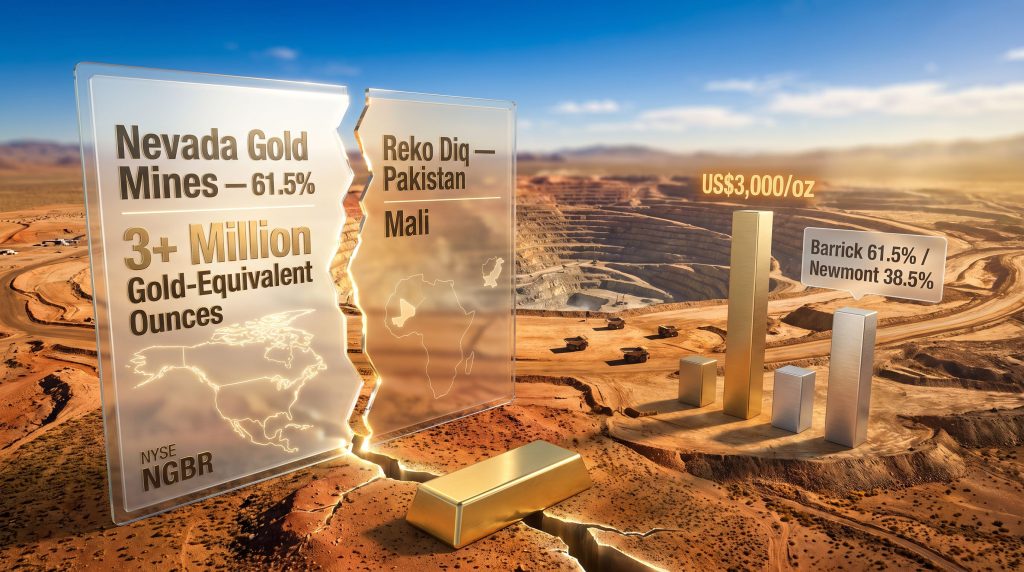
Established in 2019 through the combination of Barrick and Newmont's Nevada assets, the joint venture ranks as the single largest gold-producing complex in the world. Barrick holds a 61.5% controlling interest, with Newmont retaining the remaining 38.5%. At prevailing gold prices above US$3,000 per ounce in the 2025–2026 environment — and with a broadly positive gold price outlook supporting sentiment — this asset base alone generates production volumes and cash flows capable of supporting a standalone listed entity of considerable institutional appeal.
The problem, however, is structural rather than financial. Any attempt to spin off Nevada Gold Mines into a new publicly listed North American entity requires Newmont's active cooperation. Joint venture agreements of this complexity typically include:
- Transfer restriction clauses governing how a partner can deal with its interest
- Consent rights triggered by corporate restructuring events affecting the JV's ownership structure
- Tag-along and drag-along provisions that affect how the non-restructuring party must be treated
- Pre-emptive rights that could allow Newmont to acquire Barrick's stake before it is transferred to a new vehicle
Newmont has its own strategic agenda and its own shareholders to serve. There is no obvious reason why Newmont would expedite its consent to a process that primarily benefits Barrick's restructuring timeline. Barrick could, in theory, pursue a buyout of Newmont's 38.5% stake, but doing so at fair value would represent a capital commitment likely running to several billion dollars, and would require financing at a scale that complicates the very simplification exercise the spin-off is meant to achieve.
Without Nevada Gold Mines as the anchor asset, a North American IPO vehicle loses much of its institutional appeal. The asset is not merely the largest contributor to the proposed entity's production profile; it is the primary justification for the premium valuation multiple the spin-off would need to command.
Frontier Exposure: Mali, Pakistan, and the Limits of Optionality
The assets that would remain in Barrick's international portfolio after any North American separation are not uniformly troubled, but they share a common characteristic: they require a specific type of investor with a high tolerance for sovereign risk, security complexity, and long development timelines.
Mali represents the most immediately concerning jurisdiction. The country has experienced successive military coups and a deteriorating relationship between the transitional government and foreign mining companies. Barrick's operations there represent a multi-billion dollar capital commitment in an environment where the risk of asset impairment, capital repatriation restrictions, and operational interruption is materially elevated. The situation in Mali is not static, and the direction of travel in recent years has not favoured foreign mining interests.
The Reko Diq copper-gold project, located in Pakistan's Balochistan province, presents a different but equally complex profile. The deposit itself is remarkable: one of the largest undeveloped copper-gold porphyry systems anywhere in the world, with a resource scale that would, under normal circumstances, attract intense competition among major mining companies. Copper's strategic importance in the global energy transition adds a dimension of long-term optionality that pure gold investors typically cannot capture in their valuation models.
However, Reko Diq is not operating in normal circumstances. Militant activity has been reported near exploration areas in Balochistan, a security dimension that adds operational complexity to an already challenging permitting and financing environment. Barrick's Reko Diq strategy and its capital structure have been identified by industry analysts as the two variables most critical to determining whether the project can be advanced on any credible timeline. These are not minor execution details; they represent the foundational conditions for whether the project becomes a world-class copper producer or remains a long-dated option on geological potential.
Geopolitical Risk Comparison: North American vs. Frontier Portfolio
| Jurisdiction | Risk Category | Primary Concerns |
|---|---|---|
| Nevada, USA | Low | Regulatory stability, established infrastructure |
| Dominican Republic | Low-Medium | Royalty framework, community engagement |
| Mali | High | Political instability, coup risk, capital controls |
| Pakistan (Balochistan) | High | Security incidents, sovereign complexity, timeline uncertainty |
What a North American Spin-Off Would Actually Require
Executing a spin-off IPO for a major mining asset is a multi-year process involving legal, regulatory, and market preparation that most commentary dramatically underestimates. Based on precedent transactions in the sector, the typical sequence involves:
- Board mandate and formal resolution to proceed with structural separation
- Joint venture partner engagement, specifically securing Newmont's consent for Nevada Gold Mines inclusion
- Legal ring-fencing of North American assets into a newly incorporated corporate entity
- Regulatory filings with the SEC and relevant exchange authorities, including prospectus preparation meeting disclosure standards for a US-listed vehicle
- Institutional pre-marketing, typically involving sovereign wealth funds, gold-specialist long-only funds, and generalist resource investors
- Book-building and IPO pricing, with final valuation determined by institutional demand
- Post-listing governance establishment, including an independent board and defined relationship agreements with Barrick as the continuing major shareholder
The proposed North American entity would initially comprise Nevada Gold Mines (subject to JV consent), Pueblo Viejo in the Dominican Republic, and the Fourmile development project in Nevada. This combination would represent one of the highest-quality gold-focused portfolios available to public market investors, with Fourmile offering meaningful exploration upside within a well-understood geological district.
The Bull and Bear Cases: Competing Frameworks for Evaluating the Break-Up
The strategic logic for separation is coherent, but it is not without meaningful counterarguments. Both perspectives deserve rigorous treatment.
Arguments Supporting Structural Separation
- A pure-play North American producer would attract a dedicated, natural investor base that currently cannot justify holding Barrick due to its frontier exposure
- Valuation re-rating potential is substantial: if the North American entity trades at multiples comparable to peers like Agnico Eagle, the implied per-share value uplift for existing Barrick shareholders could be significant
- Management focus and capital allocation discipline improve materially when a leadership team is accountable to a single operational and geographic mandate
- Activist pressure, once established, rarely dissipates without either a substantive strategic response or a change in board composition
Arguments Against Structural Separation
- Reko Diq's copper exposure gives Barrick a differentiated energy-transition narrative that would be difficult to replicate in a gold-only North American vehicle
- Large, diversified mining majors typically enjoy stronger negotiating positions with host governments than smaller, single-jurisdiction operators
- Execution risk across multiple simultaneous processes — JV consent, SEC registration, asset sales in frontier jurisdictions — creates a period of strategic uncertainty that could itself depress the share price
- If gold prices correct materially before the IPO is completed, the proceeds could fall below the intrinsic value of the assets being transferred
Consequently, gold miners' valuation sensitivity to commodity price timing is a genuine risk that cannot be dismissed when assessing whether the spin-off delivers the anticipated premium.
The gap between Barrick's current market capitalisation and a credible sum-of-parts valuation is the central analytical argument driving restructuring pressure. If that gap cannot be closed operationally through production improvements and cost discipline, structural separation becomes an increasingly rational response.
The next major ASX story will hit our subscribers first
Industry Precedents and What They Actually Demonstrate
Three comparable transactions from the broader mining sector offer instructive, though imperfect, parallels.
BHP's petroleum separation via the Woodside merger in 2022 demonstrated that large-cap diversified miners can execute complex structural separations, but the process required years of preparation and a favourable commodity price environment at the point of execution. The transaction was widely regarded as value-accretive for BHP shareholders over a multi-year horizon.
Rio Tinto's coal asset exits illustrated a different dynamic: when a major miner divests non-core or reputationally complex assets under external pressure, it often accepts below-book valuations. The speed premium paid to conclude transactions can erode the theoretical value unlock that justified the process. In addition, broader mining consolidation trends suggest that the window for optimal separation timing is often narrower than boards initially anticipate.
AngloGold Ashanti's portfolio rationalisation, which involved a sustained multi-year programme of African asset restructuring, demonstrated that gold-specific separations are achievable but carry significant execution costs and management bandwidth requirements. As analysts have noted, a Barrick break-up of this scale could, if successful, trigger a wider wave of restructuring across the gold sector that should not be underestimated.
Key Milestones and What to Watch
The H1 2026 results presentation represents the first formal opportunity for Barrick's management to address restructuring questions with the specificity that institutional investors and analysts are demanding. Beyond that immediate catalyst, several medium-term decision points will determine whether the Barrick break-up plans move from speculation to execution:
- Newmont engagement signals: Any public indication that JV negotiations are underway would represent a significant market catalyst, as it would confirm that the largest structural obstacle is being actively addressed
- Mali operational clarity: A resolution or further deterioration of the situation in Mali will materially affect how the international rump entity is valued by any prospective buyer or public market
- Reko Diq capital structure announcement: Confirmation of financing arrangements and a revised construction timeline would either enhance or diminish the asset's attractiveness to potential acquirers
- Formal IPO filing or withdrawal: The presence or absence of an SEC registration filing within the next 12–18 months will provide the clearest possible signal of management's true intentions
This article is analytical in nature and does not constitute financial advice. Statements regarding potential valuations, restructuring outcomes, and investor returns involve significant uncertainty. Readers should conduct independent research before making any investment decisions.
Ready to Catch the Next Major ASX Mineral Discovery Before the Market Does?
Discovery Alert's proprietary Discovery IQ model scans ASX announcements in real time, instantly identifying high-potential mineral discoveries across more than 30 commodities — turning complex data into clear, actionable opportunities for both traders and long-term investors. Explore how major mineral discoveries have historically delivered exceptional returns, then begin your 14-day free trial at Discovery Alert to position yourself ahead of the broader market.