August 4, 2026
When the Dust Settles: Reassessing Geopolitical Risk Across Global Mining Markets
Commodity markets have long been shaped by the gravitational pull of geopolitical instability. History shows that disruption rarely destroys supply chains outright; instead, it warps them, redirecting flows, compressing margins, and creating winners and losers in ways that take months or years to fully surface. The current period of Middle East conflict fits squarely within this pattern, and understanding its true impact on mining sector and Middle East conflict risks requires looking well beyond headline production figures and spot prices.
The initial reaction among commodity analysts was one of alarm. Shipping corridors were threatened, energy markets convulsed, and worst-case supply deficit scenarios circulated widely. However, as mid-year data has emerged, a more nuanced picture is forming. The relationship is proving far more complex than first assumed, with the damage less visible but potentially more durable than the early headlines suggested. According to Wood Mackenzie's analysis of Middle East conflict impacts, the disruption is reshaping metals and mining markets in ways that extend well beyond immediate price movements.
When big ASX news breaks, our subscribers know first
The Architecture of Risk: How Middle East Disruption Reaches Mine Sites
Energy Corridors and the Transmission Belt of Cost Shock
To understand why Middle East instability matters so deeply to mining, it helps to trace the physical connections between the region and global mineral production. The most direct link runs through energy. Oil and liquefied natural gas prices respond almost immediately to conflict escalation in the Gulf, and those price movements flow directly into mine operating costs through diesel consumption, electricity generation, and the energy-intensive chemical processes that separate ore from waste rock.
Open-pit copper operations, for instance, direct roughly 25 to 35% of their total operating expenditure toward energy. Aluminium smelting is even more exposed, with energy representing as much as 30 to 40% of costs. Nickel laterite processing through high-pressure acid leach, or HPAL, methods sits in a similar range. When oil prices spike during periods of conflict, these operations face immediate margin compression even when their headline output figures remain unchanged.
The Strait of Hormuz and Red Sea as Chokepoints
Beyond direct energy pricing, the physical geography of Middle East conflict creates logistical risks that affect mining supply chains in ways that are often underappreciated. The Strait of Hormuz and the Red Sea together form two of the world's most critical maritime corridors, through which vast quantities of energy commodities, industrial chemicals, and mining reagents transit each year.
Conflict-related disruption in these corridors forces vessels onto longer Cape of Good Hope routes, adding transit time, fuel consumption, and cost. Furthermore, marine insurance premiums also escalate sharply during periods of elevated conflict risk, adding a further layer of cost that ultimately flows through to delivered input prices at mine sites. The geopolitical risk in mining landscape has rarely presented such a concentrated combination of logistical and cost pressures simultaneously.
Key Insight: The dominant risk pattern emerging from Middle East conflict is not widespread mine shutdowns. It is a compounding squeeze on operational costs, input availability, and capital allocation that erodes margins over time while leaving headline production figures deceptively stable.
The Two-Layered Risk Framework Facing Miners
Margin Compression vs. Supply Disruption
It is useful to separate the two distinct risk layers currently operating within the sector. The first is a cost shock, driven by elevated energy prices and logistics expenses. The second is a logistics shock, driven by shipping delays, reagent availability constraints, and procurement disruption. Together, these forces create what analysts describe as a cost-plus-logistics squeeze that erodes mine-level margins without necessarily reducing output volumes in the short term.
This distinction matters enormously for investors. A company reporting stable quarterly production figures may simultaneously be experiencing deteriorating margins, inventory drawdowns, and deferred capital expenditure decisions. The headline number hides the erosion occurring beneath it.
| Commodity Segment | Energy Cost as % of Opex | Conflict-Period Cost Increase Estimate | Net Margin Sensitivity |
|---|---|---|---|
| Open-pit copper mining | ~25-35% | Moderate to High | High |
| Aluminium smelting | ~30-40% | High | Very High |
| Nickel laterite processing | ~20-30% | Moderate to High | High |
| Underground gold mining | ~15-25% | Moderate | Moderate |
| Phosphate mining | ~20-28% | Moderate | Moderate to High |
Smaller Producers: The Structural Vulnerability
One of the less discussed dimensions of the mining sector and Middle East conflict risks is the disproportionate exposure carried by smaller producers relative to their larger, diversified counterparts. Major miners typically maintain strategic input stockpiles, operate hedging programmes across energy and currency markets, and have the procurement scale to pre-position critical reagents before disruption windows materialise.
Smaller operators have none of these structural advantages. A junior copper producer relying on just-in-time sulphuric acid deliveries faces acute operational risk when Red Sea shipping slows, while a global major with months of acid inventory absorbs the same disruption with relative ease.
Operational Warning: Smaller mining producers with limited buffer inventory are disproportionately exposed to shipping delays, as they lack the procurement scale to pre-position critical reagents and equipment ahead of disruption windows.
Sulphur and Sulphuric Acid: The Critical Input Shock Hidden in Plain Sight
Why Reagent Supply Is as Important as Ore Grade
Of all the lesser-known risk channels connecting Middle East conflict to global mining operations, the sulphur and sulphuric acid supply chain may be the most consequential. Sulphuric acid is the backbone of hydrometallurgical copper and nickel processing, particularly in regions where leach-based extraction methods dominate. Without consistent acid supply, processing operations grind to a halt regardless of how much ore is available at the mine face.
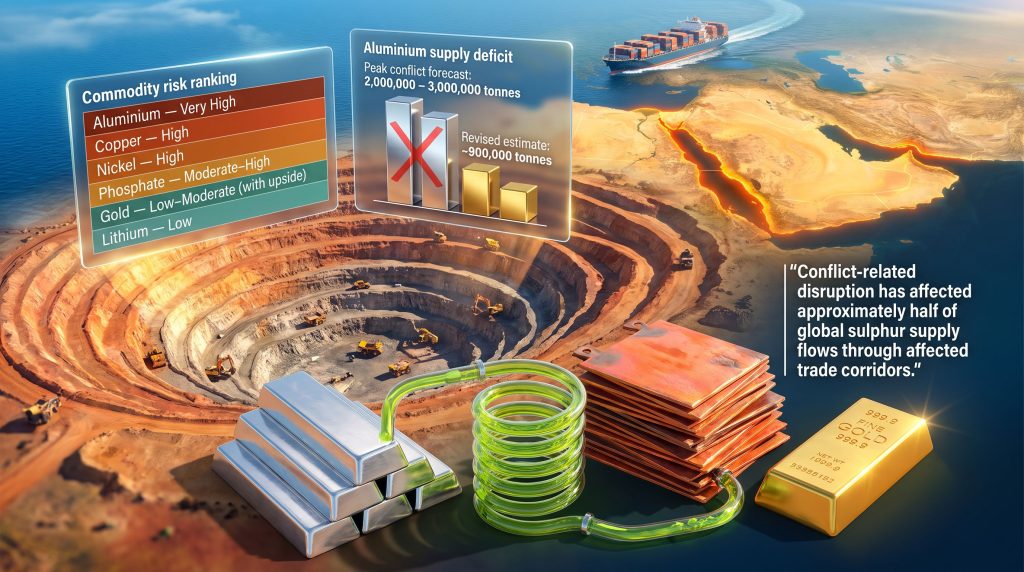
Conflict-related disruption has affected approximately half of global sulphur supply flows through the affected trade corridors, according to Wood Mackenzie's mid-year review. This figure is striking precisely because it receives so little attention relative to more visible metrics like spot copper prices or LME inventory levels. Sulphur disruption does not show up immediately in production statistics; it shows up weeks or months later as processing throughput falls and unit costs escalate.
China's Sulphuric Acid Export Restrictions: A Compounding Effect
The sulphur supply shock has been further amplified by China's restrictions on sulphuric acid exports, which have converged with Middle East trade disruption to tighten the global reagent market. China steel demand dynamics are also intersecting with these broader supply-side pressures, compounding uncertainty across multiple commodity segments. The regions facing the greatest exposure from this dynamic include:
- Sub-Saharan Africa: Copper leach operations dependent on imported sulphuric acid face both supply tightening and cost escalation, with limited alternative procurement options
- Indonesia: Nickel laterite HPAL processors are exposed to sulphur trade disruption through Middle East supply corridors, and Indonesia's dominant role in global nickel supply means this vulnerability carries systemic weight
- South America: Copper producers in Chile and Peru, already navigating domestic cost pressures and water constraints, now face amplified reagent procurement risk on top of existing operational challenges
Aluminium: Where the Numbers Moved Most Dramatically
From Catastrophe to Manageable Deficit
The aluminium sector provides the clearest evidence of how the mining sector and Middle East conflict risks have played out differently from initial expectations. At the height of conflict escalation, modelling suggested a potential supply deficit of between two million and three million tonnes, a figure that would have represented a genuinely severe structural shock to global markets.
The revised mid-year estimate from Wood Mackenzie has pulled that figure back to approximately 900,000 tonnes, alongside disruption affecting roughly 32% of global direct reduced iron production, though this remains a relatively contained share of total global steel output.
| Scenario | Projected Aluminium Supply Deficit |
|---|---|
| Peak conflict disruption forecast | 2,000,000 to 3,000,000 tonnes |
| Revised mid-year estimate | ~900,000 tonnes |
| Direct reduced iron production affected | ~32% of global output |
What a 900,000-Tonne Deficit Actually Represents
It would be a mistake to interpret the downward revision as reassuring. A 900,000-tonne deficit is a meaningful structural imbalance; it is simply less severe than the worst-case scenario that markets initially priced into aluminium premiums and futures curves. The revision reflects greater-than-expected supply rerouting and demand-side softening, not a resolution of the underlying disruption.
Analyst Perspective: A revised 900,000-tonne aluminium deficit is not a clean bill of health. It represents a significant structural imbalance that is simply less severe than the worst-case scenario that markets initially priced in.
Copper: Surface Stability With Structural Vulnerability Underneath
The Surplus That Conceals Deeper Risks
Despite the sulphuric acid supply pressures described above, copper is still expected to record a surplus position for the current year. Tariff-driven US inflows have played a meaningful role in supporting this outcome, with trade imbalances pulling copper inventory toward American storage facilities and providing a floor under global prices.
However, this surplus position should be interpreted carefully. The copper supply crunch dynamics building beneath the surface suggest that apparent equilibrium reflects demand-side softening and trade flow distortion rather than genuine supply abundance. As reagent availability tightens and energy costs build, the surplus cushion could erode faster than current price signals suggest.
The Processing Dependency That Price Data Does Not Capture
Copper's hidden vulnerability lies in its processing requirements rather than its mining volumes. HPAL and heap leach operations together account for a significant share of global copper production, and both are heavily dependent on sulphuric acid availability. Tightening acid markets translate into higher processing costs and, in extreme cases, throughput reductions that would not be visible in mine-level output figures until several quarters into the disruption cycle.
The next major ASX story will hit our subscribers first
Nickel: Processing Pressure From Multiple Directions
Converging Risks in HPAL Operations
Nickel faces a particularly complex risk environment because its dominant processing pathway, HPAL, is simultaneously exposed to energy cost escalation, sulphur input disruption, and China's trade policy shifts. Indonesia's position as the world's largest nickel producer creates a degree of buffer, given the country's proximity to alternative sulphur sources, but it also concentrates systemic risk in a single geography.
The convergence of Middle East conflict disruption and Chinese export restrictions on sulphuric acid creates a compounding pressure that is structurally more dangerous than either force in isolation. Consequently, if nickel HPAL throughput contracts meaningfully, the downstream impact on battery-grade nickel sulphate supply chains could emerge with relatively little warning.
Lithium: The Notable Exception
Why Lithium Has Remained Largely Insulated
Among the major battery and critical minerals demand categories, lithium has navigated the current disruption with the least visible damage. The reasons are structural rather than coincidental. Global lithium markets entered the conflict period already experiencing significant oversupply conditions, and the commodity's offtake relationships are heavily concentrated in China, where supply chains operate largely outside the disrupted trade corridors.
Scenarios that could change this insulation include a rapid demand recovery that absorbs the current inventory overhang, a significant expansion of non-Chinese processing capacity that creates new supply chain dependencies on Middle East-linked shipping routes, or a sharp escalation in conflict that affects Chinese domestic energy supply and therefore lithium processing economics directly.
Gold: The One Commodity Where Conflict Creates Upside
Safe-Haven Premium as a Partial Cost Hedge
Gold occupies a structurally distinct position in the current geopolitical environment. Where base metals and battery minerals face cost headwinds from energy and logistics disruption, gold safe-haven demand pushes the gold price higher even as operational costs increase for producers.
African gold producers, in particular, find themselves in a relatively favourable position, with revenue tailwinds from elevated gold pricing partially offsetting the energy and logistics cost increases that affect their operations alongside those of every other mining subsector.
Investment Context: Gold producers, particularly those operating in Africa, occupy a unique position in the current environment, benefiting from elevated safe-haven pricing that can offset the energy and logistics cost increases affecting the broader sector.
Risk-Ranked Commodity Exposure at a Glance
| Commodity | Conflict Risk Level | Primary Risk Channel | Smaller Producer Vulnerability |
|---|---|---|---|
| Aluminium | Very High | Energy costs, smelter disruption | High |
| Copper | High | Sulphuric acid supply, shipping | Very High |
| Nickel | High | HPAL reagent inputs, energy | High |
| Phosphate | Moderate to High | Energy, shipping corridors | Moderate |
| Gold | Low to Moderate (with upside) | Energy costs offset by price gains | Moderate |
| Lithium | Low | Oversupply, China-anchored offtake | Low |
The Electrification Debate: Conflict as a Policy Accelerant
From Reshoring Rhetoric to Regional Energy Resilience
One of the more consequential secondary effects of the current conflict period has been its impact on the policy conversation around electrification and regional energy self-sufficiency. As oil and gas shipments through affected corridors became less reliable, discussions around accelerating the transition to electrified energy systems intensified dramatically, shifting from a narrative about economic reshoring to one about genuine geopolitical resilience.
The updated EU Carbon Border Adjustment Mechanism intersects directly with this dynamic, creating additional economic incentives for European industrial operators to reduce carbon intensity and therefore reduce exposure to fossil fuel price volatility linked to Middle East instability. This policy momentum, if sustained, strengthens the long-term demand outlook for critical minerals including copper, nickel, and lithium.
Whether this momentum survives a potential global recession, which could dampen industrial investment and compress the timeline for electrification capital deployment, remains an open and genuinely important question for long-term mining sector positioning.
The Invisible Risks Building Beneath the Surface
What Current Data Is Not Yet Showing
Perhaps the most important insight for investors and operators navigating this environment is that the most consequential risks are not yet visible in headline data. Current price and production figures present a misleadingly stable picture. The real risks are accumulating in areas that lagging indicators do not capture in real time:
- Inventory drawdowns across aluminium, copper, and nickel supply chains are reducing the buffer available to absorb future disruption without immediate price impact
- Deferred investment decisions in new mine development and processing capacity expansion are building a medium-term supply gap that will be difficult to reverse quickly
- Demand reorientation away from China-concentrated offtake is reshaping supply chain structures in ways that create new logistical dependencies and cost layers
- Reagent market tightness in sulphuric acid is building toward a potential processing constraint that will not become visible in production data until it is already causing operational disruption
- Capital allocation shifts among major diversified miners toward lower-risk jurisdictions and projects are reducing the long-term supply pipeline in ways that will materialise over a multi-year horizon
Forward-Looking Warning: Current commodity price data and production figures present a misleadingly stable picture. The more consequential risks, including depleting strategic inventories, stalled project financing, and accelerating supply-chain restructuring, are building beneath the surface and will likely materialise over a 12 to 24 month horizon.
Scenario Planning: Three Pathways for the Next 18 Months
Scenario A: Contained Disruption
In this pathway, conflict remains regionally contained, shipping corridors remain partially functional, and cost inflation persists but at manageable levels. Markets adjust through rerouting, input substitution, and demand-side softening. Margins remain compressed but not critically so for well-capitalised operators.
Scenario B: Extended Conflict
A prolonged conflict without escalation would allow reagent shortages to deepen progressively, project financing pipelines to stall, and smaller producers to face genuinely acute operational constraints. This scenario would likely be accompanied by a meaningful price response in copper and aluminium as inventory buffers are depleted.
Scenario C: Regional Escalation
Full shipping corridor closure in the Strait of Hormuz or Red Sea would represent an acute supply shock with immediate and severe implications across energy, reagent, and finished metal markets. This scenario remains a tail risk rather than a base case, but its probability is not negligible given the current trajectory of regional tensions. The IMF's assessment of how war affects energy, trade, and finance provides further context on the broader economic consequences of sustained regional escalation.
Frequently Asked Questions: Mining Sector and Middle East Conflict Risks
Is the mining sector at risk from the Middle East conflict?
Yes, though the damage has been more contained than early forecasts suggested. The primary risks operate through energy cost escalation, logistics disruption, and reagent supply tightening rather than direct mine shutdowns.
Which commodities are most affected by Middle East geopolitical instability?
Aluminium and copper face the highest direct exposure, followed by nickel. Gold is unusual in that conflict escalation tends to support rather than damage its price. Lithium has remained largely insulated due to oversupply and China-concentrated offtake.
How does the Middle East conflict affect copper and nickel production?
Primarily through sulphuric acid supply disruption, energy cost escalation, and shipping delays for critical processing inputs. Output volumes have remained relatively stable so far, but margin compression and inventory drawdowns are building.
Why is sulphuric acid supply important to mining?
Sulphuric acid is an essential reagent in hydrometallurgical copper and nickel processing, including heap leach and HPAL operations. Without consistent acid supply, processing facilities cannot operate at full capacity regardless of ore availability.
Are gold miners benefiting from Middle East conflict escalation?
Yes, on balance. Elevated safe-haven demand supports higher gold prices that can more than offset the energy and logistics cost increases affecting gold mine operations.
What is the risk to aluminium supply from Middle East disruption?
The initial worst-case forecast of a two to three million tonne deficit has been revised to approximately 900,000 tonnes, alongside disruption to around 32% of global direct reduced iron output. This remains a meaningful structural imbalance.
How does Red Sea shipping disruption affect mining supply chains?
Longer transit routes increase fuel costs, extend delivery timelines for critical reagents and equipment, and elevate marine insurance premiums. Smaller producers without buffer inventory are most acutely affected.
Are smaller mining companies more exposed than major diversified miners?
Significantly so. Majors maintain strategic stockpiles, hedging programmes, and procurement scale that provide meaningful insulation. Smaller operators typically carry none of these structural advantages.
Key Takeaways: Navigating the Mining Sector Through Geopolitical Uncertainty
The Five Most Important Structural Risks to Monitor
- Sulphur and sulphuric acid availability for copper and nickel processors, particularly in Sub-Saharan Africa, Indonesia, and South America
- Energy cost trajectories and their compounding effect on open-pit operational margins across aluminium, copper, and nickel segments
- Inventory depletion rates across key supply chains, which will determine how much buffer remains before tighter supply translates into price escalation
- Capital investment deferral and its medium-term impact on new mine and processing capacity development
- The pace of demand reorientation away from China-concentrated offtake, and the new supply chain structures and cost layers this creates
What Markets Are Currently Underpricing
The single most important gap between current market pricing and underlying fundamental risk is the slow-building nature of the pressures described above. Markets respond quickly to dramatic events and adjust slowly to gradual erosion. The combination of inventory drawdowns, deferred investment, and reagent market tightness represents exactly the kind of gradual erosion that price signals tend to underweight until it becomes acute.
Investors and operators focused on mining sector and Middle East conflict risks should prioritise monitoring these lagging indicators rather than relying on headline production and price data to assess the true state of supply chain health. In addition, those seeking to understand the broader implications for African operations can find further perspective in detailed regional analysis covering what Middle East conflict means for African mining, which explores how the continent's producers are navigating this evolving landscape.
Want to Identify the Next Major Mineral Discovery Before the Market Does?
While geopolitical uncertainty reshapes global commodity supply chains, Discovery Alert's proprietary Discovery IQ model cuts through the complexity, delivering real-time ASX mineral discovery alerts across more than 30 commodities — from copper and nickel to gold — so subscribers can act on actionable opportunities the moment they emerge. Explore historic discoveries and the returns they generated on Discovery Alert's dedicated discoveries page, or start your 14-day free trial today to gain a market-leading edge before the next major find is priced in.