July 18, 2026
Large-scale Arctic energy development represents one of the most capital-intensive sectors in the global oil industry, with projects requiring specialized infrastructure, extended development timelines, and substantial risk premiums to overcome extreme operational environments. The convergence of regulatory certainty, accumulated industry demand, and strategic positioning within North American energy corridors has created unprecedented investment opportunities in previously restricted Arctic reserves. Furthermore, the recent Alaska oil lease sale demonstrates how policy shifts can dramatically reshape market dynamics in the energy sector.
Understanding the Strategic Significance of Alaska's National Petroleum Reserve
Geographic and Geological Context of the NPR-A
The National Petroleum Reserve-Alaska encompasses 23 million acres of strategically positioned Arctic territory on Alaska's North Slope, representing one of the largest undeveloped hydrocarbon reserves under U.S. jurisdiction. The reserve's proximity to the Trans-Alaska Pipeline System provides critical infrastructure connectivity that distinguishes NPR-A from other remote Arctic territories, enabling potential integration with existing transportation networks that have transported over 17 billion barrels of crude oil since 1977.
Geological formations within NPR-A contain multiple productive horizons, including the Nanushuk Formation and Torok Formation, which demonstrate similar characteristics to prolific North Slope discoveries. The reserve's positioning within the Arctic Alaska petroleum province provides access to proven source rock systems that have generated substantial hydrocarbon accumulations throughout the region.
Arctic operational challenges create unique technical requirements that differentiate NPR-A development from conventional onshore projects:
• Seasonal accessibility windows limited to winter months when ice roads enable heavy equipment transport
• Permafrost considerations requiring specialised foundation and drilling technologies
• Extreme weather conditions with temperatures reaching -40°F during operational periods
• Wildlife protection protocols including caribou migration timing restrictions
• Remote logistics requirements for workforce, equipment, and supply chain management
Historical Context: Seven-Year Leasing Hiatus Analysis
The seven-year gap between Alaska oil lease sales from 2019 to 2026 created accumulated demand effects that contributed significantly to the March 2026 auction's record-breaking results. During the Biden administration's tenure, zero lease sales were conducted in the National Petroleum Reserve, effectively removing approximately 35 million acres of potential leasing opportunities from the market across multiple planned sales.
This moratorium period coincided with global energy security concerns, supply chain disruptions, and increased focus on domestic production capabilities. Industry participants accumulated capital reserves and technical expertise during the restricted access period, positioning major energy corporations to compete aggressively once regulatory certainty returned under the Trump policy reversal.
The Integrated Activity Plan implemented in early 2026 opened 18.5 million of the reserve's 23 million acres to potential development, representing approximately 80% of the total NPR-A area. This represents the most expansive access framework in the reserve's history, substantially increasing the geographic scope available for competitive leasing. Moreover, this expansion has significant implications for the US oil production outlook over the coming decade.
When big ASX news breaks, our subscribers know first
How Did Industry Giants Position Themselves in This Historic Auction?
Bidding Strategy Analysis by Major Players
The March 2026 Alaska oil lease sale attracted eleven companies submitting competitive bids across 187 successful lease tracts, with three major integrated oil companies securing the majority of awarded acreage. The concentration of winning bids among ExxonMobil, ConocoPhillips, and the Repsol-Shell consortium indicates strategic positioning by large-capitalised corporations capable of managing extended development timelines and substantial capital requirements.
ConocoPhillips Strategic Positioning: The company leveraged its existing $9 billion Willow project investment as a foundation for additional lease acquisitions, creating opportunities for infrastructure sharing and operational economies of scale. ConocoPhillips' strategy demonstrates capital-efficient expansion through shared transportation, processing, and export infrastructure for subsequent development phases.
ExxonMobil's Arctic Expansion: ExxonMobil's participation represents a strategic entry into Alaska Arctic operations, building upon the company's global Arctic experience in regions including offshore Russia and Canadian Arctic territories. The company's lease acquisitions indicate assessment of long-term economic viability for Arctic crude extraction despite elevated development costs.
Repsol-Shell Consortium Dynamics: The partnership between Repsol and Shell subsidiaries demonstrates international collaboration in high-risk Arctic development. This consortium structure enables risk sharing and combined technical expertise for challenging Arctic operational environments.
Financial Commitment Patterns and Market Signals
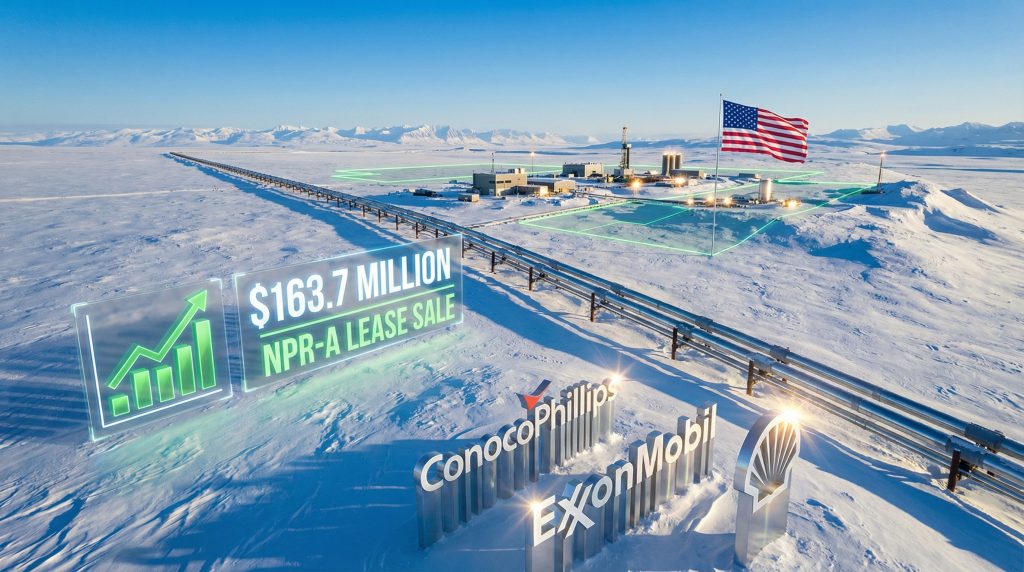
The $163.7 million in total lease revenue represents an average bid of approximately $122.66 per acre across the 1,334,967 acres awarded in the sale. This per-acre valuation reflects competitive assessment of geological prospectivity, infrastructure proximity, and long-term commodity price expectations embedded in corporate bidding strategies.
| Bidding Metric | March 2026 Sale | Historical Context | Market Signal |
|---|---|---|---|
| Total Revenue | $163.7 Million | 36% of cumulative historical NPR-A revenue | Unprecedented demand concentration |
| Average Per Acre | $122.66 | Requires historical comparison analysis | Premium Arctic valuation |
| Tract Participation | 187 of 625 tracts | Highest tract bid count in NPR-A history | Selective geological targeting |
| Company Participation | 11 companies | Moderate competitive intensity | Major player concentration |
Arctic development economics typically require break-even oil prices of $60-75 per barrel for project viability, considering specialised equipment costs, extended supply chains, and seasonal operational constraints. Competitive bidding at these premium levels implies that participating companies project long-term crude oil price stability above these threshold levels, particularly in light of the recent oil price rally.
What Economic Factors Drive Record-Breaking Lease Sale Performance?
Revenue Distribution and Economic Impact Framework
The revenue sharing structure for Alaska oil lease sales creates aligned economic incentives between federal and state stakeholders. Approximately $82 million flows to the State of Alaska while $82 million enters the U.S. Federal Treasury, with additional variable allocation through the NPR-A Impact Program supporting North Slope communities directly affected by development activities.
State of Alaska revenue allocation supports multiple public finance mechanisms:
• Operating budget contributions reducing dependence on other revenue sources
• Capital project funding for infrastructure development throughout Alaska
• Permanent Fund dividend programme providing direct payments to Alaska residents
• Education and social service funding enhancing state-level public services
The March 2026 sale's $163.7 million revenue represents approximately 36% of the cumulative historical NPR-A revenue of $457 million generated since 1999. This concentration indicates substantial acceleration of development momentum and market confidence in Alaska Arctic prospects.
Comparative Analysis with Previous NPR-A Sales
Historical NPR-A lease sale performance demonstrates cyclical patterns influenced by commodity prices, regulatory frameworks, and industry capital availability:
1999-2010 Period: Initial NPR-A sales generated modest revenue reflecting limited industry experience with Arctic development and lower commodity price environments.
2010-2019 Period: Increased participation and revenue generation coinciding with higher oil prices and technological advancement in Arctic drilling capabilities.
2019-2026 Hiatus: Zero sales during Biden administration created accumulated demand and regulatory uncertainty affecting industry planning.
2026 Record Sale: Convergence of regulatory certainty, accumulated demand, and strategic positioning created unprecedented competitive dynamics. This timing coincides with broader market concerns about the Trump tariff impact on global trade patterns.
How Does the One Big Beautiful Bill Act Reshape Alaska's Energy Landscape?
Regulatory Framework Changes Under Trump Administration
The One Big Beautiful Bill Act (OBBBA) establishes mandatory requirements for five lease sales by 2035, with each subsequent auction comprising minimum 4 million acres offered for competitive bidding. This represents a minimum of 20 million acres that must be made available to industry over the nine-year implementation period, creating unprecedented regulatory commitment to Arctic development acceleration.
Key policy reversals implemented through OBBBA include:
• Executive Order rescission of Biden administration Arctic drilling restrictions
• Streamlined permitting processes reducing administrative timelines for development approvals
• Expanded lease sale requirements mandating regular auction schedules through 2035
• Infrastructure development support enabling associated pipeline and transportation projects
The Integrated Activity Plan framework opened 18.5 million acres for potential development consideration, representing the most expansive access framework in NPR-A history. This geographic scope expansion enables industry to pursue large-scale integrated development strategies rather than isolated project approaches.
Policy Stability and Investment Confidence Metrics
Industry statements emphasise regulatory certainty as the primary driver enabling long-term capital commitments in Arctic development. The Alaska Oil and Gas Association noted that policy stability allowed industry participants to advance meaningful commitments after years of regulatory uncertainty.
Long-term Development Planning Implications:
• 5-7 year lead times from lease acquisition through initial production
• Multi-billion dollar capital commitments requiring regulatory certainty for project financing
• Infrastructure investment coordination enabling shared facility development
• Workforce development programmes supporting specialised Arctic operational capabilities
The Trump administration's policy mandate creates investment certainty through 2035, providing sufficient timeline for major integrated oil companies to pursue large-scale Arctic development strategies. This regulatory framework enables project financing, partnership agreements, and infrastructure development planning with reduced political risk premiums. However, the broader implications of US‑China trade impact remain important considerations for global energy markets.
What Development Challenges and Opportunities Await Lease Winners?
Technical and Operational Considerations
Arctic development conditions impose substantial technical requirements that differentiate NPR-A projects from conventional onshore operations:
Environmental Challenges:
• Ice road construction required for heavy equipment access during winter months only
• Permafrost stability affecting foundation design and drilling operations
• Wildlife protection timing restricting operations during caribou migration periods
• Waste management protocols requiring specialised containment and transportation
• Emergency response capabilities in remote locations with limited infrastructure
Infrastructure Development Requirements:
• Pipeline connectivity to Trans-Alaska Pipeline System requiring new construction
• Processing facilities designed for extreme weather operational capability
• Transportation networks including airports, roads, and logistics hubs
• Workforce housing providing accommodation for rotating operational crews
• Communications systems enabling remote operations management and safety protocols
Timeline and Production Potential Analysis
Arctic development projects typically require extended pre-production periods due to regulatory approvals, environmental assessments, infrastructure construction, and seasonal operational constraints. The ConocoPhillips Willow project demonstrates industry-standard development timelines, with production commencement targeted for 2029 approximately six years after project approval.
Development Phase Timeline:
- Years 1-2: Environmental impact assessments and regulatory approvals
- Years 3-4: Infrastructure construction and site preparation
- Years 5-6: Drilling operations and facility completion
- Years 7+: Production ramp-up and operational optimisation
Production Capacity Expectations:
• Willow project peak production: 180,000 barrels per day
• NPR-A aggregate potential: Requires detailed geological assessment
• Infrastructure capacity: Trans-Alaska Pipeline System integration capability
• Market integration: West Coast refinery and export market access
Why Are Environmental Groups Mounting Legal Challenges?
Litigation Strategy and Legal Precedents
Environmental organisations have initiated multiple legal challenges targeting both the March 2026 lease sale and the underlying regulatory framework enabling NPR-A development. Earthjustice, Center for Biological Diversity, and Friends of the Earth represent coalition groups pursuing litigation strategies designed to delay or prevent Arctic drilling operations.
Primary Legal Arguments:
• Climate impact assessments challenging adequacy of environmental impact analysis
• Indigenous rights protection asserting consultation and consent requirements
• Wildlife habitat preservation focusing on caribou migration route protection
• Federal law compliance alleging violations of NEPA and Endangered Species Act requirements
Teshekpuk Lake Conservation Focus: Environmental groups specifically target development activities near Teshekpuk Lake, citing the area's significance for caribou calving grounds and bird migration routes. This region represents approximately 600,000 acres within NPR-A that environmental organisations seek to exclude from development consideration.
Historical Success Rates of Environmental Challenges
Previous environmental litigation targeting Alaska oil development has produced mixed results, with some temporary delays achieved but limited permanent development prevention:
Litigation Outcomes Pattern:
• Temporary injunctions creating 1-2 year development delays during court proceedings
• Negotiated settlements establishing enhanced environmental monitoring requirements
• Mitigation agreements mandating specific wildlife protection measures during operations
• Permit modifications requiring additional environmental compliance measures
Industry participants typically incorporate litigation contingency planning into project timelines and budgets, anticipating court challenges and potential delay scenarios. Major integrated oil companies possess legal resources and experience managing environmental litigation throughout project development cycles.
The next major ASX story will hit our subscribers first
How Does This Sale Position Alaska Within Global Energy Markets?
Strategic Importance for U.S. Energy Security
Alaska Arctic development contributes to domestic production objectives reducing U.S. dependence on crude oil imports from geopolitically unstable regions. The state currently produces approximately 450,000 barrels per day, representing roughly 4% of total U.S. crude oil production, with potential for substantial expansion through NPR-A development.
Geopolitical Energy Security Benefits:
• Supply chain resilience reducing exposure to international transportation disruptions
• Strategic petroleum reserve contributions supporting national energy security stockpiles
• Allied energy cooperation enabling exports to Pacific region allies including Japan and South Korea
• Economic sovereignty reducing financial outflows from imported crude oil purchases
Market Integration and Infrastructure Requirements
Alaska crude oil integration with North American energy markets requires substantial infrastructure development and transportation network expansion:
Transportation Infrastructure Priorities:
• Trans-Alaska Pipeline System capacity currently operating below historical peak utilisation
• West Coast refinery integration serving California, Washington, and Oregon markets
• Export terminal development enabling Pacific basin crude oil exports
• Pipeline interconnection potential integration with Canadian pipeline networks
Market Access Optimisation:
• Asian export markets offering premium pricing for Alaska North Slope crude quality
• Strategic reserve contributions supporting U.S. government stockpile requirements
• Domestic refinery supply reducing West Coast import dependence
• Emergency supply capability providing backup production during global supply disruptions
What Investment Implications Emerge from This Record-Breaking Sale?
Capital Allocation and Return Expectations
Arctic development projects require substantial capital commitments with extended payback periods and elevated risk profiles compared to conventional onshore operations. The ConocoPhillips Willow project's $9 billion investment represents approximately 55 times the total lease sale revenue, illustrating the substantial gap between lease acquisition costs and total project capital requirements.
Investment Return Framework:
• Break-even oil prices typically $60-75 per barrel for Arctic projects
• Development timelines of 5-7 years from lease award to initial production
• Peak production periods of 15-25 years for major Arctic developments
• Infrastructure asset values providing long-term competitive advantages
Risk-Adjusted Return Considerations:
• Regulatory stability affecting long-term project viability and financing costs
• Commodity price volatility requiring hedging strategies for extended development periods
• Operational risk premiums reflecting Arctic environment challenges and costs
• Environmental compliance costs including monitoring, mitigation, and potential litigation expenses
Market Sentiment and Analyst Perspectives
The record-breaking participation levels and revenue generation in the March 2026 Alaska oil lease sale signal renewed industry confidence in Arctic development economics despite acknowledged challenges and extended development timelines.
Industry Confidence Indicators:
• Major company participation by ExxonMobil, ConocoPhillips, and Repsol-Shell consortium
• Premium per-acre bidding reflecting competitive geological assessments
• Long-term commodity price assumptions supporting capital allocation decisions
• Regulatory certainty value enabling project financing and partnership agreements
Investment analysts note that environmental, social, and governance (ESG) considerations continue influencing public company investment decisions, with Arctic development requiring enhanced environmental compliance and community engagement protocols compared to conventional projects. In addition, the record-setting auction results demonstrate the market's confidence in Alaska oil lease sale opportunities.
Future Outlook: What's Next for Alaska Oil Development?
Upcoming Lease Sale Schedule and Opportunities
The One Big Beautiful Bill Act mandate requires four additional lease sales between 2027 and 2035, each comprising minimum 4 million acres offered for competitive bidding. This regulatory framework creates sustained development opportunities and predictable lease availability for industry participants.
Projected Lease Sale Timeline:
• 2027-2028: Second mandated NPR-A sale with expanded acreage offerings
• 2029-2030: Third sale potentially including previously restricted areas
• 2031-2032: Fourth sale coordinated with infrastructure development progress
• 2034-2035: Final mandated sale completing OBBBA requirements
Additional Development Opportunities:
• Arctic National Wildlife Refuge (ANWR) Coastal Plain development potential
• State of Alaska Areawide sales in coordination with federal lease offerings
• Offshore Cook Inlet federal lease opportunities in Alaska waters
• Native corporation partnerships enabling development on Alaska Native lands
Technology and Innovation Drivers
Arctic development advancement depends significantly on technological innovation addressing extreme environment challenges while maintaining environmental protection standards:
Emerging Technology Applications:
• Enhanced recovery techniques optimising production from Arctic reservoir conditions
• Remote operations capabilities reducing workforce exposure and operational costs
• Environmental monitoring systems providing real-time ecosystem impact assessment
• Carbon capture technologies addressing emissions reduction requirements for Arctic projects
Innovation Investment Areas:
• Permafrost stabilisation techniques protecting infrastructure and environmental integrity
• Seasonal operations optimisation maximising productivity during limited access windows
• Wildlife protection technologies minimising development impacts on Arctic ecosystems
• Supply chain efficiency reducing logistics costs and environmental footprint
The convergence of regulatory certainty, accumulated industry demand, and technological advancement positions Alaska Arctic development as a significant component of North American energy security strategy. The March 2026 Alaska oil lease sale's record-breaking results demonstrate industry confidence in Arctic development economics despite acknowledged challenges requiring substantial capital investment and extended development timelines.
Environmental challenges and legal opposition will continue influencing project development timelines and operational requirements. However, the regulatory framework established through 2035 provides sufficient certainty for major integrated oil companies to pursue large-scale Arctic development strategies contributing to domestic energy production objectives and reducing import dependence.
Investors should note that Arctic oil development involves substantial risks including regulatory changes, environmental challenges, commodity price volatility, and extended development timelines that may affect project economics and investment returns. This analysis is for informational purposes and does not constitute investment advice.
Ready to Capitalise on Energy Sector Investment Opportunities?
Discovery Alert's proprietary Discovery IQ model delivers real-time alerts on significant ASX mineral discoveries, instantly empowering subscribers to identify actionable opportunities in the energy and resources sector ahead of the broader market. Discover why major mineral discoveries can generate substantial returns by exploring Discovery Alert's dedicated discoveries page, which showcases historic examples of exceptional outcomes, then begin your 14-day free trial today to position yourself ahead of the market.