July 18, 2026
The Battery Chemistry Shift Rewriting Australia's Industrial Playbook
For most of the past decade, the dominant narrative around battery materials focused almost entirely on lithium. Yet quietly, in the background of the energy transition, manganese has been staging a comeback that materials scientists and battery chemists have anticipated for years. Unlike cobalt, manganese is geopolitically accessible, relatively abundant, and cost-competitive. Unlike nickel-heavy chemistries, manganese-based cathodes carry a more favourable thermal stability profile. The emergence of lithium manganese iron phosphate (LMFP) and lithium-manganese-rich (LMR) battery formats as serious commercial contenders has transformed manganese from a secondary additive into a primary battery material, and with that shift comes a structural question: where in the world will manganese-to-cathode processing actually happen?
Until now, the answer has been China, almost exclusively. The Firebird Metals ARENA payment and the progression of the Perth battery plant represents the first serious attempt to change that answer outside of Chinese borders.
When big ASX news breaks, our subscribers know first
Why the Cathode Processing Gap Is Australia's Most Expensive Blind Spot
Australia extracts and exports vast quantities of battery-relevant minerals. It is one of the world's leading producers of lithium, and holds substantial manganese resources. However, for most of the battery supply chain's existence, Australian ore has been shipped offshore for value-add processing, with the economic benefits of refining, chemical conversion, and cathode manufacturing captured predominantly by Chinese facilities.
This arrangement is not merely a missed commercial opportunity. It represents a structural vulnerability for any country or manufacturer attempting to build battery supply chains independent of Chinese processing infrastructure. Cathode active materials (CAM) sit near the apex of the battery manufacturing value chain, immediately upstream of cell assembly. Whoever controls CAM production exercises significant leverage over battery manufacturers, and by extension, over EV manufacturers and energy storage developers. Understanding the broader battery metals investment landscape helps contextualise why this processing gap carries such strategic weight.
The manganese-to-cathode processing gap is not merely a commercial opportunity. It is a sovereign capability question that battery manufacturers and downstream customers are increasingly treating as a supply chain security issue.
Manganese is particularly interesting from a geopolitical standpoint because its processing chemistry is less well-established outside China than lithium conversion pathways. High-purity manganese sulphate monohydrate (HPMSM), the critical intermediate product between manganese concentrate and cathode material, requires sophisticated chemical processing to achieve the purity specifications demanded by battery cell manufacturers. Getting those specifications right, consistently, in a continuous integrated process rather than a fragmented multi-facility approach, is precisely the technical challenge that the Perth battery plant is designed to solve.
Understanding the ARENA Battery Breakthrough Initiative and Its Funding Architecture
ARENA, the Australian Renewable Energy Agency, operates as a federal government funding body channelling capital toward clean energy technology commercialisation. Its Battery Breakthrough Initiative (BBI) was established within the broader Future Made in Australia policy framework, with an explicit focus on building domestic processing and manufacturing capability at the stages of the battery supply chain where value is actually generated.
Critically, the BBI grant structure is non-dilutive. Firebird Metals does not surrender equity, shares, or any current or future intellectual property rights to ARENA in exchange for the funding. This distinction matters enormously for a company whose entire commercial proposition rests on proprietary processing technology. A dilutive or IP-sharing grant structure would have fundamentally compromised the negotiating position Firebird needs when approaching battery manufacturers and automotive OEMs as a potential supply partner.
The grant is also milestone-triggered, meaning funds are released incrementally as specific project deliverables are completed. This structure protects public capital while ensuring the recipient remains operationally committed throughout the project lifecycle. Furthermore, the ARENA demonstration plant project reflects a broader policy commitment to building sovereign battery processing capability.
The Firebird Metals ARENA Payment: Grant Structure at a Glance
| Grant Feature | Detail |
|---|---|
| Total ARENA Grant Value | A$2 million |
| First Milestone Payment Received | A$1 million |
| Remaining Grant Amount | A$1 million (subject to further milestones) |
| Funding Mechanism | Non-dilutive; no IP rights transferred |
| Matched Funding Requirement | 1:1 (Firebird cash reserves) |
| Total Project Funding (This Stage) | A$4 million |
| Payment Structure | Milestone-triggered disbursements |
| First Milestone Trigger | Site lease execution and equipment orders |
| Estimated Commercial-Scale Capital | ~A$123 million (excluding working capital) |
The matched funding requirement is a deliberate policy mechanism. By requiring the grant recipient to contribute equivalent private capital, ARENA ensures that public funds are only deployed alongside demonstrated commercial conviction. It also functions as a market signal to private investors: a company willing to commit its own cash reserves to match a government grant has passed its own internal investment threshold, not merely accessed free money.
Inside the Perth Battery Plant: Technical Architecture of a World First
The Australian Demonstration Plant (ADP), located at 13 Sangiorgio Court, Osborne Park approximately seven kilometres from the Perth CBD, is a 775 square metre facility secured under a multi-year lease executed on 30 April 2026. The lease completion formally satisfied the first project milestone under the ARENA grant agreement, triggering the initial A$1 million payment.
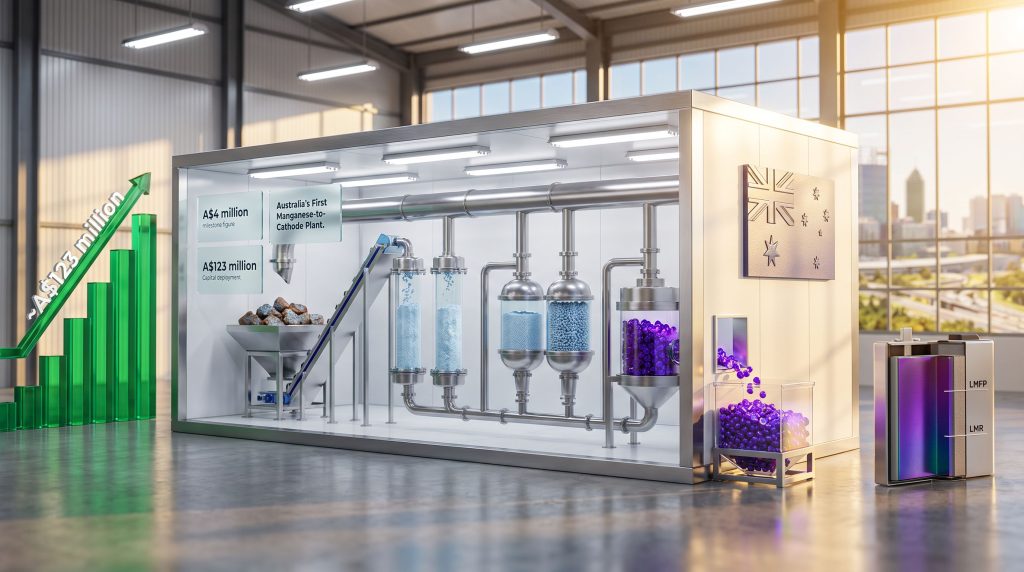
What makes the ADP technically significant extends well beyond its physical specifications. The facility is designed as a fully integrated, single-line processing facility, converting manganese concentrate sequentially into HPMSM, then into precursor cathode active material (p-CAM), and finally into finished CAM. That complete processing sequence, within a single continuous facility, does not currently exist outside China at demonstration scale.
Conventional approaches to battery materials processing typically involve geographically separated facilities for each stage, introducing inter-stage logistics costs, contamination risks during material transfer, and quality control challenges at each handover point. Integration eliminates these friction points, enabling tighter process control and theoretically lower per-unit production costs.
Technical Insight: The distinction between integrated and fragmented processing is not merely operational. It fundamentally alters the quality consistency of the final cathode material. Each material transfer point in a fragmented system introduces contamination risk that can affect cathode performance at the cell level — an issue that battery manufacturers managing tight electrochemical tolerances treat as a significant qualification risk.
Firebird's patented and exclusively licensed processing technology underpins the entire integrated sequence. The company's collaboration with engineering firm Sedgman adds a further dimension: developing energy-efficient kiln technology specifically optimised for the high-temperature calcination step that converts p-CAM into finished CAM. Kiln energy consumption is one of the largest operating cost drivers in cathode production, and engineering solutions that reduce thermal energy requirements directly improve the competitive economics of ex-China production.
Project Commissioning Timeline
| Milestone | Target Date |
|---|---|
| Project commencement | 20 April 2026 |
| Site lease execution | 30 April 2026 |
| All major equipment orders placed | Completed (pre-Q3 2026) |
| Equipment arrival (post-fabrication) | Early Q4 2026 |
| Commissioning | Q3 2026 |
| Customer sample production phase | Q3 2026 to Q1 2028 (estimated) |
| Grant period completion | 31 March 2027 |
Equipment sourced from China has undergone independent inspection by an Australian electrical contractor, confirming compliance with local regulatory standards. This step, while procedurally straightforward, is essential for obtaining the operational approvals required to run the facility safely and legally within Western Australia's regulatory framework.
The Four Strategic Functions of the Australian Demonstration Plant
The ADP is not a commercial production facility. Understanding what it is actually designed to accomplish clarifies why this stage matters so much relative to the far larger capital commitment required for commercial-scale deployment.
-
Technology validation confirming that the integrated processing line performs as designed under sustained real-world operating conditions, not just laboratory-scale trials.
-
Process optimisation refining chemical processing parameters, temperature profiles, residence times, and material handling procedures to maximise yield and reduce per-unit cost before committing to commercial-scale capital expenditure.
-
Customer qualification producing cathode material samples that meet the stringent testing and certification requirements demanded by battery cell manufacturers and automotive OEMs before they will consider any supply agreement.
-
Operational data generation building the documented performance dataset required to underpin a bankable feasibility study for the ~A$123 million commercial-scale deployment decision.
The customer qualification function deserves particular emphasis. Battery manufacturers do not purchase cathode active materials based on specifications alone. They require independently produced batches that can be tested in their own laboratory environments, assessed against electrochemical performance benchmarks, cycled through charge and discharge protocols, and evaluated for consistency across multiple production runs. This qualification process can take anywhere from six to eighteen months, which is precisely why the ADP production phase is structured over that timeframe.
Manganese Chemistry and Why LMFP and LMR Are the Target Markets
The choice of LMFP and LMR as target cathode chemistries reflects important trends in how battery manufacturers are evolving their product portfolios. Both are cobalt-free formulations, which is commercially significant given cobalt's concentrated supply base in the Democratic Republic of Congo and the ongoing scrutiny around its extraction conditions.
LMFP extends the established lithium iron phosphate (LFP) chemistry by incorporating manganese into the crystal structure, boosting energy density by approximately 10 to 20 percent relative to standard LFP while retaining much of LFP's thermal stability advantage. Several major Chinese battery manufacturers have moved to volume production of LMFP cells, and adoption outside China is accelerating as EV manufacturers seek chemistries that balance range, cost, and safety. In addition, shifts in the battery raw materials market are reinforcing the commercial case for manganese-based alternatives.
LMR cathodes are a more advanced target. Lithium-manganese-rich materials can theoretically achieve energy densities competitive with, or exceeding, high-nickel NMC chemistries while using far less nickel and no cobalt. The challenge with LMR has historically been voltage fade during cycling, but materials engineering advances are steadily improving long-term stability. LMR's potential relevance to next-generation solid-state battery platforms adds a further strategic dimension to Firebird's technology development pathway.
Speculative Consideration: If LMR cathode chemistry successfully transitions from laboratory optimisation to commercial cell production within the next five to seven years, as some battery researchers project, companies that have already established demonstration-scale production capability and customer qualification relationships could hold a meaningful first-mover advantage in an ex-China supply context. This is not guaranteed, but it represents a plausible scenario that informs the strategic logic of the ADP timeline.
The next major ASX story will hit our subscribers first
The Resource Foundation: 234 Million Tonnes Backing the Technology Platform
The commercial proposition for the ADP gains additional credibility from the resource base sitting behind it. Firebird holds 234 million tonnes of manganese resources in Western Australia across its Oakover and Hill 616 projects. Owning substantial upstream resources while simultaneously developing downstream processing technology creates a vertically integrated value proposition that is structurally different from a pure processing technology play.
For battery manufacturers and automotive OEMs evaluating potential supply chain partners, vertical integration from resource to cathode carries specific advantages. It reduces the number of counterparties required to secure a stable material supply, simplifies the traceability and provenance documentation increasingly demanded by ESG frameworks, and creates a single point of accountability for supply reliability. Existing memoranda of understanding for manganese offtake in China signal that commercial relationships are already developing around the resource base, providing a foundation upon which ex-China customer engagement can be built. The growing critical minerals demand driven by the energy transition further reinforces why vertical integration at this level carries such strategic value.
Commercial Momentum and the Qualification Pathway to Offtake
Active commercial discussions are underway with international battery manufacturers, automotive OEMs, and downstream supply chain participants. The structure of these conversations is governed by the qualification logic described above: no serious offtake agreement will be finalised before customers have tested qualification-grade material produced by the actual processing technology at the actual facility.
This is why the ADP's twelve to eighteen month production phase is the critical operational period for the entire commercialisation strategy. The samples produced during this window will determine whether potential customers proceed to commercial offtake negotiations, and whether the ~A$123 million commercial-scale deployment can be supported by project finance arrangements. Banks and infrastructure investors financing battery materials processing facilities require demonstrated technology performance, existing customer relationships, and ideally indicative offtake commitments before committing project capital at that scale.
What the Grant Signal Means for Australia's Battery Materials Investment Landscape
ARENA's selection of manganese-to-cathode processing as a Battery Breakthrough Initiative priority reflects a policy judgment that cathode active material production represents a strategically important domestic capability gap. This is distinct from the longstanding policy focus on raw materials extraction and export. Consequently, Australia's critical minerals strategy is evolving to address these downstream processing gaps more directly.
The BBI framework sits alongside analogous programs emerging in other major economies. The United States Inflation Reduction Act provides production tax credits for domestically manufactured battery components. The European Union's Critical Raw Materials Act targets domestic processing capacity for strategic minerals. Japan maintains long-standing industrial policy support for battery materials technology through its New Energy and Industrial Technology Development Organization. Australia's BBI operates within this competitive international context, attempting to build processing capability before the most commercially attractive supply agreements are locked up by better-capitalised competitors.
The non-dilutive, IP-neutral character of the ARENA grant is a policy design choice with real commercial implications. By explicitly excluding IP rights from the grant conditions, the BBI framework preserves the full commercial value of any proprietary technology developed or validated with grant support. This makes BBI grants substantially more attractive to technology companies than equity-diluting or IP-sharing instruments. Furthermore, advances in Chinese battery recycling serve as a reminder of how quickly processing technology can evolve, reinforcing the urgency of building sovereign capability now.
Key Takeaways for Investors and Industry Observers
-
The Firebird Metals ARENA payment of A$1 million confirms the first milestone has been achieved on schedule and within budget, with a further A$1 million available upon completing assembly and commissioning targets.
-
The Perth battery plant is the only facility outside China pursuing fully integrated manganese concentrate to finished CAM processing in a single continuous line, a configuration with genuine technical and commercial differentiation.
-
LMFP and LMR battery chemistries represent the target commercial markets, both growing as cobalt-free alternatives to conventional NMC formulations gain adoption across EV and energy storage applications.
-
The twelve to eighteen month customer qualification production phase will be the decisive operational test of whether the commercial-scale deployment decision, estimated at ~A$123 million excluding working capital, can proceed with bankable technology validation and customer support.
-
The non-dilutive, IP-neutral grant structure preserves Firebird's full intellectual property position, which is central to its negotiating leverage with downstream customers and project finance providers.
-
A resource base of 234 million tonnes of manganese across the Oakover and Hill 616 projects provides a vertically integrated foundation that differentiates the company's commercial proposition from pure processing technology developers.
This article is intended for informational purposes only and does not constitute financial advice. Statements regarding project timelines, capital requirements, and commercial outcomes involve forward-looking assumptions that are subject to material risks and uncertainties. Readers should conduct their own due diligence and consult a qualified financial adviser before making any investment decisions.
Want to Track the Next Major Battery Materials Discovery Before the Market Does?
Discovery Alert's proprietary Discovery IQ model scans ASX announcements in real time, instantly identifying significant mineral discoveries across manganese, lithium, and more than 30 other commodities — including the kind of vertically integrated plays reshaping Australia's battery supply chain. Explore historic examples of major discoveries and their returns, then begin your 14-day free trial to position yourself ahead of the broader market.