July 18, 2026
When Electoral Mandates Meet Geological Realities: Colombia's Energy Crossroads
Energy transitions rarely reverse cleanly. History shows that when political winds shift in resource-dependent economies, the gap between a new government's extraction ambitions and the structural constraints it actually faces tends to be substantial. Colombia in mid-2026 offers one of the most instructive case studies of this dynamic playing out in real time, with the country's incoming conservative administration promising a Colombia fossil fuel comeback while inheriting a landscape shaped by depleting reserves, congressional arithmetic, and communities that have lived alongside oil production long enough to know its full costs.
When big ASX news breaks, our subscribers know first
The Four Years That Reshaped Colombia's Energy Architecture
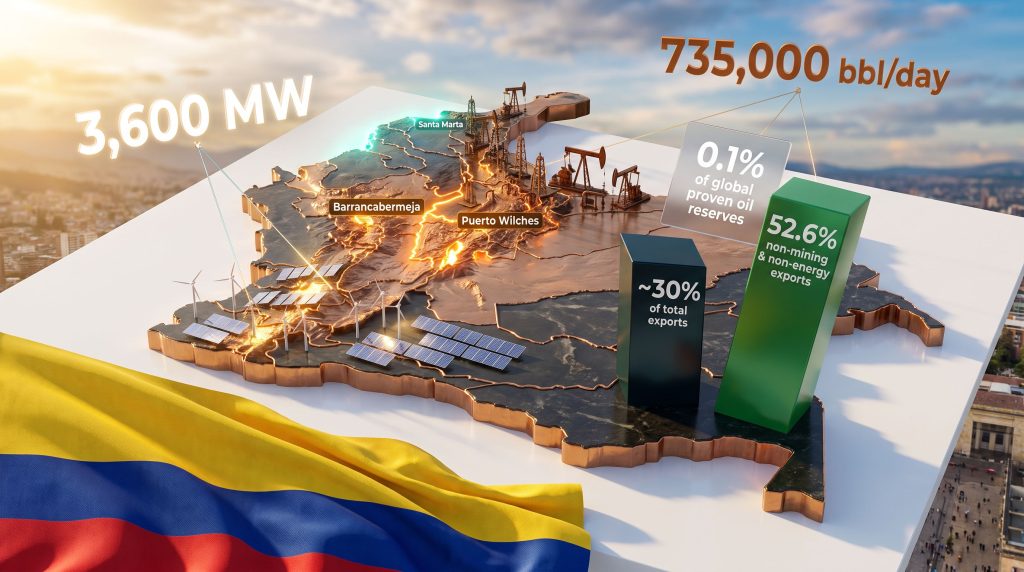
To understand the scale of what the incoming government is attempting to reverse, it is worth examining what the Petro administration actually built between 2022 and 2026. The transformation went well beyond incremental policy adjustments. Colombia's installed renewable energy capacity expanded from 200 MW to 3,600 MW over the four-year period, with solar generation surpassing coal in the national energy mix for the first time in the country's history.
The economic diversification metrics were equally striking. By 2025, non-mining and non-energy exports had climbed to 52.6% of Colombia's total export value, displacing hydrocarbons from the dominant position they had occupied for well over a decade. This was not a marginal statistical shift. It represented a genuine structural reorientation of how Colombia generates foreign exchange.
On the international stage, Colombia positioned itself as a voice for accelerated fossil fuel phase-out. The country co-hosted the First International Conference for the Phase-Out of Fossil Fuels with the Netherlands in Santa Marta in 2026, lending diplomatic capital to a global movement that the incoming administration is now ideologically opposed to.
What made this transition politically vulnerable, however, was that it remained more dependent on executive commitment than on embedded market and institutional frameworks. When the executive changes, the scaffolding holding the transition in place becomes exposed.
The June 2026 Election: Reading the Signal Correctly
Conservative candidate Abelardo de la Espriella, known domestically as "The Tiger," defeated left-leaning candidate Iván Cepeda on 21 June 2026 by a margin of approximately one percentage point. He is scheduled to be sworn in as president on 7 August 2026.
Critical framing point: A one-percentage-point electoral margin in a politically polarised country does not constitute a policy blank cheque. It signals a contested transition in which the winning candidate holds a democratic mandate but not a consensus for sweeping unilateral action.
The geographic voting patterns within this result carry analytical weight that is often overlooked in coverage of the election. In the major oil-producing regions of Barrancabermeja and Puerto Wilches, approximately 60% of voters backed the left-leaning candidate. These are communities with direct, multigenerational exposure to hydrocarbon extraction, including documented concerns about water contamination and ecosystem degradation. Their voting behaviour reflects not an abstract preference for green ideology but a lived assessment of what oil-led development actually delivers at the community level.
This creates an immediate paradox for any administration seeking to expand extraction in precisely those regions. The communities where new production would be most concentrated are the same communities that voted most strongly against the pro-extraction platform.
What the De la Espriella Energy Agenda Actually Proposes
The incoming administration has signalled a range of energy policy priorities, but the structural feasibility of each varies considerably.
| Policy Priority | Stated Intent | Structural Constraint |
|---|---|---|
| Ecopetrol redirection | Accelerate domestic oil and gas output | Declining proven reserves; Colombia holds approximately 0.1% of global proven oil reserves |
| Fracking authorisation | Revive unconventional resource pilots | Requires full congressional approval; cannot be enacted by executive decree |
| Environmental licensing reform | Restructure or dismantle ANLA | Legislative process required; political left holds 68 congressional seats |
| Accelerated permitting | Fast-track oil, gas, and coal exploration | Community opposition; social licence challenges in key producing regions |
| Natural gas as bridge fuel | Promote gas during transition reversal | Infrastructure gaps; international financing constraints for new fossil projects |
The fracking question is particularly instructive. Hydraulic fracturing for unconventional oil and gas resources has been one of Colombia's most contested energy policy battlegrounds for years. The incoming administration has indicated strong support for authorising regulated fracking pilots, but this pathway requires congressional approval. With approximately 20% national public support for fracking and significantly lower approval in directly affected communities, the social licence deficit is substantial, independent of whatever legislative obstacles exist.
For comparison, Argentina's Vaca Muerta unconventional development, often cited as a model for what Latin American fracking could achieve, required years of community engagement frameworks, benefit-sharing negotiations, and regulatory scaffolding before reaching meaningful production scale. Colombia's reserve base is considerably smaller, and its community opposition considerably more organised.
The Fiscal Argument: Real Pressure, Contested Solutions
The economic case for expanded extraction is not invented. Colombia's fiscal deficit reached 6.4% of GDP in 2025, the highest recorded level outside the pandemic period. Oil, gas, and coal collectively contribute approximately 5% of GDP and generate roughly USD $15 billion in annual export revenues, representing close to 30% of total exports. In a country facing genuine fiscal pressure, these are not trivial numbers.
Featured Insight: Oil, gas, and coal account for approximately 5% of Colombia's GDP and generate close to USD $15 billion annually, representing around 30% of the country's total export revenues. However, Colombia holds only approximately 0.1% of the world's proven oil reserves, making long-term revenue sustainability from hydrocarbons structurally uncertain.
The counterargument, however, is geological rather than ideological. With Colombia holding only 0.1% of global proven oil reserves, aggressive extraction acceleration does not solve a fiscal problem. It converts a manageable long-term vulnerability into an accelerated one. The faster the remaining reserves are extracted, the sooner Colombia reaches a point where the fiscal option they represent is permanently foreclosed. Reserve depletion is irreversible in any policy-relevant timeframe.
Colombian hydrocarbon output had already fallen to approximately 735,000 barrels per day in early 2026, a multi-year low driven by a combination of regulatory restrictions under the Petro administration and natural field depletion. The distinction between those two causes matters enormously for policy design. Regulatory restrictions are reversible. Natural field depletion is not.
The global oil price environment adds a further dimension. Elevated prices driven in part by escalating U.S.-Iran tensions have pushed benchmarks significantly higher in mid-2026, temporarily strengthening the investment case for Colombian upstream development. However, commodity price assumptions built into a multi-year fiscal strategy carry their own risks. Building structural budget projections around sustained $90+ oil requires confidence in geopolitical stability that market history does not support. This dynamic is not unique to Colombia — the broader geopolitical mining landscape illustrates how political risk and price volatility continue to shape resource-dependent economies worldwide.
Three Fiscal Scenarios for Colombia's Energy Sector
Scenario A: Aggressive Extraction Push
- Accelerated permitting, fracking pilots approved, Ecopetrol redirected toward upstream expansion
- Short-term revenue uplift possible if oil prices remain above $90 per barrel
- Long-term risk: reserve depletion accelerates, renewable investment stalls, fiscal vulnerability deepens post-2030
- Probability constraint: requires congressional cooperation that current seat distribution does not guarantee
Scenario B: Managed Hybrid Approach
- Fossil fuel production stabilised at current levels while selective renewable projects continue
- Congressional negotiation produces a compromise energy framework
- Fiscal deficit addressed through combination of hydrocarbon revenues and continued diversified export growth
- Most likely outcome given legislative arithmetic and community dynamics
Scenario C: Constrained Reversal
- Congressional opposition blocks key legislative changes; fracking remains restricted
- International climate finance reduced; renewable investment pipeline stalls
- Colombia loses positioning in both the fossil fuel investment community and green finance ecosystem
- A lose-lose outcome in which neither the extraction agenda nor the transition agenda advances coherently
The next major ASX story will hit our subscribers first
The Congressional Firewall and Community Opposition
Two structural barriers stand between De la Espriella's stated energy ambitions and their implementation. The first is legislative. The political left retains 68 seats in the Colombian Congress, sufficient to block the legislative changes required for fracking authorisation and comprehensive environmental licensing reform. Certain energy policies are structurally insulated from executive action by constitutional design and can only be changed through full legislative passage.
Historical precedent is instructive here. The so-called "mining locomotive" strategy pursued under presidents Álvaro Uribe (2002-2010) and Juan Manuel Santos (2010-2018) expanded extraction permits and loosened environmental oversight through a combination of executive action and legislative alignment. Former Environment Minister Susana Muhamad has assessed that the new administration is likely to pursue a similar pattern, expanding permits and restructuring environmental oversight where possible, including potential moves against ANLA (the national environmental licensing authority). Whether full restructuring of ANLA is achievable without legislative approval remains a contested legal question.
The second barrier is the social licence deficit described earlier. The documented environmental legacy in regions like Barrancabermeja, including water contamination and long-term ecosystem degradation, has produced organised community resistance that investors and international energy developers cannot simply bypass. In practical terms, a new extraction permit issued in Bogotá does not automatically become a functioning production operation in a community that retains legal rights to consultation and opposition.
Climate Commitments, International Standing, and the Renewable Pipeline
Colombia's participation in the First International Conference for the Phase-Out of Fossil Fuels and its association with the Fossil Fuel Non-Proliferation Treaty created diplomatic capital that the incoming administration now risks forfeiting. The practical consequences extend beyond symbolic positioning.
Access to green finance, multilateral development funding at concessional rates, and international climate finance mechanisms is conditioned partly on demonstrated policy alignment with transition commitments. A government that actively dismantles its predecessor's climate framework faces a meaningful reduction in access to these financing channels, which matters given the fiscal pressures already described.
The 3,600 MW of clean energy capacity built between 2022 and 2026 does not disappear with a change of government. Existing infrastructure represents sunk investment that continues to generate electricity regardless of the political environment. What is at risk is the expansion pipeline: projects in development, financing under negotiation, and permitting processes in progress. International renewable energy developers are already reassessing Colombia's risk profile in light of the election result, and that reassessment affects the capital available for the next phase of clean energy build-out. Furthermore, Colombia's experience with the renewable energy transition offers broader lessons for resource-dependent nations navigating similar political pressures.
What Durable Energy Policy in Colombia Would Actually Require
The binary framing of "fossil fuels versus renewables" misrepresents the actual policy design challenge Colombia faces. A country with a genuine fiscal deficit, declining but still significant hydrocarbon reserves, rapidly growing renewable capacity, and deep community divisions over extraction does not have the luxury of ideological purity in either direction.
A resilient Colombian energy framework would require several elements that neither the Petro administration fully delivered nor the De la Espriella administration appears to be prioritising:
- Independent regulatory capacity insulated from political cycles, capable of managing both hydrocarbon production and renewable development on technical and environmental merits
- Community benefit-sharing mechanisms that give oil-producing regions a genuine stake in extraction revenues and therefore a reason to support rather than oppose new development
- Diversified export revenue streams that reduce the vulnerability of the national budget to commodity price cycles, building on the progress achieved by 2025
- Long-term reserve management planning that treats remaining hydrocarbon reserves as a finite asset to be managed strategically rather than a resource to be extracted as rapidly as possible
- Access to international climate finance as a bridge mechanism while the domestic energy mix transitions, requiring maintenance of credible transition commitments
The broader lesson from Colombia's experience is one that applies across Latin America and beyond: energy transitions driven primarily by executive mandate rather than embedded in durable institutional and market frameworks remain vulnerable to political reversal at the next electoral cycle. The challenge is not choosing between fossil fuels and renewables. It is building the institutional architecture that allows both to be managed coherently across governments of different political orientations.
Investor Implications: Positioning Between Ambition and Constraint
For international investors assessing Colombia's upstream and energy sectors, the key analytical risk is overweighting political signals relative to geological and legislative realities. The gap between what the De la Espriella administration intends and what it can structurally achieve is substantial.
Ecopetrol remains the primary vehicle for any upstream expansion and is simultaneously the entity most exposed to governance risk when a major state energy company is rapidly redirected by political mandate. Its existing sustainability commitments, international investor relationships, and operational trajectory reflect years of strategic positioning that cannot be unwound by decree without cost to its credibility in international capital markets.
The most defensible investment thesis across all three scenarios described above involves neither a pure extraction play nor a pure renewables bet. It involves positioning around the managed hybrid outcome, where some hydrocarbon production continues while selective renewable development proceeds, and where the institutional framework, however imperfect, prevents the worst outcomes of both extremes. In addition, investors seeking resilience would do well to consider commodities diversification as a broader strategy, given the resource export challenges that commodity-dependent nations routinely face across shifting political cycles. That scenario is also the most consistent with the legislative arithmetic that Colombia actually faces.
Disclaimer: This article is intended for informational purposes only and does not constitute financial or investment advice. All forecasts, scenario analyses, and projections involve inherent uncertainty. Readers should conduct independent research and seek professional advice before making any investment decisions.
Want to Stay Ahead of the Next Major Mineral Discovery on the ASX?
While Colombia's energy crossroads illustrates how quickly political shifts can reshape commodity markets, Discovery Alert's proprietary Discovery IQ model ensures subscribers receive real-time notifications the moment significant ASX mineral discoveries are announced — transforming complex geological data into actionable investment insights. Explore how historic discoveries have generated substantial market returns and begin your 14-day free trial today to position yourself ahead of the broader market.