July 18, 2026
The Debt Clock Is Ticking: Sigma Lithium's $100M Maturity and the Cash Flow Thesis Investors Are Watching
Hard-rock lithium producers occupy a structurally unusual position in the mining capital stack. Unlike base metals operations that can draw on deep commodity derivatives markets for hedging, spodumene concentrate producers often rely on a combination of offtake prepayments, development finance, and shareholder-backed debt facilities to bridge the gap between capital-intensive mine builds and steady-state cash generation. When these instruments converge at a single maturity date during a period of operational disruption, the resulting liquidity calculus becomes one of the most closely watched variables in any junior or mid-tier lithium equity.
That is precisely the situation confronting Sigma Lithium (CVE: SGML) as December 2026 approaches. The Brazilian hard-rock lithium producer is navigating the convergence of a $100 million debt maturity, a mine restart from a deliberate operational pause, and an unresolved disbursement timeline from Brazil's BNDES development bank. Understanding how these threads interact requires more than a surface-level read of quarterly financials. The Sigma Lithium debt maturity, consequently, has become one of the most scrutinised events in the critical minerals calendar.
When big ASX news breaks, our subscribers know first
Why Grota do Cirilo Matters Before the Balance Sheet Does
Any analysis of the Sigma Lithium debt maturity must begin with the asset that underpins every repayment assumption. Grota do Cirilo, situated in the Jequitinhonha Valley of Minas Gerais in Brazil's Lithium Valley, is widely regarded as one of the world's largest and highest-grade hard-rock lithium deposits. The complex integrates open-pit mining with an on-site processing facility producing spodumene concentrate, the primary feedstock for lithium hydroxide conversion plants that supply battery manufacturers.
What makes Grota do Cirilo particularly significant from a financing perspective is its grade consistency. High-grade hard-rock deposits command premium valuations not only because they yield more lithium per tonne of ore processed, but because they generate better unit economics at the mine gate, which in turn supports the prepayment structures that Sigma has embedded into its offtake agreements. These advance payment arrangements are not incidental to the debt repayment thesis; they are central to it.
The site also carries material expansion optionality. A second processing plant, contingent on BNDES financing, would lift annual concentrate output capacity to approximately 520,000 metric tonnes, nearly doubling current throughput. This long-dated growth profile is the foundation of the insider accumulation thesis advanced by A10 Investimentos, the fund co-founded by Sigma's CEO Ana Cabral and co-chair Marcelo Paiva.
Anatomy of the $100 Million Synergy Facility
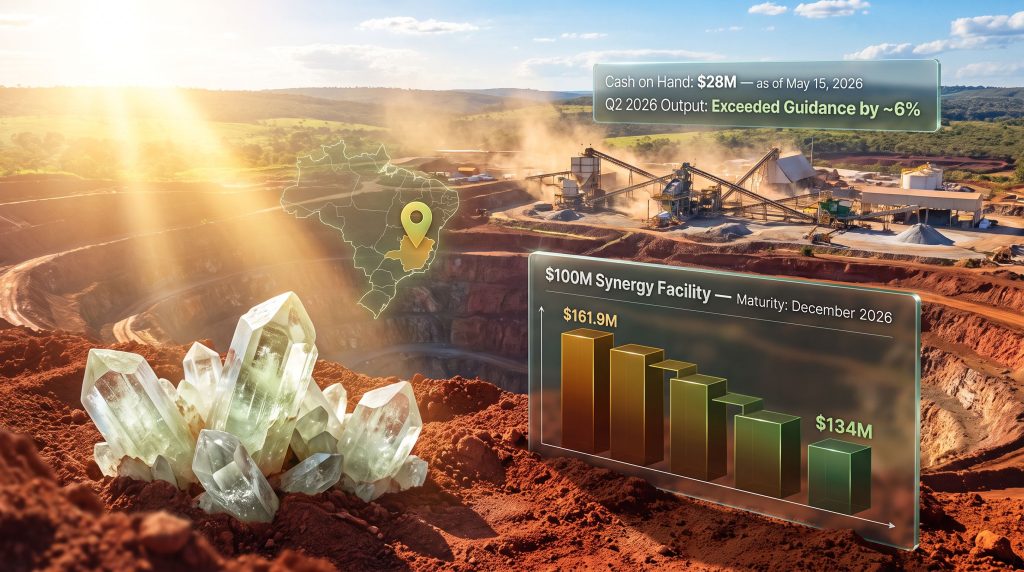
The Synergy Capital pre-export financing facility was executed in late 2022, structured as a four-year senior secured instrument, and is now approaching its maturity window. As of March 31, 2026, this single facility accounted for the substantial majority of Sigma's $134 million total debt position, making it the defining variable in near-term liquidity analysis.
The security package attached to the facility is notably comprehensive:
- A pledge over all shares of the Brazilian operating entity, Sigma Brazil
- A corporate guarantee that remains active until specific release conditions are formally satisfied
- Asset-level security over the Grota do Cirilo operating base
This structure means that until the Synergy debt is retired, Sigma's Brazilian asset base remains encumbered in a way that limits strategic flexibility and could affect the company's ability to attract additional project-level financing. The removal of this security package upon full repayment would therefore represent a qualitative improvement in the company's capital structure, not merely a quantitative debt reduction.
Paiva has publicly characterised the facility as carrying a high borrowing cost, and has indicated that management has no intention of renewing it on its existing terms. This framing matters for investors: it signals that the repayment target is firm, not negotiable, which reduces the probability of a passive rollover but increases the execution stakes if cash generation falls short.
The Three-Layer Debt Stack: Sequencing the Obligations
Sigma's debt structure as it stands in mid-2026 is best understood as a waterfall with three distinct tranches, each carrying different maturity profiles and repayment mechanics:
| Obligation | Principal | Maturity Profile | Repayment Source |
|---|---|---|---|
| Short-term trade finance | ~$34M (as of Oct 2025) | Rolling 30-360 days | Export proceeds |
| Synergy Capital pre-export facility | $100M | ~December 2026 | Offtake prepayments + operating cash |
| BNDES Plant 2 climate loan | ~$96M (BRL 487M) | 16-year term | Future Plant 2 cash flows |
The sequencing here is important. Short-term trade finance obligations were substantially resolved through 2025, with the company reducing that portion of its debt by approximately 44% year-to-date through October 2025. Total short-term debt retirement over the course of 2025 reached approximately 60%, and total debt across all tranches was reduced by approximately 35% during that period.
The BNDES loan, while large in nominal terms, carries an 18-month grace period and a 16-year repayment horizon, meaning it creates no near-term liquidity competition with the Synergy maturity. The critical path runs directly through the December 2026 deadline.
How Sigma Plans to Retire the Facility: The Offtake Prepayment Model
The repayment mechanism that management has publicly endorsed deserves closer examination, because it reflects a financing structure that is increasingly common in the critical minerals sector but remains poorly understood by generalist investors.
Advance payment structures embedded in spodumene offtake agreements allow producers to monetise future production volumes before they are physically delivered. In practical terms, an offtake counterparty, typically an Asian or European battery material converter, prepays a portion of the contracted volume at an agreed price. The producer receives cash today and delivers concentrate over the forward period.
For Sigma, this mechanism converts long-dated sales commitments into near-term liquidity without requiring equity issuance or new debt. It is, in effect, a self-liquidating financing instrument secured by the production capacity of the mine itself.
The key risk embedded in this approach is counterparty concentration. If a primary offtake partner delays payment, renegotiates price floors, or encounters its own financial stress, the advance payment inflow that management is counting on to service the Synergy maturity could be deferred or reduced. This is the downside scenario that the market appears to be pricing into SGML's more than 20% year-to-date share price decline as of mid-2026. Furthermore, the broader lithium market downturn has amplified pressure on counterparty pricing and contract stability across the sector.
Reading the Operational Tea Leaves: Q2 2026 Production
The production outcome for Q2 2026 provides the most direct available signal about whether the cash generation thesis is credible. Despite the operational disruption caused by the equipment upgrade and contractor transition initiated in late 2025, output for the quarter came in approximately 6% ahead of internal guidance.
This beat is modest in absolute terms but meaningful in context. It indicates that the Grota do Cirilo restart is tracking ahead of internal projections, which is a prerequisite for the offtake prepayment structures to function as designed. Prepayments are typically calibrated to a contracted delivery schedule; if production lags that schedule, the prepayment inflows slow.
Free cash flow was negative in Q1 2026, reflecting the production gap created by the operational pause. However, as of May 15, 2026, Sigma reported $28 million in cash on hand, described as its strongest liquidity position since the end of 2024. The improvement from a negative free cash flow quarter to the highest cash balance in over a year suggests the advance payment structures were activated in Q2, providing the liquidity bridge that management had projected.
The next major ASX story will hit our subscribers first
The BNDES Question: Expansion Financing or Refinancing Wildcard?
The BNDES facility introduces a layer of complexity that warrants careful framing. In 2024, Sigma secured a binding commitment from Brazil's national development bank for a BRL 487 million (~$96 million) climate financing loan designated for Plant 2 construction. In April 2026, the company confirmed it had obtained a bank guarantee enabling it to draw on the facility.
However, as of mid-July 2026, BNDES confirmed to media that no funds had been disbursed. The bank indicated it was reviewing new documentation submitted by Sigma before determining whether to proceed with the formal financing agreement.
Several important distinctions apply here:
- The BNDES facility is ring-fenced for climate-aligned capital expenditure on the second processing plant, not for commercial debt retirement.
- Using these funds to retire the Synergy facility would likely require structural renegotiation with BNDES and potentially conflict with the loan's mandate conditions.
- Management has not publicly positioned the BNDES disbursement as a repayment source for the December 2026 maturity.
- The unresolved disbursement conditions create independent uncertainty about the Plant 2 construction timeline, separate from the Synergy repayment question.
The BNDES situation illustrates a broader principle in development finance: a binding commitment and an active disbursement are materially different milestones, and the gap between them can stretch considerably when technical and documentary conditions remain outstanding.
Stress Testing the Repayment Scenarios
A disciplined investor framework requires examining the full range of outcomes, not just the management base case:
| Scenario | Key Conditions | Probability Assessment | Investor Implication |
|---|---|---|---|
| Base Case | Offtake prepayments flow as contracted; operating cash accumulates through H2 2026 | Moderate | Debt retired; security released; credit profile improves |
| Upside Case | Lithium concentrate prices recover materially; cash generation exceeds prepayment schedule | Lower given current market | Accelerated retirement; potential for capital return signals |
| Downside Case | Offtake counterparty delays or renegotiates; operating disruptions recur | Elevated given track record | Partial refinancing required; equity dilution risk increases |
| Negotiated Extension | Synergy Capital agrees to extend at modified terms given shareholder relationship | Possible but not preferred by management | Near-term pressure relieved; cost of capital concern remains |
The insider accumulation by A10 Investimentos, conducted through open-market purchases while maintaining a position below the 5% disclosure threshold, provides a non-trivial signal. Insiders with deep operational knowledge and access to management information are increasing exposure at current prices. This behaviour is consistent with a genuine conviction that the base case is achievable, though it does not eliminate downside risk.
Legal and Regulatory Risk: The Non-Financial Variable
Sigma's liquidity analysis cannot be conducted in isolation from the company's legal environment. Brazilian prosecutors have filed lawsuits alleging community impact from the Grota do Cirilo operation, a development that has contributed to negative sentiment and added a non-financial risk layer to an already complex investment thesis.
This type of environmental and community litigation is not unusual in the Brazilian mining sector, but its presence introduces operational continuity risk that is difficult to quantify. An adverse ruling that required operational modifications or temporary shutdowns would directly affect the production trajectory that underpins every repayment assumption.
The Minas Gerais regulatory environment has historically been receptive to responsible mining development, but the Jequitinhonha Valley's ecological sensitivity and the presence of indigenous and traditional communities mean that community relations represent a long-term operating risk that extends well beyond the December 2026 debt horizon.
What Successful Debt Retirement Would Mean for Sigma's Capital Structure
If Sigma does retire the Synergy facility in full by year-end, the balance sheet transformation would be significant. In addition, the improvements to lithium market dynamics more broadly could amplify the re-rating potential for producers carrying cleaner balance sheets.
- The security package over Sigma Brazil's assets, including the share pledge, would be released, removing a structural encumbrance on the operating entity
- The company's highest-cost debt instrument would be eliminated, improving interest coverage ratios and reducing cash drain on future quarters
- The remaining debt stack would consist almost entirely of the long-dated, low-cost BNDES climate loan, representing a dramatically simplified and lower-risk liability profile
- A cleaner balance sheet would strengthen Sigma's negotiating position with potential offtake partners and project financiers for the Plant 2 build-out
The combination of asset-level scale at Grota do Cirilo, a resolved near-term maturity, and long-term expansion financing through BNDES would represent a materially different risk profile than the market is currently pricing. Whether that re-rating occurs depends entirely on execution over the next five months.
How Do Evolving Lithium Extraction Methods Affect the Outlook?
The evolution of lithium extraction methods across the industry also has indirect implications for hard-rock producers like Sigma. As direct lithium extraction technologies mature, competitive dynamics within the supply chain could shift, placing additional pressure on spodumene producers to demonstrate cost discipline and operational reliability — precisely the metrics on which Sigma's debt retirement thesis rests.
Key Milestones to Monitor Through December 2026
Investors tracking the Sigma Lithium debt maturity situation should focus on the following catalyst sequence:
- Q3 2026 production results: Confirmation of continued output recovery and guidance adherence is the single most important operational signal
- Offtake prepayment disclosures: Any corporate communication confirming advance payment receipts will validate the primary repayment mechanism
- BNDES formal decision: A disbursement approval or rejection will clarify the Plant 2 timeline and remove a significant uncertainty from the long-term thesis
- Synergy facility status: Any announcement confirming early repayment, extension, or restructuring will be a material share price catalyst in either direction
- Legal proceedings updates: Developments in the Brazilian prosecutor lawsuits could affect operational continuity assumptions
This article is intended for informational purposes only and does not constitute financial advice. Statements regarding future cash flows, debt repayment timelines, and production outcomes are inherently forward-looking and subject to material risks and uncertainties. Investors should conduct independent due diligence and consult a qualified financial adviser before making investment decisions.
Want to Stay Ahead of the Next Major Mineral Discovery?
Discovery Alert's proprietary Discovery IQ model delivers real-time alerts on significant ASX mineral discoveries, instantly converting complex mineral data into actionable investment insights for traders and long-term investors alike — explore historic discoveries and their exceptional returns, then begin your 14-day free trial to secure a market-leading edge before the broader market catches on.