July 18, 2026
The Geology Gap: Why Venezuela's Reserve Scale Has Never Translated Into Production Reality
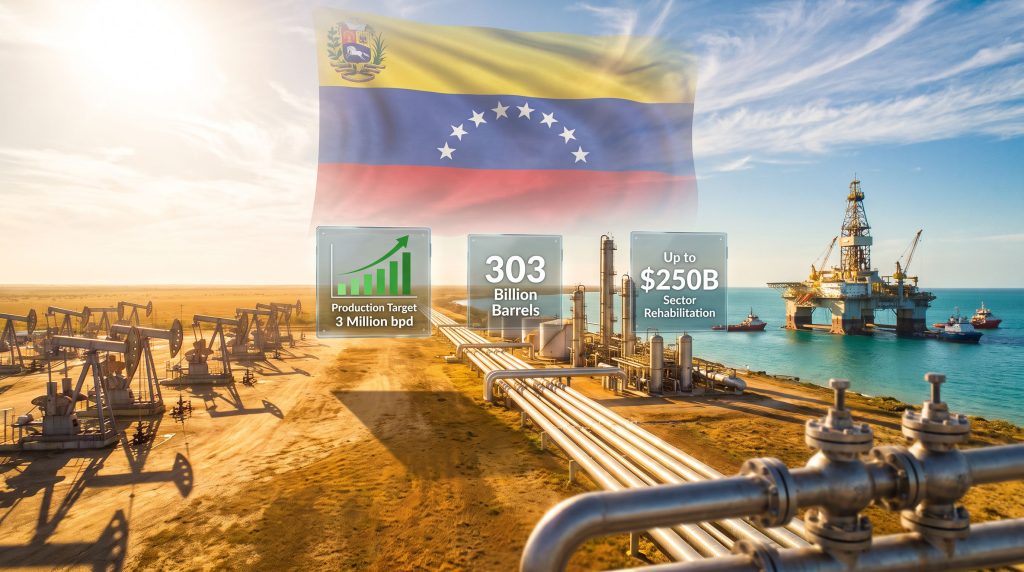
Few mismatches in global energy markets are as structurally significant as the divergence between what lies beneath Venezuelan soil and what actually flows from its wellheads. The country holds 303 billion barrels of proven oil reserves, a figure that places it above Saudi Arabia as the single largest proven reserve holder on the planet. Yet its current production hovers at roughly 1 to 1.1 million barrels per day (bpd), a fraction of what its geology could theoretically support. Understanding why that gap exists, and why 2026 may represent a genuine inflection point for Venezuela energy investment opportunities, requires examining the technical, regulatory, and geopolitical layers that have kept one of the world's most remarkable hydrocarbon endowments chronically underperforming.
The core geological reality is striking. Venezuela's reserves are concentrated predominantly in the Orinoco Heavy Oil Belt, a sedimentary formation stretching across the southern flank of the Eastern Venezuela Basin. This belt contains the densest accumulation of recoverable heavy crude on earth, distributed across the Junín, Carabobo, and Ayacucho project areas. These are not speculative resources. They are proven, mapped, and in many cases previously producing. The production constraint is not geological; it is infrastructural, political, and financial.
When big ASX news breaks, our subscribers know first
What Changed in Early 2026: Regulatory Architecture Reshaped
Two regulatory developments in early 2026 have materially altered the investment calculus for international operators evaluating Venezuelan upstream exposure.
On January 29, 2026, Venezuela enacted a revised hydrocarbons law that formally reintroduces private sector participation mechanisms, including production participation agreements and joint venture structures. This reverses core elements of the nationalisation framework that had progressively locked out foreign capital over the preceding two decades. For international operators, the significance lies not just in market access but in contract enforceability: the new law provides defined legal frameworks within which private producers can operate with greater autonomy alongside state oil company PDVSA.
Then in February 2026, the U.S. Treasury's Office of Foreign Assets Control issued general licences permitting major international corporations, specifically naming Chevron, Shell, and bp, to operate within Venezuela and renegotiate existing contractual arrangements. This does not eliminate compliance obligations. Investors must maintain active OFAC monitoring programmes because sanctions frameworks remain subject to change based on US policy on PDVSA decisions. However, the practical effect has been to reopen a door that had been largely shut for Western majors.
These two developments, taken together, represent the most substantive shift in Venezuela's upstream investment environment in over a generation. They do not eliminate country risk, but they do change the risk-return equation in ways that make institutional evaluation viable where it previously was not.
Upstream Oil: The Brownfield Recovery Thesis
Orinoco Belt: Capital Deployment at Scale
The heavy crude of the Orinoco Belt presents specific technical characteristics that shape the investment model. Extra-heavy crude in this region typically has API gravity in the range of 8 to 12 degrees, classifying it as bitumen-adjacent and requiring either upgrading to synthetic crude or blending with lighter diluents before it can be transported through pipelines or processed in conventional refineries. This upgrading requirement adds a capital and operational layer that lighter crude jurisdictions do not face, but it also creates integrated investment opportunities across extraction, upgrading, and logistics.
Restoring 1.4 million bpd of incremental production capacity within a 24-month window would require an estimated $14 billion in capital deployment, primarily directed at reactivating shut-in wells, rehabilitating upgrader units, and restoring pipeline and pump station integrity. Over a ten-year horizon, full sector restoration toward the government's stated target of 3 million bpd implies approximately $10 billion per year in sustained upstream capital expenditure.
The government has articulated a longer-range scenario of 5 million bpd, contingent on securing an estimated $150 billion in targeted upstream investment. This is a projection, not a commitment, and should be evaluated as a ceiling scenario rather than a base case. Furthermore, crude oil price trends will play a significant role in determining how quickly international capital flows toward these targets.
Lake Maracaibo: The World's Oldest Producing Basin and Its Rehabilitation Potential
Lake Maracaibo is one of the most historically significant hydrocarbon basins on the planet, with continuous commercial production dating back to the early twentieth century. This longevity means an extensive inventory of brownfield wells requiring workover programmes, artificial lift system upgrades, and pipeline integrity restoration rather than new greenfield exploration.
From an investment risk perspective, brownfield rehabilitation carries meaningfully lower geological uncertainty than frontier exploration, with faster production ramp timelines as a secondary advantage. The infrastructure exists. The question is the capital and technical capability to restore it to productive service.
Natural Gas: Venezuela's Most Underappreciated Hydrocarbon Asset
Offshore Gas Commercialisation: Dragon and Cocuina-Manakin
Venezuela's non-associated natural gas resource base is estimated at 160 to 200 trillion cubic feet (Tcf), the largest in Latin America. Despite this scale, gas monetisation has historically been minimal compared to the resource's potential. The offshore North Paria shelf is now emerging as the focal point for gas commercialisation strategy.
Shell is advancing offshore drilling at the Dragon gas project, with operations scheduled to commence in 2027. Separately, bp signed upstream development agreements in 2026 to advance the Cocuina-Manakin offshore gas field. These are not exploratory commitments; both projects involve known gas accumulations being moved toward development-phase capital deployment by operators with established track records in complex offshore environments.
A less widely understood dimension of Venezuela's gas opportunity is associated gas. Across both Orinoco Belt oil production and Maracaibo operations, significant volumes of gas are currently flared or vented due to the absence of adequate gathering, compression, and processing infrastructure. Capturing this associated gas represents both an environmental improvement and an immediately monetisable revenue stream that does not require new reservoir development, only infrastructure construction.
| Gas Investment Category | Key Projects | Estimated Capital Requirement |
|---|---|---|
| Offshore Development | Dragon, Cocuina-Manakin | Included in $18-20B total |
| Associated Gas Capture | Orinoco Belt, Maracaibo | Infrastructure-scale EPC contracts |
| Onshore Gas Processing | North Paria licences | Licence-specific JV structures |
| Export Terminal Expansion | Coastal infrastructure | Midstream EPC/JV models |
The Venezuelan government's target is to scale gas production to 10.5 million standard cubic feet per day by 2030, requiring an estimated $18 to $20 billion in capital across all gas investment categories. Venezuela has additionally opened legally to renewable energy private investors, further broadening the scope of opportunity beyond hydrocarbons alone.
Refining and Midstream: The $100 Billion Infrastructure Deficit
Venezuela's installed refining nameplate capacity is approximately 1.3 million bpd, which on paper would place it among the more capable refining nations in the Western Hemisphere. The operational reality is starkly different. Current utilisation rates are estimated at roughly 35% of installed capacity, meaning the country is effectively leaving two-thirds of its refining infrastructure idle due to deterioration, equipment failure, and lack of maintenance investment.
This utilisation gap is arguably the most capital-efficient near-term opportunity in the entire Venezuelan energy sector, because the physical assets already exist. The investment required is rehabilitation rather than greenfield construction, which changes both the timeline to first revenue and the risk profile of capital deployed.
Commodity trader Vitol's renewed participation in Venezuelan crude export operations is a meaningful market signal. Vitol's business model depends on logistics certainty and counterparty reliability. Its re-engagement indicates that the pathway from Venezuelan wellhead to international market is viable in a way that supports commercial trading activity.
Total sector-wide rehabilitation across refining, storage, and export terminal infrastructure is estimated to require up to $100 billion, representing the single largest capital component within Venezuela's broader energy rehabilitation programme.
Power Infrastructure: The Hidden Constraint on Every Other Sector
Grid Losses as an Industrial Bottleneck
Venezuela's electricity transmission network currently loses more than 30% of generated power through grid inefficiencies, a structural constraint that affects not just residential supply but the operational viability of upstream production facilities, refining operations, and gas processing plants. Any investor evaluating upstream or midstream opportunities in Venezuela must factor power availability into their operational assumptions. This creates a secondary investment category in grid stabilisation and distributed generation that is prerequisite to the broader energy sector thesis.
Renewable Energy: Resource Quality That Warrants Serious Evaluation
| Renewable Resource | Geographic Concentration | Measured Resource Quality |
|---|---|---|
| Solar Irradiation | Northwestern Venezuela | 5.5 to 6.0 kWh/m²/day |
| Wind Speed | Zulia and Falcón states | Greater than 7.5 m/s average |
| Hydroelectric | Existing installed capacity | Efficiency upgrade focus |
| Thermal Generation | Nationwide | Modernisation and fuel switching |
The solar and wind resource quality in northwestern Venezuela compares favourably with established renewable energy development markets. A solar irradiation level of 5.5 to 6.0 kWh/m²/day is sufficient to support utility-scale photovoltaic economics in most project finance frameworks. Average wind speeds exceeding 7.5 m/s in Zulia and Falcón states are commercially significant for wind energy development. Power sector rehabilitation and renewable integration is estimated to require $10 to $30 billion, accessible via EPC contracts or joint ventures with CORPOELEC, the state power utility.
The next major ASX story will hit our subscribers first
Active International Operators: Who Is Already Committed
| Operator | Project or Activity | Current Status (2026) |
|---|---|---|
| Shell | Dragon offshore gas field | Drilling scheduled for 2027 |
| bp | Cocuina-Manakin offshore gas field | Agreements signed in 2026 |
| Repsol | Existing Venezuelan upstream assets | Production increase plans announced |
| Eni | Orinoco Belt heavy oil project | Active development phase |
| Maurel & Prom | Urdaneta Oeste field | Ongoing development operations |
| Vitol | Venezuelan crude export logistics | Renewed participation in 2026 |
The concurrent re-engagement of multiple European majors and independent operators across both offshore gas and heavy oil segments reflects a shift in institutional risk appetite that follows, rather than precedes, the 2026 regulatory reforms. These operators have legal and compliance departments that conduct rigorous country risk assessments before committing capital. Their presence is meaningful due diligence validation for investors who are earlier in their own evaluation process.
However, it is worth noting that oil market shocks and broader oil price movements remain factors that can reshape operator appetite at short notice, particularly given ongoing geopolitical volatility in global energy markets.
Risk Framework: What Investors Must Quantify Before Entering
Venezuela energy investment opportunities are real, but they exist within a risk environment that demands sophisticated analysis rather than headline optimism. The four risk categories that warrant structured assessment are:
-
Political and governance risk: The new hydrocarbons law provides legal framework, but institutional continuity and contract enforceability remain elevated concerns relative to peer Latin American energy jurisdictions. Scenario analysis around policy continuity is non-negotiable.
-
Sanctions compliance risk: February 2026 OFAC general licences expanded operational permissions, but they are not permanent and can be modified. Any shift in U.S. foreign policy posture toward Venezuela would have direct implications for licence holders. Active compliance monitoring is an ongoing operational requirement, not a one-time exercise.
-
Currency and repatriation risk: Currency volatility and restrictions on profit repatriation are structural features of the Venezuelan operating environment that must be addressed in investment structuring, particularly for operators without established in-country infrastructure.
-
Legacy contractual complexity: Investors must conduct thorough due diligence on prior nationalisation claims, existing PDVSA contractual obligations, and any arbitration proceedings that may affect asset title or revenue sharing arrangements.
Furthermore, the trade war impact on oil markets adds an additional layer of macroeconomic uncertainty that investors must incorporate into their risk modelling when evaluating frontier energy jurisdictions such as Venezuela.
The Total Capital Requirement: Sector-by-Sector Summary
| Sector | Estimated Investment Requirement | Timeline |
|---|---|---|
| Upstream Oil (Full Restoration to 3 mbpd) | ~$10B per year ongoing | 10-year horizon |
| Rapid Production Restoration (1.4 mbpd increment) | $14B | 24-month deployment |
| Natural Gas Commercialisation | $18 to $20B | To 2030 |
| Refining and Midstream Rehabilitation | Up to $100B | Multi-decade |
| Power Sector and Renewables | $10 to $30B | Medium-term |
| Total Sector-Wide Rehabilitation Estimate | Up to $250B | Decade-long |
Investment Forums Shaping Capital Attraction in 2026
Venezuela Energy Week: October 26-29, Caracas
Venezuela's largest-ever international energy investment summit is scheduled for October 26 to 29, 2026, in Caracas. The event will bring together government officials, PDVSA representatives, international operators, and industry leaders to advance upstream development agreements, gas commercialisation discussions, and infrastructure investment commitments. It represents the primary formal mechanism through which the Venezuelan government is seeking to translate regulatory reform into committed international capital.
London Showcase: July 30, 2026
A dedicated industry showcase on July 30, 2026, in London is designed to provide UK and European institutional stakeholders with a structured overview of Venezuela's upstream investment landscape ahead of the Caracas summit. The event is expected to attract representatives from:
- Investment funds evaluating frontier and emerging market energy exposure
- Commercial banks and export credit agencies assessing project finance structures
- Engineering and technology firms pursuing EPC and service contracts
- Independent energy companies evaluating upstream entry strategies
The London event functions as a pre-summit engagement mechanism, connecting European capital with Venezuelan government officials and private sector participants in a format suited to institutional due diligence conversations.
Strategic Assessment: Three Scenarios for Venezuela's Energy Trajectory
The Bull Case
The combination of the world's largest proven reserve base, extensive existing upstream and refining infrastructure, a newly formalised legal framework, and demonstrated commitment from European majors creates a credible brownfield recovery investment thesis. Speed-to-market in brownfield heavy oil rehabilitation is faster than greenfield development, and the presence of known reserve volumes eliminates geological exploration risk as the primary uncertainty variable.
The Bear Case
Political continuity risk, the potential for sanctions framework reversal, and the sheer scale of infrastructure deterioration mean Venezuela remains one of the most complex investment jurisdictions in the global energy market. The $250 billion rehabilitation estimate implies a multi-decade capital commitment that requires patient institutional capital and sophisticated risk management frameworks that many investors cannot credibly deploy.
The Balanced Analytical View
Venezuela energy investment opportunities in 2026 are best characterised as high-risk, high-potential-return frontier exposure suited to investors with emerging market energy expertise, robust compliance infrastructure, and the capital patience to navigate a multi-year rehabilitation timeline. The regulatory inflection point is real, the resource base is unambiguously extraordinary, and institutional validation from major operators is accumulating. But the structural complexity of Venezuela's operating environment means that return outcomes will diverge sharply based on operator capability, contract structure, and risk management rigour.
Readers seeking additional context on Venezuela's upstream sector dynamics and international energy investment frameworks can explore related coverage at World Oil, which covers ongoing developments across Venezuela's oil and gas sector.
This article contains forward-looking statements, projections, and estimates sourced from government targets and sector analyses. These figures represent scenarios and planning assumptions rather than guaranteed outcomes. Investors should conduct independent due diligence and seek professional financial and legal advice before making any investment decisions related to Venezuelan energy assets. Sanctions frameworks and regulatory conditions are subject to change.
Want To Identify The Next Major Resource Discovery Before The Broader Market?
Discovery Alert's proprietary Discovery IQ model delivers real-time alerts on significant ASX mineral discoveries, transforming complex geological and commodity data into actionable investment insights for both short-term traders and long-term investors. Explore Discovery Alert's discoveries page to understand how historic mineral discoveries have generated substantial returns, and begin a 14-day free trial today to position yourself ahead of the market.