June 13, 2026
Arctic Innovation in Multi-Metal Extraction
Modern polymetallic mining operations represent sophisticated industrial ecosystems where technological advancement meets geological complexity. These integrated facilities must simultaneously optimise extraction of multiple valuable metals while navigating challenging environmental conditions, regulatory frameworks, and market dynamics. Furthermore, understanding how such operations achieve consistent performance requires examining the intersection of geological science, mechanical engineering, and operational excellence within extreme climate conditions.
When big ASX news breaks, our subscribers know first
Strategic Positioning Within Finland's Mineral Landscape
Geographic Advantages of the Central Lapland Greenstone Belt
The Central Lapland Greenstone Belt represents one of Northern Europe's most significant geological provinces for polymetallic mineralisation. Located approximately 30 kilometres north of Sodankylä in Finnish Lapland, the Boliden Kevitsa polymetallic mine operates within this geologically favourable terrain. The region's established mining infrastructure and proximity to downstream processing facilities creates operational synergies that reduce transportation costs and improve economic efficiency.
Initial prospecting activities in this area began in 1987 when geologists discovered rock samples containing nickel and copper. This discovery marked the beginning of what would become one of Finland's largest polymetallic operations, demonstrating the region's potential for hosting economically viable mineral deposits.
The geological setting provides access to intrusion-hosted nickel-copper-precious metals mineralisation. This favourable configuration facilitates economically viable extraction of multiple commodity streams simultaneously. In addition, this approach represents a critical factor in modern mining economics where diversified metal production reduces commodity price risk.
Economic Impact on Northern Finland's Industrial Development
The mine's integration within Boliden's European production network creates significant economic multiplier effects throughout the region. The operation generates over 560 full-time positions directly, with additional contractor workforce exceeding 200 positions. Economic analysis indicates a regional employment multiplier effect of approximately 3.2 times the direct employment impact.
Regional Employment Impact:
• Direct employment: 560+ full-time positions
• Contractor workforce: Additional 200+ positions
• Economic multiplier effect: 3.2x direct employment impact
• Primary service area: Sodankylä municipality and surrounding communities
Downstream Processing Network Integration
The Boliden Kevitsa polymetallic mine operates as part of an integrated European production network. Concentrates produced at the facility undergo processing at Boliden's Harjavalta and Rönnskär facilities in Finland and Sweden respectively. This vertical integration reduces transportation costs and ensures consistent concentrate specifications aligned with downstream smelter requirements.
The strategic positioning within established supply chains provides operational flexibility during market fluctuations. Consequently, this reduces exposure to third-party processing constraints that might limit production optimisation.
Geological Characteristics and Resource Classification
Intrusion-Hosted Mineralisation Analysis
The Kevitsa deposit belongs to the magmatic sulphide category of ore deposits, characterised by complex mineralogical assemblages requiring sophisticated extraction and processing approaches. The primary mineralisation consists of pentlandite [(Fe,Ni)₉S₈], chalcopyrite (CuFeS₂), and associated platinum group minerals.
This mineralogical composition determines both mine planning parameters and downstream processing methodology. The deposit's intrusion-hosted character means that mineralisation occurs within igneous rock formations. Furthermore, this creates distinct geological zones that require careful delineation during resource estimation and mine planning, particularly through 3d geological modelling.
Reserve and Resource Growth Trajectory
The 2024 reserve re-estimation incorporated advanced three-dimensional geological modelling and updated resource classification standards. This comprehensive analysis resulted in a 25-million-tonne addition to the reserve base, representing significant mine life extension potential.
2024 Resource Update Summary:
| Metric | Previous Estimate | 2024 Update | Change |
|---|---|---|---|
| Total Reserves | Base estimate | +25 Mt | Substantial increase |
| Total Resources | Previous total | +15 Mt | 9% growth |
| Mine Life Extension | Historical | 10+ years | Significant extension |
| Geological Confidence | Standard | Enhanced | Improved modelling |
Resource estimation in polymetallic deposits requires sophisticated geostatistical techniques accounting for multiple metal associations and varying continuity characteristics. The enhanced geological modelling incorporated additional drilling data and improved understanding of mineralogical controls on grade distribution.
Large-Scale Arctic Mining Operations
Equipment Selection for Sub-Arctic Conditions
Large-scale open-pit operations in sub-Arctic environments require specialised equipment capable of reliable performance across extreme temperature ranges. The primary haul truck fleet consists of Komatsu 830E-5 units, representing 290-metric-ton class vehicles engineered for severe-duty mining applications.
These haul trucks operate across temperature ranges from -30°C to +50°C, requiring specialised winterisation protocols for hydraulic systems. Moreover, they use fuel specifications designed for extreme conditions, and modified maintenance intervals accounting for thermal stress cycles.
Arctic Equipment Specifications:
• Operating temperature range: -30°C to +50°C ambient conditions
• Haul capacity: 290-metric-ton class vehicles
• Powertrain: Diesel-hydraulic configuration
• Bucket capacity: 25.3-cubic-metre standard capacity
• Specialised features: Cold-weather hydraulic systems and heated operator cabins
Production Performance Metrics
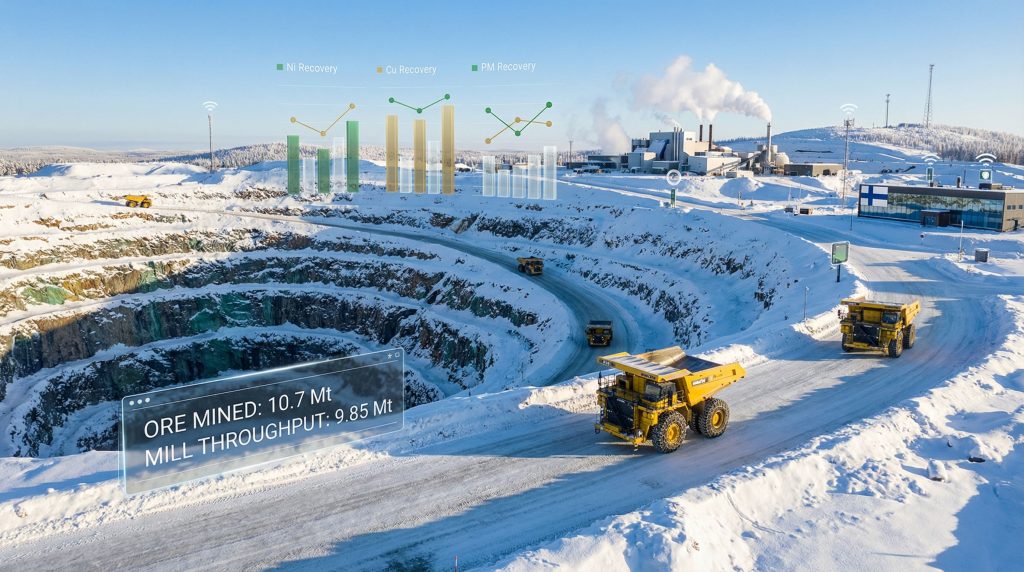
The 2024 operational performance demonstrated sustained excellence across multiple production parameters. Ore mining reached 10.7 million tonnes, exceeding the permitted 10.0 million tonnes per year baseline by seven percent. This performance reflects optimised pit sequencing and improved equipment availability despite challenging Arctic conditions.
2024 Production Analysis:
| Performance Metric | 2024 Achievement | Design Target | Performance Ratio |
|---|---|---|---|
| Ore Mined | 10.7 Mt | 10.0 Mt/year | 107% |
| Total Material Handled | 32.2 Mt | Variable | Optimised |
| Mill Throughput | 9.85 Mt | 9.9 Mt design | 99.5% |
| Concentrator Utilisation | 9.5 Mtpa capacity | Expanded target | Near-maximum |
The concentrator capacity expansion from 7.5 million tonnes per annum to 9.5 million tonnes per annum involved addition of flotation cells and associated grinding capacity. Processing throughput of 9.85 million tonnes during 2024 represents 99.5 percent of design capacity, indicating highly efficient operational execution.
Waste Rock Management and Pit Optimisation
Strip ratio optimisation represents a fundamental determinant of pit economics and overall mine life. Effective pit sequencing balances short-term production rates against long-term resource recovery. In addition, this ensures extraction occurs in economically optimal sequences that minimise waste rock per unit ore extracted.
Progressive pit development requires systematic waste rock removal in advance of ore extraction zones. The total material handling of 32.2 million tonnes in 2024 demonstrates the scale of overburden management required for sustained ore access.
Progressive rehabilitation occurs concurrent with mining advancement, ensuring environmental compliance and long-term site stability. Waste rock placement follows engineered designs that facilitate future reclamation activities.
Digital Infrastructure and Automation Integration
Private LTE Network Deployment
The Boliden Kevitsa polymetallic mine has implemented comprehensive digital infrastructure centred on a private LTE wireless network providing site-wide connectivity. This system replaces legacy radio communication with higher bandwidth, lower latency capabilities suitable for real-time equipment monitoring and semi-autonomous operation control.
Private LTE networks operate in dedicated spectrum bands, typically within the 700 MHz to 2.6 GHz range, providing broadband connectivity with latency below 100 milliseconds. Base station placement requires detailed topographical analysis of pit geometry to ensure comprehensive coverage throughout the mining area.
Digital Infrastructure Components:
• Network type: Private LTE wireless system
• Coverage area: Complete site-wide connectivity
• Latency performance: <100 milliseconds for real-time applications
• Primary applications: Equipment monitoring, production tracking, safety systems
• Weather resilience: Arctic-hardened base station infrastructure
Remote Equipment Monitoring Systems
Real-time data connectivity systems enable continuous monitoring of equipment performance, fuel consumption, and maintenance requirements. This capability provides operational teams with immediate visibility into fleet utilisation, mechanical condition, and productivity metrics across the entire mining operation.
Equipment monitoring integration facilitates predictive maintenance protocols, reducing unplanned downtime and extending equipment service life. However, sensor networks track hydraulic pressure, engine temperature, tyre condition, and operational cycles to optimise maintenance scheduling.
Automation Capabilities in Harsh Climates
Semi-autonomous equipment operation capability exists for both drilling and hauling systems, though deployment must account for Arctic-specific challenges. For instance, these include sensor calibration drift in extreme temperatures and communication reliability during severe weather events.
Drilling automation systems employ automated percussive control, precision positioning, and real-time rock mass parameter feedback to optimise hole placement and drilling efficiency. Temperature compensation algorithms account for thermal expansion of mechanical components and sensor performance variations.
Automation deployment enhances operator safety by reducing direct exposure to hazardous conditions while maintaining operational efficiency. Remote operation capabilities provide operational flexibility during extreme weather events.
Multi-Metal Processing and Recovery Optimisation
Flotation Circuit Configuration
Polymetallic ore processing requires sequential flotation circuits optimised for selective separation of different sulphide minerals with varying hydrophobic properties. The processing system must simultaneously recover nickel-rich pentlandite, copper-rich chalcopyrite, and associated precious metals while maintaining acceptable grade specifications for each concentrate stream.
Circuit configuration balances recovery optimisation against concentrate grade specifications that must meet downstream smelter input requirements. The expanded concentrator capacity accommodates increased throughput while maintaining metallurgical performance standards through data-driven mining operations principles.
Processing Circuit Components:
• Grinding stage: Comminution to 70-80% passing 75 micrometres particle size
• Conditioning stage: Collector and frother chemistry optimisation
• Rougher flotation: Initial sulphide mineral concentration
• Cleaner circuits: Grade improvement through re-flotation
• Quality control: Real-time monitoring of concentrate specifications
Multiple Concentrate Stream Production
The processing facility generates distinct concentrate streams optimised for different downstream processing pathways. Nickel concentrates proceed to Boliden's Harjavalta smelter, while copper concentrates undergo processing at the Rönnskär facility. Precious metal recovery occurs as integrated by-products within these primary concentrate streams.
Annual Production Overview:
| Product Stream | 2024 Performance | Processing Destination |
|---|---|---|
| Nickel Metal Equivalent | 11.5 kt | Harjavalta Smelter |
| Copper Concentrate | Variable tonnage | Rönnskär Smelter |
| Gold Recovery | Integrated stream | European refineries |
| Platinum Group Elements | By-product recovery | Specialised processors |
Quality control systems maintain consistent concentrate specifications through automated sampling, real-time chemical analysis, and process parameter adjustment. This ensures compliance with smelter input requirements and maximises payment terms for concentrate sales.
Metallurgical Performance Optimisation
Recovery optimisation in polymetallic operations requires precise control of flotation residence time, feed size distribution, and reagent dosing. The 9.85 million tonnes processed through the concentrator during 2024 demonstrates successful operational execution near design capacity limits.
Particle size distribution control ensures optimal liberation of target minerals while minimising over-grinding that could reduce flotation efficiency. Furthermore, reagent consumption optimisation balances recovery performance against operating cost considerations.
The next major ASX story will hit our subscribers first
Environmental Management and Sustainability Protocols
Tailings Storage Facility Engineering
Tailings storage facility management represents a critical component of environmental stewardship in polymetallic mining operations. The facility design incorporates engineering modifications to accommodate expanded throughput while maintaining long-term structural stability under Arctic conditions.
Construction techniques account for permafrost considerations, seasonal freeze-thaw cycles, and precipitation patterns characteristic of the Lapland region. Stability monitoring systems provide continuous assessment of facility performance and early warning capabilities for any structural concerns.
Progressive Site Rehabilitation
Progressive closure implementation occurs concurrent with active mining operations, ensuring environmental compliance and preparation for eventual site closure. Waste rock area rehabilitation follows established protocols designed to establish sustainable vegetation cover and prevent long-term environmental impacts, highlighting the mine reclamation importance in sustainable mining practices.
Rehabilitation Components:
• Soil storage area management for future revegetation
• Biodiversity protection measures for Arctic flora and fauna
• Water management systems for surface and groundwater protection
• Air quality monitoring throughout operational phases
• Community consultation and indigenous rights considerations
Energy Efficiency and Carbon Footprint Management
Fleet electrification represents a long-term strategy for reducing operational carbon emissions and improving energy efficiency. While full electrification remains under evaluation, incremental improvements in fuel efficiency and renewable energy integration contribute to sustainability objectives.
Energy consumption optimisation focuses on processing circuit efficiency, equipment utilisation optimisation, and waste heat recovery where technically feasible within Arctic operating constraints.
Regulatory Compliance and Community Relations
Finnish Mining Regulatory Framework
Operations occur within Finland's comprehensive mining regulatory framework requiring continuous environmental compliance monitoring and operational permit adherence. The permitted annual capacity of 10.0 million tonnes provides operational flexibility while maintaining regulatory compliance.
Environmental permit modifications accommodate facility expansions and operational improvements through established regulatory processes. Closure plan development ensures long-term environmental protection and financial assurance for eventual site rehabilitation.
Regional Community Engagement
Community engagement programmes focus on employment generation within the Sodankylä region and local contractor development initiatives. The operation's economic impact extends throughout Northern Finland through supply chain integration and service provision.
Indigenous rights considerations include consultation regarding traditional reindeer herding activities and cultural site protection. Ongoing dialogue ensures operational activities account for traditional land use patterns and community concerns.
Community Impact Framework:
• Regional employment: 760+ total positions (direct and contractor)
• Local procurement: Preference for regional suppliers and services
• Cultural consultation: Ongoing dialogue with indigenous communities
• Environmental monitoring: Community-accessible reporting systems
• Educational partnerships: Technical training and development programmes
Mine Life Extension and Strategic Planning
Resource Expansion and Geological Modelling
The 2024 reserve update incorporated advanced three-dimensional geological modelling techniques and updated mineral resource classification standards. This comprehensive analysis added 25 million tonnes to the reserve base while increasing total resources by 15 million tonnes, representing nine percent growth in the overall resource inventory.
Enhanced geological modelling integrated additional drilling data and improved understanding of mineralogical controls on grade distribution. Resource estimation methodologies account for multiple metal associations and varying geological continuity characteristics specific to intrusion-hosted deposits.
Production Planning for Extended Operations
Mine life extension beyond ten years requires optimisation of production sequencing and infrastructure utilisation. The permitted capacity of 10.0 million tonnes per year provides operational flexibility for production planning while maintaining regulatory compliance.
Infrastructure investment requirements for extended operations include equipment replacement planning, processing facility maintenance, and potential capacity modifications based on geological and market conditions. Moreover, the implementation of ai in mining operations offers significant potential for further efficiency gains.
Strategic Value Within European Supply Chains
The Boliden Kevitsa polymetallic mine represents a critical component of European critical mineral supply chain resilience. Domestic nickel and copper production reduces import dependency while supporting European Union strategic autonomy objectives for battery metals and industrial commodities.
Integration with Boliden's processing network enhances value capture through vertical integration while providing operational flexibility during market volatility. Future expansion potential depends on continued resource delineation and market demand for multiple commodity streams, reinforcing the mineral exploration significance in maintaining competitive operations.
The operation's role in European critical mineral supply chains positions it favourably for long-term sustainability as governments prioritise domestic resource development and supply chain security.
Technology Leadership and Future Development
Digital Transformation Applications
The comprehensive digital infrastructure deployment at the Boliden Kevitsa polymetallic mine provides a scalable model for technology integration in Arctic mining operations. Private LTE network implementation demonstrates the feasibility of advanced connectivity in remote, harsh climate environments.
Real-time data integration enables optimisation of equipment utilisation, maintenance scheduling, and production planning through advanced analytics and machine learning applications. These technological capabilities provide competitive advantages in operational efficiency and cost management.
Arctic Mining Innovation Development
Operational experience in sub-Arctic conditions contributes to broader industry understanding of technology deployment and operational best practices for extreme climate mining. Equipment modification techniques and maintenance protocols developed at Kevitsa push drilling technology to its limits, informing industry standards for similar operations.
Automation system deployment in harsh climate conditions demonstrates the potential for expanding semi-autonomous operation capabilities while maintaining safety and productivity standards.
Environmental Stewardship Model
Progressive environmental management practices implemented at the facility establish industry benchmarks for responsible Arctic mining operations. Tailings storage facility engineering modifications and progressive rehabilitation protocols provide reference examples for similar operations.
The integration of environmental monitoring systems with digital infrastructure enables real-time compliance verification and proactive environmental protection measures. This approach supports social licence maintenance and regulatory compliance throughout extended mine life scenarios.
The Boliden Kevitsa polymetallic mine represents sophisticated integration of geological science, mechanical engineering, and operational excellence within challenging Arctic conditions. Through continued technology advancement and environmental stewardship, such operations demonstrate the potential for sustainable mineral extraction supporting European industrial competitiveness and supply chain resilience.
Are You Searching for the Next Breakthrough in ASX Mineral Discoveries?
Discovery Alert's proprietary Discovery IQ model delivers instant notifications on significant ASX polymetallic and critical mineral discoveries, empowering subscribers to identify actionable trading opportunities ahead of the broader market. Explore how major mineral discoveries have generated exceptional returns by visiting Discovery Alert's dedicated discoveries page, then begin your 30-day free trial to secure your competitive advantage in mineral exploration investing.