
June 13, 2026
Arctic Mining Infrastructure Under Siege: The Hidden Engineering Crisis Reshaping Northern Operations
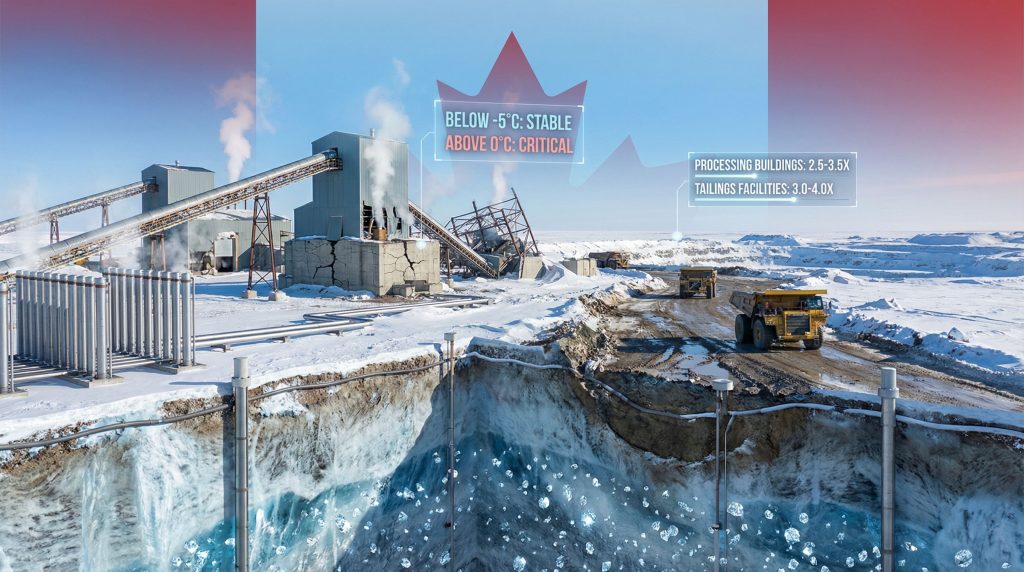
Across the circumpolar Arctic, a silent engineering catastrophe unfolds beneath mining facilities that have operated successfully for decades. The permanently frozen ground that once provided unwavering structural support for massive processing plants, tailings facilities, and transportation networks now represents one of the most complex permafrost infrastructure challenges in mining facing the global industry.
This transformation extends far beyond simple foundation problems. The degradation of permafrost creates cascading system failures that threaten entire mining operations, generating astronomical remediation costs and environmental liabilities that can exceed project revenues. Understanding these mechanisms requires examining how frozen ground physics interact with industrial thermal loads, seasonal temperature cycles, and long-term climate trends to create unprecedented infrastructure vulnerabilities.
When big ASX news breaks, our subscribers know first
Permafrost Foundation Mechanics: The Science Behind Structural Collapse
Furthermore, permafrost infrastructure challenges in mining begin with understanding the fundamental physics of frozen ground systems. Ice-bonded soils create exceptional load-bearing capacity through mechanical interlocking and thermal cementing processes that can support processing facilities exceeding 500 tonnes per foundation point when continuously frozen below -2°C.
The engineering properties of permafrost vary dramatically based on ice content, soil composition, and thermal regime. Ice-rich permafrost containing 60-80% ice by volume provides maximum structural integrity but exhibits catastrophic failure characteristics when thermal stability is compromised. Ice-poor permafrost with 20-40% ice content offers more gradual degradation patterns but lower baseline load capacity.
Critical Temperature Thresholds for Mining Operations
Research from Arctic engineering studies reveals specific temperature ranges that determine infrastructure stability:
Stable Operations Zone (-8°C to -3°C):
- Foundation capacity: 8-15 megapascals
- Settlement risk: Less than 2cm annually
- Maintenance requirements: Standard industrial protocols
Warning Zone (-3°C to -1°C):
- Foundation capacity: 3-8 megapascals
- Settlement risk: 5-15cm annually
- Maintenance requirements: Enhanced monitoring protocols
Critical Failure Zone (-1°C to +2°C):
- Foundation capacity: 0.5-3 megapascals
- Settlement risk: 15-50cm annually
- Maintenance requirements: Emergency stabilisation measures
Thermal Loading from Mining Operations
Mining facilities generate substantial thermal energy that accelerates permafrost degradation through multiple pathways. Process heat discharge from mineral processing equipment, building heating systems, and warm water usage create localised thermal plumes that penetrate 8-12 meters into underlying permafrost over operational timescales.
The cumulative effect transforms stable permafrost zones into transitional thermal regimes where seasonal freeze-thaw cycles create differential settlement patterns. These patterns concentrate structural stress in foundation systems originally designed for uniform support conditions.
Infrastructure Failure Patterns: From Subsidence to System Collapse
Processing Facility Vulnerabilities
Large-scale mineral processing operations face unique challenges when permafrost infrastructure challenges in mining manifest as foundation instability. In addition, the mining industry evolution has made ball mills, crushers, and conveyor systems require precise alignment within 5-10 millimetres over 100-metre operational spans. Differential settlement exceeding these tolerances creates:
- Mechanical misalignment reducing processing efficiency by 15-25%
- Increased equipment wear shortening operational lifespans by 30-40%
- Material spillage creating housekeeping and environmental challenges
- Structural steel fatigue in support frameworks and building connections
Transportation System Degradation
Haul Road Infrastructure:
Mining haul roads traversing permafrost terrain experience accelerated degradation through combined thermal and mechanical loading. Heavy haul trucks carrying 150-300 tonne payloads generate mechanical stress whilst dust suppression water and solar heating create thermal disturbance.
Research indicates that haul roads over ice-rich permafrost experience settlement rates of 8-15 centimetres annually in affected sections, creating washboard surfaces that reduce truck speeds by 40-60% and increase tyre wear by 200-300%.
Railway System Impacts:
Mining railways require track geometry within 10-15 millimetres per 10-metre rail section for safe heavy-load operation. Permafrost-induced differential settlement exceeding these parameters creates operational shutdowns requiring emergency track realignment.
Studies of northern Canadian mining railways document settlement-related service interruptions averaging 15-25 days annually for lines traversing degraded permafrost zones, with remediation costs ranging from $2-5 million per kilometre for severe sections.
Waste Containment Crisis: Environmental and Financial Catastrophe
Tailings Storage Facility Risks
Permafrost infrastructure challenges in mining create their most severe consequences in waste containment systems where foundation failure can trigger environmental disasters. However, sustainable mining transformation requires tailings storage facilities constructed on permafrost to address multiple simultaneous failure mechanisms:
Foundation Instability Mechanisms:
- Progressive thaw settlement beneath dam embankments
- Thermal erosion from tailings slurry discharge
- Differential settlement creating structural stress concentrations
- Seepage pathway development through thawed foundation zones
Containment System Failures:
- Synthetic liner displacement due to foundation movement
- Pipe infrastructure rupture from differential settlement
- Emergency spillway functionality loss from grade changes
- Secondary containment system compromise
Hazardous Material Storage Challenges
Fuel storage tanks, chemical reagent containment, and process water systems require specialised foundation designs accounting for both thermal stability and ground movement accommodation. Double-wall tank systems must maintain integrity throughout seasonal temperature cycles whilst accommodating foundation settlement up to 15-20 centimetres without rupture.
Environmental liability exposure from containment failures in remote Arctic locations can exceed $50-100 million per incident due to:
- Extended remediation timelines in harsh weather conditions
- Specialised equipment mobilisation costs for Arctic operations
- Ecological damage assessments in pristine northern environments
- Regulatory penalties and third-party litigation exposure
Advanced Engineering Solutions: Thermosyphon Technology and Adaptive Design
Two-Phase Thermosyphon Systems
Modern permafrost preservation technology utilises two-phase closed thermosyphons as the most effective active cooling solution for mining infrastructure foundations. These systems extract thermal energy from foundation soils through passive heat transfer mechanisms, maintaining frozen conditions even under substantial thermal loading.
Technical Specifications:
- Evaporator sections: Embedded 4-6 metres into permafrost substrate
- Condenser sections: Extended 2-3 metres above ground for atmospheric heat rejection
- Working fluid selection: Ammonia, carbon dioxide, or specialised refrigerants based on local temperature conditions
- Heat extraction capacity: 2,000-5,000 watts per thermosyphon unit under design conditions
Installation Patterns:
- Spacing intervals: 3-5 metre grid patterns for uniform thermal control
- Array configurations: Perimeter cooling for building foundations or comprehensive coverage for critical facilities
- Monitoring integration: Temperature sensors and automated control systems for performance optimisation
Adjustable Foundation Technologies
Mining facilities in permafrost regions increasingly incorporate hydraulic foundation adjustment systems that accommodate ground movement without structural damage. Consequently, data-driven operations enable these systems to feature:
Mechanical Components:
- Hydraulic jacking points at 25-50 structural connection points
- Load monitoring systems providing real-time foundation stress data
- Automated levelling protocols responding to settlement detection
- Flexible utility connections accommodating vertical and horizontal movement
Operational Parameters:
- Adjustment range: ±30 centimetres vertical accommodation
- Response time: 4-8 hour correction cycles for detected settlement
- Load capacity: 100-500 tonnes per adjustment point
- Service life: 15-25 years under Arctic operating conditions
Financial Impact Assessment: Quantifying the Infrastructure Crisis
Direct Construction Cost Multipliers
Permafrost infrastructure challenges in mining create substantial cost premiums across all facility types:
| Infrastructure Category | Standard Construction | Permafrost Premium | Total Cost Multiple |
|---|---|---|---|
| Processing Buildings | $2,000/m² | +250-350% | 3.5-4.5x baseline |
| Haul Road Construction | $500,000/km | +180-220% | 2.8-3.2x baseline |
| Tailings Storage Facilities | $15 million/facility | +300-400% | 4.0-5.0x baseline |
| Utility Infrastructure | $1,200/linear metre | +200-300% | 3.0-4.0x baseline |
| Equipment Foundations | $50,000/foundation | +400-600% | 5.0-7.0x baseline |
Operational Impact Quantification
Beyond construction premiums, permafrost-related infrastructure challenges create ongoing operational expenses that can exceed initial capital costs:
Maintenance Cost Escalation:
- Increased inspection frequency: 300-500% higher than temperate climate operations
- Specialised repair equipment: $2-5 million annually for Arctic-capable maintenance tools
- Emergency response capacity: $1-3 million annually for rapid deployment teams
- Replacement component inventory: 200-400% higher spare parts requirements
Production Disruption Costs:
- Unplanned downtime: 15-25 additional days annually from infrastructure failures
- Reduced throughput capacity: 10-20% processing efficiency loss during unstable periods
- Transportation delays: 25-40 additional days annually from access road failures
- Emergency logistics: $500,000-2 million annually for expedited material delivery
The next major ASX story will hit our subscribers first
Risk Management Frameworks: Insurance and Contingency Planning
Specialized Insurance Products
Traditional mining insurance policies exclude or inadequately cover permafrost-related risks, creating market demand for specialised coverage addressing:
Business Interruption Coverage:
- Production loss protection: Coverage for revenue loss during infrastructure repair periods
- Extended replacement time: Policies accounting for Arctic construction timelines
- Increased cost of working: Coverage for temporary facility deployment costs
- Supply chain disruption: Protection against transportation infrastructure failures
Environmental Liability Coverage:
- Gradual pollution coverage: Protection against slow-developing contamination from foundation settlement
- Emergency response costs: Coverage for immediate containment and cleanup expenses
- Third-party liability: Protection against downstream environmental damage claims
- Regulatory compliance costs: Coverage for enhanced monitoring and reporting requirements
Emergency Response Protocols
Mining operations in permafrost regions require comprehensive emergency response capabilities addressing infrastructure failure scenarios. Furthermore, AI in mining technology enhances:
Immediate Response Capabilities:
- 24-hour engineering support: On-call structural engineers with Arctic experience
- Emergency equipment stockpiles: Heavy lifting equipment, temporary support systems, and repair materials
- Evacuation protocols: Personnel safety procedures for structural collapse scenarios
- Communication systems: Redundant communication networks maintaining connectivity during infrastructure failures
Extended Recovery Planning:
- Alternative processing capacity: Backup facilities or mobile processing units
- Transportation route redundancy: Multiple access roads and supply chain pathways
- Temporary facility deployment: Pre-engineered structures for rapid installation during extended repairs
- Regulatory notification protocols: Streamlined reporting procedures for environmental agencies
Future-Proofing Strategies: Climate Adaptation and Technology Development
Climate Projection Integration
Long-term infrastructure planning in permafrost regions must incorporate climate scenarios extending 25-50 years into operational lifespans. Current climate projections indicate:
Temperature Increase Scenarios:
- Conservative projections (RCP 4.5): 2-4°C warming in circumpolar regions by 2070
- High-emission scenarios (RCP 8.5): 4-8°C warming in Arctic regions by 2070
- Seasonal variation changes: Increased freeze-thaw cycle frequency and intensity
- Precipitation pattern shifts: Altered snow loading and drainage patterns affecting thermal regimes
Infrastructure Design Standard Evolution:
- Enhanced thermal design criteria: Foundation cooling requirements increased by 50-100%
- Extended monitoring requirements: Continuous ground temperature monitoring throughout facility lifecycles
- Redundant support systems: Multiple independent foundation stabilisation technologies
- Modular construction approaches: Infrastructure systems enabling rapid reconfiguration or replacement
Emerging Technology Development
Research and development priorities for permafrost infrastructure challenges in mining focus on:
Advanced Cooling Technologies:
- High-efficiency thermosyphon designs: 30-50% improved heat extraction capacity
- Hybrid cooling systems: Integration of passive and active cooling technologies
- Renewable energy integration: Solar-powered active cooling systems for remote locations
- Smart control systems: Machine learning algorithms optimising cooling system operation
Predictive Monitoring Systems:
- Distributed sensor networks: Real-time ground temperature monitoring with millimetre-scale movement detection
- Satellite-based monitoring: Remote sensing technology tracking large-scale ground movement patterns
- Predictive analytics: Artificial intelligence systems forecasting infrastructure failure timelines
- Integrated risk management: Comprehensive monitoring systems linking ground conditions to operational planning
Regulatory Compliance Evolution
Environmental regulations governing mining operations in permafrost regions continue evolving to address climate-related risks:
Enhanced Environmental Standards:
- Permafrost protection requirements: Mandatory thermal impact assessments for new construction
- Enhanced monitoring protocols: Continuous environmental monitoring for permafrost-affected sites
- Stricter containment standards: Upgraded design requirements for waste storage facilities in unstable ground
- Climate risk disclosure: Mandatory climate vulnerability assessments for project financing
Compliance Cost Implications:
- Environmental monitoring: $500,000-2 million annually for comprehensive monitoring programmes
- Enhanced containment systems: 200-400% cost increases for upgraded waste storage facilities
- Climate risk assessments: $200,000-500,000 per project for comprehensive vulnerability studies
- Regulatory reporting: Increased administrative costs for enhanced documentation and compliance verification
What Are the Long-Term Solutions for Arctic Mining Operations?
The transformation of permafrost from reliable foundation material to unpredictable geotechnical hazard represents one of the most significant infrastructure challenges facing Arctic mining operations. Whilst engineering solutions exist to address these challenges, they require substantial capital investment, specialised expertise, and long-term commitment to adaptive management strategies.
Success in permafrost regions increasingly depends on comprehensive risk assessment, advanced engineering design, and proactive monitoring systems that can detect and respond to changing ground conditions before catastrophic failures occur. For instance, implementing waste management solutions becomes critical when dealing with unstable permafrost conditions.
Mining companies that invest in these capabilities will maintain operational viability in Arctic regions, whilst those that underestimate permafrost infrastructure challenges face potentially catastrophic financial and environmental consequences.
"Investment considerations: Investors evaluating Arctic mining projects should carefully assess permafrost risk management strategies, infrastructure adaptation capabilities, and long-term climate vulnerability when making investment decisions. Projects with comprehensive permafrost management programmes may command valuation premiums reflecting reduced operational risk profiles."
Looking to Invest in Arctic Mining Operations?
Discovery Alert's proprietary Discovery IQ model provides real-time alerts on significant ASX mineral discoveries, helping subscribers identify actionable opportunities in challenging mining environments before the broader market responds. With Arctic mining operations facing unprecedented infrastructure challenges, staying ahead of discovery announcements becomes crucial for both short-term trading advantages and long-term investment positioning.