August 7, 2026
Arctic Resource Dynamics in Critical Mineral Security
The global scramble for critical minerals has fundamentally altered how nations approach resource procurement, moving beyond traditional cost-based models toward security-focused supply chain strategies. This transformation becomes particularly evident when examining rare earth supply in Greenland, which represents one of the most significant concentrations of these strategic materials outside Chinese control. As Western economies grapple with supply chain vulnerabilities exposed by recent geopolitical tensions, the Arctic island's mineral wealth has emerged as a potential cornerstone for diversifying critical material sources.
The shift from price-driven to security-oriented procurement reflects a broader recognition that supply chain resilience now carries strategic premiums that often outweigh pure economic considerations. Furthermore, this evolution has positioned Greenland critical minerals at the intersection of mining economics, environmental policy, and international relations, creating a complex landscape where traditional investment models meet national security imperatives.
When big ASX news breaks, our subscribers know first
Greenland's Position in Global Rare Earth Markets
Resource Scale and Strategic Significance
Greenland's rare earth endowment represents approximately 38.5 million tonnes of rare earth oxides (REO), establishing the territory as one of the world's most significant untapped reserves. This substantial resource base positions Greenland to potentially supply a meaningful portion of global demand, which currently stands at approximately 240,000-250,000 tonnes REO annually.
The geological significance extends beyond simple tonnage, with Greenland's deposits containing substantial concentrations of heavy rare earth elements (HREEs), particularly dysprosium and terbium. These materials command premium pricing due to their critical applications in permanent magnet technology, with dysprosium averaging $360-380 per kilogram and terbium trading at $1,200-1,400 per kilogram in 2024.
| Global REE Reserves | Million Tonnes REO | Market Share |
|---|---|---|
| China | 44.0 | 34% |
| Vietnam | 22.0 | 17% |
| Greenland (estimated) | 38.5 | 30% |
| Rest of World | 25.5 | 19% |
Kvanefjeld Project: Scale and Complexity
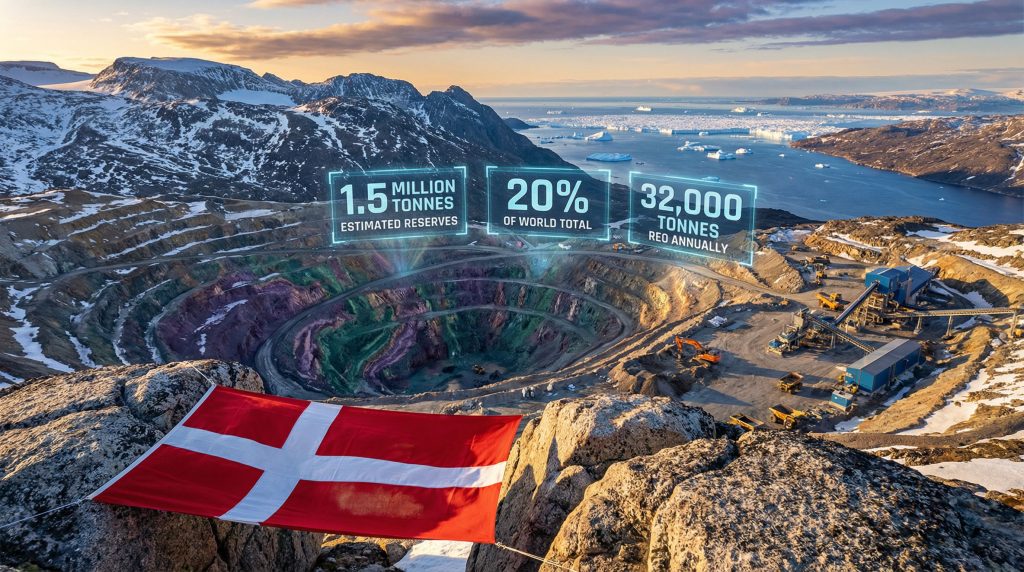
The Kvanefjeld deposit exemplifies both the potential and challenges of rare earth supply in Greenland. With 1.01 billion tonnes at 1.10% Total Rare Earth Oxides (TREO), the project represents one of the world's largest undeveloped rare earth resources. At full capacity, Kvanefjeld could theoretically produce 32,000 tonnes REO annually, representing approximately 12-13% of current global consumption.
However, the project faces significant technical hurdles rooted in its geological characteristics. The dominant ore type, eudialyte, presents processing challenges that have never been commercially resolved at scale. This sodium-rich zirconium silicate contains rare earth elements in a complex mineral matrix that requires specialized metallurgical approaches, adding both cost and technical risk to development scenarios.
The presence of uranium as a co-product further complicates the project's trajectory. The deposit contains an estimated 228.7 million pounds of U3O8, which historically provided economic benefits but now represents a regulatory barrier following Greenland's parliamentary decision to ban uranium mining in November 2021.
Regulatory and Political Barriers to Development
The 2021 Uranium Mining Ban
The regulatory landscape for rare earth supply in Greenland fundamentally shifted when the Inatsisartut (Greenland's parliament) voted to prohibit uranium mining with 37 supporting votes in November 2021. This decision effectively suspended development of multi-element projects like Kvanefjeld, despite previous investments exceeding AUD $100 million by project developers.
The uranium ban emerged from environmental concerns, particularly those raised by Greenland's fishing industry, which contributes approximately 90% of the territory's total exports valued at 4.5 billion DKK annually. The fishing sector's opposition centred on potential radioactive contamination risks that could impact marine ecosystems and export markets.
Environmental and Social Considerations
Beyond uranium-related concerns, rare earth development in Greenland faces broader environmental challenges typical of Arctic mining operations. The territory experiences ice-free periods of only 6-8 months annually, limiting shipping access and requiring specialised logistics approaches. Additionally, permafrost conditions affect 60% of Greenland's land area, necessitating specialised engineering solutions for mine infrastructure and tailings management.
Infrastructure development requirements add substantial capital costs, with estimates suggesting $500 million to $1 billion for port facilities, power generation, and transportation networks needed to support major mining operations. These costs run 30-50% higher than comparable projects in temperate zones due to Arctic operating conditions.
Technical Challenges in Greenlandic Rare Earth Processing
Metallurgical Processing Complexities
The technical challenges associated with rare earth supply in Greenland extend beyond simple extraction to complex metallurgical processing requirements. Eudialyte ores require sophisticated separation techniques involving hydrochloric acid, sulfuric acid, and sodium hydroxide in large quantities, along with associated environmental management systems.
Commercial-scale eudialyte processing has never been economically demonstrated, representing a fundamental technical risk for Greenlandic rare earth projects.
The absence of proven processing pathways creates uncertainty around both capital and operating costs, as well as recovery rates for individual rare earth elements. This technical gap has contributed to investor hesitation and delayed project advancement, despite the resource scale.
Supply Chain Integration Strategies
Successful development of rare earth supply in Greenland requires careful consideration of processing location strategies. Concentration at mine sites can reduce shipping volumes by 90-95%, as only concentrated material requires transport to refineries. However, final separation typically occurs near end-user markets to minimise transportation of specialised products.
This geographic separation of processing stages creates logistical complexity and requires coordination across multiple jurisdictions, each with distinct regulatory frameworks and environmental standards.
Market Dynamics and Chinese Competition
Current Market Structure
China's dominance in rare earth markets extends across the entire supply chain, controlling approximately 70% of global mining and 90% of processing capacity. This concentration creates strategic vulnerabilities for Western economies, particularly in defence and clean energy applications where rare earth elements are irreplaceable.
The rare earth oxide market, valued at $7.2 billion in 2024, is projected to reach $12.8 billion by 2030, driven primarily by permanent magnet applications that consume 38% of global rare earth production. This growth trajectory underlies Western interest in developing alternative supply sources, including the global scramble for Greenland's rare earths.
Price Dynamics and Security Premiums
Recent market developments demonstrate how geopolitical factors influence rare earth pricing beyond traditional supply-demand fundamentals. Neodymium-praseodymium (NdPr) oxide prices fluctuated from $48-52 per kilogram in Q4 2024, down from 2022 peaks of $148 per kilogram, reflecting both demand volatility and supply chain adjustments.
Industry analysis indicates that Western purchasers increasingly factor security premiums into procurement decisions, accepting higher costs for non-Chinese sources to reduce supply chain concentration risks. This premium structure could provide economic advantages for rare earth supply in Greenland, even if production costs exceed Chinese alternatives.
Investment Scenarios and Development Pathways
Capital Requirements and Funding Models
Rare earth mine development in Arctic environments requires substantial capital investment, with integrated operations typically requiring $500 million to $1.5 billion for mine and concentration facilities. Kvanefjeld's capital expenditure was previously estimated at $1.5-1.8 billion for full development, though revised estimates would likely reflect higher costs due to inflation and enhanced environmental requirements.
Financing models for rare earth supply in Greenland projects may involve combinations of:
- Export credit agency support providing 30-40% of project capital
- Strategic investor partnerships with offtake agreements
- Government-backed financing for strategic mineral projects
- Private equity and mining major participation
Alternative Development Scenarios
While Kvanefjeld remains suspended due to uranium-related regulatory restrictions, alternative approaches to rare earth supply in Greenland continue advancing. The Tanbreez project represents a uranium-free development pathway, with modular expansion potential from 85,000 to 425,000 tonnes REO equivalent annually.
Tanbreez offers several strategic advantages:
- Heavy REE concentration exceeding 27% of total REE content
- Modular expansion approach reducing initial capital requirements
- Uranium-free ore avoiding regulatory complications
- Pilot facility development providing technical validation pathway
The next major ASX story will hit our subscribers first
Geopolitical Implications and Strategic Considerations
Western Diversification Initiatives
The European Union's Critical Raw Materials Act, adopted in March 2023, establishes targets limiting member states to no more than 65% sourcing from any single third country for strategic raw materials by 2030. This regulatory framework creates market opportunities for rare earth supply in Greenland by mandating supply chain diversification.
Similarly, the U.S. Defense Production Act Title III program allocated $500 million for rare earth processing capacity in 2023-2024, demonstrating American commitment to reducing Chinese supply dependence. These initiatives provide policy support for alternative supply development, including Greenlandic projects, whilst supporting broader energy security strategy objectives.
Arctic Sovereignty and Resource Control
Denmark's sovereignty over Greenland, combined with the territory's self-governing status since 2009, creates unique jurisdictional dynamics for resource development. The annual block grant of 3.9 billion DKK (approximately $570 million) from Denmark represents about 60% of Greenland's government budget, highlighting economic interdependencies that influence mining policy decisions.
Recent geopolitical attention to Greenland, including renewed American interest in territorial acquisition, has created unprecedented focus on the island's strategic resource value. This attention translates into market volatility, with rare earth developers experiencing significant share price movements based on geopolitical developments rather than fundamental project advancement.
Production Timeline Analysis and Market Integration
Near-term Supply Prospects (2026-2030)
Realistic timelines for rare earth supply in Greenland depend heavily on regulatory resolution and financing completion. Historical precedents suggest 4-7 years from final approvals to full-scale production, based on comparable projects like Mountain Pass (4 years) and Lynas Mt Weld (7 years).
Near-term milestones include:
- Legal proceedings resolution for Kvanefjeld exploitation licence
- Pilot facility commissioning for alternative projects like Tanbreez
- Environmental impact assessment completion for major developments
- Infrastructure development planning and financing
Long-term Market Integration (2030-2040)
Assuming successful development, rare earth supply in Greenland could theoretically contribute 25-30% of projected 2035 demand of 450,000-500,000 tonnes, based on clean energy transition scenarios. This market share would represent a fundamental restructuring of global rare earth supply chains.
Production ramp-up typically follows industry standards of 60% nameplate capacity in the first commercial year, reaching full production capacity by years 2-3 following commissioning. This gradual scaling allows for technical optimisation and market integration whilst managing operational risks.
Technology Applications and End-Use Demand
Critical Applications Driving Demand
The strategic importance of rare earth supply in Greenland stems from irreplaceable applications in modern technology. Each electric vehicle requires 1-2 kg of rare earth permanent magnets, primarily neodymium-praseodymium with dysprosium and terbium additions for high-temperature performance.
Offshore wind turbines using direct-drive systems require 600-1,000 kg of permanent magnets per megawatt of capacity, creating substantial demand for heavy rare earth elements where Greenlandic deposits show particular strength.
Defence and Aerospace Applications
Military applications represent a critical demand segment where supply security outweighs cost considerations. Rare earth elements enable guidance systems, radar technology, and advanced materials in defence platforms. The U.S. military's recognition of supply chain vulnerabilities has driven strategic stockpiling initiatives and alternative source development support, aligning with broader defense materials strategy developments.
Risk Assessment and Market Scenarios
Technical and Operational Risks
Primary risk factors for rare earth supply in Greenland include:
- Metallurgical processing challenges with unproven commercial viability
- Arctic operating conditions limiting operational windows and increasing costs
- Infrastructure dependency requiring coordinated development across multiple sectors
- Environmental compliance in sensitive Arctic ecosystems
- Regulatory uncertainty regarding uranium co-products and mining permissions
Market and Economic Risks
Chinese market response represents a significant uncertainty, as dominant producers could potentially reduce prices to maintain market share against new entrants. Historical precedent exists for such competitive responses to Western rare earth development initiatives, which have broader implications for trade war impacts on global markets.
Demand volatility in clean energy and automotive sectors could impact project economics, particularly given the long development timelines and high capital requirements characteristic of Arctic mining projects.
Investment Implications and Strategic Outlook
Valuation Considerations
Investment analysis for rare earth supply in Greenland requires incorporating both traditional mining metrics and strategic premium valuations. Recent share price movements, including nearly 80% increases in early 2026 for Greenlandic rare earth developers, demonstrate how geopolitical factors can drive valuations beyond fundamental project economics.
Key valuation factors include:
- Resource scale and grade compared to global alternatives
- Processing pathway viability and technical risk assessment
- Regulatory timeline and political stability considerations
- Strategic value premiums for non-Chinese supply sources
- Infrastructure development cost allocation and timing
Strategic Portfolio Positioning
For investors and strategic buyers, rare earth supply in Greenland represents exposure to multiple themes:
- Supply chain diversification away from Chinese concentration
- Clean energy transition material security
- Arctic resource development and climate change adaptation
- Geopolitical rebalancing in critical mineral markets
- Technology advancement in metallurgical processing
Furthermore, understanding Greenland's rare earth potential requires considering both the national critical minerals strategy implications and the broader geopolitical context.
Disclaimer: This analysis contains forward-looking statements and projections based on current information and industry trends. Rare earth mining investments carry substantial risks including technical, regulatory, environmental, and market uncertainties. Potential investors should conduct independent due diligence and consider their risk tolerance before making investment decisions. Past performance of comparable projects does not guarantee future results.
The evolution of rare earth supply in Greenland reflects broader transformations in how strategic materials are valued, developed, and integrated into global supply chains. Success will depend on navigating complex technical, regulatory, and geopolitical challenges whilst capitalising on growing Western demand for supply chain diversification. As the Arctic becomes increasingly accessible and strategically important, Greenland's rare earth resources may play a pivotal role in reshaping global critical mineral markets over the coming decades.
Ready to Capitalise on Critical Mineral Discoveries?
Discovery Alert's proprietary Discovery IQ model delivers real-time alerts on significant ASX mineral discoveries, instantly empowering subscribers to identify actionable opportunities ahead of the broader market. With rare earth and critical mineral demand surging globally, positioning yourself for the next major discovery announcement could provide the market-leading advantage serious investors seek through Discovery Alert's specialised service.