August 24, 2026
Understanding Argentina's Strategic Copper Development Framework
Argentina's transformation into a critical copper jurisdiction reflects broader economic pressures facing resource-rich nations seeking foreign investment diversification. The nation's mineral wealth—ranked fourth globally for copper reserves—represents untapped potential in a market where supply constraints increasingly drive investment decisions. This positioning becomes particularly significant as global copper supply outlook demands create structural deficits in copper supply chains.
The South American nation holds approximately 9.9 million tonnes of copper reserves according to U.S. Geological Survey data, with 52% concentrated in Salta and Catamarca provinces. This geographic concentration enables infrastructure sharing and operational synergies that reduce development costs for multiple projects. Argentina's strategic approach centres on attracting large-scale international partnerships through regulatory frameworks designed to provide investment certainty.
Global copper demand projections indicate consumption reaching 24 million tonnes by 2030, representing 50% growth from 2020 levels. Supply deficit scenarios suggest potential shortages of 3.8 million tonnes annually if development timelines extend beyond current projections. These market dynamics create compelling investment cases for major projects capable of contributing meaningful production volumes.
The mining sector currently contributes 2.3% of Argentine GDP, with copper and lithium projects expected to expand this to 4.5-5% by 2030. This economic transformation requires sustained capital inflows and operational excellence across multiple development phases.
When big ASX news breaks, our subscribers know first
IFC Partnership Mechanisms and Project Finance Transformation
International Finance Corporation involvement fundamentally alters risk perception frameworks used by global institutional investors. The World Bank Group's private sector arm operates as a quality assurance mechanism that reduces information asymmetry between project developers and potential lenders. This credibility enhancement becomes particularly valuable for projects in emerging market jurisdictions where regulatory uncertainty may complicate financing decisions.
Research demonstrates that projects achieving IFC Performance Standards certification experience 12-18% reductions in debt capital costs compared to non-certified developments. Risk premium improvements typically range from 200-300 basis points in project debt spreads, translating to significant financing cost savings across multi-billion dollar development timelines.
The First Quantum Taca Taca Argentina project benefits from this standardisation framework through eight specific Performance Standards addressing environmental assessment, labour conditions, resource efficiency, community safety, land acquisition protocols, biodiversity conservation, indigenous peoples' rights, and cultural heritage protection.
IFC Performance Standards Implementation
The certification process requires comprehensive environmental and social impact assessments alongside management systems establishment. For mining projects, this includes air and water emissions monitoring, waste management protocols, and hazardous materials handling procedures. Community health and safety standards address project-induced risks affecting local populations while ensuring culturally appropriate engagement with indigenous communities.
The First Quantum Taca Taca Argentina project has completed Free, Prior, and Informed Consent procedures, indicating compliance with Performance Standard 7 requirements. This achievement demonstrates the project's commitment to establishing sustainable relationships with local stakeholder groups throughout the operational timeline.
Comparable IFC-aligned mining developments include Tanzania's Kabanga Nickel Project, which achieved $1.2 billion USD financing with 280 basis point debt spread improvements. Furthermore, the Democratic Republic of Congo's Kamoa-Kakula Copper Mine was supported by $150 million IFC equity investment alongside World Bank political risk guarantees.
Investment Scale Analysis and Global Competitive Positioning
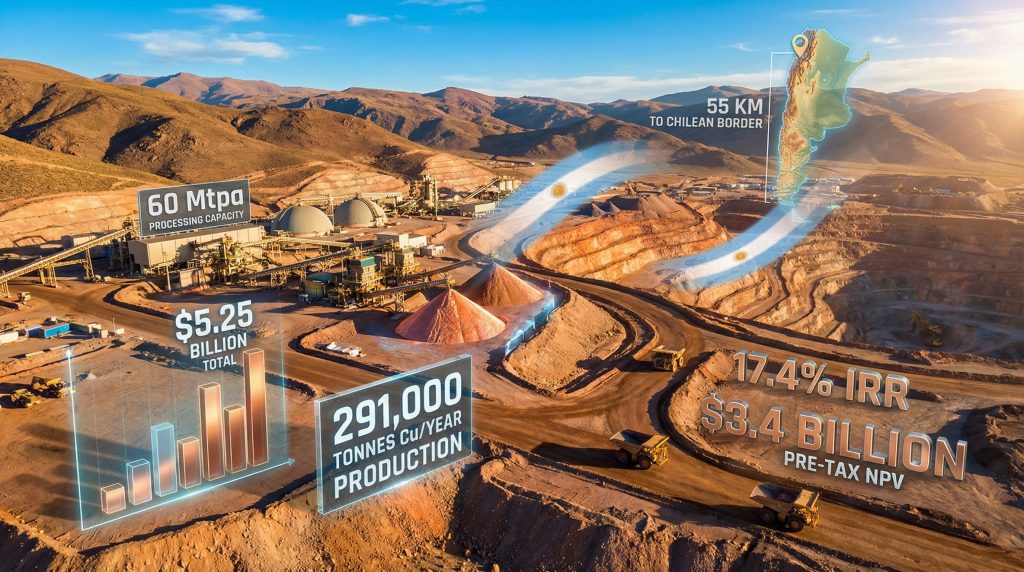
The First Quantum Taca Taca Argentina project requires $5.25 billion total investment across development phases, positioning it among the world's ten largest undeveloped copper projects. Initial development demands $4.2 billion for 40 million tonnes per annum processing capacity, with expansion to 60 million tonnes per annum completing the full investment program.
| Development Phase | Investment Required | Processing Capacity | Production Timeline |
|---|---|---|---|
| Phase 1 Development | $4.2 billion USD | 40 Mtpa | Initial operations |
| Phase 2 Expansion | $1.05 billion additional | 60 Mtpa total | Years 3-5 post-startup |
| Full Production | $5.25 billion total | 60 Mtpa optimised | 35-year mine life |
Global comparative analysis reveals similar investment scales for Resolution Copper ($5.2-5.8 billion), Filo del Sol ($3.8-4.2 billion), and other major undeveloped deposits. These projects compete for institutional capital allocation alongside renewable energy infrastructure and alternative commodity developments.
Total global mining exploration and development spending reached $41.2 billion in 2023, with copper projects commanding 28% of this allocation. Consequently, copper investment insights represent significant capital commitment within this competitive landscape.
Production Economics and Revenue Diversification
Annual copper production targets of 291,000 tonnes during the first ten years post-expansion represent approximately 1.6% of global refined copper production. This contribution level provides meaningful market presence without creating supply dominance concerns for consuming nations seeking diversified sourcing strategies.
Financial Performance Metrics:
- Pre-tax NPV: $3.4 billion at 8% discount rate
- Internal Rate of Return: 17.4%
- Payback Period: Approximately 4 years post-tax
- Operational Timeline: 32-35 year mine life
Revenue diversification through gold and molybdenum co-production provides natural hedging against copper price volatility. Typical porphyry copper deposits generate 0.3-0.5 grams of gold per tonne and 200-800 parts per million molybdenum, creating additional revenue streams that improve project economics during base metal price cycles.
At current copper prices of approximately $5.74 per pound, annual copper revenue would approximate $3.67 billion before processing and transportation costs. This revenue base supports debt service capabilities across the project's extended operational timeline.
Infrastructure Development and Regional Economic Integration
The First Quantum Taca Taca Argentina project requires comprehensive infrastructure development including power generation, transportation networks, and processing facilities. Power supply strategy combines grid connectivity through a 122.5-kilometre transmission line with potential renewable energy integration addressing both operational reliability and environmental performance requirements.
Strategic positioning 55 kilometres from the Chilean border enables efficient concentrate export through established Pacific shipping routes. The planned 5-kilometre rail spur connection to the Salta-Mejillones line leverages existing infrastructure whilst minimising additional capital requirements for transportation logistics.
Employment Generation and Skills Development
| Project Phase | Employment Level | Duration | Economic Impact |
|---|---|---|---|
| Construction Period | 4,000 positions | Multi-year timeline | Peak regional employment |
| Operations | 2,000 positions | 35-year mine life | Sustained economic foundation |
| Indirect Benefits | Multiplier effects | Ongoing | Supply chain development |
Workforce requirements create opportunities for technical training programmes and local supplier development, establishing long-term economic benefits extending beyond direct employment. These multiplier effects typically generate 2-3 additional jobs in supporting industries for every direct mining position created.
Moreover, gold and copper exploration workforce development strategies include partnerships with local educational institutions and skills training centres to ensure sustainable employment opportunities throughout the operational timeline.
Regulatory Framework and Investment Incentive Structure
Argentina's Regime of Incentives for Large Investments (RIGI) provides critical policy support for major mining developments through tax stability guarantees and import duty exemptions. The First Quantum Taca Taca Argentina project qualification for this framework demonstrates governmental commitment to supporting international mining investment.
RIGI Framework Benefits
- Ten-year tax stability guarantees for qualifying projects
- Import duty exemptions on equipment and materials
- Income tax reductions for mining activities
- Currency stability provisions for foreign investors
Environmental assessment and community consultation processes, including completed Free, Prior, and Informed Consent procedures, establish replicable frameworks for future developments. This regulatory pathway creates precedents that reduce permitting uncertainty for subsequent projects.
In addition, comprehensive environmental assessments demonstrate effective collaboration between international developers and Argentine regulatory authorities. This partnership approach supports broader mining sector development objectives whilst maintaining environmental and social performance standards.
Global Copper Supply Chain Implications
Copper demand driven by electrification and renewable energy infrastructure creates structural supply deficits requiring new production capacity. The First Quantum Taca Taca Argentina project addresses these market needs through significant annual production contributions during critical transition periods.
Geographic diversification away from traditional copper sources enhances supply chain resilience for consuming nations. Furthermore, Argentina's stable regulatory environment and established mining sector provide additional security for long-term supply agreements compared to politically unstable regions.
Strategic Resource Security
Global copper concentrate trade flows increasingly favour diversified sourcing strategies that reduce dependency on single-country supply. For instance, unlocking copper investments contributes to this diversification whilst supporting South American regional development objectives.
Mine life projections of 32-35 years provide sustained production capacity supporting long-term infrastructure planning by consuming nations. This operational timeline enables strategic partnership development between Argentina and key copper-consuming economies.
The next major ASX story will hit our subscribers first
Sustainability Standards and Environmental Performance
Modern mining developments require comprehensive Environmental, Social, and Governance frameworks to access international capital markets. However, detailed project specifications demonstrate alignment with IFC Performance Standards addressing biodiversity protection, community engagement, and environmental management throughout the operational lifecycle.
Sustainability standards implementation includes continuous monitoring systems, community grievance mechanisms, and adaptive management protocols. These frameworks ensure ongoing compliance with international best practices whilst supporting local community development initiatives.
Long-Term Environmental Stewardship
The project's 35-year operational commitment requires sustainable resource management and ongoing community partnerships. This extended timeline demonstrates responsible mining practices extending beyond immediate extraction activities to include post-closure land rehabilitation and community transition support.
Water management systems, waste containment protocols, and air quality monitoring represent critical components of environmental performance frameworks. Consequently, implementation of these systems sets precedents for future mining developments in the region.
Industry Transformation and Future Development Patterns
Multilateral institution engagement reflects growing recognition of mining's essential role in global decarbonisation efforts. As renewable energy deployment accelerates, responsible copper production becomes increasingly critical for achieving climate transition objectives.
The project partnership with the International Finance Corporation establishes frameworks for how major mining developments can meet evolving ESG requirements whilst maintaining commercial viability. This template influences industry standards and investor expectations across the sector.
Investment standard evolution requires comprehensive sustainability frameworks to access institutional capital. Projects demonstrating superior ESG performance increasingly command financing premiums whilst those lacking adequate frameworks face capital constraints and higher borrowing costs.
However, copper growth strategy insights reveal that successful projects must balance environmental stewardship with commercial viability to attract long-term institutional investment.
Disclaimer: This analysis contains forward-looking statements regarding project development, production forecasts, and market conditions. Actual results may differ significantly from projections due to operational, regulatory, market, and other factors. Investment decisions should be based on comprehensive due diligence and professional financial advice.
Could Argentina's Copper Surge Unlock Your Next Investment Opportunity?
Discovery Alert's proprietary Discovery IQ model delivers real-time alerts on significant copper discoveries across the Australian market, instantly empowering subscribers to identify actionable opportunities ahead of the broader market. Understand why major mineral discoveries can lead to substantial market returns by exploring Discovery Alert's dedicated discoveries page, showcasing historic examples of exceptional outcomes, then begin your 14-day free trial today to position yourself ahead of the market.