July 9, 2026
The Infrastructure Bottleneck That Determines Who Wins the Copper Decade
Global copper markets are approaching a structural inflection point that most investors underestimate. The challenge is not simply finding more copper in the ground. The world already knows where enormous deposits sit. The real constraint is the processing infrastructure required to convert ore into market-ready cathode at the scale electrification demands. Smelting and refining capacity, not geology, is increasingly the limiting factor in the copper supply equation. Understanding this distinction is essential to appreciating why the BHP Olympic Dam smelter expansion represents one of the most consequential capital allocation decisions in Australian mining this decade.
When big ASX news breaks, our subscribers know first
Why Olympic Dam Is Central to Australia's Copper Supply Chain Strategy
The Strategic Weight of a Single South Australian Operation
Olympic Dam is not simply a large copper mine. It is one of the world's most significant polymetallic ore bodies, hosting copper, uranium, gold, and silver within a single geological system located in South Australia's arid interior. The scale of the resource has been understood for decades, but the operation's full productive potential has long been constrained not by what lies underground, but by the processing infrastructure sitting above it.
The smelter and refinery complex at Olympic Dam functions as the operational chokepoint of the entire system. Integrated mine-to-cathode processing is what separates a world-class copper producer from a concentrate exporter. When a mining company processes ore all the way to finished copper cathode on-site, it captures a substantially larger share of the commodity's final value. The alternative, exporting copper concentrate to overseas smelters, surrenders that value margin to processing countries, typically in Asia. For Australia, this distinction has material implications for economic output, employment, and sovereign capability in critical minerals.
Furthermore, the copper smelting expansion debate extends well beyond a single operation, reflecting a broader geopolitical contest over where refined copper value is created globally.
From 200,000 tpa to 650,000 tpa: The Scale of What's Being Proposed
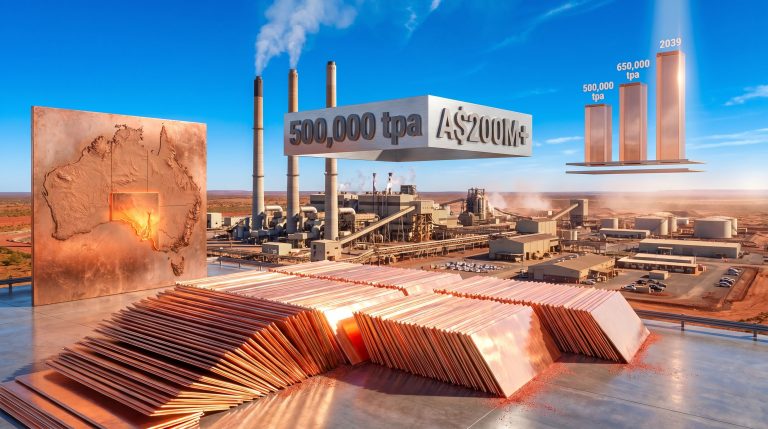
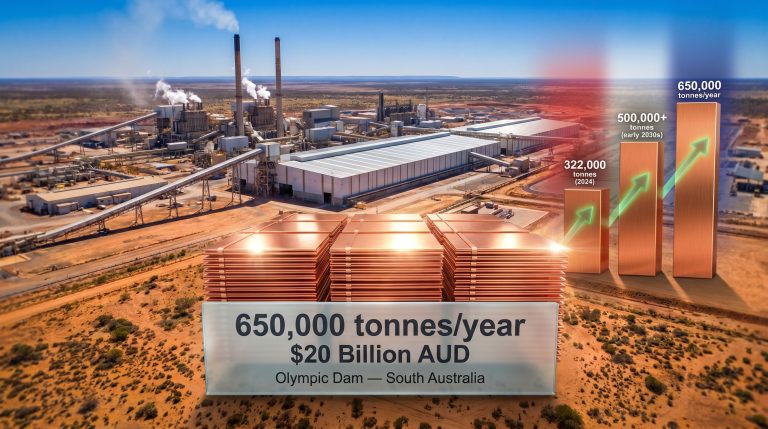
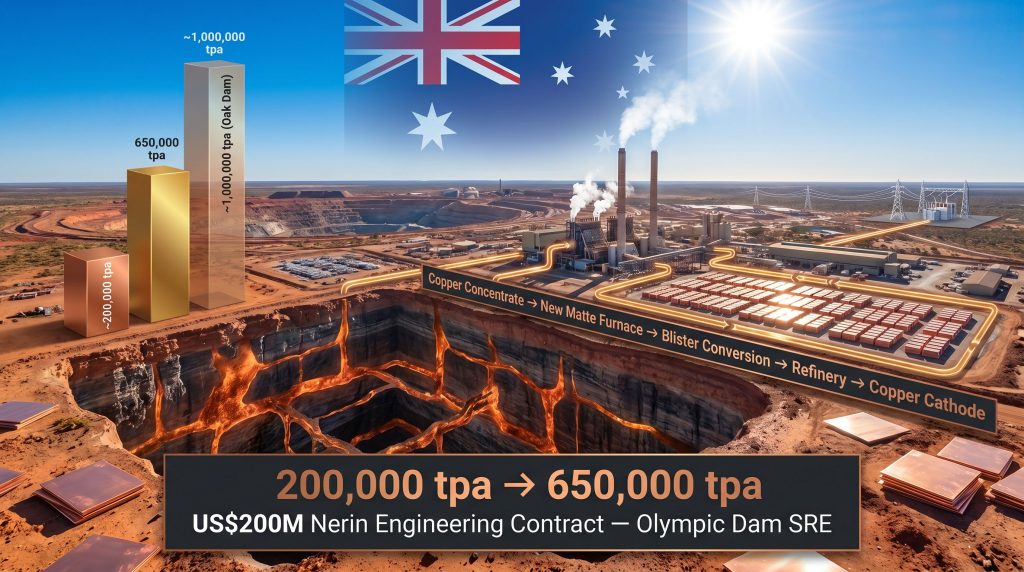
The gap between Olympic Dam's current output and its theoretical ceiling is striking. At present, the operation produces approximately 200,000 tonnes per annum (tpa) of copper cathode. BHP's expansion program targets a tripling of that figure to 650,000 tpa in Phase 1, with a longer-term pathway to approximately 1 million tpa contingent on integrating the nearby Oak Dam discovery.
| Metric | Current State | Post-Expansion Target | Long-Term Potential |
|---|---|---|---|
| Copper cathode output | ~200,000 tpa | 650,000 tpa | ~1,000,000 tpa |
| Timeline to Phase 1 | Active | Early 2030s | Late 2030s |
| Capital committed to date | Ongoing | A$840M+ (growth projects) | FID expected H1 FY2027 |
The ceiling figure of 1 million mt/y is explicitly conditional on Oak Dam resource delineation and development approval, meaning the long-term scenario represents a staged optionality model rather than a committed capital program. Phase 1 builds the processing foundation; Oak Dam integration, if it proceeds, unlocks the upper production tier.
What Does the $200 Million Nerin Engineering Contract Actually Cover?
Engineering, Procurement, and Construction: Breaking Down the EPC Scope
Contract nomenclature in large mining projects carries significant meaning for investors. An EPC (Engineering, Procurement, and Construction) contract assigns fixed-scope delivery responsibility to the contractor, covering design, sourcing of materials, and physical construction within defined parameters. This differs from an EPCM (Engineering, Procurement, and Construction Management) contract, where the contractor manages the process but the owner retains direct procurement authority and bears more of the financial risk on cost overruns.
In January 2025, BHP awarded an EPCM contract to a Fluor Australia and Hatch Pty Ltd joint venture for project strategy and study phases. The July 2026 award of a US$200 million design and supply EPC contract to Nerin Engineering represents a downstream execution mandate, moving the project from study-phase planning into the physical delivery of smelter infrastructure. These are complementary but sequentially distinct roles.
Key Insight: The selection of Nerin Engineering reflects BHP's prioritisation of deep pyrometallurgical expertise over geopolitical optics. Very few engineering firms globally possess the specialised knowledge required to design high-throughput copper smelting systems at this scale, and the pool of qualified candidates is significantly narrower than it might appear from the outside.
The Two-Stage Smelter Architecture: How It Works
The proposed smelter configuration employs a two-furnace architecture designed to decouple production stages and reduce systemic vulnerability:
- Stage 1: A newly constructed smelting furnace receives copper concentrate and produces copper matte, an intermediate product with significantly higher copper content than raw concentrate, typically in the range of 65-75% copper by mass.
- Stage 2: The existing Direct-to-Blister Flash Furnace is repurposed to receive the matte output and convert it into blister copper, a product of approximately 98-99% purity that feeds directly into the downstream refinery.
The current single-furnace configuration means any unplanned shutdown interrupts the entire production chain. The two-stage design distributes operational risk across separate processing units, improving both throughput flexibility and production resilience. In addition, the copper leaching process represents a complementary hydrometallurgical pathway that may further inform how BHP optimises broader feed processing decisions at Olympic Dam.
Process Flow Overview:
Copper Concentrate → New Matte Furnace (Stage 1) → Blister Conversion via Existing Flash Furnace (Stage 2) → Electrolytic Refinery → Copper Cathode (export-ready, 99.99% Cu)
It is worth noting that the repurposing of the existing flash furnace is a technically sophisticated undertaking. Direct-to-blister flash smelting was developed to bypass the matte stage entirely, so reconfiguring the furnace to accept matte feed requires meaningful process and refractory engineering adjustments.
What Infrastructure Must Be Built Alongside the Smelter?
The Five Supporting Infrastructure Pillars of the SRE Program
The smelter itself is only one element of a broader infrastructure program. Five interconnected systems must be developed in parallel:
- Water Supply Infrastructure – New storage and supply systems connecting to the proposed Northern Water Project, addressing Olympic Dam's location in one of Australia's most water-stressed regions. Expanded processing volumes require significantly greater water throughput than the current operation consumes.
- 275kV Transmission Line Upgrades – Electrical infrastructure upgrades from Davenport to Olympic Dam to meet the substantially higher power draw of expanded smelting operations. Smelting is among the most energy-intensive industrial processes in the mining sector, and the existing transmission capacity was not engineered for a tripled production rate.
- Copper Concentrate Import and Blending Facilities – New handling infrastructure to receive and blend concentrate from BHP's broader Copper SA portfolio, including Prominent Hill and Carrapateena. The expanded smelter is designed to process feed from multiple operations, not only Olympic Dam ore.
- Additional Refinery Capacity – Downstream refining upgrades to match the increased blister copper output from the expanded smelter. A production bottleneck in the refinery would negate gains achieved in smelting capacity.
- Utility and Ancillary Upgrades – Supporting systems covering gas supply, compressed air networks, and waste management infrastructure all scaled to the expanded operational footprint.
Why the Northern Water Project Is a Critical Path Dependency
The water supply challenge at Olympic Dam is frequently underestimated in mainstream coverage. Hydrometallurgical and pyrometallurgical processing both require substantial water volumes, and Olympic Dam's location in the Gawler Craton region of South Australia places it far from reliable freshwater sources.
The proposed Northern Water Project involves large-scale desalination and a significant pipeline solution to deliver water to the operation at scale. Crucially, this infrastructure is not simply complementary to the smelter expansion — it is a prerequisite. Without a confirmed water supply solution capable of meeting expanded processing demand, the smelter's production targets cannot be sustained.
This creates a co-dependency risk that investors should monitor closely. Delays in water infrastructure approvals or construction timelines could push back smelter commissioning independently of progress on the smelter itself. Two critical path items, each capable of becoming the binding constraint.
What Is the Investment and Regulatory Timeline for the Olympic Dam SRE?
Capital Commitment and Decision Gates
| Milestone | Status / Date |
|---|---|
| Impact-assessed development declaration | 29 August 2024 |
| EPCM contract awarded (Fluor/Hatch JV) | January 2025 |
| EPC design and supply contract (Nerin Engineering) | July 2026 |
| Final Investment Decision (Phase 1) | Expected H1 FY2027 |
| Phase 1 production ramp-up target | Early 2030s |
| Long-term capacity ceiling (with Oak Dam) | ~1,000,000 tpa by late 2030s |
BHP has committed over A$840 million across a suite of growth-enabling projects at Olympic Dam, encompassing the smelter expansion alongside a new Southern Mine Area decline and a paste backfill system. The paste backfill system is particularly noteworthy from a technical standpoint. It allows waste material from processing to be returned underground as structural fill, reducing surface tailings volumes and enabling more aggressive mining geometries in the block cave.
Regulatory Pathway: Who Approves This Project?
The South Australian government's assessment framework places final decision-making authority with the Minister for Energy and Mining under the impact-assessed development framework that applies to the Olympic Dam expansion. This regulatory mechanism requires:
- Comprehensive environmental impact studies covering air quality, groundwater, and biodiversity
- Community consultation processes open to public submissions
- Heritage assessments covering both Indigenous and historic heritage values
- Infrastructure impact modelling across transport, utilities, and regional services
Regulatory approval proceeds as a parallel workstream to engineering development. BHP cannot reach a Final Investment Decision without both regulatory clearance and a bankable feasibility study confirming project economics.
Regulatory Risk Callout: Impact-assessed developments in South Australia carry multi-year approval timelines. Any material objections lodged during public consultation phases could extend the pre-FID period beyond BHP's H1 FY2027 target, potentially shifting Phase 1 commissioning timelines from the early 2030s toward the mid-2030s.
How Does the Smelter Expansion Fit Into BHP's Broader Copper SA Growth Strategy?
Three Mines, One Processing Hub: The Copper SA Integration Logic
The architecture of BHP's South Australian copper strategy is built around a centralised processing model. The Copper SA operational cluster comprises:
- Olympic Dam – Underground block cave operation, hosting the primary smelter and refinery
- Prominent Hill – Underground operation approximately 130 kilometres to the north of Olympic Dam
- Carrapateena – Underground block cave operation located between the two, currently in production ramp-up
The expanded smelter is not engineered solely for Olympic Dam ore. Its concentrate blending facilities are specifically designed to receive feed from all three operations. This centralised hub model is a standard approach in large mining provinces, but it requires that the hub infrastructure be sized well beyond what any single mine could justify independently. The economics improve as more feed sources are incorporated, creating a structural incentive to add production from new satellite deposits over time.
The Oak Dam Wildcard: What a Potential 1 Million tpa Future Looks Like
Oak Dam represents an advanced exploration target located in close proximity to Olympic Dam within the same geological province. The iron-oxide copper-gold (IOCG) mineralisation style at Oak Dam shares genetic characteristics with Olympic Dam, though the resource has not yet been delineated to a level that supports development planning.
BHP's stated pathway to 1 million mt/y by the late 2030s is explicitly conditional on Oak Dam progressing through resource definition drilling, scoping studies, and ultimately a separate development decision. This is not a committed pathway. It is a staged optionality model where Phase 1 infrastructure creates the processing platform that Oak Dam feed could eventually leverage.
From an investor perspective, Oak Dam functions as a long-dated call option on an already-constructed processing hub. If Oak Dam's resource economics prove attractive, the marginal cost of processing its ore through an already-expanded Olympic Dam smelter would be substantially lower than building standalone processing infrastructure, potentially making otherwise marginal grades economic.
Jobs, Local Supply Chains, and the South Australian Economic Multiplier
BHP's ambition to double Copper SA production carries significant economic implications for South Australia. Large-scale EPC contracts of this magnitude typically embed local procurement commitments and workforce development requirements. The shift from concentrate exporter to cathode producer also has export revenue implications, with refined cathode commanding premium pricing in Asian and European markets compared to copper concentrate sold on treatment charge and refining charge (TC/RC) terms.
Processing copper domestically to cathode standard captures the value-added margin that would otherwise flow to overseas smelters, a meaningful distinction given that TC/RC terms for copper concentrate can represent a substantial deduction from the underlying metal price. Consequently, those exploring copper investment strategies should consider how domestic refining capability reshapes value distribution across the supply chain.
The next major ASX story will hit our subscribers first
Is the Nerin Engineering Contract a Geopolitical Risk or a Pragmatic Choice?
Chinese State-Owned Engineering Firms in Australian Critical Minerals: The Broader Context
Nerin Engineering operates within China's state-owned enterprise ecosystem and holds deep institutional expertise in pyrometallurgical smelter design, accumulated through decades of involvement in China's domestic copper smelting buildout, which now accounts for the majority of global copper smelting capacity. Very few engineering organisations globally can claim comparable design depth in flash smelting and converter systems at the scale Olympic Dam requires.
Australian policy frameworks apply heightened scrutiny to foreign ownership of mineral assets, particularly from Chinese state-linked entities, through the Foreign Investment Review Board (FIRB) process. However, engineering services contracts sit in a distinctly different regulatory category from ownership stakes. There is no blanket prohibition on Chinese engineering firms performing design and construction work on Australian mining projects, and BHP's procurement decision reflects a commercial assessment of technical capability rather than an ownership transfer.
What Precedent Exists for Chinese Engineering Involvement in Australian Mining Projects?
Chinese engineering and construction firms have participated in Australian mining infrastructure projects across iron ore, coal, and base metals for over two decades. The risk considerations that matter most for BHP centre on three distinct areas:
- Technology transfer and IP protection – Ensuring proprietary process knowledge developed for Olympic Dam does not become embedded in competitor designs
- Sovereign risk perception – Managing how institutional investors and government stakeholders interpret the contractor selection decision
- Supply chain continuity risk – Geopolitical escalation scenarios that could complicate an ongoing construction relationship
None of these risks are insurmountable, and BHP's legal and commercial teams will have structured the contract with these considerations in mind. The more fundamental observation is that the alternative, selecting a less technically capable contractor to avoid geopolitical optics, carries its own project execution risk in an expansion of this complexity.
What Does the Olympic Dam Expansion Signal for Global Copper Supply?
Copper Demand Fundamentals: Why Timing Matters
The structural case for copper demand growth is well documented. Electrification of transport, expansion of renewable energy generation, buildout of grid transmission infrastructure, and growth in data centre construction all require copper at volumes that dwarf historical demand patterns. Industry analysts broadly project a structural copper supply deficit emerging in the late 2020s and deepening through the early 2030s, precisely the window in which the BHP Olympic Dam smelter expansion Phase 1 capacity is designed to begin ramping.
This timing alignment is not coincidental. BHP's capital commitment sequence, with FID targeted for H1 FY2027 and first production from expanded capacity in the early 2030s, reflects a deliberate positioning to bring new supply online at the peak of the projected demand-supply gap. However, the growing copper supply crunch means that even a fully operational Olympic Dam expansion may not be sufficient to close the structural deficit on its own.
Australia's Competitive Position in the Global Copper Refining Landscape
Australia currently exports a significant proportion of its copper production as concentrate rather than refined cathode, directing downstream value creation offshore. The Olympic Dam expansion, if fully realised, would represent a material reorientation of Australia's position in the global copper value chain.
Competing copper provinces in Chile, Peru, and the Democratic Republic of Congo each face distinct challenges: Chile and Peru confront water scarcity, community opposition, and declining ore grades in many mature operations; the DRC carries elevated sovereign and infrastructure risk. Australia's combination of geological scale, political stability, established infrastructure, and proximity to Asian end-user markets positions an expanded Olympic Dam favourably within the global competitive landscape for responsibly sourced, refined copper.
The difference between shipping copper concentrate and shipping copper cathode is not merely financial. Premium cathode attracts a different class of buyer, including manufacturers requiring certified quality specifications that concentrate cannot meet, embedding Olympic Dam's output deeper into the end-user supply chain and providing greater price realisation certainty over time. For comparison, the Rio Tinto copper expansion illustrates how a peer major is pursuing a similar value-chain integration strategy across its own assets.
Frequently Asked Questions: BHP Olympic Dam Smelter Expansion
What is the BHP Olympic Dam smelter expansion?
The BHP Olympic Dam smelter expansion is a proposed capital program to increase copper cathode production capacity from approximately 200,000 tonnes per annum to 650,000 tpa, with a long-term pathway to 1 million tpa contingent on the development of the Oak Dam discovery.
How much is BHP investing in the Olympic Dam expansion?
BHP has committed over A$840 million across a suite of growth-enabling projects at Olympic Dam, including the smelter expansion, a new Southern Mine Area decline, and a paste backfill system. The Nerin Engineering design and supply contract is valued at US$200 million.
Who won the Olympic Dam smelter EPC contract?
China's Nerin Engineering was awarded a US$200 million design and supply contract for the Olympic Dam smelter expansion in July 2026.
When will BHP make a Final Investment Decision on Olympic Dam?
BHP has indicated a Final Investment Decision for Phase 1 of the smelter expansion is expected in the first half of FY2027.
What is the two-stage smelter design at Olympic Dam?
The proposed configuration involves constructing a new furnace to produce copper matte from concentrate, then repurposing the existing Direct-to-Blister Flash Furnace to convert that matte into blister copper, a two-stage architecture designed to increase throughput flexibility and production resilience.
How does the Olympic Dam expansion connect to BHP's Copper SA strategy?
The expanded smelter is engineered to process blended concentrate from all three BHP Copper SA operations — Olympic Dam, Prominent Hill, and Carrapateena — functioning as a centralised refining hub for the entire South Australian copper province.
This article contains forward-looking statements regarding production targets, investment timelines, and market projections. These statements involve inherent uncertainty and should not be relied upon as guarantees of future outcomes. Readers should conduct their own due diligence before making investment decisions based on information contained herein.
Want to Know Which ASX Copper Explorers Could Benefit From the Copper Decade?
Discovery Alert's proprietary Discovery IQ model scans ASX announcements in real time, instantly identifying significant mineral discoveries — including copper — so subscribers can act on actionable opportunities well ahead of the broader market. Explore historic discovery returns to understand the potential scale of early-mover positioning, and begin your 14-day free trial at Discovery Alert to secure your market-leading edge.