July 9, 2026
The Copper Supply Crunch That's Rewriting Mining Investment Logic
The global mining industry is entering a period where the gap between copper supply and demand is no longer a forecast on a spreadsheet — it is becoming a structural reality that major producers are scrambling to address. Decades of underinvestment in new mine development, combined with accelerating electrification across virtually every sector of the global economy, have created conditions where existing supply pipelines simply cannot keep pace with projected consumption. The growing copper supply crunch means large-scale, integrated copper processing infrastructure is becoming one of the most strategically valuable assets in the resources sector.
It is within this context that the BHP South Australia smelter and refinery expansion is emerging as one of the most consequential capital projects in contemporary mining. The project represents not just a capacity upgrade, but a fundamental re-engineering of how one of the world's most significant copper provinces processes, refines, and delivers copper to global markets.
When big ASX news breaks, our subscribers know first
Olympic Dam as the Nucleus of a Copper Province Strategy
From Single Asset to Integrated Multi-Mine System
Olympic Dam is not simply a copper mine. It is one of the most mineralogically complex and resource-rich deposits on the planet, hosting copper alongside uranium, gold, and silver within a massive iron oxide copper-gold system. Furthermore, IOCG deposits of this scale are exceptionally rare globally. The orebody sits beneath the South Australian outback and has been in continuous operation since 1988, making it one of the longest-running large-scale copper operations globally.
What distinguishes Olympic Dam from many of its global peers is the presence of an integrated on-site smelter and refinery. Most copper mines around the world produce concentrate, which must then be shipped to third-party smelters, often overseas, before it becomes refined copper cathode. Olympic Dam processes its own concentrate to cathode entirely on site, which gives BHP direct control over the full value chain from ore extraction to finished metal.
This integrated model is the foundation upon which the BHP South Australia smelter and refinery expansion is being constructed. The expansion is not a greenfield build requiring entirely new infrastructure from scratch. Instead, it is a phased transformation of existing facilities, which meaningfully de-risks the capital program and shortens the engineering pathway to increased output.
The Copper SA Province: Three Mines, One Processing Backbone
BHP's Copper South Australia strategy treats Olympic Dam not as an isolated operation but as the processing spine of a three-mine feed system. In addition, BHP's broader copper expansion plans across the sector reflect how major miners are responding to the structural supply gap:
- Olympic Dam serves as the primary ore source and the location of the smelter and refinery complex.
- Prominent Hill, located approximately 130 kilometres to the northwest, is a high-grade underground copper-gold operation currently undergoing significant deepening through the construction of a 1.3-kilometre-deep haul shaft, designed to access ore at greater depth and extend mine life well into the future.
- Carrapateena, situated between the two, is an underground block cave operation with substantial copper-gold resources and the capacity to feed additional concentrate to the Olympic Dam processing complex.
The strategic logic is straightforward: by expanding the smelter and refinery capacity at Olympic Dam, BHP can absorb concentrate from all three operations, eliminating the need to pay third-party smelting tolls and capturing the full margin from ore to cathode across its South Australian portfolio.
What the Expansion Actually Involves: Engineering at Scale
Two-Stage Smelter Transformation
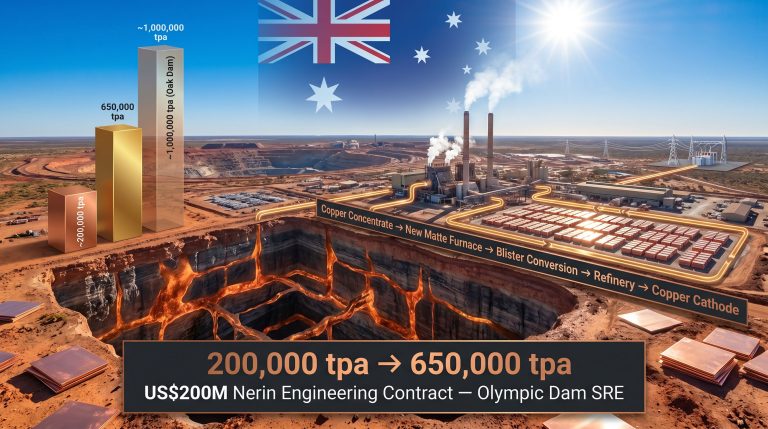
The existing Olympic Dam smelter uses a single-stage flash furnace process, which was state-of-the-art at the time of its original commissioning but has technological limitations when pushed toward the production volumes BHP is now targeting. The expansion involves a two-stage upgrade:
- Stage One involves enhancing and optimising the existing flash furnace system to improve throughput and energy efficiency within the current configuration.
- Stage Two introduces a secondary converter circuit, which significantly improves copper recovery rates by processing the intermediate products of the primary smelting stage with greater precision and yield.
Together, these two stages allow the smelter to process substantially more concentrate while also extracting a higher percentage of the copper content from each tonne processed. This dual benefit of volume and recovery is critical to reaching the production targets BHP has outlined. BHP's January 2025 contract award to the Fluor-Hatch joint venture marked a significant step forward in advancing this engineering program.
Refinery Extension: Scaling Electrorefining Capacity
Expanding smelter throughput without equivalent refinery capacity would simply create a bottleneck further down the processing chain. The refinery extension component of the project involves scaling the electrorefining infrastructure to match the increased smelter output. Electrorefining is the process by which blister copper, the intermediate product of smelting, is dissolved in an electrolytic solution and re-deposited as high-purity copper cathode. The purity levels achievable through modern electrorefining typically exceed 99.99% copper, which is the benchmark grade required for electrical applications including motors, wiring, and grid infrastructure.
Key Project Metrics: Numbers Behind the Ambition
The scale of what BHP is proposing becomes clearest when examined through the lens of hard data:
| Metric | Current State | Post-Expansion Target |
|---|---|---|
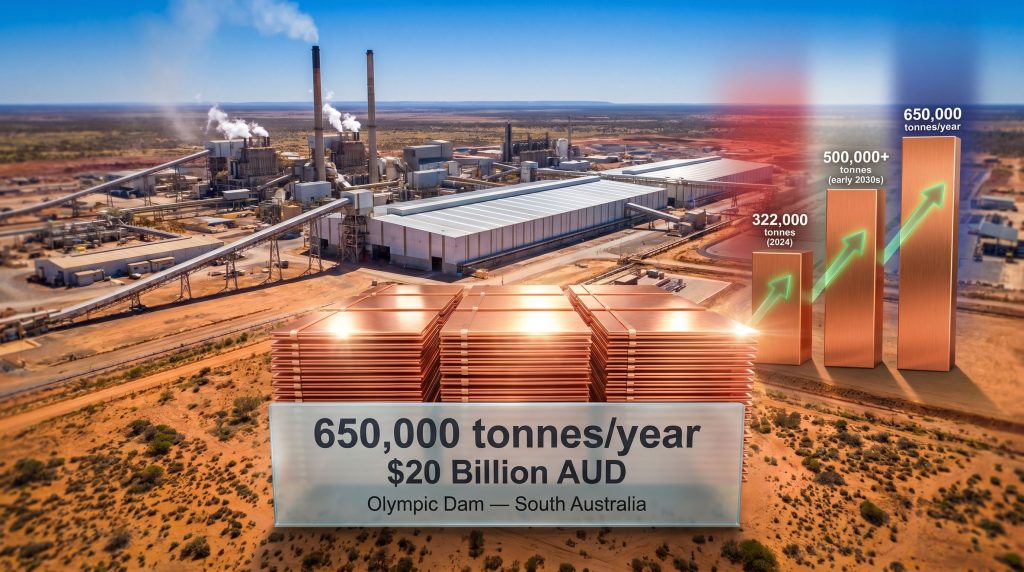
| Annual Copper Production | ~322,000 tonnes (2024) | 500,000+ tonnes (early 2030s) |
| Long-Term Production Ceiling | Existing capacity | Up to 650,000 tonnes per year |
| Active Project Investment | AUD $2 billion+ (in execution) | AUD $20 billion+ (full expansion) |
| Final Investment Decision | Study phase underway | Expected first half of FY2027 |
| EPCM Contract (Fluor-Hatch JV) | Awarded January 2025 | AUD $40 million+ |
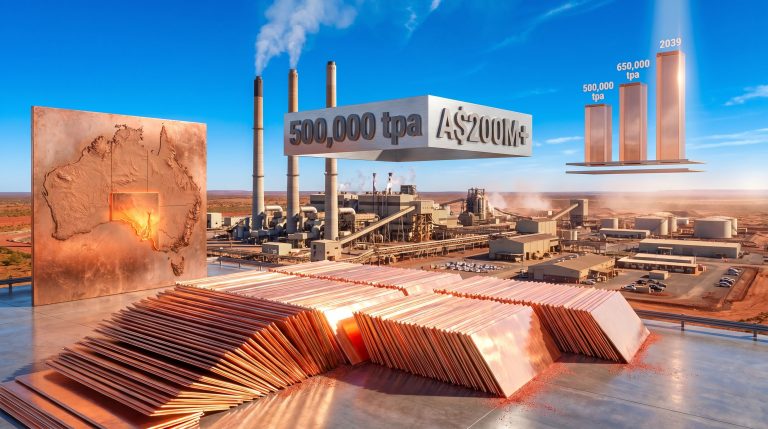
| Design and Supply Contract (Nerin) | Awarded July 2026 | AUD $200 million+ |
A production volume of 650,000 tonnes per year would position Olympic Dam among the top two or three copper-producing operations globally. For reference, the world's largest copper mines, including Escondida in Chile, produce in the range of 1 million tonnes annually, but very few other single-province integrated operations approach even half that figure.
China Nerin Engineering: Why This Contractor Selection Matters
A Track Record Built Across Seven Major Copper Smelters
The July 2026 award of a AUD $200 million+ design and supply contract to China Nerin Engineering Co. Ltd is among the most technically significant procurement decisions BHP has made in the study phase of this expansion. Nerin is not a generalist engineering firm. It is one of China's premier metallurgical engineering design institutes, with a portfolio that includes the design and construction of seven large-scale modern copper smelters across multiple countries. This depth of copper-specific smelting expertise is rare globally and directly relevant to what BHP needs at Olympic Dam.
The decision to engage a Chinese engineering firm for a project of this strategic importance reflects a pragmatic recognition that the deepest and most current expertise in large-scale copper smelter construction currently resides within Chinese engineering institutions, given China's dominance in building global copper processing infrastructure over the past two decades.
How the Contract Structure Manages Risk
The design and supply agreement is structured in discrete phases, with the supply component contingent on BHP making a formal final investment decision. This staged approach allows engineering momentum to continue without committing the full capital envelope prematurely.
This structure is deliberate and sophisticated. By separating design work from equipment supply, BHP retains the ability to absorb the design expenditure as a study cost while deferring the much larger supply commitment until the project economics are fully validated. It also means that engineering learnings from the design phase can inform and potentially improve the capital cost estimates used in the definitive feasibility study.
The Fluor-Hatch joint venture, awarded the EPCM contract in January 2025, operates alongside Nerin in a complementary role, managing the broader engineering, procurement, and construction management program. The use of two major international engineering relationships within a single project reflects the complexity and scale of what is being attempted.
The $2 Billion Already in the Ground: De-Risking the Larger Bet
One aspect of BHP's South Australian strategy that is often underappreciated is the scale of investment already underway before any final investment decision on the smelter expansion is made:
- The 1.3-kilometre deep haul shaft at Prominent Hill is one of the deepest mine shafts currently under construction in Australia, representing a major engineering commitment to extending the operational life and output of that asset.
- The Southern Mine Area underground access tunnel at Olympic Dam opens up new ore zones within the existing mine boundary, providing feed flexibility for the expanded processing facilities.
- Carrapateena's block cave development continues to mature, building toward its role as a third feed source for the Olympic Dam smelter.
This AUD $2 billion-plus of active capital expenditure serves multiple purposes. It extends mine lives, builds infrastructure that will be necessary regardless of the smelter expansion decision, and demonstrates to stakeholders that BHP's commitment to South Australian copper is not contingent on a single investment decision. The South Australian government has also signalled its support, with the state's major investment commitment reinforcing the strategic alignment between BHP and regional authorities.
The next major ASX story will hit our subscribers first
The 2027 Final Investment Decision: What It Means and What Must Happen First
Why FY2027 Is the Defining Moment
The final investment decision, expected in the first half of FY2027, is the pivotal moment at which the BHP South Australia smelter and refinery expansion transitions from a study-phase program to a fully funded, committed capital project. A positive decision would unlock the remainder of the AUD $20 billion-plus capital commitment and set a decade-long production growth trajectory in motion.
Before reaching that decision point, BHP must complete several critical milestones:
- Definitive feasibility study completion, incorporating the detailed design work being undertaken by Nerin and the EPCM framework managed by Fluor-Hatch.
- Capital cost confirmation within an acceptable range of accuracy, typically within ten to fifteen percent for a project of this complexity.
- Environmental and regulatory approvals, which for a project of this scale in South Australia involve multiple state and federal assessment processes.
- Commodity price and demand outlook validation, ensuring the long-term copper price assumptions underpinning the project economics remain robust.
Reading the Signal in Contract Awards
Each contract award in the study phase, including the Nerin engagement, functions as a confidence signal. Companies do not commit AUD $200 million to design work on projects they do not intend to build. While technically no capital is locked in until the final investment decision, the pattern of procurement activity at Olympic Dam strongly suggests BHP's internal conviction around the expansion is high.
Copper Demand Fundamentals: The Structural Case for 650,000 Tonnes
Electrification as a Permanent Demand Driver
The demand thesis for copper is unusually durable compared to many other commodities. Unlike thermal coal, which faces structural demand decline, or iron ore, whose growth trajectory is tied to construction cycles, copper sits at the intersection of nearly every major decarbonisation technology. For instance, consider the following demand drivers:
- Electric vehicles use approximately three to four times more copper than internal combustion engine vehicles.
- Grid-scale battery storage systems require substantial copper in wiring, busbars, and connection infrastructure.
- Wind and solar generation both require significantly more copper per megawatt of capacity than fossil fuel generation.
- Data centres and AI infrastructure, an increasingly significant demand source, use copper extensively in power distribution and cooling systems.
Industry analysts project a structural copper supply deficit emerging through the late 2020s and deepening into the 2030s, driven by this demand acceleration colliding with a decade of underinvestment in new mine supply. Consequently, Olympic Dam's expanded output, at up to 650,000 tonnes per year, represents a meaningful contribution toward addressing this shortfall from a single integrated processing hub. This stands in contrast to more geographically complex solutions such as a major copper-gold project in frontier markets, where execution risk is considerably higher.
Risks the Project Must Navigate
However, balanced analysis requires acknowledging the headwinds that could complicate delivery:
- Capital cost escalation remains a live risk in large-scale mining construction, particularly given persistent labour and materials inflation in the Australian resources sector.
- Commodity price cyclicality could alter the investment economics if copper prices move materially below long-run incentive levels during the period between the final investment decision and first production.
- Execution complexity in simultaneously managing smelter upgrades while maintaining continuous production at an operating facility presents technical and operational risk.
- Regulatory timelines for environmental approvals of projects at this scale can be unpredictable, introducing schedule risk that compounds capital cost uncertainty.
What This Means for South Australia's Economic Landscape
The economic footprint of a fully realised BHP South Australia smelter and refinery expansion extends well beyond the mine gate. Construction-phase employment across the Copper SA province is expected to generate tens of thousands of direct and indirect jobs, with the operational workforce at Olympic Dam alone representing a major source of skilled employment in regional South Australia.
Supply chain effects radiate broadly, benefiting engineering firms, logistics operators, specialist equipment suppliers, and professional services across the state. The concentration of copper processing expertise developing around the Olympic Dam hub also positions South Australia as an increasingly significant node in the global critical minerals supply chain, with long-term implications for skills development and industrial capability.
Frequently Asked Questions: BHP South Australia Smelter and Refinery Expansion
What is the BHP South Australia smelter and refinery expansion?
It is a phased, multi-decade transformation of the existing Olympic Dam processing facility designed to increase annual copper production from approximately 322,000 tonnes toward 500,000 tonnes and ultimately up to 650,000 tonnes per year.
Where is Olympic Dam located?
Olympic Dam is situated in the outback of South Australia, approximately 560 kilometres north of Adelaide.
When will BHP make its final investment decision?
BHP has indicated the final investment decision is expected in the first half of FY2027.
How much copper will Olympic Dam produce after the expansion?
The near-term target is 500,000 tonnes per year through the early 2030s, with a longer-term ceiling of up to 650,000 tonnes per year.
Who has BHP contracted for the design and supply work?
China Nerin Engineering Co. Ltd was awarded a AUD $200 million-plus design and supply contract in July 2026. The Fluor-Hatch joint venture holds the broader EPCM contract awarded in January 2025.
What is the total estimated cost of the expansion?
The full expansion program carries a capital estimate exceeding AUD $20 billion, with the final investment decision expected to formally unlock the bulk of that commitment.
How does this project relate to Prominent Hill and Carrapateena?
Both operations are part of the Copper SA province and are expected to contribute concentrate feed to the expanded Olympic Dam smelter and refinery, making the province a genuinely integrated three-mine processing system.
This article contains forward-looking statements and references to project timelines, production targets, and capital expenditure estimates that are subject to change based on study outcomes, regulatory decisions, and commodity market conditions. Nothing in this article constitutes financial advice. Readers should conduct their own research and consult qualified advisers before making investment decisions.
Want to Invest in the Next Major Copper Discovery Before the Market Catches On?
Discovery Alert's proprietary Discovery IQ model delivers real-time alerts on significant ASX mineral discoveries — instantly translating complex copper and critical minerals data into actionable investment insights for both short-term traders and long-term investors. Explore historic examples of major mineral discoveries and their extraordinary returns, then begin your 14-day free trial at Discovery Alert to position yourself ahead of the market as the copper supply crunch intensifies.