July 9, 2026
The Structural Copper Deficit Reshaping How the World's Largest Miners Allocate Capital
The global copper supply chain is approaching a structural inflection point that has been decades in the making. Analysts across the commodities sector broadly agree that existing smelting and refining infrastructure worldwide is insufficient to process the volumes of copper concentrate that energy transition demand will require through the 2030s and beyond. Electric vehicles, utility-scale battery storage, offshore wind arrays, and high-voltage transmission grids all share one common input: copper, and lots of it. The critical minerals demand projected by the International Energy Agency suggests the clean energy transition could require more than double current copper production levels by 2040, yet the pipeline of new smelting capacity remains critically thin relative to that trajectory.
It is within this structural context that the BHP South Australia smelter project contract to Nerin takes on significance well beyond a single contract announcement. This is not simply a procurement decision by a large mining company. It is a capital allocation signal pointing toward where one of the world's most sophisticated mining operators believes the highest-quality copper growth opportunity exists on the planet.
When big ASX news breaks, our subscribers know first
Olympic Dam: The Centralised Hub That Makes or Breaks the Province
To understand why the Nerin contract matters, you first need to understand the architecture of BHP's Copper South Australia province. Unlike most large copper operations, which process ore closer to each individual mine, BHP's South Australian province is built around a centralised model: three underground mines feed a single smelter and refinery complex located at Olympic Dam.
Those three mines are:
- Olympic Dam in South Australia's north, one of the world's largest known deposits of copper, uranium, gold, and silver
- Prominent Hill, approximately 130 kilometres southeast of Olympic Dam
- Carrapateena, located roughly 160 kilometres south of Olympic Dam
All three operations converge at Olympic Dam's processing hub, which means the smelter's capacity ceiling is the province's production ceiling. No matter how much ore the underground mines can extract, throughput is ultimately constrained by what the smelter can handle. This creates a classic bottleneck dynamic: expanding the province's output requires expanding the hub, not just the individual mines.
"The centralised processing model at Olympic Dam creates extraordinary operational leverage. Unlocking the smelter's capacity doesn't just benefit one mine, it multiplies output potential across the entire province simultaneously."
Oak Dam, an exploration site within the province, adds longer-term reserve optionality to this picture, though it remains in earlier-stage assessment compared to the three operating assets.
Unpacking the BHP South Australia Smelter Project Contract to Nerin
The A$200 Million Design and Supply Agreement
BHP has awarded China Nerin Engineering Co. Ltd a design and supply contract valued at more than A$200 million (approximately US$138.8 million) covering critical processing facilities for the proposed smelter and refinery expansion. The centrepiece of the scope is a new two-stage copper smelting system, a configuration that offers meaningful advantages in terms of energy efficiency and throughput recovery compared to older single-stage flash smelting designs.
Critically, the contract is structured in stages. The design and study phases are scheduled to commence across 2026 and 2027, but the supply component, which represents the bulk of the capital commitment, is explicitly contingent on BHP granting Final Investment Decision approval for the project.
This staged architecture is deliberate. It allows BHP to advance the engineering work necessary to make a well-informed FID while limiting its exposure if market conditions or feasibility outcomes shift materially before that decision point. Furthermore, this approach aligns closely with the principles outlined in a definitive feasibility study framework, where staged capital deployment reduces downside risk considerably.
Who Is China Nerin Engineering?
Nerin is headquartered in Jiangxi Province, China, which is itself one of the world's most significant non-ferrous metals processing regions. The firm is regarded as one of China's foremost metallurgical engineering design institutes, with a track record of designing and delivering large-scale copper smelters across multiple international jurisdictions.
What is less widely understood outside the technical community is that two-stage copper smelting technology, which Nerin has helped develop and refine, represents a genuinely significant advance over earlier pyrometallurgical methods. In conventional flash smelting, concentrate is processed in a single high-temperature furnace. Two-stage systems separate the smelting and converting reactions, which improves sulphur capture efficiency, reduces fugitive emissions, and can lower specific energy consumption per tonne of copper produced. For a project of Olympic Dam's scale, these efficiency gains compound significantly over the asset's operating life.
The selection of a Chinese engineering firm for a flagship Australian copper project reflects the reality that Chinese metallurgical engineering firms, shaped by decades of rapid domestic smelter construction, have developed genuine technical capability that Western engineering houses have not fully replicated at comparable cost. This dynamic is part of a broader copper supply crunch reshaping global procurement strategies across the industry.
The Complementary EPCM Contract: Fluor Australia and Hatch
Running parallel to the Nerin agreement is a separate engineering, procurement, and construction management study contract awarded to a joint venture between Fluor Australia and Hatch, valued at approximately A$40 million. Where Nerin's scope covers the design and eventual supply of the smelting system itself, the Fluor-Hatch JV is responsible for broader project delivery oversight, procurement integration, and construction management planning.
This bifurcated structure is analytically important. By separating metallurgical design and equipment supply from project execution management, BHP retains Western-firm oversight of the construction and commissioning process, while accessing Chinese metallurgical engineering expertise for the core technology package. This model addresses, at least partially, supply chain sovereignty concerns that have become increasingly prominent in the critical minerals policy landscape.
| Contract Type | Awarded To | Estimated Value | Primary Scope |
|---|---|---|---|
| Design and Supply | China Nerin Engineering Co. Ltd | A$200m+ (~US$138.8m) | Two-stage copper smelting system design and equipment supply |
| EPCM Study | Fluor Australia / Hatch JV | ~A$40m | Engineering, procurement and construction management |
Production Scenarios: What the Numbers Could Mean
Near-Term Target: 500,000 Tonnes Per Annum
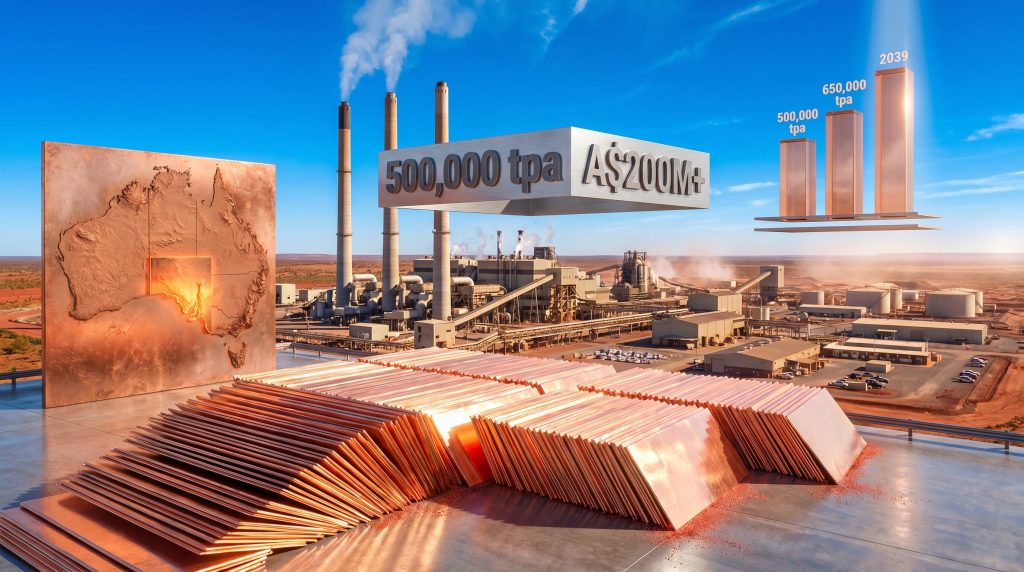
BHP's stated near-term ambition is to lift Copper South Australia output to 500,000 tonnes per annum during the early 2030s. Reaching this threshold requires not just smelter expansion but coordinated underground production increases across Olympic Dam, Prominent Hill, and Carrapateena. The smelter upgrade is the enabling constraint, but it is not the only variable.
Project completion is currently targeted for early 2032, approximately five years post-FID. For that timeline to hold, the FID must proceed on schedule in the first half of FY2027 and construction must commence without significant regulatory or logistical delays.
Long-Term Stretch: 650,000 Tonnes Per Annum by 2039
If the initial expansion proceeds and reserve performance supports it, BHP has identified a pathway to reach 650,000 tpa by the end of the 2030s. Achieving this would require additional underground development, workforce scaling across the province, and potentially further processing infrastructure investment beyond what the current contract scope covers.
To put this in global context, 650,000 tonnes of refined copper per annum from a single integrated province would make Copper South Australia one of the largest refined copper production centres on Earth, comparable in output terms to some of the most significant smelting nations. This trajectory is consistent with broader copper investment strategies that major mining operators are pursuing globally as the energy transition accelerates.
The A$2 Billion Pre-FID Capital Signal
Perhaps the most instructive data point for investors and market observers is BHP's current capital deployment position. The company already has more than A$2 billion in active projects underway across South Australia, including the new deep haul shaft at Prominent Hill and underground development tunnelling at Olympic Dam.
"Pre-FID capital commitments of this scale are unusual in the mining sector. They signal that the operational planning framework is treating the expansion as a near-certainty, even while the formal governance process remains open."
This level of pre-commitment also functions as a credibility mechanism with supply chain partners, regulators, and the engineering firms engaged on the project. It reduces the perceived probability of an FID rejection, which in turn allows contractors to resource their project teams with greater confidence.
The FID: What Has to Go Right
First Half of FY2027: What BHP Must Clear
A Final Investment Decision in large-scale mining infrastructure is not a single event. It is the culmination of multiple parallel workstreams:
- Feasibility study completion: Updated capital cost estimates, operational cost modelling, and schedule confirmation
- Regulatory and environmental approvals: South Australia has established environmental impact assessment processes for major industrial facilities, and Olympic Dam's existing operational footprint provides both a baseline and a set of legacy compliance obligations
- Board-level capital allocation review: BHP's capital allocation framework requires internal rate of return hurdles and balance sheet capacity assessments
- Copper price and market outlook: At the time of FID, the prevailing and forecast copper price environment will heavily influence the economic case
The staged contract structure means that if the FID is deferred or ultimately not granted, BHP's financial exposure is limited largely to the design and study phase expenditure, with the larger supply commitment remaining unactivated.
Environmental and Permitting Considerations at Olympic Dam
Olympic Dam operates under a uniquely complex regulatory environment in South Australia. The site encompasses one of the world's largest uranium deposits alongside its copper, gold, and silver resources, which means environmental oversight involves both standard mining regulation and elements of Australia's nuclear materials licensing framework. This regulatory complexity is a factor that can extend permitting timelines in ways that comparable copper projects in Chile or Peru do not face.
However, BHP's decades-long operational presence at Olympic Dam also means the company has established relationships with regulatory bodies and an existing environmental monitoring and compliance infrastructure that a greenfield project would need to build from scratch.
Portfolio Concentration: The Arizona Divestment Decoded
The decision to sell 100% of the San Manuel property in Arizona to Faraday Copper sits in direct strategic dialogue with the Nerin contract award. BHP is, in effect, exchanging geographic diversification across two copper jurisdictions for deeper concentration in one. The logic is straightforward: capital that would have been required to develop San Manuel can instead be directed toward a province where BHP already controls the full value chain from underground mine to refined copper cathode.
This integrated model, mine to cathode within a single geographic province, is a structural competitive advantage that few copper producers globally can replicate. Furthermore, it reduces exposure to third-party smelting terms and treatment and refining charges, and it allows BHP to capture more of the value added by processing rather than selling concentrate into a global spot market. Rio Tinto's copper expansion guide illustrates how competing majors are pursuing similarly integrated approaches in their own portfolios.
The next major ASX story will hit our subscribers first
The Geopolitical Dimension: Chinese Engineering in an Australian Critical Minerals Context
Reading the Contract Structure as a Strategic Choice
The engagement of China Nerin Engineering in a high-profile Australian copper expansion project will attract scrutiny in a geopolitical environment where critical minerals supply chains have become an explicit national security consideration for multiple Western governments. Australia's own critical minerals policy framework classifies copper as a priority commodity, reflecting its indispensability to both industrial and defence-related manufacturing.
What is analytically notable is that BHP's contract architecture may itself represent a considered response to this tension:
- Nerin handles metallurgical technology design and equipment supply (the area of Chinese comparative advantage)
- Fluor-Hatch manages project execution, procurement governance, and construction oversight (retaining Western firms in the control layer)
- The supply component does not activate without BHP's FID, preserving a final decision gate
This structure does not eliminate geopolitical risk, but it does distribute it differently than a full EPC contract awarded to a Chinese firm would. Whether this model satisfies the expectations of Australia's strategic partners is a question that extends beyond the mining sector's remit.
The Broader Pattern in Global Mining
Chinese metallurgical engineering firms winning contracts in non-Chinese jurisdictions is not a new phenomenon. What has changed is the scrutiny applied to such arrangements in the context of the broader critical minerals competition between Western economies and China. Projects in Africa, Latin America, and increasingly in developed-economy jurisdictions have all navigated versions of this dynamic, with outcomes that vary based on the specific technology involved, the strategic importance of the commodity, and the host country's policy settings at the time.
Key Project Metrics at a Glance
| Metric | Detail |
|---|---|
| Design and Supply Contract Value | A$200m+ (~US$138.8m) |
| EPCM Study Contract Value | ~A$40m |
| Design and Study Phase | 2026 to 2027 |
| Expected FID | First half of FY2027 |
| Projected Completion | Early 2032 (~5 years post-FID) |
| Near-Term Production Target | 500,000 tpa (early 2030s) |
| Long-Term Production Target | 650,000 tpa (by 2039) |
| Total Active South Australia Capital Deployment | A$2 billion+ |
Frequently Asked Questions
What is the BHP South Australia smelter project?
It is a proposed expansion of the Olympic Dam smelter and refinery complex designed to materially increase BHP's copper processing capacity in South Australia, enabling higher output across the entire Copper South Australia province.
What did BHP award to China Nerin Engineering?
A design and supply contract exceeding A$200 million (~US$138.8 million) covering critical processing facilities, centred on a new two-stage copper smelting system.
When is BHP's Final Investment Decision expected?
The FID is anticipated in the first half of FY2027. The supply component of the Nerin contract is explicitly conditional on this decision being granted.
What are BHP's copper production targets for South Australia?
500,000 tonnes per annum in the early 2030s, with a potential pathway to 650,000 tpa by the end of the 2030s if the full expansion proceeds as modelled.
What other contract was awarded alongside the Nerin agreement?
A separate EPCM study contract worth approximately A$40 million was awarded to a joint venture between Fluor Australia and Hatch.
A Generational Asset in Motion
The BHP South Australia smelter project contract to Nerin is best understood not as a procurement event but as a staged commitment to what BHP clearly views as a generational copper asset. The contract structure, the parallel capital deployment already underway, and the divestment of competing copper properties all point in the same direction: South Australia is being positioned as BHP's primary copper growth vehicle for the next two decades.
The road to 2032, and potentially to 650,000 tonnes per annum by 2039, passes through an FID that has not yet been granted, a permitting environment with genuine complexity, and a geopolitical backdrop that will continue to scrutinise the role of Chinese engineering firms in Western critical minerals infrastructure. None of these factors make the outcome certain.
What the pre-FID capital commitments, the contracted engineering workstreams, and the broader portfolio restructuring do suggest is that BHP has moved from evaluating this expansion to operationally preparing for it. For investors and industry observers tracking the copper supply equation, that distinction matters considerably.
This article contains forward-looking statements and scenario analysis that involve inherent uncertainty. Production targets, project timelines, capital figures, and FID outcomes are subject to change. Readers should not treat this content as financial advice. Independent professional guidance should be sought before making investment decisions based on information presented here.
Want to Track the Next Major Copper Discovery Before the Market Does?
Discovery Alert's proprietary Discovery IQ model scans ASX announcements in real time, instantly identifying significant mineral discoveries across copper and more than 30 other commodities — turning complex data into clear, actionable insights for investors at every level. Explore how major discoveries have historically generated substantial returns on Discovery Alert's dedicated discoveries page, and begin your 14-day free trial today to position yourself ahead of the broader market.