July 9, 2026
Copper Mining's Quiet Reckoning: Why Sequential Output Metrics Can Mislead Investors
In capital-intensive mining operations, the temptation to interpret a quarter-on-quarter production decline as evidence of structural deterioration is persistent and, more often than not, misleading. Large-scale underground copper mines operate within intricate sequencing frameworks where development phases, smelter maintenance cycles, and ore sourcing constraints routinely suppress output in the short term. Understanding this distinction separates informed analysis from reactive market sentiment, and it is central to evaluating Kamoa-Kakula second quarter copper output Ivanhoe figures correctly.
Furthermore, broader copper market trends suggest that temporary production dips at major operations are often misread as systemic failures, when in reality they reflect deliberate operational sequencing. The raw numbers tell one story; the operational context tells quite another.
When big ASX news breaks, our subscribers know first
Unpacking the Q2 2026 Production Figures
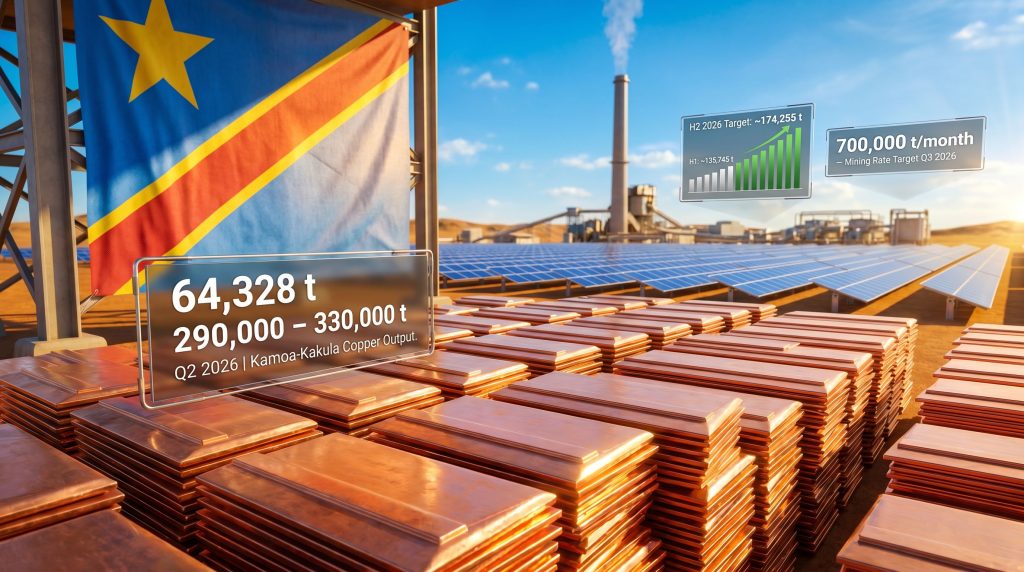
Ivanhoe Mines reported that Kamoa-Kakula produced a combined 64,328 tonnes of copper across all output streams during the second quarter of 2026. This figure encompasses 62,072 tonnes of copper anode from the on-site smelter and 2,256 tonnes of copper blister from the Lualaba Copper Smelter (LCS), with the remainder comprising saleable slag concentrate.
The Phase 1, 2, and 3 concentrators collectively milled 2.97 million tonnes of ore during the quarter, generating 61,134 tonnes of copper in concentrate as the primary feed into the smelting circuit.
Q2 2026 Output by Processing Stream
| Output Stream | Q2 2026 Volume | Key Context |
|---|---|---|
| Copper in concentrate (Phase 1, 2 & 3) | 61,134 t | From 2.97 Mt ore milled |
| Copper anode (on-site smelter) | 62,072 t | Primary smelter output stream |
| Copper blister (Lualaba Copper Smelter) | 2,256 t | Heavily impacted by 56-day LCS shutdown |
| Total copper produced | 64,328 t | Anode + blister + saleable slag concentrate |
| Ore milled (all concentrators) | 2.97 million t | Batch-operated Phase 1 and 2 concentrators |
Quarter-on-Quarter Comparison
| Metric | Q1 2026 | Q2 2026 | Change |
|---|---|---|---|
| Total copper produced | 71,417 t | 64,328 t | ▼ approximately 10% |
| Copper in inventory (end of period) | ~40,000 t | ~40,000 t | Unchanged |
Investor Context: The approximately 10% sequential decline from Q1 to Q2 was not driven by geological underperformance, grade deterioration, or operational failure. Two discrete and temporary factors account for virtually the entire shortfall: a 56-day shutdown of the Lualaba Copper Smelter and the batch-mode operation of the Phase 1 and 2 concentrators caused by reduced ore availability from Kakula during its current development phase.
The Two Factors Behind the Output Decline
The Lualaba Copper Smelter Shutdown Explained
The LCS was offline for 56 days during Q2 2026, directly suppressing copper blister output for the quarter. This type of planned or semi-planned maintenance shutdown is a standard feature of pyrometallurgical operations, where refractory lining replacement, converter maintenance, and off-gas system overhauls periodically require extended downtime windows.
Critically, the LCS resumed normal operations on July 1, 2026, meaning the constraint was fully resolved at the start of the second half. Its impact will not carry over into H2 production figures.
Campaigned Concentrator Operations: A Nuance Worth Understanding
The term campaigned or batch operation describes a mode of concentrator utilisation where processing facilities run intermittently rather than continuously. This is distinct from a throughput reduction caused by equipment failure or processing inefficiency.
During Q2 2026, the Phase 1 and 2 concentrators were batch-operated because ore supply from Kakula was constrained. The reason for that constraint is equally important to understand: Kakula was operating exclusively in development mining mode during the quarter. No stoping had commenced. Ore was being sourced only from development drives, which are inherently lower in volume and, in the current phase, targeted at peripheral, lower-grade areas around the orebody margins.
This sequencing is not a production failure. It is a deliberate underground mine planning strategy in which peripheral development drives are completed first, establishing the access infrastructure and ventilation networks needed before high-grade stoping panels can be safely and productively mined. Stoping at Kakula is expected to begin in the second half of 2027, at which point ore volumes and grades from that source will increase materially.
Inventory Dynamics: A Hidden Production Lever for H2 2026
One of the less-discussed but operationally significant features of Kamoa-Kakula's current position is its substantial copper inventory buffer. At the start of 2026, approximately 50,000 tonnes of copper were held across on-site storage and the LCS. By the end of both Q1 and Q2 2026, this figure had settled at approximately 40,000 tonnes, reflecting some early drawdown.
Management has indicated that a planned destocking of up to 10,000 tonnes from this inventory is now scheduled for H2 2026, with a year-end inventory target of between 25,000 and 30,000 tonnes of contained copper.
Key Insight: Inventory destocking functions as a non-mining production lever. In periods where mined output is ramping up, destocking allows a mine to deliver copper to market in excess of what is being extracted in real time. For H2 2026, this mechanism effectively supplements mined output without requiring additional ore to be processed.
Full-Year 2026 Guidance: The Arithmetic of Closing the Gap
| Guidance Parameter | Figure |
|---|---|
| Full-year 2026 production guidance | 290,000 to 330,000 t copper (anode or blister) |
| H1 2026 actual output (Q1 + Q2 combined) | approximately 135,745 t |
| Required H2 output at guidance midpoint (~310,000 t) | approximately 174,255 t |
| Implied H2 step-up versus H1 | approximately 28% increase required |
A 28% half-on-half increase is a meaningful ask, but it is supported by multiple converging operational catalysts rather than relying on any single variable. Understanding the underlying copper price growth drivers further contextualises why closing this gap matters for the broader market.
Mining Rate Expansion: The Operational Engine Driving H2 Growth
A Targeted 30% Increase in Monthly Mining Rates
Mining rates across the Kamoa mines are planned to increase by 30%, rising from approximately 6.5 million tonnes per annum (Mtpa) to 700,000 tonnes per month, equivalent to roughly 8.5 Mtpa annualised, by the end of Q3 2026. This step-up is being enabled by three concurrent developments:
- Mobilisation of additional underground mining crews
- The commencement of production stoping at Kamoa, transitioning from a development-only mining profile
- New mine access points providing incremental ore supply channels
The additional 2 Mtpa of ore, grading at an average of approximately 2.5% copper, will feed directly into the Phase 1 and 2 concentrators, restoring continuous utilisation and lifting throughput.
New Access Points Expanding the Ore Source Network
Kahala Box Cut
A new access route to the Kamoa mine was established via the Kahala box cut, with the decline advancing through ore since June 2026. This represents an immediately contributing source of incremental ore volumes heading into H2 2026.
Kansoko Sud
A second decline under development at the Kamoa mines, Kansoko Sud represents a longer-dated ore source. The boxcut construction was completed during Q2 2026, with twin declines currently being driven. Approximately 700 metres of additional decline development remains before reaching the orebody, with access expected in Q1 2027.
From a geological perspective, the development of multiple decline access points at different spatial positions within the orebody is significant. It reduces the operational dependency on any single mining front, creates redundancy in ore supply, and enables more flexible mine scheduling as stoping ramps up. For a mine targeting 500,000 tonnes per year of copper from 2028, this infrastructure groundwork is non-negotiable.
Kakula Development Rate: A 21% Acceleration
During Q2 2026, Kakula recorded a 21% increase in its development rate compared to the prior quarter. By year-end, management is targeting an average development rate of approximately 128 metres of advance per development drill rig per month across both Kamoa and Kakula combined. This metric is a leading indicator of future ore availability, making it arguably more important than the current quarter's production figures for long-term investors. In this context, active drilling programs remain one of the most reliable indicators of where future output growth will originate.
Concentrator Feed Strategy for H2 2026
| Feed Parameter | H2 2026 Target |
|---|---|
| Primary feed source | Western Kakula development ore |
| Kakula feed rate | approximately 400,000 t/month (4.8 Mtpa annualised) |
| Kakula feed grade | approximately 2.7% copper |
| Additional Kamoa feed (incremental from rate increase) | approximately 2 Mtpa at 2.5% copper grade |
The combined feed profile improves both volume and blended grade heading into the second half, providing a more favourable input for concentrator recovery and downstream smelter throughput.
The next major ASX story will hit our subscribers first
Smelter Targets and the Sulphuric Acid Revenue Story
On-Site Smelter: Targeting 850 Tonnes Per Day in H2
The on-site copper smelter is targeting production of approximately 850 tonnes per day of copper anode in H2 2026, equating to an annualised rate of roughly 300,000 tonnes, or approximately 60% of design capacity. Full nameplate capacity of 500,000 tonnes per year is expected to be reached in 2028, when concentrate feed availability from the ramping underground mines catches up with smelter throughput capability.
This is a subtle but important distinction for investors: the smelter is not constrained by its own processing capacity. It is constrained by concentrate supply. As Kamoa and Kakula mining rates increase and stoping commences, the smelter ramp-up will follow organically.
Sulphuric Acid: An Underappreciated Revenue Stream
Copper smelting generates sulphur dioxide as a by-product of the pyrometallurgical process. When captured and converted to sulphuric acid, this by-product transforms from an environmental liability into a commercial asset. At Kamoa-Kakula, this conversion is already generating meaningful revenue.
| Sulphuric Acid Metric | Current Position |
|---|---|
| Average production rate | approximately 1,250 t/day |
| Annualised production rate | approximately 450,000 t/year |
| Steady-state design capacity | 700,000 t/year |
| Q2 2026 total production | 112,307 t |
| End-of-quarter inventory | approximately 11,300 t |
| July 2026 realised price | approximately $840/t (record level) |
| Offtake destination | DRC Copperbelt mining operations |
Callout: A realised price of approximately $840 per tonne for high-strength sulphuric acid in July 2026 represents a record for the operation. Sulphuric acid demand on the DRC Copperbelt is structurally supported by the region's large number of oxide copper deposits, which require acid for heap leach and solvent extraction operations. As Kamoa-Kakula's smelter scales toward its 700,000 tonne per year design acid output, this revenue stream will become an increasingly material contributor to site-level economics.
Africa's Largest Mining-Sector Hybrid Solar and BESS Facility
433 MW Peak Solar Capacity with 1,107 MWh of Battery Storage
Commissioning of Kamoa-Kakula's on-site solar photovoltaic facilities is currently underway. Once fully operational during Q3 2026, these facilities will deliver 60 megawatts of continuous baseload power to Kamoa Copper as the sole offtaker. The infrastructure is owned, operated, and funded by CrossBoundary Energy and Green World Energie.
| Infrastructure Specification | Capacity |
|---|---|
| Peak installed solar PV capacity | 433 MW |
| Battery energy storage system (BESS) capacity | 1,107 MWh |
| Continuous baseload power delivered | 60 MW |
| Current phase expansion target | 120 MW by end of 2027 |
The scale of this installation, described as the largest hybrid solar PV and battery energy storage facility installed by a mining company anywhere in Africa, reflects a broader industry shift toward energy cost reduction and emissions intensity management. Renewable energy in mining is increasingly seen as both a cost management tool and an ESG differentiator for institutional investors. Securing 60 MW of renewable baseload power, with plans to double that to 120 MW by end of 2027, provides both cost certainty and a compelling narrative.
Expansion Pipeline: An Additional 30 MW Under Contract, 30 MW in Negotiation
During Q2 2026, a tender was awarded and a power purchase agreement signed with Green World Energie for an additional 30 MW hybrid solar PV and BESS facility, with construction expected to complete in Q3 2027. A further 30 MW facility is in final contract negotiation. Together, these expansions form the pathway to the 120 MW total renewable baseload target.
The 2028 Production Inflection: Building Toward 500,000 Tonnes Per Year
The current operational configuration at Kamoa-Kakula is best understood as a multi-year construction programme nested within an active producing mine. While the site generates substantial copper output today, the development activities underway across both Kamoa and Kakula are explicitly designed to support a production rate of approximately 500,000 tonnes per year from 2028. The Kamoa-Kakula second quarter copper output Ivanhoe figures should therefore be assessed in the context of this long-duration production plan rather than in isolation.
This target is underpinned by the updated mineral reserve estimate released on March 31, 2026, and involves operating the Phase 1, 2, and 3 concentrators at a steady-state throughput of 17 million tonnes per annum over approximately 25 years. The geological quality of the Kamoa-Kakula deposit, with its high copper grades relative to global peers, gives this long-duration mine plan a structural cost advantage that few other copper development projects can match.
Development Priorities Over the Next 18 Months
- Completing peripheral access drives at Kakula before high-grade stoping panels can be unlocked
- Ramping up production stoping at Kamoa through H2 2026 and into 2027
- Progressing Kansoko Sud decline development toward orebody contact in Q1 2027
- Increasing development advance rates at Kakula toward the 128-metre-per-rig-per-month target
- Commissioning Shaft #3 infrastructure at Platreef to support concurrent ore and waste hoisting
Kipushi: Seven Consecutive Records and What They Signal
Ivanhoe's Kipushi zinc mine in the DRC produced a record 70,177 tonnes of zinc in concentrate in Q2 2026, up 8% quarter-on-quarter and equivalent to an annualised production rate of approximately 280,000 tonnes. This marks the seventh consecutive quarter-on-quarter production record for the operation.
| Kipushi Metric | Q2 2026 Performance |
|---|---|
| Zinc in concentrate produced | 70,177 t (record) |
| Quarter-on-quarter change | +8% |
| Ore milled | 200,774 t (record) |
| Feed grade | 38.7% zinc (record) |
| Concentrator recovery rate | 92% (record) |
| Single-month production record | 25,677 t (May 2026) |
| Full-year 2026 guidance | 240,000 to 290,000 t zinc in concentrate |
A feed grade of 38.7% zinc is extraordinary by global standards. Most zinc operations process ore grading between 5% and 12% zinc. Kipushi's deposit, hosted in a carbonate-replacement style mineralisation system, represents one of the highest-grade zinc sources currently in production anywhere in the world. The combination of record throughput, record grade, and record recovery achieving 92% simultaneously in a single quarter is a rare operational outcome.
Platreef: From Commissioning Complexity to Commercial Production
The Path to Q4 2026 Commercial Production
Platreef's Phase 1 concentrator commenced production on November 18, 2025, and has since produced approximately 3,931 ounces of platinum, palladium, rhodium, and gold (4E metals combined). However, the operation has not yet reached commercial production status, meaning current output rates are not representative of steady-state performance.
The Phase 1 concentrator continued to operate in batch mode during Q2 2026, primarily processing lower-grade development ore. Commercial production is now targeted for Q4 2026, contingent on resolving identified bottlenecks in materials handling and the processing plant circuit.
Shaft #3: A Fivefold Increase in Hoisting Capacity
The commissioning of Shaft #3 represents one of the most significant infrastructure milestones at Platreef in the project's history. Construction was completed in late Q1 2026, with first ore hoisted to surface on April 1, 2026 and full shaft commissioning finalised by June 2026.
Following commissioning, total hoisting capacity at Platreef increased by approximately fivefold. Critically, Shaft #3 enables the simultaneous hoisting of stoping ore and development waste, a capability that was not possible with Shaft #1 alone and that is essential for accelerating underground mining rates.
Stoping of higher-grade ore within the Flatreef orebody commenced at the end of Q2 2026, with two stopes completed to date. Mining rates are expected to build progressively throughout H2 2026.
Phase 2 Expansion: Construction Milestones
| Phase 2 Milestone | Status |
|---|---|
| Concentrator capacity | 3.3 Mtpa |
| Earthworks commencement | Start of Q2 2026 |
| First concrete pour (foundations) | Expected July 2026 |
| Flotation plant installation package | Awarded in Q2 2026 |
| Shaft #2 widening (3.1 m to 10 m) | Commenced Q2 2026 |
| Shaft #2 widening method | Slipe-and-line (top-down with concurrent lining) |
| Shaft #2 ready for labour and materials hoisting | End of 2028 |
| Shaft #2 ready for ore hoisting | End of 2029 |
| Phase 2 concentrator completion target | End of 2027 |
The slipe-and-line technique used to widen Shaft #2 from 3.1 metres to 10 metres in diameter is a specialised shaft-widening method that progresses from the top of the shaft downward while simultaneously installing a permanent concrete lining. This approach allows widening to proceed without full shaft decommissioning, maintaining partial operational continuity during the process.
FAQ: Kamoa-Kakula Second Quarter Copper Output and H2 2026 Outlook
How Much Copper Did Kamoa-Kakula Produce in Q2 2026?
Kamoa-Kakula produced a total of 64,328 tonnes of copper in Q2 2026, comprising copper anode from the on-site smelter, copper blister from the Lualaba Copper Smelter, and saleable slag concentrate. According to Ivanhoe Mines, this output reflects temporary operational constraints rather than any underlying performance deterioration.
Why Did Production Fall from Q1 to Q2 2026?
The decline from 71,417 tonnes in Q1 to 64,328 tonnes in Q2 was primarily attributable to a 56-day LCS shutdown and batch-mode operation of the Phase 1 and 2 concentrators resulting from reduced Kakula ore availability during its current development-only mining phase. Neither factor reflects structural underperformance.
What Is Kamoa-Kakula's Full-Year 2026 Guidance?
Ivanhoe Mines has maintained its 2026 production guidance at 290,000 to 330,000 tonnes of copper in anode or blister.
What Will Drive Higher Output in H2 2026?
Key H2 catalysts include:
- LCS resumption from July 1, 2026
- A planned 30% increase in Kamoa mining rates to 700,000 t/month by end of Q3 2026
- Planned destocking of up to 10,000 tonnes from on-site copper inventory
- Restored continuous utilisation of the Phase 1 and 2 concentrators
- Commencement of production stoping at Kamoa
When Does Kamoa-Kakula Expect to Reach 500,000 Tonnes Per Year?
The updated mine plan targets a production rate of approximately 500,000 tonnes per year from 2028, with Phase 1, 2, and 3 concentrators operating at a combined steady-state rate of 17 Mtpa over roughly 25 years. For investors exploring copper investment strategies with a long-duration horizon, this production trajectory positions Kamoa-Kakula as one of the most compelling assets in the global copper landscape.
This article is for informational purposes only and does not constitute financial or investment advice. Production guidance, development timelines, and operational targets referenced herein are forward-looking in nature and subject to change based on actual operating conditions, geological findings, regulatory developments, and other risk factors. Readers should conduct their own due diligence before making investment decisions.
Want to Stay Ahead of the Next Major Copper Discovery on the ASX?
Discovery Alert's proprietary Discovery IQ model delivers real-time alerts the moment significant mineral discoveries — including copper — are announced on the ASX, transforming complex geological data into clear, actionable opportunities for investors at every level. Explore historic examples of major mineral discoveries and their market returns, then begin your 14-day free trial to ensure you're positioned before the broader market catches on.