August 21, 2026
Argentina's Strategic Mining Asset Base
Argentina possesses substantial copper reserves concentrated along the Andean geological belt, with the nation's mining potential significantly underexplored compared to neighbouring Chile and Peru. The country's geological formations contain high-grade porphyry deposits that present attractive economics for large-scale extraction operations. These ore bodies demonstrate superior metallurgical characteristics, with copper concentrations often exceeding industry averages found in traditional South American mining districts.
The geological advantage extends beyond copper, with many deposits containing economically significant quantities of gold, silver, and molybdenum as by-products. This polymetallic nature enhances project economics through diversified revenue streams, reducing exposure to single-commodity price volatility. Furthermore, advanced exploration techniques have identified numerous prospects along the 4,000-kilometre Andean spine within Argentine territory, suggesting substantial resource expansion potential.
Key Geological Characteristics:
- Porphyry copper systems with proven high-grade mineralisation
- Strategic location within the Central Andes metallogenic belt
- Co-occurrence of precious metals enhancing project economics
- Infrastructure accessibility compared to remote Chilean deposits
- Water availability from Andean watersheds for processing operations
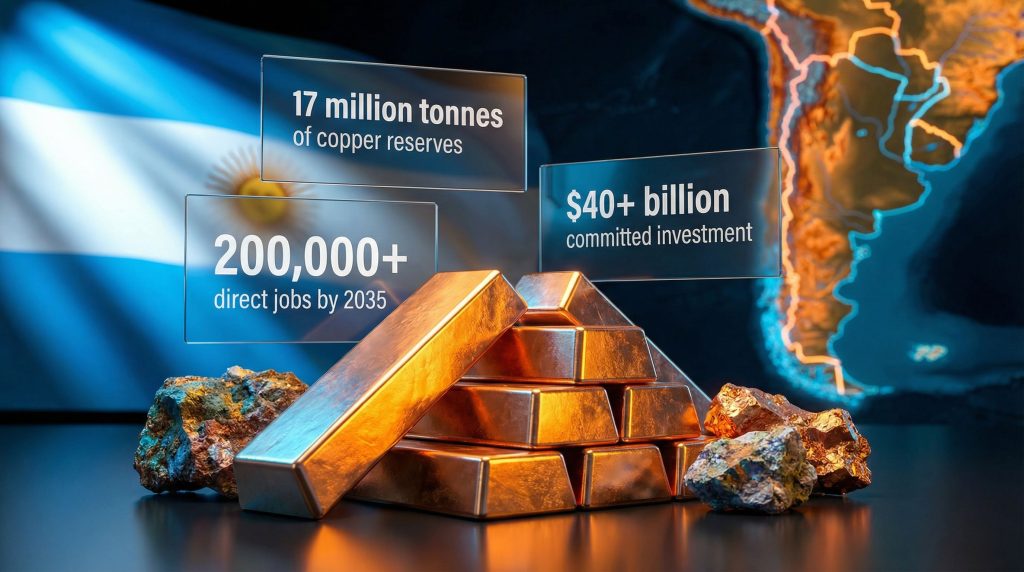
Argentina currently produces approximately 180,000 tonnes of copper annually, ranking 15th globally according to industry production statistics. However, this output represents a fraction of the nation's geological potential, with identified reserves capable of supporting dramatically expanded production levels. Industry projections suggest Argentina could achieve copper production exceeding one million tonnes annually by 2035, contingent on successful project development and sustained investment inflows.
When big ASX news breaks, our subscribers know first
Revolutionary Investment Incentive Framework
The Regime of Incentives for Large Investments (RIGI) represents Argentina's most aggressive attempt to attract international mining capital through unprecedented fiscal stability guarantees. This framework provides 30-year tax rate protection, addressing historical concerns regarding policy volatility that previously deterred major mining investments in Argentina.
RIGI Framework Provisions:
Fiscal Stability Elements
- Corporate tax reduction from 35% to 25% for qualified projects
- Guaranteed tax rates maintained for three decades
- Accelerated depreciation schedules for mining equipment
- Import duty exemptions for specialised extraction technology
- Value-added tax exemptions on capital goods importation
Operational Flexibility
- Foreign exchange control exemptions allowing international fund transfers
- International arbitration rights protecting against regulatory changes
- Streamlined environmental permitting through provincial coordination
- Flexible labour regulations supporting skilled workforce recruitment
The framework specifically targets projects exceeding $200 million in investment, ensuring focus on world-class mining developments capable of meaningful economic impact. Recent approvals demonstrate government commitment, with twelve projects receiving RIGI designation totalling over $15 billion in committed investment across various mining sectors.
Comparative Investment Environment Analysis
Argentina's investment incentives now exceed those offered by traditional mining jurisdictions, creating competitive advantages for project selection among international mining companies. The 30-year fiscal stability period surpasses comparable frameworks in Chile, Peru, and Australia, where tax stability typically ranges from 10-15 years maximum.
| Investment Factor | Argentina (RIGI) | Chile | Peru | Australia |
|---|---|---|---|---|
| Tax Stability Duration | 30 years | 12 years | Variable | Market-based |
| Corporate Tax Rate | 25% | 27% | 29.5% | 30% |
| Foreign Exchange Controls | Exempt | Limited | Restricted | None |
| Environmental Permitting | Streamlined | Complex | Bureaucratic | Comprehensive |
| Arbitration Rights | International | Domestic | Mixed | Domestic |
The foreign exchange exemption provisions particularly distinguish Argentina's offering, as mining companies can repatriate profits and import equipment without currency restrictions that historically complicated operations in the country.
Macroeconomic Transformation Potential
Mining sector expansion under current policy frameworks could generate substantial economic multiplier effects throughout Argentina's regional economies. In addition, direct employment creation represents only the initial impact, with supporting industries experiencing proportional growth through increased demand for transportation, construction, engineering services, and specialised equipment supply.
Economic Impact Projections:
Direct Sector Benefits
- Employment generation exceeding 200,000 positions across mining operations
- Annual export revenue potential of $12-15 billion at current commodity prices
- Government revenue enhancement of $2-3 billion through mining taxation
- Infrastructure investment requirements totalling $8-10 billion regionally
Indirect Economic Multipliers
- Transportation network expansion supporting remote mining operations
- Service sector development in previously underdeveloped provinces
- Technology transfer through international mining company partnerships
- Financial services growth supporting project financing and operations
Argentina's chronic current account challenges could experience significant relief through diversified export revenue streams. For instance, mining exports would reduce dependence on agricultural commodity price cycles whilst providing more stable foreign currency inflows. The sector's capital-intensive nature also attracts sustained foreign direct investment, improving balance of payments dynamics beyond operational revenue generation.
Regional economic development represents perhaps the most transformational aspect of mining expansion. Previously isolated Andean provinces could experience urban development similar to patterns observed in Chile's northern mining regions, where cities emerged around major copper operations. This geographic redistribution of economic activity could address Argentina's historical concentration of wealth in Buenos Aires and surrounding areas.
Glacier Law Reform: Environmental and Investment Balance
The proposed Glacier Law modifications represent a critical policy inflection point, transferring environmental oversight authority from federal to provincial governments whilst maintaining core water resource protections. This decentralisation aims to accelerate project permitting whilst addressing legitimate environmental concerns through enhanced monitoring protocols.
The reformed regulatory structure distinguishes between water-producing glacial formations and non-functional ice masses, allowing mining operations near the latter whilst protecting active water sources. However, this scientific approach replaces blanket restrictions with targeted protections based on hydrological function rather than arbitrary geographic boundaries.
What Environmental Protection Measures Remain in Place?
Protection Mechanisms:
- Advanced water monitoring technology deployment across affected watersheds
- Mandatory environmental impact assessments with third-party verification
- Community consultation requirements ensuring local stakeholder participation
- Biodiversity offset programmes compensating for ecosystem disruption
Stakeholder Impact Assessment:
- Mining Industry: Enhanced operational certainty and reduced regulatory delays
- Environmental Organisations: Concerns regarding water resource protection adequacy
- Local Communities: Economic opportunities balanced against environmental risks
- Provincial Governments: Increased revenue authority and regulatory responsibility
The legislation passed Argentina's Senate with modifications, requiring final approval from the Chamber of Deputies for implementation. Industry representatives emphasise the reforms as fundamental for unlocking mining investment, whilst environmental groups maintain concerns about water resource protection in arid Andean regions. According to Mining.com, "The reforms are seen as essential for attracting international mining investment while maintaining environmental safeguards."
Major Project Development Pipeline
The Javier Milei mining boom centres around several world-class copper development projects representing over $10 billion in committed investment. These developments demonstrate the practical application of RIGI incentives and illustrate the scale of potential mining sector expansion.
Tier 1 Development Projects:
Josemaría Copper Project
- Total investment commitment: $4.2 billion
- Annual production capacity: 136,000 tonnes copper equivalent
- Projected mine life: 19 years of operations
- RIGI approval status: Fully approved and advancing to construction
- Employment generation: 2,500 direct positions during operation
Los Azules Copper Development
- Investment requirement: $3.9 billion capital expenditure
- Production target: 149,000 tonnes copper annually
- Operating period: 28 years of commercial production
- Regulatory status: Under RIGI evaluation process
- Regional impact: Significant infrastructure development in San Juan Province
Filo del Sol Project
- Capital investment: $2.8 billion development cost
- Annual output: 83,000 tonnes copper equivalent
- Mine life: 15 years of commercial operation
- RIGI application: Pending government approval
- Cross-border potential: Shared resources with Chilean territory
These projects collectively represent production capacity exceeding 350,000 tonnes of copper annually, potentially doubling Argentina's current output. The geographic distribution across multiple provinces demonstrates mining sector expansion beyond traditional regional concentrations, supporting gold and copper exploration initiatives nationwide.
Investment Risk-Return Analysis
Risk Factor Assessment:
Political and Regulatory Risks
- Policy continuity concerns despite current reform momentum
- Provincial-level regulatory coordination challenges
- Community relations management requirements
- Environmental permitting complexity and timeline uncertainty
Operational and Economic Risks
- Infrastructure development requirements in remote locations
- Skilled workforce availability and training needs
- Currency volatility and inflation impact on operational costs
- Water availability and competing usage demands
Return Potential Drivers
- High-grade ore bodies with attractive cash costs
- Favourable fiscal regime reducing effective tax burden
- Strategic positioning in global copper supply chains
- Long-term supply agreement opportunities with premium pricing
The projects demonstrate attractive internal rates of return exceeding 15% under conservative copper price assumptions, with upside potential as global demand growth outpaces supply additions. Enhanced fiscal terms through RIGI participation further improve project economics compared to operations in traditional mining jurisdictions.
Global Copper Market Integration Strategy
Argentina's mining expansion aligns strategically with global energy transition demands driving unprecedented copper consumption growth. Electric vehicle production requires four times more copper than conventional vehicles, whilst renewable energy infrastructure demands 3-5 times greater copper intensity than traditional power generation.
Demand Transformation Drivers:
Electrification Trends
- Electric vehicle manufacturing scaling globally
- Grid modernisation requiring enhanced copper infrastructure
- Renewable energy installation acceleration
- Battery production and storage system deployment
- Smart grid technology implementation
Supply-Demand Gap Analysis
- Projected global copper deficit of 8-10 million tonnes by 2035
- Limited new mine development in traditional producing regions
- Aging mine assets requiring replacement production
- Geopolitical supply chain diversification requirements
Argentina's positioning within the Western Hemisphere provides strategic advantages for supply chain security, offering alternatives to Chinese-controlled African resources and reducing dependence on single-country concentration in Chile and Peru. Consequently, this geographic diversification becomes increasingly valuable as countries prioritise supply chain resilience for critical materials supporting energy transition technologies.
The timeline for Argentine project development aligns favourably with projected supply shortfalls, potentially capturing premium pricing as global markets experience supply constraints. Advanced development projects could reach production by 2028-2030, coinciding with accelerating demand growth from transportation electrification and grid infrastructure modernisation. Furthermore, understanding copper investment drivers becomes crucial for investors evaluating these opportunities.
The next major ASX story will hit our subscribers first
Future Scenario Modeling and Strategic Implications
Argentina's mining transformation trajectory depends on successful implementation of regulatory reforms, sustained political support, and international capital market conditions. Multiple scenarios emerge based on varying success rates in these critical factors, with copper market trends influencing investment decisions.
Base Case Development (70% probability)
- Glacier Law reform achieves legislative approval with modifications
- 60-70% of planned projects secure financing and advance to production
- Argentina reaches 800,000-1,200,000 tonnes annual copper production by 2035
- Mining sector contributes 4-5% of GDP with significant regional economic impact
Optimistic Expansion (20% probability)
- Comprehensive regulatory framework implementation without major obstacles
- 80%+ project success rate with additional exploration discoveries
- Argentina becomes world's 4th largest copper producer by 2035
- Mining sector contributes 6-7% of GDP with integrated lithium co-production
Conservative Outcome (10% probability)
- Political opposition delays or blocks key regulatory reforms
- Environmental challenges and community resistance slow project development
- Limited expansion beyond current production levels
- Modest economic transformation impact
Strategic Recommendations for Market Participants
International Mining Companies:
- Prioritise early-stage project development to maximise RIGI benefit capture
- Invest substantially in community relations and environmental stewardship programmes
- Develop strategic partnerships with Argentine suppliers and service providers
- Consider integrated copper-lithium-gold development opportunities for enhanced economics
Investment Community:
- Focus on companies with established Argentine operations and RIGI approvals
- Diversify exposure across project development stages and commodity types
- Monitor political developments and regulatory implementation progress closely
- Evaluate infrastructure and service sector opportunities alongside direct mining investments
Policy Framework Considerations:
- Ensure transparent and consistent regulatory implementation across provinces
- Balance environmental protection with economic development objectives through science-based approaches
- Develop comprehensive skilled workforce training programmes for mining sector employment
- Create equitable benefit distribution frameworks across affected regions
Why Is the Javier Milei Mining Boom Transformational?
The Javier Milei mining boom represents more than cyclical commodity investment; it signifies Argentina's strategic repositioning within global supply chains essential for energy transition success. The convergence of geological endowment, regulatory innovation, and market timing creates unprecedented opportunities for transforming Argentina into a major copper producer whilst generating substantial economic benefits across multiple sectors and regions.
However, monitoring global copper production outlook remains essential for understanding how Argentina's expansion fits within worldwide supply dynamics. Additionally, tracking industry evolution trends provides insight into technological innovations that could enhance Argentina's competitive position.
According to the Oakland Institute, "Argentina's mining transformation under Milei represents a fundamental shift towards market-oriented policies designed to attract international investment while maximising resource extraction potential."
This analysis incorporates projections and forecasts that involve inherent uncertainties. Readers should conduct independent research and consult qualified financial advisors before making investment decisions related to Argentine mining sector opportunities.
Want to Capitalise on Argentina's Mining Transformation?
Discovery Alert instantly tracks significant ASX mineral discoveries using its proprietary Discovery IQ model, helping investors identify emerging opportunities in copper, gold, and critical minerals before broader market recognition. With Argentina's mining boom potentially influencing global supply chains, stay ahead of related ASX discovery announcements that could benefit from shifting commodity dynamics and begin your 14-day free trial today.