June 25, 2026
Reading Argentina's Recovery Through a Structural Lens
Emerging market recoveries rarely follow a straight line. For economies that have passed through periods of acute fiscal stress, currency adjustment, and demand compression, the return to positive growth tends to unfold in phases: first, a sharp rebound driven by base effects and pent-up activity; then a more difficult transition toward self-sustaining expansion where productivity, investment, and real purchasing power must carry the load. Argentina's economy is currently navigating that second, more demanding phase, and the data released for Argentina GDP growth in the first quarter of 2026 provides an unusually clear window into how that transition is progressing.
When big ASX news breaks, our subscribers know first
What the Q1 2026 GDP Numbers Actually Show
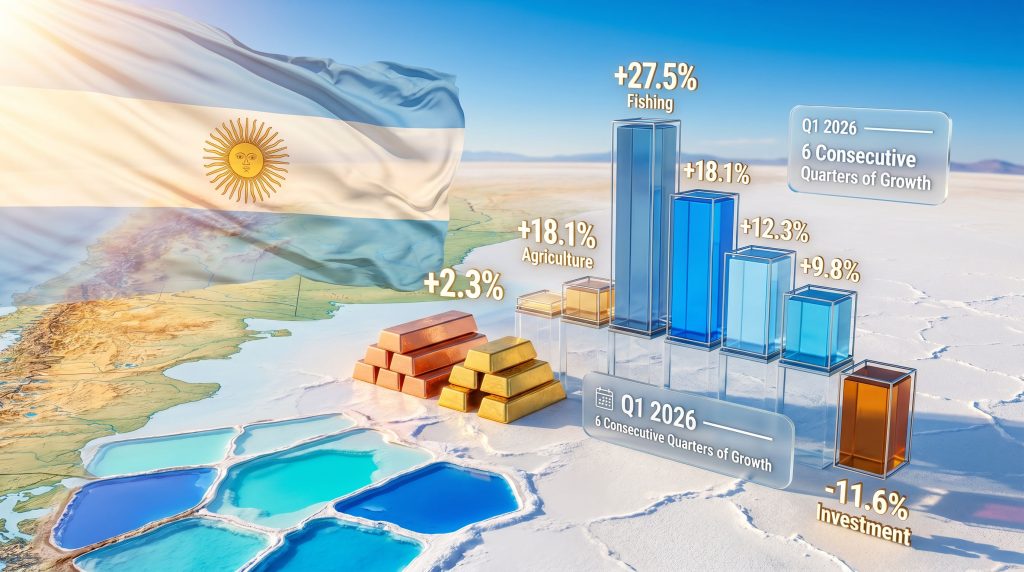
Argentina's official statistics agency INDEC confirmed that the economy expanded 2.3% year-on-year in the first quarter of 2026, nudging ahead of the fourth quarter 2025 result of 2.2% and comfortably exceeding the analyst consensus forecast of 1.7%. On a sequential basis, quarter-on-quarter growth came in at +0.7%, again ahead of the +0.4% expected.
The headline result marked the sixth consecutive quarter of positive annual GDP growth for Argentina, a streak that would have seemed optimistic during the depths of the 2024 contraction. Furthermore, according to recent data, Argentina's economy had already demonstrated resilience in the preceding period, providing a platform for this continued momentum.
Quarterly Growth Trend at a Glance
| Period | Annual GDP Growth Rate |
|---|---|
| Q3 2025 | +3.3% |
| Q4 2025 | +2.2% |
| Q1 2026 | +2.3% |
The deceleration from Q3 2025's +3.3% pace is worth contextualising carefully. Much of the early recovery momentum was amplified by base effects: comparisons were made against a deeply contracted economy, making percentage gains look more dramatic than underlying activity warranted. As those base effects fade through 2026, the economy's ability to sustain growth above 2% will increasingly depend on genuine productive output rather than favourable arithmetic.
The marginal improvement from Q4 2025 to Q1 2026 signals that momentum has not collapsed, but the trajectory is clearly transitioning from a rebound-driven phase into a slower, more structurally grounded expansion.
Sector Breakdown: Where Argentina's Economy Is Winning
The sectoral picture behind Argentina GDP growth in the first quarter tells a story of deep divergence between natural resource industries and the domestic economy.
Sector Performance Summary: Q1 2026 (Year-on-Year)
| Sector | Growth Rate |
|---|---|
| Fishing | +27.5% |
| Agriculture, Livestock & Forestry | +18.1% |
| Mining (copper, gold, lithium) | +12.3% |
| Exports | +9.8% |
| Construction | +2.5% |
| Private Consumption | +2.7% |
| Retail & Wholesale Trade | -0.3% |
| Utilities | -1.1% |
| Manufacturing | -1.7% |
| Investment | -11.6% |
Agriculture, livestock and forestry delivered an 18.1% annual surge, reinforcing its status as Argentina's primary economic engine. The sector's dominance in the GDP composition is not incidental: Argentina is one of the world's largest exporters of soybean meal, soybean oil, and corn, and global commodity prices have remained supportive through early 2026.
Fishing posted the highest sectoral growth rate at 27.5%, though its relatively modest share of total GDP limits its contribution to aggregate output. The figure nonetheless reflects improving operational conditions in Atlantic fishing grounds and stronger international demand for Argentine seafood exports.
Mining's 12.3% Growth: An Early Signal of a Structural Shift
Perhaps the most strategically significant data point in the Q1 release is the 12.3% expansion in mining output, encompassing copper, gold, and lithium production. This figure represents early-stage volume gains from projects that have only recently moved into or toward commercial production, and analysts broadly expect the contribution from this sector to compound materially through the second half of the decade.
Argentina's position within the so-called Lithium Triangle, shared with Chile and Bolivia, places it among the world's most significant repositories of lithium brine resources. The country's Puna region, spanning the provinces of Jujuy, Salta, and Catamarca, hosts brine deposits characterised by relatively high lithium concentrations and large resource footprints, though extraction economics vary considerably between projects. The Argentina lithium brine market continues to attract significant international attention as production scales across the Puna plateau.
What makes Argentina's lithium geology distinct from Chile's Atacama brine operations is the diversity of its resource base. While the Atacama hosts exceptionally concentrated brines, Argentina's Puna plateau hosts dozens of smaller salar systems, each with different lithium grades, magnesium-to-lithium ratios, and processing requirements. A lower magnesium-to-lithium ratio is generally preferred by producers because it reduces the complexity and cost of producing battery-grade lithium carbonate or lithium hydroxide.
This geological variability means Argentina's lithium sector will not scale uniformly: projects with more favourable brine chemistry will reach nameplate production faster and at lower cost per tonne than those requiring more complex processing circuits. Understanding the various lithium deposit types is consequently essential for investors assessing project-level risk across the region.
Multiple large-scale lithium projects across Argentina are progressing through development and early production phases, with meaningful output scaling anticipated through the 2027 to 2030 window. The 12.3% mining growth rate in Q1 2026 is best understood as an early indicator of this longer-term trajectory rather than a mature steady-state contribution.
The Structural Weaknesses That Cannot Be Ignored
Critical Risk: Investment fell 11.6% year-on-year in Q1 2026. Capital formation is the single most important leading indicator of an economy's future productive capacity, and a contraction of this magnitude raises serious questions about whether today's headline growth is being built on a shrinking foundation.
The investment contraction reflects a combination of forces that are difficult to disentangle:
- Persistently high inflation raises the real cost of capital and increases uncertainty around project returns, making long-duration commitments unattractive without substantial risk premiums
- Elevated interest rates, maintained in part to support disinflation, directly increase financing costs for businesses considering expansion
- Residual uncertainty around the pace and durability of structural reform introduces political risk premia that lengthen investment payback calculations
- The compression of domestic purchasing power reduces the addressable market for businesses considering capacity additions oriented toward local demand
Manufacturing's 1.7% contraction is consistent with this environment. Argentine industrial producers face a combination of compressed consumer demand, elevated input costs, and import competition that has become more intense following currency realignment. Utilities declining 1.1% likely reflects the ongoing rationalisation of energy subsidies under the fiscal adjustment programme, a process that reduces volume metrics even as it improves the long-term fiscal position.
Inflation at 33.2%: Disinflation Progress With Structural Complications
Argentina's annualised inflation rate stood at 33.2% in May 2026, a modest uptick after two consecutive months of easing, according to INDEC. The monthly inflation reading for May was 2.1%, representing the lowest single-month print since September 2025.
While the directional improvement from the hyperinflationary peaks seen in 2023 and 2024 is unambiguous and meaningful, a 33.2% annualised rate remains structurally elevated by virtually any international benchmark. For context, the IMF's threshold for classifying a high-inflation environment is typically around 10% annualised, meaning Argentina remains well above the zone where inflation begins to behave as a conventional macroeconomic variable rather than a systemic constraint.
The interaction between persistent inflation and GDP measurement deserves scrutiny. In high-inflation environments, the accuracy of GDP deflators becomes a technical challenge: if the deflator used to convert nominal output to real GDP understates actual price increases, real growth figures may be modestly overstated. This is not a phenomenon unique to Argentina, but it is particularly relevant given the scale of the inflationary episode the country has recently experienced.
Practically, the +2.7% private consumption figure is best understood in light of this inflationary backdrop. Households are spending more in nominal terms partly because prices are higher, not solely because real purchasing power has recovered. Real wage growth remains constrained, limiting the extent to which consumption can meaningfully accelerate without a further, sustained reduction in the inflation rate.
Export Performance and the Current Account Imperative
Export growth of 9.8% year-on-year in Q1 2026 represents one of the cleaner positive signals in the data release. Volume-driven gains across agricultural commodities account for the majority of this improvement, with mining exports beginning to contribute at the margin.
For Argentina, export performance carries significance beyond the GDP accounting identity. The country's ability to accumulate foreign exchange reserves is tightly linked to export receipts, and maintaining adequate reserve buffers is a prerequisite for servicing external debt obligations and sustaining the exchange rate framework underpinning the broader stabilisation programme.
The trajectory of mining exports over the next several years will be particularly important in this regard. Copper and gold projects with Canadian and Chinese operator backing are advancing through development, while lithium brine extraction volumes are expected to scale significantly as newer projects move past commissioning phases. In addition, advances in direct lithium extraction technology are improving recovery rates and reducing the capital intensity of new projects across the Puna region.
If these volume increases materialise on the timelines currently projected, Argentina's export base will become materially more diversified by the early 2030s than it is today, reducing the economy's historical dependence on soybean complex prices alone. Consequently, the global lithium market dynamics will play an increasingly significant role in shaping Argentina's macroeconomic trajectory over the medium term.
The next major ASX story will hit our subscribers first
Bull and Bear Scenarios for Argentina's Economy Through 2026
Bull Case Conditions:
- Global agricultural commodity prices remain supported, sustaining export revenue and farm-sector investment
- Monthly inflation continues declining toward a 1.5% or below monthly rate, enabling real wage recovery and consumption growth
- Foreign direct investment into mining and energy infrastructure accelerates as the regulatory environment stabilises
- IMF programme compliance is maintained, preserving access to multilateral financing and anchoring market confidence
Bear Case Conditions:
- Inflation re-accelerates above current levels, eroding household purchasing power and undermining the consumption recovery
- The investment contraction deepens or persists through 2026, hollowing out future productive capacity
- Global commodity price weakness, particularly in soybeans and copper, reduces export revenues and foreign exchange accumulation
- Political uncertainty ahead of electoral cycles disrupts reform continuity and increases risk premiums across asset classes
The -11.6% investment contraction is the variable that most deserves ongoing monitoring. An economy can sustain headline growth for several quarters on the strength of consumption and exports while capital formation deteriorates, but it cannot do so indefinitely. Investment today is output tomorrow, and without a reversal in this trend, Argentina's medium-term growth potential will remain structurally compressed regardless of what the quarterly GDP prints show. The OECD's economic assessment of Argentina similarly highlights investment recovery as a prerequisite for durable long-term expansion.
FAQ: Argentina GDP Growth in the First Quarter of 2026
What was Argentina's GDP growth rate in Q1 2026?
Argentina's economy expanded 2.3% year-on-year in Q1 2026 according to INDEC, with quarter-on-quarter growth of 0.7%, both figures exceeding analyst expectations.
Which sectors grew the fastest in Q1 2026?
Fishing recorded the highest growth at 27.5%, followed by agriculture, livestock and forestry at 18.1%, and mining at 12.3%.
Why did investment fall so sharply in Q1 2026?
Investment contracted 11.6% year-on-year, reflecting the combined impact of high inflation, elevated borrowing costs, and uncertainty around the pace of structural reform, all of which increase the risk premium on long-duration capital commitments.
What is Argentina's current inflation rate?
Argentina's annualised inflation rate was 33.2% in May 2026, with monthly inflation at 2.1%, the lowest monthly reading since September 2025.
How many consecutive quarters has Argentina's economy grown?
Q1 2026 marked the sixth consecutive quarter of positive year-on-year GDP growth, reflecting a sustained recovery from the 2024 contraction.
Why is Argentina's lithium sector considered strategically important?
Argentina holds extensive lithium brine reserves across the Puna plateau region, forming part of the global Lithium Triangle. As battery demand scales with electric vehicle adoption, Argentina's geological endowment positions its mining sector as a long-term structural growth driver, though project economics vary significantly based on individual brine chemistry and site-specific factors.
This article is intended for informational purposes only and does not constitute financial or investment advice. Forward-looking statements regarding growth forecasts, sector projections, and commodity market trajectories involve inherent uncertainty and should not be relied upon as predictions of future performance.
Want to Track the Next Major Mineral Discovery Before the Market Does?
Argentina's expanding mining sector — with copper, gold, and lithium output growing 12.3% in Q1 2026 — signals a structural shift that is already attracting significant international capital; Discovery Alert's proprietary Discovery IQ model instantly translates significant ASX mineral discoveries into actionable insights, ensuring subscribers are positioned ahead of the broader market. Explore historic discoveries and their extraordinary returns to understand the potential at stake, then begin a 14-day free trial at Discovery Alert to secure your market-leading advantage.