June 24, 2026
The Uncomfortable Truth Hidden Inside the Clean Energy Revolution
Every megawatt of wind capacity installed, every electric vehicle rolling off a production line, and every battery storage system connected to a grid requires raw materials pulled from the earth. That physical reality sits at the heart of a growing and deeply uncomfortable contradiction: the minerals powering the world's shift away from fossil fuels are increasingly linked to documented patterns of community harm, worker exploitation, and Indigenous rights violations that rival the social damage of the industries they are meant to replace.
Understanding why human rights allegations at critical minerals mines are accelerating requires more than cataloguing individual incidents. It demands an examination of the structural forces, geographic fault lines, and governance failures that make this pattern not just predictable, but in many cases, systemic. Furthermore, critical minerals energy transition ambitions are now inseparable from the social consequences of how those minerals are extracted.
When big ASX news breaks, our subscribers know first
A Crisis Measured in Numbers
The Business and Human Rights Resource Centre's 2026 Transition Minerals Tracker delivers what may be the most comprehensive annual accounting of social harm in critical mineral supply chains currently available. Its findings for 2025 are striking.
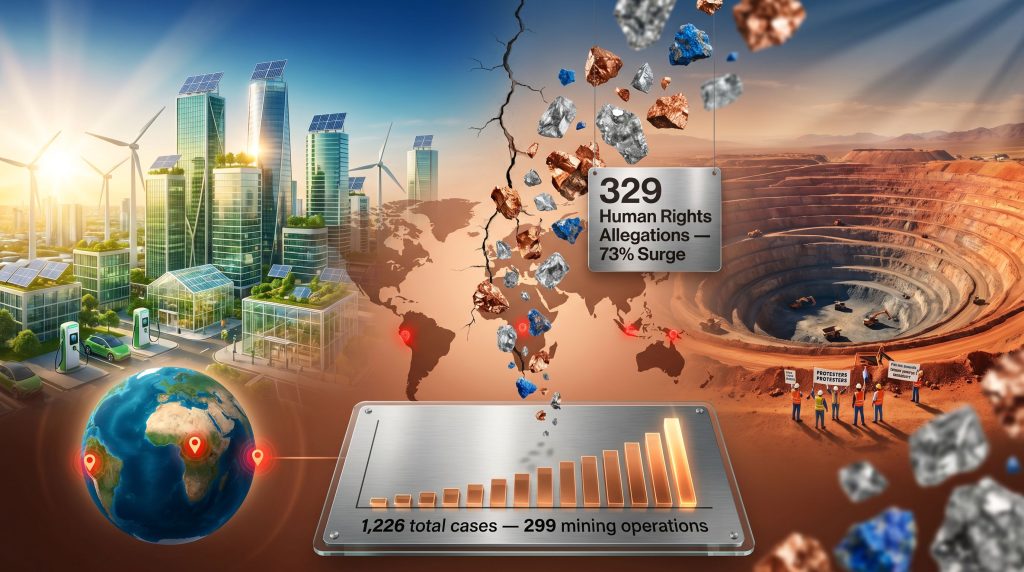
329 separate human rights allegations were recorded across major mining operations in 2025 alone, representing a 73% increase from the 190 allegations documented the prior year. The cumulative total since tracking began in 2010 now stands at 1,226 allegations spanning 299 mining operations globally.
To appreciate the scale of that trajectory, consider where the data started: just 11 allegations were recorded in 2010. The curve from that baseline to 329 in a single year does not resemble a random fluctuation. It mirrors, almost precisely, the growth curve of global clean energy investment over the same period.
Key 2025 Metrics at a Glance
| Metric | 2025 Figure |
|---|---|
| Total allegations recorded | 329 |
| Year-on-year increase | 73% |
| Cumulative allegations since 2010 | 1,226 |
| Mining operations implicated (total) | 299 |
| Attacks on defenders | 42 |
| Increase in defender attacks (YoY) | >50% |
| Protests linked to mine conflicts | 61 |
| Strikes recorded | 10 |
| Lawsuits or regulatory actions | 44 |
| Mine suspensions or closures | 27+ |
Beyond the allegation count, 42 documented attacks on human rights and environmental defenders were recorded in 2025, more than 50% higher than the preceding year. These are not abstract governance statistics. They represent incidents of physical violence, forced disappearance, judicial harassment, and community silencing directed at individuals who challenged extraction operations near their lands.
The trajectory from 11 allegations in 2010 to 329 in 2025 represents a compound acceleration that closely mirrors the growth of clean energy investment itself, suggesting structural rather than incidental causation.
Copper: The Transition Metal With the Largest Human Rights Footprint
No commodity in the clean energy portfolio carries a heavier burden of documented social harm than copper. In 2025, copper mining operations accounted for approximately 60% of all recorded allegations, a proportion consistent with long-run data showing more than 370 copper-linked allegations between 2010 and 2021 alone.
The reasons are embedded in copper's geology and economics. The world's largest deposits are concentrated in the central Andes and the Central African Copperbelt, regions where state regulatory institutions are frequently under-resourced, where Indigenous land rights frameworks remain contested, and where large-scale open-pit operations require extensive land clearance and water-intensive processing.
Water is a particular flashpoint. The Andean highlands that host Chile's and Peru's copper districts are also among the world's most water-stressed environments. The same aquifer systems that sustain Indigenous Andean communities and pastoral agricultural economies are drawn upon by processing operations that require millions of litres daily. Contamination events and depletion conflicts have generated sustained protest cycles at projects including Peru's Antapaccay mine, which carries active land rights and water pollution disputes in the 2026 tracker data.
Why Copper's Risk Profile Is Structurally Different From Other Minerals
- Copper deposits are geographically inseparable from regions with documented institutional weakness
- Open-pit scale means physical footprints spanning thousands of hectares, frequently overlapping Indigenous territories
- Water consumption during processing is non-negotiable at current technology levels, making conflict with water-dependent communities structurally inevitable without careful management
- The commodity's centrality to electrification creates investor pressure to accelerate timelines, compressing the community engagement processes that might otherwise buffer conflict
Cobalt, Lithium, and Nickel: Distinct Risk Profiles, Shared Governance Failures
Cobalt and the DRC's Artisanal Mining Crisis
The Democratic Republic of Congo accounts for more than 70% of global cobalt production, and its artisanal and small-scale mining sector remains one of the most extensively documented sites of child labour in any global supply chain. Children as young as six have been documented sorting and washing cobalt ore in conditions without protective equipment, while militarised zones have generated allegations of forced labour and sexual violence linked to armed group control of extraction sites.
A dimension less commonly understood is the role of négociants (informal mineral traders) in laundering cobalt from artisanal sources into formal supply chains. By the time cobalt reaches a battery cathode manufacturer in South Korea or Japan, it may have passed through four or five intermediary transactions, each of which obscures its origin. This opacity is precisely what makes due diligence so difficult and why legislative instruments like the EU's Corporate Sustainability Due Diligence Directive are focused as much on supply chain mapping as on direct supplier auditing. Indeed, critical minerals supply chains represent a core vulnerability that regulators are only beginning to address.
Lithium and Indigenous Sovereignty in South America
Chile, Argentina, and Bolivia together hold the majority of the world's lithium reserves within the Atacama and Puna plateau salt flat systems. These are among the driest environments on Earth, yet they contain shallow brine aquifers that sustain the ecosystems and livelihoods of Atacameño and other Indigenous communities who have inhabited these landscapes for millennia.
Lithium brine extraction pumps those aquifers, reducing water table levels and threatening the wetland habitats that local flamingo species and pastoral economies depend upon. The specific violation pattern documented in this region centres on Free, Prior, and Informed Consent (FPIC), the internationally recognised right of Indigenous communities to be consulted before projects affecting their lands proceed.
What makes FPIC violations particularly difficult to address in this region is the deliberate fragmentation of community governance structures. In documented cases, companies and permitting authorities have identified minority factions within Indigenous governance bodies willing to sign consultation agreements, then characterised those partial agreements as community-wide consent. This practice constitutes a structural corruption of the consent process, not a technical procedural failure. Amnesty International's analysis of critical minerals and human rights provides further context on why these violations are so persistent across multiple jurisdictions.
Nickel and Southeast Asia's Accelerating Environmental Risk
Indonesia's extraordinary nickel reserves have made it the world's largest nickel producer, a position reinforced by Chinese investment in large-scale nickel processing facilities on islands including Sulawesi and Halmahera. The environmental damage associated with this expansion has generated a rapidly growing allegations profile, with documented cases including:
- Waterway contamination from nickel laterite processing waste affecting fishing communities
- Forced displacement of Indigenous Tobelo and other forest-dwelling peoples from concession areas
- Environmental impact assessment processes that critics characterise as inadequate given the scale and speed of project approvals
Commodity Risk Comparison
| Mineral | Primary Documented Violations | Key Hotspot Regions |
|---|---|---|
| Copper | Water contamination, land rights, labour safety | Peru, Chile, Zambia |
| Cobalt | Child labour, forced labour, sexual violence | Democratic Republic of Congo |
| Lithium | FPIC violations, aquifer depletion, displacement | Chile, Argentina |
| Nickel | Environmental contamination, community displacement | Indonesia |
| Rare Earths | Radioactive tailings, groundwater pollution | China, Myanmar |
| Graphite | Air pollution, occupational health | China, Mozambique |
Geographic Concentration of Risk: Where the Crisis Is Worst
South America consistently records the highest total volume of human rights allegations across the tracker's full history, driven by the density of copper and lithium operations intersecting with populated Indigenous territories and fragile Andean water systems. Peru and Chile are the primary contributing nations.
Africa recorded the most dramatic single-year deterioration in 2025, with documented abuses more than doubling from the prior year. The DRC remains the primary cobalt-related risk environment, while Zambia contributes copper contamination cases and Niger has generated uranium-linked incidents.
Southeast Asia has transitioned from a peripheral to a material risk zone, driven almost entirely by the pace of Indonesian nickel expansion. The speed of this transition is itself a governance warning signal: when production capacity scales faster than regulatory institutions can monitor, violation rates typically follow. Consequently, the critical minerals geopolitics shaping investment flows are also shaping where social harm concentrates.
Regional Risk Summary (2025)
| Region | Trend | Primary Mineral Drivers |
|---|---|---|
| South America | Highest cumulative volume | Copper, Lithium |
| Africa | Fastest YoY growth (abuses doubled) | Cobalt, Copper, Uranium |
| Southeast Asia | Rapidly emerging risk zone | Nickel |
| Central Asia | Moderate, chronically underreported | Rare Earths |
Who Pays the Price: Disproportionate Burdens on Vulnerable Groups
The Indigenous Overrepresentation Problem
Indigenous Peoples account for approximately 6% of the global population yet represent 17% of all allegations in the Transition Minerals Tracker. That nearly 3:1 disproportion is not coincidental. Mineral-rich geological formations frequently coincide with territories that Indigenous communities have occupied precisely because they were remote from colonial settlement patterns, meaning today's most valuable deposits often sit beneath lands where Indigenous rights frameworks are most contested.
Worker Safety: A Separate and Worsening Crisis
Labour-related complaints surged sharply in 2025, with 92 allegations involving worker rights, occupational health, or safety failures. Within that figure, 22 reports documented work-related fatalities.
A less widely understood dimension of worker health risk in this sector involves manganese, which is co-processed with nickel and used in lithium-manganese-iron-phosphate (LMFP) battery chemistries gaining market share. Chronic occupational exposure to manganese dust has been linked to manganism, a neurological condition producing symptoms that resemble Parkinson's disease. Unlike acute safety incidents, these long-latency health outcomes rarely appear in near-term regulatory enforcement actions, making them systematically undercounted in allegation trackers.
The Policy Coverage Gap
Only 56% of mining operations associated with documented allegations maintained publicly available human rights policies. This means nearly half of implicated mines operated without even baseline published commitments to worker and community protection.
| Governance Indicator | Status |
|---|---|
| Mines with public human rights policies | 56% |
| Mines lacking published HR commitments | ~44% |
| Worker fatalities documented in 2025 | 22 |
| Labour rights allegations in 2025 | 92 |
| Indigenous share of total allegations | 17% (vs. 6% of global population) |
The next major ASX story will hit our subscribers first
From Social Risk to Financial Risk: The Investor Dimension
The 2025 data documented 61 protests, 10 strikes, and 44 lawsuits or regulatory actions linked to mining operations, with at least 27 cases producing mine suspensions, operational slowdowns, or forced closures. These are not soft reputational statistics. They represent direct production interruptions that affect mineral availability, project timelines, and asset valuations.
For institutional investors, the financial exposure is material and measurable. European financial institutions collectively channel approximately €8 billion annually into mining companies with documented human rights allegations, including operations at the DRC's Kamoa-Kakula copper complex and Peru's Antapaccay mine. Both projects carry active community disputes within the 2025 tracker. The critical minerals demand surge driving this investment makes those exposures increasingly difficult to avoid without deliberate portfolio screening.
Regulatory Liability Is Expanding Rapidly
Downstream manufacturers and investors face three distinct and growing categories of exposure:
-
Regulatory liability: The EU Corporate Sustainability Due Diligence Directive creates enforceable legal obligations for large companies to identify and address human rights risks throughout their value chains. Non-compliance carries financial penalties. The US Uyghur Forced Labor Prevention Act creates import restrictions linked to supply chain labour violations. Australia's Modern Slavery Act mandates reporting on supply chain risks.
-
Reputational damage: Investigative journalism and NGO campaigns are increasingly capable of tracing consumer products to specific mine-level violations, compressing the reputational distance that manufacturers once relied on.
-
Physical supply disruption: Mine closures caused by community opposition directly constrain mineral availability for EV manufacturers, battery producers, and renewable energy equipment suppliers who cannot easily substitute inputs in the short term.
The Systemic Governance Failures Enabling These Outcomes
Corporate Concentration of Risk
Historical tracker data reveals that approximately two-thirds of all recorded allegations are concentrated among just 12 corporate entities. This concentration indicates that sector-wide improvement is achievable if the governance failures within this limited cohort are addressed. It also means that a small number of operator decisions, investment mandates, and regulatory interventions could produce disproportionate improvements in sector-wide performance.
Permit Acceleration Without Safeguard Investment
In multiple documented cases, governments competing to attract critical minerals investment have abbreviated or bypassed environmental and social impact assessment processes. The pattern includes:
- Issuing permits before FPIC processes with affected Indigenous communities were completed
- Deploying state security forces to suppress protests against operations that lacked community consent
- Structuring consultation processes to manufacture the appearance of community agreement without its substance
This dynamic reflects a deeper tension: the same urgency that drives clean energy investment timelines also drives permitting shortcuts. Without structural separation between investment promotion mandates and social safeguard enforcement, that tension will continue to produce predictable harm. In addition, natural capital in mining frameworks that account for environmental and social value are rarely embedded in permitting processes at speed.
Building Supply Chains That Don't Repeat the Problem They Claim to Solve
The Business and Human Rights Resource Centre's analysis concludes that stronger human rights safeguards, meaningful community engagement, and fair benefit-sharing structures are not optional additions to resilient mineral supply chains but foundational requirements for them. The 2025 data make clear why: operations facing sustained community opposition experience more production disruptions, longer litigation timelines, and greater asset impairment than those that invest in genuine social licence.
The three structural requirements for a genuinely ethical extraction framework are:
-
Mandatory human rights due diligence aligned with the UN Guiding Principles on Business and Human Rights, with independent third-party auditing and transparent grievance mechanisms accessible to affected communities.
-
Substantive FPIC implementation, meaning processes that give Indigenous communities genuine capacity to withhold consent and that extend engagement beyond the permitting phase into operational monitoring.
-
Revenue-sharing architectures that direct a defined percentage of mine revenues to host communities, combined with environmental rehabilitation bonds ensuring post-closure land restoration.
These requirements function simultaneously as ethical imperatives and operational risk management tools. Mines that secure genuine community support experience fewer disruptions, lower litigation exposure, and more predictable production profiles over their operating lives. The UNEP Finance Initiative's human rights toolkit offers a practical framework for financial institutions seeking to embed these requirements into their lending and investment criteria.
Frequently Asked Questions
What types of human rights violations are most common at critical mineral mines?
The most frequently documented categories include water pollution affecting community health, violations of Indigenous land rights and Free, Prior, and Informed Consent, worker safety failures and fatalities, child labour in artisanal cobalt mining, and physical attacks on environmental and human rights defenders.
Which regions have the most severe human rights problems linked to critical mineral mining?
South America, particularly Peru and Chile, records the highest cumulative allegation volume, driven by copper and lithium operations. The Democratic Republic of Congo is the primary cobalt-related risk environment. Africa overall recorded the fastest growth in allegations in 2025, with abuses more than doubling from the prior year.
How do human rights violations at mines affect clean energy supply chains?
Operational disruptions from community opposition, strikes, and legal actions directly constrain mineral availability. In 2025, at least 27 mining operations experienced suspensions or closures linked to social conflict, creating quantifiable supply risk for EV manufacturers, battery producers, and grid infrastructure developers.
What is FPIC and why does it matter to mining investors?
Free, Prior, and Informed Consent is an internationally recognised right of Indigenous Peoples enshrined in the UN Declaration on the Rights of Indigenous Peoples. In practice, violations occur when mining proceeds without completed consultation, or when consent is manufactured through community division. FPIC failures are a leading predictor of subsequent community opposition, legal challenge, and operational disruption.
Are mining companies legally required to address human rights risks in their supply chains?
Regulatory requirements are expanding. The EU Corporate Sustainability Due Diligence Directive creates enforceable obligations for large companies. The US Uyghur Forced Labor Prevention Act restricts imports linked to forced labour. Australia's Modern Slavery Act mandates supply chain risk reporting. The direction of travel across major jurisdictions is toward mandatory disclosure and liability, not voluntary frameworks.
A Transition That Cannot Afford to Displace Harm
The moral and strategic credibility of the clean energy transition depends on whether it can deliver an unambiguous improvement in both environmental and social outcomes globally, not just for electricity consumers in wealthy nations while externalising damage to mining communities in lower-income countries.
The 2025 data published by the Business and Human Rights Resource Centre suggest that trajectory has not yet been achieved. A transition built on copper from contaminated watersheds, lithium from territories where consent was never genuinely sought, and cobalt produced with child labour does not represent a just energy future. It represents a redistribution of harm.
The trajectory is not fixed. The concentration of risk within a small number of corporate operators means that targeted governance reform, strengthened regulatory enforcement, and investor accountability mechanisms could produce meaningful change at scale. However, that requires acknowledging that human rights allegations at critical minerals mines are not a peripheral concern for the energy transition. They are a central vulnerability within it.
This article draws on data published in the Business and Human Rights Resource Centre's 2026 Transition Minerals Tracker. Figures represent documented allegations and may understate actual incidence given reporting limitations in remote or institutionally constrained jurisdictions. Forward-looking statements regarding regulatory developments and supply chain risks involve inherent uncertainty and should not be construed as financial advice.
Want to Track the ASX Mineral Discoveries Powering the Clean Energy Transition?
Discovery Alert's proprietary Discovery IQ model delivers real-time alerts the moment significant ASX mineral discoveries are announced, instantly converting complex data across 30+ commodities into clear, actionable insights for both short-term traders and long-term investors. Explore Discovery Alert's dedicated discoveries page to understand how major mineral discoveries have historically generated substantial market returns, and begin a 14-day free trial to position yourself ahead of the broader market.