June 24, 2026
The Quiet Revolution Happening Inside the World's Deepest PGM Portfolios
Underground platinum group metal mining operates on timelines that most industries would consider geological in their own right. Decisions made today about orebody extensions, shaft infrastructure, and processing capacity will define output curves well into the 2040s. For investors, this creates a paradox: the companies best positioned for long-term PGM supply are those willing to commit capital during periods of price weakness, when the temptation to conserve cash is at its strongest. That tension sits at the heart of Sibanye-Stillwater's current strategic posture, and understanding it requires looking well beyond the headline numbers.
The Sibanye-Stillwater platinum project plans announced through its capital markets presentation represent one of the most significant long-duration capital commitments seen in the South African PGM sector in recent years, totalling R20 billion across its underground operations. However, the more interesting story lies in why the company is making this bet now, and what the simultaneous restructuring of its American assets reveals about how management is thinking about the decade ahead.
When big ASX news breaks, our subscribers know first
From Acquisition Machine to Organic Growth Engine
For much of the previous decade, Sibanye-Stillwater built its identity through a series of transformative acquisitions, purchasing Stillwater Mining in Montana, absorbing Lonmin's platinum assets at Marikana, and expanding into battery minerals through the Keliber lithium project in Finland. That acquisition-led model served a specific strategic era, one defined by undervalued assets, available credit, and a management philosophy that prized portfolio breadth.
The shift under CEO Richard Stewart is philosophically distinct. Rather than seeking transformative external deals, the current capital framework explicitly prioritises maximising returns within existing orebody boundaries. As Stewart expressed during the capital markets presentation, the company's view is that investing within its own resource boundaries offers the strongest risk-adjusted return available to it at this point in the cycle — a position that reflects both the maturity of its South African reserve base and the disciplined capital environment following a period of significant write-downs.
This is not merely a tactical adjustment. The organic-versus-acquisition debate in the PGM sector carries significant implications for shareholders:
- Organic mine life extensions typically carry lower execution risk than integrating new assets
- Underground orebody extensions on known geology reduce exploration uncertainty
- Staying within existing infrastructure boundaries lowers per-ounce capital intensity
- Longer mine lives improve the net present value of sunk costs already embedded in the asset base
The Bushveld Complex, which hosts Sibanye-Stillwater's South African PGM operations, is one of the most geologically consistent large-scale mineral deposits on Earth. Its layered mafic intrusion geology means that orebodies extend laterally and at depth with a predictability that few other PGM-bearing formations can match. This geological characteristic is a key enabler of the 2050 production horizon that Sibanye-Stillwater is now targeting.
What the R20 Billion Pipeline Actually Involves
The R20 billion commitment spans multiple projects at varying stages of development, from near-term board approvals through to early-concept studies. The headline figure encompasses underground South African PGM operations and does not include separate surface and concentrate processing expansion plans, which carry their own budgets.
| Project Category | Development Stage | Production Role | Capex Estimate |
|---|---|---|---|
| Near-term board-approved projects | Approved / In execution | Sustain 1.5 Moz/yr to 2035 | R3bn (project + SIB capex) |
| Kopaneng Extension | Near-term approval | Production extension | TBC |
| Saffy (Marikana complex) | Concept stage | Post-2035 optionality | TBC |
| Surface and concentrate processing | Excluded from R20bn scope | Supplementary revenue | Separate budget |
| Chrome business expansion | Strategic growth phase | Top-five producer target | Included in broader plan |
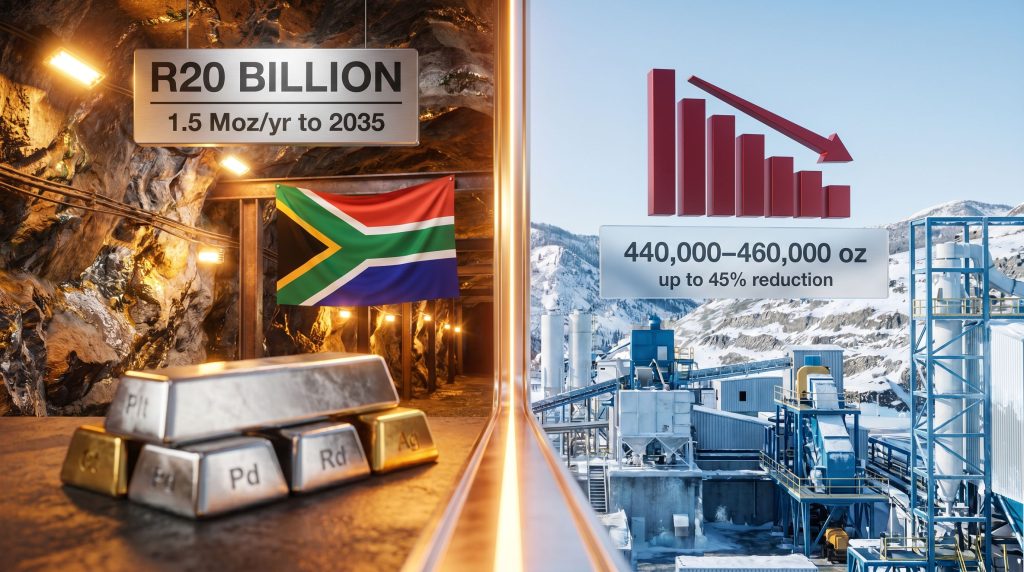
The near-term production target is 1.5 million ounces per year by 2035, supported by projects already approved at board level. Approximately 300,000 oz/year in incremental production is expected to flow from new project approvals within the broader pipeline. The long-term production floor, sustained through to 2050, targets at least 1 million oz/year from underground South African operations. An upside scenario of 1.8 million oz/year exists, contingent on supportive PGM basket price conditions.
Sibanye-Stillwater produced approximately 1.7 million oz of PGMs from its South African operations in the most recent full year, providing a meaningful production baseline from which both the sustaining target and the upside scenario can be assessed.
The near-term capital allocation is notably capital-efficient in the context of the overall pipeline. The R3 billion covering project and stay-in-business expenditure over the period to 2035 represents a relatively modest per-ounce investment to maintain a production rate of 1.5 million oz/year, reflecting the advantage of extending known underground orebodies rather than developing greenfield assets. Furthermore, you can explore the full scope of Sibanye-Stillwater's PGM project pipeline to understand how these investments are structured across the portfolio.
The Kopaneng Extension and Saffy Project: Understanding the Production Bridge
The Kopaneng Extension is positioned as a near-term production contributor, with board approval expected imminently. Its significance lies in its role within the broader Bushveld Complex geology, where extensions to existing reef packages can be developed at meaningfully lower capital intensity than standalone new mines.
The Saffy project, housed within the Marikana complex, remains at concept stage. Its primary strategic function is as a post-2035 production bridge, designed to replace declining output from older sections of the operation. The Marikana complex, inherited from the former Lonmin assets, contains extensive remaining reef potential, and Saffy's development pathway will depend on PGM price conditions and the capital environment that prevails in the early 2030s.
What is less commonly understood outside the industry is that the Merensky and UG2 reefs, which host the majority of Bushveld Complex PGM mineralisation, have dramatically different cost profiles. The UG2 reef carries higher chrome content and lower platinum-to-palladium ratios, making its relative economics sensitive to both platinum and palladium dynamics and chrome by-product credits. As palladium prices have weakened, operations with higher UG2 exposure have faced disproportionate revenue pressure, while chrome co-production has partially cushioned the impact for those with the processing infrastructure to monetise it.
The US Operations: A Fundamentally Different Story
While South African Sibanye-Stillwater platinum project plans involve expansion and mine life extension, the Montana operations require a different and more difficult response. The J-M Reef in Montana holds a geological distinction that makes its current commercial predicament particularly striking: it is widely recognised as the highest-grade PGM deposit known globally, yet it cannot sustain its existing production economics under current palladium pricing.
The reserve and resource base remains substantial, with 19.4 million reserve ounces and 80.9 million resource ounces of two-element PGMs (platinum and palladium). The problem is not geology; it is the structural mismatch between the deposit's heavy palladium weighting and the sustained weakness in palladium prices that has characterised the market since the automotive sector began its transition toward battery electric vehicles, which require no catalytic converters. Indeed, Sibanye-Stillwater posted a $394 million loss on weak prices and US impairment, underscoring the scale of the challenge.
| Asset | Operational Decision | Production Impact |
|---|---|---|
| Stillwater West | Operations suspended | Significant output reduction |
| East Boulder Mine | Production curtailed | Reduced operating footprint |
| Stillwater East | Output increased (high-grade focus) | Partial offset to curtailments |
| Net Production Effect | ~200,000 oz reduction from 2025 | Structural decline in US output |
US production is now forecast at 440,000 to 460,000 oz for the current period, compared to approximately 1.3 million oz produced in 2024. The reduction of up to 45% in Montana output, combined with approximately 800 job losses, reflects the severity of the financial pressure rather than any geological deterioration of the asset.
The context for this restructuring is a prior write-down of $2.4 billion in US asset values, a recognition that acquisition-era assumptions about palladium prices and operating cost trajectories were too optimistic. The restructuring is a capital-preservation response to an unsustainable operating model, not an abandonment of what remains a world-class orebody.
To stabilise the US balance sheet without diluting equity, Sibanye-Stillwater is in advanced negotiations to secure between $600 million and $700 million through prepay and streaming agreements across chrome, gold, and PGM production. Streaming structures have become an increasingly common tool in the mining sector's financial engineering toolkit, offering near-term liquidity at the cost of future production upside. For an asset in restructuring mode, the trade-off is generally acceptable.
South Africa vs Montana: The Portfolio Divergence Explained
The contrast between Sibanye-Stillwater's two major PGM jurisdictions is striking when viewed side by side.
| Dimension | South African Operations | US Montana Operations |
|---|---|---|
| Primary metals | Platinum, palladium, rhodium, gold (4E basket) | Platinum and palladium only (2E) |
| Strategic direction | Expansion with R20bn investment pipeline | Contraction, up to 45% output reduction |
| Production target | 1.5 to 1.8 Moz/yr (4E) | 440,000 to 460,000 oz/yr (2E) |
| Reserve base | Extensive Bushveld Complex orebodies | J-M Reef, 19.4M reserve oz (2E) |
| Capital posture | Organic growth, mine life extension to 2050 | Cost reduction, streaming finance |
| Employment trajectory | Maintained at 25,000+ direct workers | Approximately 800 job losses |
The multi-element basket composition of South African operations is a structurally important differentiator. Rhodium, the third major element in the 4E basket alongside platinum and palladium, has historically commanded prices that dwarf even gold during periods of supply tightness. Although rhodium markets are cyclical and prices have retreated significantly from their 2021 peak, their long-run contribution to South African basket revenues provides a revenue diversification layer that the palladium-dominant J-M Reef simply cannot replicate.
Chrome as a Strategic Revenue Diversifier
One of the less-discussed elements of Sibanye-Stillwater's South African strategy is its ambition to become a top-five global chrome producer. Chrome occurs naturally as a co-product of UG2 reef mining in the Bushveld Complex, and the investment required to monetise it through ferrochrome processing or chrome ore export is incremental relative to the underground mining cost already incurred.
Richard Cox, chief regional officer for Sibanye-Stillwater's South African operations, has described the chrome expansion as a strategic value driver that directly enhances the company's overall basket price per tonne of ore processed. This framing is significant because it positions chrome not as a speculative diversification play, but as a mechanism for improving the economics of existing PGM operations.
Chrome market dynamics in 2025 and 2026 are shaped primarily by stainless steel demand trends in Asia, where ferrochrome is a critical input. South Africa dominates global chrome ore production, and any producer achieving scale within that supply base has access to a relatively stable industrial demand curve that is less correlated with automotive cycle volatility than PGMs.
The next major ASX story will hit our subscribers first
Gold Operations: Social Anchor, Not Growth Engine
Sibanye-Stillwater's South African gold mines occupy a unique position within the portfolio: they are operationally challenging, have defined life-of-mine horizons, and employ a workforce of approximately 25,000 direct workers who support an estimated 250,000 people through indirect economic linkages.
The mine-by-mine picture looks like this:
- Driefontein: Operational runway of up to 11 years
- Kloof: Managed on a year-by-year basis, reflecting its mature and unpredictable geological character
- Beatrix (Free State): Approximately 6 years of remaining mine life
Management has been unambiguous that these mines will not be divested. They will be operated responsibly through to end-of-life and formally closed, with the social and community obligations of that process accepted as a core responsibility. The Burnstone gold project in Mpumalanga, suspended in 2021, remains in holding status. It would require approximately R1 billion to complete against a total project cost of roughly R5 billion, and was originally designed to produce 120,000 oz/year of gold. Whether it fits within the current capital allocation hierarchy remains an open strategic question.
Keliber Lithium: The Inherited Diversification Bet
The Keliber lithium mine in Finland, recently brought into production after approximately R15 billion in invested capital, represents the most visible legacy of the previous strategic era under former CEO Neal Froneman. Stewart took over the leadership role in October, inheriting both the asset and the ongoing capital obligations that may accompany it.
Conditions reflecting the broader lithium market downturn in 2025 and 2026 have been challenging, with prices remaining significantly below peak levels reached in 2022. The tension between the company's renewed PGM-focused organic growth philosophy and the ongoing capital demands of a battery minerals asset in Finland is one of the more interesting strategic fault lines to monitor. Consequently, whether Keliber evolves into a core part of Sibanye-Stillwater's identity or is eventually repositioned will depend heavily on lithium price recovery and management's appetite for further capital deployment outside its South African heartland.
Summary Statistics: Sibanye-Stillwater's Dual-Track Capital Framework
| Metric | Value |
|---|---|
| South African PGM project pipeline | R20 billion |
| Near-term production target (to 2035) | 1.5 million oz/yr (4E) |
| Upside production ceiling | 1.8 million oz/yr (4E) |
| Long-term production floor (to 2050) | ~1 million oz/yr |
| Incremental oz from new project approvals | ~300,000 oz/yr |
| Near-term capex (project and SIB) | R3 billion |
| US production forecast (current period) | 440,000 to 460,000 oz (2E) |
| US production reduction magnitude | ~200,000 oz / up to 45% |
| US streaming and prepay financing target | $600 to $700 million |
| Prior US asset write-down | $2.4 billion |
| US workforce reduction | ~800 job losses |
| Keliber lithium investment (Finland) | ~R15 billion |
| Burnstone remaining completion capex | ~R1 billion |
| Burnstone original production design | 120,000 oz/yr gold |
| Driefontein remaining mine life | Up to 11 years |
| Beatrix remaining mine life | ~6 years |
| Direct gold workforce | ~25,000 employees |
| Indirect social dependents | ~250,000 people |
The Sibanye-Stillwater platinum project plans that have emerged from this capital markets process reveal a company executing a genuinely bifurcated strategy: committing generational capital to extend the life of its South African PGM operations while simultaneously restructuring its American assets to survive a prolonged period of palladium price weakness. In addition, broader trends across critical minerals demand and mining industry consolidation are reshaping the competitive landscape in which these decisions are being made. The logic is internally consistent, even if the execution carries meaningful execution and price risk. For investors tracking long-duration PGM supply, the 2050 production horizon being established across the Bushveld Complex is a data point that deserves considerably more attention than the near-term restructuring headlines tend to attract.
This article contains forward-looking statements regarding production targets, capital expenditure projections, and market scenarios. All such statements are inherently uncertain and should not be construed as financial advice. Investors should conduct their own due diligence and consult qualified financial advisors before making investment decisions.
Want to Be First When the Next Major PGM Discovery Hits the ASX?
Discovery Alert's proprietary Discovery IQ model scans ASX announcements in real time, instantly identifying significant mineral discoveries — including PGMs and other critical commodities — and converting complex data into clear, actionable insights for investors at every level. Explore historic examples of exceptional discovery returns and start your 14-day free trial today to position yourself ahead of the broader market.