May 21, 2026
The Andean Logistics Gap: Why Infrastructure Is Now a Mining Competitiveness Variable
Across the global energy transition, the race to secure critical mineral supply chains has intensified competition not just between mining companies, but between entire producing nations. Within this contest, the capacity to move minerals efficiently from extraction point to export terminal has emerged as a variable that is just as consequential as the size of the resource in the ground. For Argentina, a country sitting atop extraordinary lithium and copper-adjacent mineral wealth, this infrastructure dimension has long been the sector's most persistent vulnerability.
The Argentine mining sector faces a structural paradox that is rarely discussed with the specificity it deserves. Its resource base is globally significant, yet the transport networks connecting inland production zones to international markets remain fragmented, underfunded, and in many corridors, functionally inadequate for the export volumes that future lithium and copper production will demand. This gap between what the geology offers and what the logistics chain can deliver is not an abstract concern.
It translates directly into higher per-tonne export costs, longer transit times, and a competitiveness deficit relative to peer jurisdictions. Furthermore, the critical minerals energy transition agenda only amplifies the urgency of addressing these structural weaknesses before competing jurisdictions consolidate their advantages.
The Argentina IDB road project to strengthen mining logistics with Chile represents one of the most consequential infrastructure financing commitments currently active in South America's mining corridor network. Understanding what it involves, why it matters, and how it fits into a broader continental logistics architecture requires moving well beyond the headline figure.
When big ASX news breaks, our subscribers know first
From Mine Gate to Pacific Port: How the Andean Logistics Chain Actually Works
The logistics chain for Argentine mineral exports is more complex than it appears on a map. Once ore or processed mineral product leaves a mine site in the northwest provinces or the Puna region, it must traverse a sequence of infrastructure nodes, each with its own efficiency characteristics and cost implications.
The journey typically involves road haulage from the mine to a provincial highway network, transit along national routes to a border crossing, processing through a border complex, continuation into Chilean territory, and finally delivery to a Pacific port terminal for loading onto bulk carriers or container vessels bound for Asian markets.
What makes this routing economically rational, despite its apparent complexity, is the geography of global demand. Asian battery manufacturers and copper consumers are predominantly served by Pacific shipping lanes. Routing through Chilean Pacific ports, rather than the Buenos Aires corridor on Argentina's Atlantic coast, consequently delivers meaningfully shorter ocean transit times and lower freight costs for producers targeting these markets.
The key national routes underpinning this logistics architecture are RN 51, RN 52, RN 17, RN 34, and RN 43, each serving distinct mining catchment zones across Argentina's northwest. The quality, capacity, and connectivity of these corridors directly determines the landed cost competitiveness of Argentine mineral exports at their destination.
For lithium producers operating in Argentina's Puna region, the decision of whether to route exports through Chilean Pacific gateways versus the Buenos Aires corridor is not merely an operational logistics preference. It is a direct determinant of project-level economics and the ability to compete effectively in global battery supply chain tenders.
The US$100 Million IDB Financing: What It Covers and Why It Matters
Argentina has secured US$100 million in financing from the Inter-American Development Bank (IDB) for a road infrastructure project designed to enhance cross-border mining logistics connectivity with Chile. This is a sovereign lending arrangement, structured as multilateral public investment, with co-financing expectations that extend the program's total investable reach beyond the headline commitment.
The financing is not a discretionary grant. It carries with it the institutional frameworks that multilateral development banks apply to infrastructure lending: environmental and social governance standards, project preparation requirements, procurement disciplines, and monitoring obligations. These conditionalities, while sometimes perceived as administrative burdens, also serve to de-risk projects in the eyes of private sector investors who rely on multilateral involvement as a quality signal.
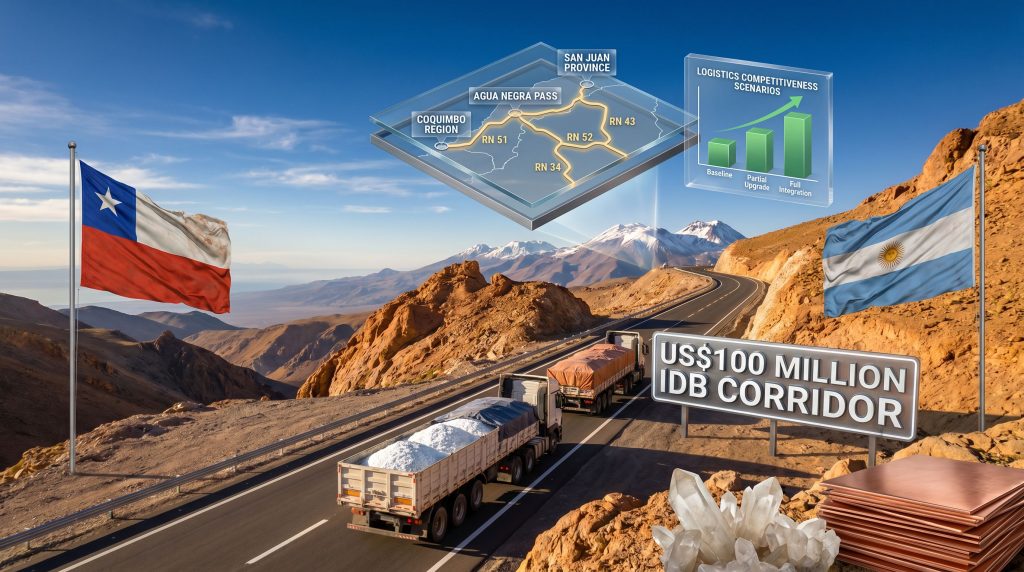
The program's primary strategic focus is the Agua Negra Pass International Tunnel and its associated cross-border integration corridor, which links Argentina's San Juan Province with Chile's Coquimbo Region. This corridor is one of the most strategically significant transport axes in the southern Andean mining belt, with relevance to the Argentina copper system, lithium input supply chains, and the broader flow of minerals and mineral processing inputs between the two countries.
Critically, the Agua Negra road project is not limited to mining. The corridor also serves grape and lime exporters, tourism operators, and regional communities across San Juan and Coquimbo. This multi-sector economic case broadens the political constituency for the project at both federal and provincial levels, which in Argentina's complex federal system is a significant factor in project durability.
Execution is already underway at the sub-national level. Río Negro Province has commenced IDB-funded roadworks on provincial routes 6 and 8, a development that demonstrates the broader corridor strategy has moved beyond planning into active construction. This is a meaningful distinction in a country where infrastructure programs have historically faced implementation gaps between announcement and delivery.
Current Corridor Status Across Key Argentine Provinces
| Province | Routes Affected | Funding Source | Status | Primary Commodity Served |
|---|---|---|---|---|
| San Juan | Agua Negra Corridor | IDB | Development/Construction | Copper, Mining Inputs |
| Río Negro | Provincial Routes 6 and 8 | IDB | Underway | Minerals, Regional Trade |
| Northwest Provinces | RN 51, 52, 17, 34, 43 | World Bank / IDB | Projected | Lithium, Gold |
Argentina's Position in the Lithium Triangle: Why Logistics Quality Is a Tier-One Issue
Argentina is one of three countries forming the Lithium Triangle, alongside Chile and Bolivia, a geographic cluster that collectively holds the majority of the world's known lithium reserves. Within this triangle, the Argentina lithium brine market is characterised by a diversity of brine chemistry and deposit types that is arguably unmatched globally. The country hosts not only conventional salar-hosted lithium brines, but also a range of brine compositions with varying concentrations of magnesium, potassium, and boron, each of which affects processing complexity and product recovery rates.
This chemical diversity is a double-edged characteristic. On one hand, it means Argentina's lithium endowment is vast and geographically distributed. On the other, it means that processing costs and product quality can vary significantly between projects, making the logistics cost component an even more sensitive variable in the overall project economics equation. When processing costs are higher due to brine complexity, the margin available to absorb logistics inefficiencies is correspondingly thinner.
The World Bank's northwest Argentina corridor analysis has explicitly identified the provincial road network as critical infrastructure for the lithium industry, modelling projected traffic volume increases on key national routes as lithium production scales toward the output levels that multiple projects in development are targeting. This analytical foundation provides the investment prioritisation rationale that underpins both IDB and World Bank infrastructure commitments in the region.
The primary export products that stand to benefit from improved corridor infrastructure include:
- Lithium carbonate (battery-grade, targeting electric vehicle cathode material manufacturers)
- Lithium hydroxide (preferred feedstock for high-nickel cathode chemistries in premium EV applications)
- Copper cathodes (produced in the Andean corridor zone, with direct access to Pacific shipping)
- Gold (from operations in the Andean mining belt)
- Mineral inputs and reagents (flowing in the reverse direction, from Chilean port entry points into Argentine mine sites)
- Agricultural products (grapes, limes) and tourism flows providing secondary economic justification
The Bioceanic Corridor Architecture: A Continental Perspective
The IDB road investment in Argentina does not exist in isolation. It is a node within a much larger continental infrastructure ambition: the development of bioceanic corridors linking South America's Atlantic and Pacific port systems across multiple national territories.
Bioceanic corridors are transcontinental transport axes designed to eliminate the logistical discontinuities that fragment South America's commodity export supply chains. For mining producers, the promise of a seamlessly integrated bioceanic corridor is the ability to access Pacific shipping lanes from landlocked or near-landlocked production zones without the cost and time penalties that currently erode competitiveness.
The IDB's involvement in the Argentina road project sits within a multi-country technical cooperation framework spanning Argentina, Chile, Bolivia, Brazil, and Ecuador, with a programmatic focus on sustainable mining value chains, institutional capacity building, and logistics infrastructure alignment. The World Bank operates a complementary analytical and financing program focused on transformational economic corridors in northwest Argentina, providing the evidence base that guides investment prioritisation.
How Argentina's Corridor Compares to Peer South American Initiatives
| Corridor | Countries | Primary Commodity | Financing Source | Development Stage |
|---|---|---|---|---|
| Agua Negra (San Juan-Coquimbo) | Argentina-Chile | Copper, Lithium Inputs | IDB | Development/Construction |
| Atacama Lithium Corridor | Chile-Bolivia | Lithium | Mixed Public/Private | Operational (partial) |
| IIRSA Central Corridor | Peru-Brazil | Multi-commodity | CAF, IDB | Operational |
| Bioceanic Road Corridor | Brazil-Paraguay-Argentina-Chile | Agriculture, Minerals | Multiple | Under Development |
What distinguishes the Argentina-Chile mining corridor from most comparable regional initiatives is its explicit orientation toward energy transition commodities. Unlike purely agricultural bioceanic corridors, the Agua Negra axis is designed to serve lithium and copper flows that are structurally tied to the global electrification agenda, giving it a strategic significance that general trade corridors do not share.
Scenario Analysis: Three Pathways for Argentina's Mining Logistics Competitiveness
The ultimate impact of the Argentina IDB road project to strengthen mining logistics with Chile depends on the scale and pace of broader corridor development. Three scenarios frame the plausible range of outcomes.
Scenario 1: Baseline (Fragmented Infrastructure, Limited Progress)
Without meaningful corridor improvement, Argentine lithium and mineral producers continue absorbing logistics cost premiums relative to Chilean and Australian competitors. Border crossing inefficiencies and road quality constraints cap the scalability of export volumes even as production capacity at new projects expands. Foreign direct investment in Argentine mining remains partially constrained by infrastructure risk, which appears in project feasibility assessments as an elevated logistics cost assumption and a wider discount rate.
Scenario 2: Partial Corridor Upgrade (Current IDB Project Scope)
The US$100 million IDB investment delivers targeted improvements on key corridors, reducing transit times and border friction on the San Juan-Coquimbo axis. Lithium export competitiveness improves incrementally, and mining companies operating in San Juan and adjacent provinces capture measurable logistics cost reductions. The Agua Negra corridor, furthermore, begins functioning as a reliable export artery, attracting incremental investment to the region.
Scenario 3: Full Bioceanic Integration (Long-Term Horizon)
Completion of the Agua Negra tunnel, combined with road upgrades and border complex modernisation, creates a seamless logistics corridor from Andean mine sites to Pacific port terminals. Argentina's northwest mining provinces become structurally integrated into Pacific-facing supply chains, with direct implications for competitiveness in supplying lithium to Asian battery manufacturers at a delivered cost that matches or undercuts competing jurisdictions.
| Scenario | Infrastructure State | Logistics Cost Impact | Mining FDI Signal | Export Competitiveness |
|---|---|---|---|---|
| Baseline | Fragmented, underinvested | High, persistent | Cautious | Below regional peers |
| Partial Upgrade | Targeted improvements | Moderate reduction | Improving | Approaching parity |
| Full Integration | Seamless corridor | Significant reduction | Positive | Regionally competitive |
These scenarios are analytical projections based on infrastructure investment trajectories and should not be interpreted as forecasts or investment advice. Actual outcomes will depend on execution quality, financing continuity, and macroeconomic conditions in Argentina.
The next major ASX story will hit our subscribers first
The Role of Multilateral Finance in De-Risking Andean Infrastructure
One of the less-discussed dimensions of the IDB's involvement in Argentine road infrastructure is the institutional function it serves beyond capital provision. Multilateral development bank financing brings with it a set of non-financial benefits that are genuinely difficult to replicate through bilateral or purely private arrangements.
These include:
- Sovereign credit enhancement, which improves Argentina's borrowing terms for the specific project
- Environmental and social governance frameworks, which reduce community and regulatory risk
- Project preparation capacity, which improves the technical quality of the infrastructure delivered
- Reputational signalling, which increases private sector confidence in the corridor as an investment destination
The World Bank's complementary engagement on northwest Argentina economic corridors extends this institutional depth further, providing detailed analytical modelling of traffic volume growth and lithium industry logistics economics that private sector investors and project developers can use in their own feasibility work.
Situating the IDB loan within Argentina's current fiscal reform context under the Milei administration adds a further layer of significance. Multilateral financing is playing an increasingly important role in funding public infrastructure that the federal budget cannot fully absorb in the current fiscal consolidation environment. The conditionalities attached to multilateral lending also provide an external accountability mechanism for project delivery, which has historically been a weak point in Argentine infrastructure programs.
Frequently Asked Questions: Argentina IDB Road Project and Mining Logistics With Chile
What is the Argentina IDB road project to strengthen mining logistics with Chile?
Argentina has secured US$100 million in IDB financing for a road infrastructure program designed to improve cross-border transport connectivity with Chile, with the Agua Negra corridor linking San Juan Province with Chile's Coquimbo Region as the flagship component. The project targets reduced transit times, lower logistics costs, and improved border crossing efficiency for mineral exporters.
Why do Argentine mining exporters prefer Chilean Pacific ports over Buenos Aires?
Chilean Pacific ports provide significantly shorter ocean transit routes to Asian battery material and copper demand markets. For producers relying on lithium brine extraction in Argentina's northwest, the delivered cost advantage of Pacific routing over the Buenos Aires Atlantic corridor is material enough to directly influence project-level economics.
Which commodities benefit most from the improved corridor?
- Primary: Lithium carbonate and lithium hydroxide (energy transition demand)
- Secondary: Copper cathodes, gold, mining inputs and reagents
- Tertiary: Agricultural products including grapes and limes, tourism flows
Is construction already underway?
Yes. Río Negro Province has commenced IDB-funded roadworks on provincial routes 6 and 8, confirming that multilateral-financed infrastructure execution is actively progressing in Argentina at the sub-national level.
What are the key risks to the project's success?
- Political continuity risk: Large infrastructure programs in Argentina have historically been vulnerable to changes in government priorities between electoral cycles.
- Financing gap risk: The US$100 million IDB commitment addresses a portion of the total corridor investment need. The gap between current commitments and full corridor development remains significant.
- Environmental and community consultation: Andean corridor development requires meaningful engagement with indigenous and local communities, which can affect project timelines.
- Macroeconomic volatility: Argentina's history of currency instability and fiscal pressure can complicate multi-year infrastructure delivery programs.
Infrastructure as Supply Chain Sovereignty: The Strategic Conclusion
The most important reframe for understanding the Argentina IDB road project is to move away from thinking about it as a civil works program and toward understanding it as a supply chain sovereignty initiative. The question at its core is whether Argentina can translate its extraordinary mineral endowment into a globally competitive export position before peer jurisdictions consolidate their logistics advantages.
Logistics infrastructure quality is becoming a primary differentiator among Lithium Triangle jurisdictions competing for battery supply chain investment. Chile's existing advantage in port access and road connectivity to its producing regions has historically given Chilean lithium producers a structural cost edge. Bolivia's landlocked position has, however, constrained its ability to compete despite its vast resources. Argentina's investment in corridor infrastructure, anchored by the IDB financing commitment, represents a deliberate effort to close this gap. In addition, improving copper supply trends across the Andean belt further reinforces the strategic case for corridor development.
The US$100 million commitment is best understood as the opening phase of a multi-decade infrastructure buildout. Key milestones that will determine whether the full scenario is realised include: progress on the Agua Negra tunnel itself, World Bank corridor investment commitments in the northwest, provincial road network upgrades across the lithium-producing Puna region, and border complex modernisation on the San Juan-Coquimbo axis.
For investors, project developers, and supply chain planners tracking South America's critical minerals landscape, the corridor's trajectory deserves monitoring with the same intensity applied to resource discovery announcements. The geology is already there. The question the Argentina IDB road project to strengthen mining logistics with Chile is beginning to answer is whether the logistics infrastructure can match it.
This article contains forward-looking analysis, scenario projections, and infrastructure investment assessments that are subject to significant uncertainty. Nothing in this article constitutes financial or investment advice. Readers should conduct independent research and seek professional advice before making investment decisions.
Want To Be First When Argentina's Critical Minerals Discoveries Hit The ASX?
Discovery Alert's proprietary Discovery IQ model delivers real-time alerts the moment significant ASX mineral discoveries are announced — turning complex data across lithium, copper, and more than 30 other commodities into clear, actionable insights for investors tracking the critical minerals supply chain. Explore how historic mineral discoveries have generated substantial returns and start your 14-day free trial at Discovery Alert to position yourself ahead of the broader market.