May 20, 2026
Why Brine-Based Lithium Could Reshape America's Battery Supply Chain
The global race to secure battery-grade lithium is forcing a fundamental rethink of where and how the mineral is produced. For decades, the dominant mental model centred on hard rock spodumene mines in Australia and evaporation pond operations in South America's Lithium Triangle. Yet both pathways carry inherent limitations for the United States: one requires oceanic supply chains, and the other depends on foreign-controlled infrastructure. The more compelling domestic answer may lie not in mountains or deserts, but in the ancient, mineral-saturated brines sitting beneath the surface of the American West.
It is within this context that the EnergyX Compass Minerals lithium plant in Utah takes on a significance that extends well beyond a single project announcement.
When big ASX news breaks, our subscribers know first
America's Lithium Import Vulnerability: A Structural Problem
The United States currently produces a negligible share of the lithium it consumes. According to the U.S. Geological Survey, domestic lithium production in recent years has come almost entirely from one operation in Nevada, while consumption requirements linked to electric vehicle battery manufacturing are projected to grow dramatically through the 2030s.
The International Energy Agency has forecast that global lithium demand could increase by a factor of six or more by 2040 relative to 2020 levels, driven overwhelmingly by battery storage demand and EV adoption.
This gap between domestic production capacity and projected consumption is not merely a commercial problem. Lithium has been formally classified as a critical mineral under U.S. policy frameworks, reflecting its importance to national energy security and advanced manufacturing competitiveness. The vulnerability is structural: without domestic supply scaled to meet demand, battery manufacturing buildouts risk becoming perpetually dependent on import channels subject to geopolitical disruption.
Brine-hosted lithium resources offer a faster path to domestic scale than hard rock alternatives for several reasons:
- No conventional mining required: Brine operations extract lithium from existing liquid flows rather than blasting and crushing rock.
- Lower embodied energy per tonne of lithium: Processing brine avoids the energy-intensive comminution circuits used in spodumene operations.
- Faster permitting alignment with existing water infrastructure: Where brine is already extracted for other mineral operations, a lithium extraction overlay can leverage established regulatory frameworks.
- Reduced freshwater demand: Properly designed DLE systems return processed brine to source circuits, avoiding net water withdrawals from sensitive ecosystems.
The Great Salt Lake's Hidden Lithium Endowment
Most people associate the Great Salt Lake with recreational access, migratory birds, or the ongoing crisis of declining water levels. What receives far less public attention is that the lake's brine system hosts one of the more concentrated naturally occurring lithium endowments in North America.
The geological explanation is straightforward in principle, though remarkable in scale. The Great Salt Lake is a terminal basin, meaning inflows from rivers and groundwater have no outflow pathway. Over millennia, evaporation has progressively concentrated dissolved minerals — including sodium, potassium, magnesium, sulphate, and lithium — in the remaining brine.
The result is a lithium concentration profile that, while lower in absolute terms than some Chilean salar brines, is paired with existing industrial brine extraction infrastructure that dramatically lowers the barrier to lithium recovery. Furthermore, understanding the global lithium reserves landscape helps contextualise just how strategically valuable the Great Salt Lake resource really is.
At the Ogden site specifically, the identified resource base is estimated at approximately 2.4 million tonnes of lithium carbonate equivalent (LCE). To contextualise that figure: global lithium consumption in 2023 was approximately 180,000 tonnes of LCE according to Benchmark Mineral Intelligence, meaning the Ogden resource theoretically represents more than a decade of current global demand in a single deposit.
Brine vs. Hard Rock: A Processing Comparison
| Factor | Brine-Hosted (DLE) | Spodumene Hard Rock |
|---|---|---|
| Mining method | Brine pumping | Open pit or underground blasting |
| Processing steps | DLE extraction + carbonate conversion | Crushing, roasting, leaching, conversion |
| Water consumption | Low (closed loop possible) | Moderate to high |
| Time to battery-grade product | Days to weeks | Weeks to months |
| Environmental footprint | Low (if brine returned) | Moderate to high (tailings) |
| Capital intensity per tonne | Moderate | High |
Project Powder Hound: Scope, Structure, and Capital Phasing
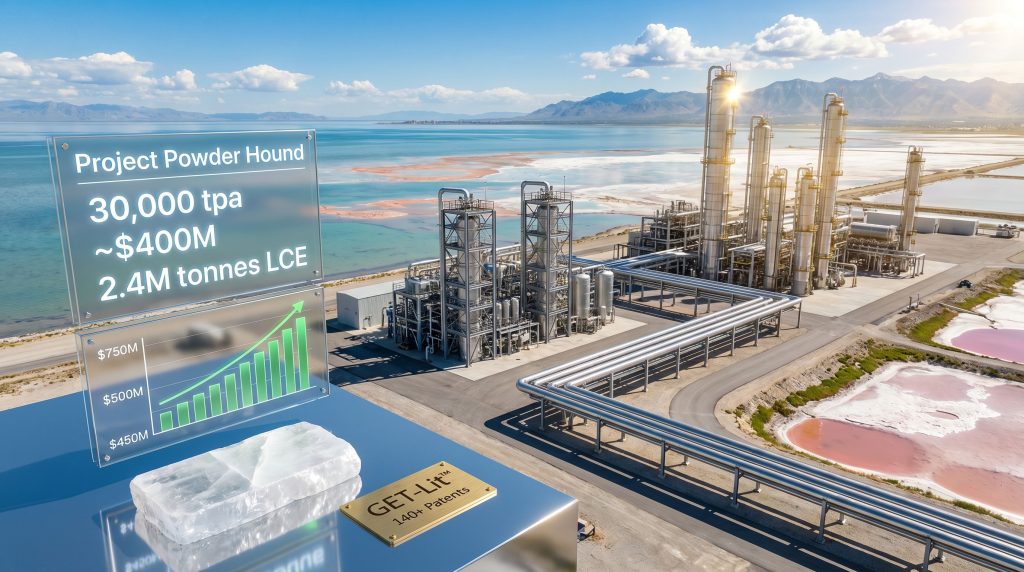
The proposed facility, named Project Powder Hound, is designed as a fully integrated DLE extraction and on-site lithium refinery. Integration is the operative word: unlike some DLE proposals that produce an intermediate lithium chloride or lithium concentrate requiring further off-site processing, the Ogden plant is designed to deliver battery-grade lithium carbonate directly from the facility gate.
The project parameters as currently disclosed are summarised below:
| Parameter | Detail |
|---|---|
| Project Name | Project Powder Hound |
| Location | Ogden, Utah (Great Salt Lake adjacent) |
| Resource Base | ~2.4 million tonnes LCE |
| Target Annual Production | 30,000 tonnes per annum (tpa) |
| Total Capital Investment | ~$400 million (two-phase) |
| Projected Annual Revenue | Over $600 million at full capacity |
| Employment Creation | ~200 direct jobs |
| Construction Start Target | 2028 (subject to approvals) |
| Current Status | MOU signed; due diligence and Utah regulatory approval pending |
The two-phase capital structure is strategically significant. Phase 1 focuses on deploying DLE extraction circuits at commercial scale, drawing on Compass Minerals' existing brine management infrastructure to reduce upfront capital requirements. Phase 2 involves constructing the full lithium carbonate refinery to deliver battery-grade output.
This sequencing allows EnergyX to validate extraction performance before committing full refinery capital, a meaningful risk management feature for a project of this scale. According to PR Newswire, the agreement marks a significant step forward for domestic lithium production in the United States.
The Stranded Capital Advantage
One of the less widely appreciated aspects of the Compass Minerals partnership is the volume of prior capital already deployed at the Ogden site. Compass Minerals had previously invested an estimated $70 to $80 million in lithium-related equipment and infrastructure before pausing its own lithium programme to refocus on core salt and plant nutrition operations.
For EnergyX, this represents an opportunity to absorb and redeploy effectively stranded capital, compressing the development timeline and reducing the effective greenfield cost basis of the project.
Structural Insight: Projects that can inherit existing industrial infrastructure from a transitioning operator often carry meaningfully lower real capital requirements than their headline investment figures suggest. The Ogden site's prior investment may reduce EnergyX's effective capital exposure by tens of millions of dollars relative to a true greenfield DLE development.
GET-Lit Technology: How EnergyX's Proprietary DLE Platform Works
Direct lithium extraction is not a single technology but a family of approaches sharing one defining characteristic: the ability to selectively isolate lithium ions from brine without requiring large-scale solar evaporation. The conventional evaporation pond method, used in the Atacama and other South American salars, requires between 12 and 24 months of solar concentration to raise lithium grades sufficiently for processing.
EnergyX's GET-Lit platform, protected by a portfolio of more than 140 patents, represents one of the more defensible intellectual property positions in the U.S. DLE space. The technology stack encompasses both the extraction phase and the downstream refining methodology required to convert lithium-loaded eluate into battery-grade lithium carbonate.
Key Technical Attributes of GET-Lit
- High lithium recovery rates from variable brine chemistries, reducing losses relative to evaporation-based approaches.
- Reduced freshwater consumption through process design that minimises dilution water requirements.
- Selectivity for lithium over competing ions, particularly magnesium and calcium, which are present in high concentrations in Great Salt Lake brine and are historically problematic for other processing routes.
- Closed-loop brine return, routing processed brine back into Compass Minerals' existing mineral-processing circuits rather than discharging to the lake or surrounding environment.
The magnesium challenge deserves specific attention. Great Salt Lake brine has an unusually high magnesium-to-lithium ratio compared to South American salar brines. Conventional processing routes struggle with elevated magnesium because it competes with lithium in precipitation and conversion steps, adding cost and complexity. DLE membrane or sorbent systems that achieve high selectivity against magnesium at the extraction stage effectively pre-solve a problem that would otherwise require expensive downstream purification.
DLE Technology Comparison
| Technology Approach | Water Use | Processing Speed | Magnesium Tolerance | Scalability |
|---|---|---|---|---|
| Solar Evaporation Ponds | Very High | 12-24 months | Low | Land-constrained |
| Ion Exchange DLE | Low to Moderate | Days to weeks | Moderate | Moderate |
| Membrane-Based DLE | Low | Days | High | High |
| Sorbent-Based DLE | Low | Days to weeks | Moderate to High | Moderate to High |
The Compass Minerals Partnership: More Than a Land Lease
The commercial architecture of the EnergyX and Compass Minerals agreement is structured to serve both parties' distinct strategic priorities. Compass Minerals receives a land lease payment and a production-linked licence fee, creating a royalty-style revenue stream from an asset class it has chosen to exit operationally. The company avoids direct capital exposure to lithium price cycles while retaining economic participation through the licence fee mechanism.
Compass Minerals' leadership has indicated the company's strategic priority is concentrating resources and management attention on its Salt and Plant Nutrition divisions, both of which generate more predictable cash flows than early-stage lithium development. The EnergyX arrangement allows Compass Minerals to monetise dormant lithium-related assets without diverting capital or operational bandwidth from its core businesses.
For EnergyX, the partnership provides something that cannot be easily replicated: an operating brine site with established permits, existing extraction and evaporation infrastructure, and a co-located industrial partner that has already navigated Utah's regulatory environment for brine-related operations. This institutional knowledge has tangible value in a state where water rights, mineral extraction rights, and environmental compliance are governed by an interconnected web of state and local regulations.
The next major ASX story will hit our subscribers first
Revenue Projections and Lithium Price Sensitivity
The $600 million or more in projected annual revenue cited for Project Powder Hound at full capacity implies a lithium carbonate price assumption in the vicinity of $20,000 per tonne at 30,000 tpa production. This is a critical variable given lithium carbonate's well-documented price cyclicality.
| Lithium Carbonate Price (USD/tonne) | Annual Revenue at 30,000 tpa |
|---|---|
| $15,000 | $450 million |
| $20,000 | $600 million |
| $25,000 | $750 million |
| $30,000 | $900 million |
Disclaimer: Revenue projections are illustrative and subject to significant uncertainty. Lithium carbonate prices have traded across a range of roughly $7,000 to over $80,000 per tonne between 2020 and 2024. Investors and stakeholders should treat forward revenue estimates as scenario-dependent rather than as forecasts.
The project's 2028 construction start target is notable from a market timing perspective. Most lithium demand forecasts anticipate a meaningful supply-demand rebalancing by the late 2020s as the current oversupply cycle works through the market. A plant commencing construction in 2028 and reaching full production by the early 2030s could consequently be well-positioned relative to the next projected demand inflection.
Securing off-take agreements with battery manufacturers or cathode producers ahead of financial close will likely be a prerequisite for project financing. Battery-grade lithium carbonate commitments from creditworthy counterparties would substantially de-risk the revenue assumptions and support debt financing at more favourable terms.
Regulatory and Environmental Considerations in Utah
Project Powder Hound faces a regulatory pathway that is more navigable than a greenfield brine project would typically encounter, but is not without complexity. Utah's mineral extraction permitting framework requires approvals at both state and county levels, and the Great Salt Lake's status as an ecologically sensitive and politically prominent water body adds layers of public scrutiny that many industrial projects do not face.
The project's no-additional-extraction design principle is its most important environmental credential. By routing processed brine back into Compass Minerals' existing mineral-processing circuit, EnergyX avoids triggering water rights challenges that have complicated lithium brine extraction projects elsewhere. Utah's water law operates on a prior appropriation doctrine, meaning new water uses require new appropriation rights, which can be contested and time-consuming.
Great Salt Lake water level decline has been a significant public policy issue in Utah, making any project perceived as adding stress to the lake's water balance politically sensitive. The brine return circuit design directly addresses this concern, and the project's alignment with conservation outcomes is a meaningful asset in the regulatory process.
EnergyX's Multi-Project U.S. Lithium Portfolio
Project Powder Hound does not exist in isolation. EnergyX is simultaneously advancing lithium projects in Texas and Arkansas, both targeting brine resources in the Smackover Formation and adjacent structures. The geographic and geological diversity of this portfolio serves multiple functions.
| Project | Location | Brine Type | Development Stage |
|---|---|---|---|
| Project Powder Hound | Ogden, Utah | Great Salt Lake terminal brine | MOU signed; pre-permitting |
| Texas Project | Permian/Smackover region | Oilfield/sedimentary brine | Development stage |
| Arkansas Project | Smackover Formation | Sedimentary brine | Development stage |
Each brine system presents a distinct chemistry profile, and successful GET-Lit deployment across multiple brine types would substantially strengthen EnergyX's technology validation narrative. For an investor or off-take partner evaluating the platform, demonstrated performance across chemically varied brines is considerably more compelling than results from a single deposit type.
The EnergyX Compass Minerals lithium plant in Utah may represent the fastest path to commercial production given the presence of an established industrial partner and pre-existing infrastructure. However, the Texas and Arkansas projects provide portfolio optionality, ensuring that permitting delays or technical complications at any single site do not define the company's entire development trajectory. Reuters reporting has highlighted the broader significance of this partnership for the U.S. lithium market.
What Project Powder Hound Signals for U.S. DLE Development
The partnership model underpinning Project Powder Hound — in which a DLE technology developer teams with an established mineral operator who provides infrastructure, land, and institutional knowledge in exchange for a capital-light royalty stream — may prove to be a replicable template across the U.S. critical minerals landscape. Several incumbent industrial brine operators hold assets that are underutilised from a lithium perspective and may be open to similar arrangements as the economics of DLE improve.
For the broader U.S. DLE sector, the Ogden project's regulatory and technical outcomes will establish important precedents. How Utah's permitting authorities treat brine-return DLE operations, what environmental monitoring requirements they impose, and how quickly approvals can progress will shape the development timelines of comparable projects nationwide. In addition, the alignment of this project with the broader critical minerals strategy emerging across allied nations underscores the geopolitical dimensions at play.
Industry Watch: If Project Powder Hound achieves its 2028 construction start and progresses to commercial production in the early 2030s, it would position EnergyX among the first commercial-scale DLE operators in the United States, with meaningful implications for technology licensing opportunities and off-take negotiating leverage.
The combination of a ~2.4 million tonne LCE resource, inherited industrial infrastructure, a closed-loop environmental design, and a proprietary 140-plus patent technology platform represents a genuinely differentiated project profile. The key variables for the EnergyX Compass Minerals lithium plant in Utah now centre on definitisation of commercial agreements, Utah regulatory timelines, and the lithium price environment that will greet the project when it reaches production.
This article is intended for informational purposes only and does not constitute financial or investment advice. Forward-looking statements, revenue projections, and production targets are subject to material uncertainty and should not be relied upon as predictions of future outcomes.
Want To Position Yourself Ahead Of The Next Major Mineral Discovery?
Discovery Alert's proprietary Discovery IQ model delivers real-time alerts on significant ASX mineral discoveries — including critical minerals like lithium — turning complex geological and market data into actionable investment insights for both short-term traders and long-term investors. Explore historic examples of extraordinary discovery returns and begin your 14-day free trial today to secure a market-leading advantage.