May 20, 2026
The Geometry of Boom and Bust: Understanding What Drives Mine Restarts in the Lithium Sector
Commodity markets have a brutal way of sorting producers. When prices surge, capital flows freely and new mines race to production. When prices collapse, the weakest operations shutter first, and the survivors spend their downtime rebuilding cost structures, preserving assets, and waiting. The lithium market downturn between 2022 and 2026 played out this cycle with unusual speed and intensity, compressing what might have taken a decade in other commodities into fewer than four years.
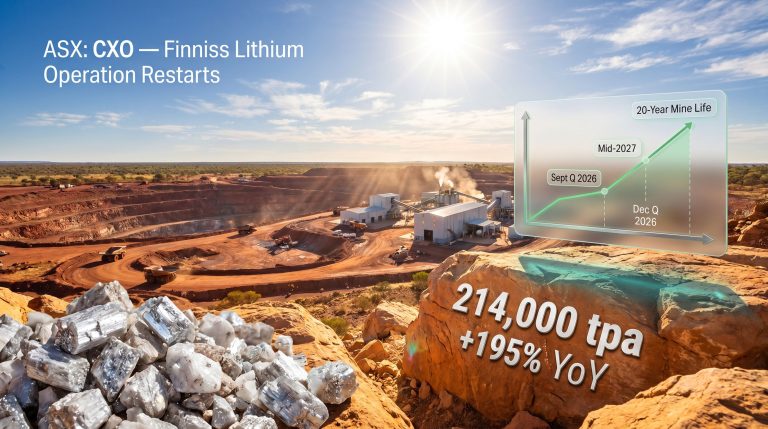
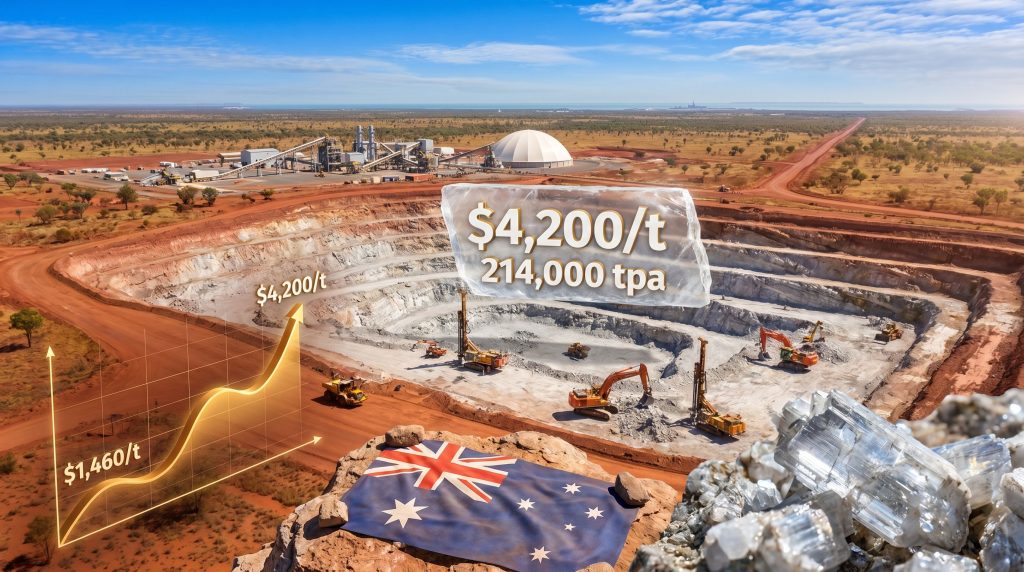
Understanding why Core Lithium restarts Finniss mine in May 2026 requires looking at the full arc of that cycle, not just the price number that crossed a threshold. The restart is as much a story about structural cost reform, geological advantages, and logistics geography as it is about spodumene concentrate recovering to approximately $4,200 per tonne.
When big ASX news breaks, our subscribers know first
Finniss in Context: Why Location and Geology Create a Different Risk Profile
Most casual observers of Australia's lithium industry associate the sector almost entirely with Western Australia, and with good reason. The Pilbara and Goldfields regions host the majority of the country's spodumene output, including some of the world's largest hard-rock lithium operations.
Finniss occupies a structurally distinct position. Situated roughly 90 kilometres south of Darwin in the Northern Territory, it is the only lithium mine outside of Western Australia currently operating in Australia. That geographic outlier status comes with genuine advantages that are frequently underappreciated.
Darwin Port sits at one of the closest points on the Australian continent to the major lithium processing markets of Northeast Asia. Chinese converters, which dominate the transformation of spodumene concentrate into battery-grade lithium hydroxide and carbonate, represent the primary destination for Australian hard-rock lithium. The freight differential between Darwin and the Pilbara ports is meaningful at scale, particularly as shipping costs and supply chain efficiency become increasingly scrutinised by downstream customers.
The BP33 Ore Body: Geological Characteristics That Matter
The long-term value case for Finniss rests heavily on the BP33 underground lithium mine deposit, and the geological characteristics of this ore body deserve closer examination than they typically receive.
Management has described BP33 as possessing high-grade lithium mineralisation within an ore body that is notably thick and geometrically regular. In underground mining, geometry is almost as important as grade. Ore bodies that are wide, consistent in dip, and free from complex structural interruptions allow for mechanised bulk mining methods such as long-hole open stoping, which dramatically improves the economics of extraction compared to narrower, more erratic ore bodies requiring selective mining.
A geometrically well-behaved underground ore body reduces dilution, improves equipment utilisation rates, and supports predictable production scheduling. These factors translate directly into lower operating costs per tonne of concentrate produced. The $274 million contract awarded to Develop Global for BP33 underground development reflects the scale of the asset, and the decision to commit that capital at this stage of the cycle signals genuine confidence in the deposit's long-term economics.
Key Project Metrics at a Glance
| Metric | Detail |
|---|---|
| Location | ~90km south of Darwin, NT |
| Mine type | Open pit (near-term) + underground (long-term) |
| Annual production capacity | ~214,000 tonnes per annum |
| Projected total mine life | 20 years |
| Underground contract value | $274 million (Develop Global) |
| Surface mining contract | NRW (Grants open pit) |
| Workforce at full capacity | Up to 300 employees |
The 2024 Shutdown: What Spodumene Price Collapse Actually Means for Marginal Producers
To appreciate the significance of the 2026 restart, it is worth reconstructing the economic mechanics that forced the 2024 closure with some precision.
Spodumene concentrate prices peaked dramatically in late 2022, driven by a combination of surging electric vehicle adoption, inventory building by Chinese converters, and supply constraints across the hard-rock lithium sector. By early 2024, that cycle had reversed sharply. Prices fell to approximately $1,460 per tonne, a level that represented roughly a 75 to 80 per cent decline from peak pricing in many market estimates.
For a mine like Finniss in its early operational phase, this was not merely a margin compression event. It was an existential cost challenge. Early-stage operations typically carry higher unit costs than mature producers because fixed costs are spread across lower production volumes, learning curves have not yet been fully realised, and workforce productivity improvements take time to embed. When the price floor drops below the all-in sustaining cost of production, the rational decision is suspension.
The 2024 closure was not a geological verdict on Finniss. It was a commodity market verdict on the cost structure of a young operation at the worst possible moment in the price cycle.
Up to 150 jobs were lost when mining was suspended in early 2024, a reminder that commodity price volatility carries human costs that extend well beyond balance sheets.
What Changed Between 2024 and 2026?
Several factors converged to make the May 2026 restart commercially viable:
- Spodumene concentrate prices recovered to approximately $4,200 per tonne, nearly triple the 2024 trough level
- The care-and-maintenance period was used to restructure the operating cost base, though specific details of cost reduction measures have not been fully disclosed publicly
- Stockpiled ore mined before the 2024 closure continued to generate cash flow during the shutdown, preserving liquidity
- Retained on-site equipment and existing processing infrastructure eliminated the need for major capital expenditure on plant construction for the restart
- The Final Investment Decision was formally approved prior to mobilisation, providing the governance framework for recommencement
The combination of materially higher prices and a structurally lower cost base creates a wider margin buffer than existed at the time of the original 2022 start-up, which is arguably the most important improvement of all.
How the Restart Was Financed: Capital Structure and Risk Layering
Financing a mine restart from care and maintenance requires a different capital approach than a greenfield development. The asset base already exists, which reduces construction risk, but the commodity price environment and operational track record must be sufficiently strong to attract debt capital on acceptable terms.
Core assembled a layered financing package to support the Finniss restart:
| Financing Component | Approximate Value |
|---|---|
| Initial debt and convertible notes package | ~$170 million |
| Equity raise (intended component) | ~$120 million |
| Cash on hand | ~$41 million |
| Supplementary: stockpile sale proceeds | Variable |
| Total financing envelope | ~$205-$290 million |
The use of convertible notes alongside senior secured debt reflects a nuanced approach to capital structure. Convertible instruments allow the company to access financing at lower cash interest costs than pure debt, while providing noteholders with upside exposure through conversion rights if the equity price appreciates. This structure is particularly useful when a company's equity valuation may not fully reflect the project's recovered economics at the time of financing.
Furthermore, the ~$41 million in existing cash combined with stockpile sale proceeds provided a liquidity bridge that reduced the urgency of completing the equity raise before operations recommenced, giving management some flexibility in timing the share issuance to market conditions. According to Core Lithium's investor updates, the company has been transparent about the capital allocation strategy underpinning this phased approach.
The Two-Stage Production Strategy: Risk Management Through Sequencing
One of the most strategically intelligent aspects of the Finniss restart is its deliberate sequencing of production stages. Rather than attempting to develop the underground mine and generate near-term cash flow simultaneously, Core has structured a phased approach that manages capital risk and cash flow timing effectively.
Stage One: Grants Open Pit as the Cash Flow Bridge
The Grants open pit deposit serves as the immediate revenue engine. Blasting and excavation recommenced in May 2026, with first concentrate shipments from newly mined ore targeted for the September to December 2026 quarter. The open pit is expected to operate for approximately 12 months, providing ore feed to the existing processing plant during the period when the underground operation is being developed.
This approach is capital-efficient for several reasons:
- Open pit mining requires less upfront development capital than underground mining
- The existing processing infrastructure can be utilised immediately without major modifications
- Early cash flow from open pit production reduces the financing burden on the balance sheet during underground development
- Any operational challenges can be identified and addressed before the company is reliant on underground ore feed
Stage Two: BP33 Underground as the Long-Term Anchor
The underground development at BP33 is projected to deliver a 10-year mine life, forming the backbone of a total project mine life of approximately 20 years. Underground development is scheduled to commence in the months following the open pit restart.
The geological characteristics of BP33, particularly its thickness and grade consistency, are well-suited to mechanised underground extraction. Understanding how lithium mining works at this scale helps illustrate why high-grade, wide ore bodies in underground environments support bulk mining methods that achieve lower operating costs per unit of ore extracted, which is critical for maintaining profitability across multiple price cycles.
Production Timeline
| Milestone | Timing |
|---|---|
| Open pit mining recommences | May 2026 |
| First new concentrate shipments | Q3-Q4 2026 |
| Underground development commences | Mid-2026 onwards |
| Open pit operational period | ~12 months |
| Underground mine life | 10 years |
| Total projected mine life | 20 years |
Infrastructure Vulnerability and the Cox Peninsula Road Problem
No analysis of Finniss is complete without a frank assessment of its logistical dependency on Cox Peninsula Road. This single road represents the entire export supply chain between the mine and Darwin Port, and its condition directly determines whether mined ore can be converted into shipped revenue.
The 2025-26 wet season in the Northern Territory was notably severe, causing widespread road damage across the region. Cox Peninsula Road sustained damage that requires coordinated repair efforts involving local council and broader stakeholders. Management has acknowledged the challenge and indicated active engagement to minimise production scheduling impacts.
This infrastructure dependency is an underappreciated risk in most conventional assessments of Finniss. A single-road logistics chain in a remote tropical environment introduces a category of operational risk that is fundamentally different from the geological or commodity price risks that analysts typically model.
For investors evaluating the restart, the key question is not whether road damage will occur — because in the Northern Territory wet season context it almost certainly will in any given year — but whether the repair and maintenance regime is robust enough to minimise cumulative production losses over a multi-year operating period.
The next major ASX story will hit our subscribers first
What Finniss Means for Australia's Lithium Supply Chain
The recommencement of Core Lithium restarts Finniss mine adds meaningful spodumene concentrate supply back into a market that has been recovering from a period of producer rationalisation. Australia remains the world's largest producer of lithium spodumene, and the geographic diversification that Finniss provides relative to the Western Australian cluster is strategically relevant.
Finniss vs. Typical WA Lithium Operations
| Factor | Finniss (NT) | Typical WA Spodumene Operation |
|---|---|---|
| Geographic location | Northern Territory | Western Australia (Pilbara/Goldfields) |
| Export port | Darwin Port | Port Hedland / Fremantle |
| Mine type | Open pit + underground | Predominantly open pit |
| Proximity to Asian markets | High | Moderate |
| Infrastructure maturity | Established (pre-existing) | Varies by project |
Lithium spodumene concentrate is the primary upstream input for lithium-ion battery manufacturing, feeding into conversion facilities that produce the battery-grade lithium compounds required by cathode manufacturers. In addition, innovations such as direct lithium extraction are reshaping how efficiently the broader sector processes lithium, adding further competitive pressure on traditional hard-rock producers to optimise their cost structures.
Demand growth continues to be anchored by electric vehicle adoption globally and the expanding deployment of grid-scale stationary energy storage. Australia's position as a reliable, politically stable, and technically sophisticated spodumene supplier makes projects like Finniss strategically significant to battery supply chains across Asia.
Key Risks and Investor Considerations
Any assessment of the Finniss restart must be balanced against the risks that remain material:
- Commodity price volatility remains the dominant risk. The 2024 experience demonstrated how rapidly spodumene prices can move from economically comfortable to operationally threatening levels
- Single-road logistics dependency introduces production continuity risk that is difficult to fully hedge
- Underground development execution at BP33 carries the inherent complexity and cost uncertainty associated with any large-scale underground mining project
- Cost structure transparency is limited, as specific cost reduction measures have not been fully disclosed, making independent verification of the improved economics challenging
- Equity dilution from the intended $120 million equity raise represents a consideration for existing shareholders evaluating the capital structure
Detailed operational performance data, including processing recoveries and unit cost benchmarks, can be found in the Finniss restart study presentation, which provides further context for investors assessing the project's revised economics.
This article is informational in nature and does not constitute financial advice. Investments in mining equities involve significant risk, including commodity price risk, operational risk, and capital loss. Readers should seek independent financial advice before making investment decisions.
Frequently Asked Questions: Core Lithium Restarts Finniss Mine
Why did the Finniss mine close in 2024?
Mining was suspended in early 2024 after spodumene concentrate prices fell to approximately $1,460 per tonne, a level that rendered the operation economically unviable given its cost structure at the time. Up to 150 jobs were lost during the closure.
How was the restart funded?
Core assembled a financing package comprising an initial $170 million debt and convertible notes arrangement, an intended $120 million equity raise, approximately $41 million in existing cash reserves, and supplementary proceeds from the sale of stockpiled ore mined before the 2024 closure.
When will the first shipments from newly mined ore occur?
First concentrate shipments from ore extracted during the 2026 restart are targeted for the September to December 2026 quarter.
What is the long-term development plan?
The long-term strategy centres on the BP33 underground mine, for which a $274 million contract has been awarded to Develop Global. BP33 is projected to deliver a 10-year underground mine life, contributing to an overall project life of approximately 20 years and annual production capacity of around 214,000 tonnes of spodumene concentrate.
How many people will the operation employ?
At full production capacity, the Finniss operation is expected to employ up to 300 people.
Want to Stay Ahead of the Next Major Lithium Discovery on the ASX?
Discovery Alert's proprietary Discovery IQ model delivers real-time alerts on significant ASX mineral discoveries across lithium and more than 30 other commodities, turning complex market data into clear, actionable investment insights. Explore how historic mineral discoveries have generated exceptional returns and begin your 14-day free trial today to position yourself ahead of the broader market.