May 20, 2026
Why Lithium's Boom-Bust Cycle Is the Feature, Not the Bug
Commodity markets have a long memory, but investors often do not. The lithium sector's dramatic price collapse between 2023 and 2024 was not an anomaly within the broader critical minerals story. It was a textbook supply overshoot following a period of demand euphoria, a pattern repeated across virtually every major battery metal in modern history. Understanding this cycle is the starting point for interpreting what Core Lithium restarts operations at Finniss actually means, not just as a corporate milestone, but as a signal about where the lithium market stands within its longer structural arc.
The critical minerals investment landscape operates on layered timelines. Short-term price volatility drives operational decisions. Medium-term demand forecasts drive capital allocation. Long-term structural themes, electrification, battery storage, grid infrastructure, drive the underlying thesis that justifies entering the sector at all. When these three timelines realign after a period of dislocation, the result is precisely what is unfolding in Australia in 2026: a coordinated wave of production restarts by operators who used the lithium market downturn not to exit, but to rebuild on more efficient foundations.
When big ASX news breaks, our subscribers know first
The Price Signal That Unlocked the Restart Decision
Lithium carbonate prices have recovered approximately +195% year-on-year against futures benchmarks tracked by TradingEconomics, a reversal significant enough to shift the internal economics of multiple previously suspended operations back into viable territory. Importantly, this recovery has not been fragile. While the commodity did give back some short-term gains in recent sessions, both lithium and copper have broadly shrugged off geopolitical headwinds that have weighed heavily on energy commodities such as Brent Crude.
The parallel behaviour of lithium and copper in the current cycle is worth noting. Both commodities are benefiting from structural electrification tailwinds that are largely independent of the conflict-driven risk aversion affecting oil markets. This divergence between energy commodities and critical minerals is a meaningful signal for investors trying to calibrate exposure across the resources sector.
Market Psychology Note: The +195% year-on-year price recovery in lithium has crossed a psychological and operational threshold for producers. This is not simply a price move, it is a trigger event that shifts dormant assets from a cost-only state into a revenue-generating calculation.
What is less commonly understood is how the 2023 to 2024 shutdown cycle, painful as it was for shareholders, functioned as a forced rationalisation of project economics. Operators who remained in care and maintenance used the period to renegotiate contractor rates, redesign mine sequences, and identify cost structures that simply could not have been achieved under continuous production pressure. The restart models emerging in 2026 are, in several cases, materially leaner than the operating configurations that preceded the downturn.
Finniss Lithium Operation: What Makes This Asset Different
Infrastructure Maturity and the Northern Territory Advantage
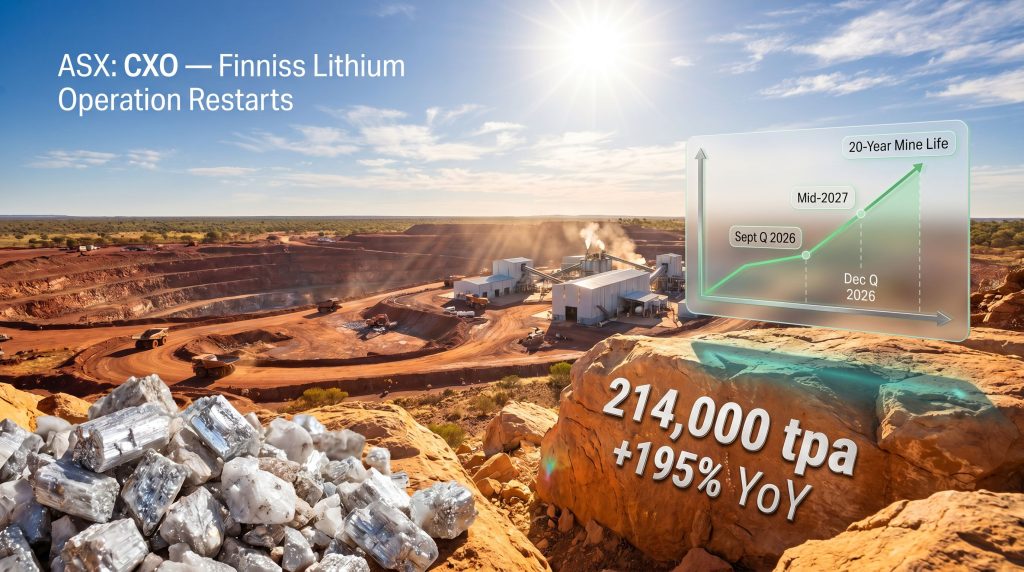
The Finniss Lithium Operation, located in the Northern Territory of Australia and operated by Core Lithium (ASX: CXO), carries a current market capitalisation of approximately A$918.6 million. The project is positioned as a 20-year mine life operation with an annual nameplate production capacity of 214,000 tonnes of spodumene concentrate.
What separates Finniss from many restart candidates across the Australian lithium sector is the maturity of its surface infrastructure. Processing facilities, haul roads, and logistics corridors already exist. This compresses the critical path from investment decision to first ore, and ultimately to first revenue, in a way that genuinely greenfield operations cannot replicate. In a commodity cycle where timing is everything, existing infrastructure is a competitive advantage that does not appear on resource estimates but is deeply material to project economics.
The project also benefits from secured offtake and capital arrangements with Glencore, InfraVia, and Nebari, a multi-partner structure that distributes counterparty risk and signals institutional conviction in the project's medium-term economics.
The A$290 Million Funding Architecture
Core Lithium secured a fully committed funding package alongside a Final Investment Decision (FID) in March 2026, with the total package reportedly reaching approximately A$290 million. This capital structure is significant not just for its size, but for what it represents directionally. Institutional capital is flowing back into proven lithium assets with existing infrastructure, not into unbuilt greenfield projects requiring years of permitting and construction.
| Metric | Detail |
|---|---|
| Market Capitalisation | ~A$918.6 million |
| Annual Production Capacity | 214,000 tonnes spodumene concentrate |
| Projected Mine Life | 20 years |
| Funding Package | ~A$290 million |
| FID Approval | March 2026 |
| First Concentrate Target | September Quarter 2026 |
| First Sales Target | December Quarter 2026 |
| Strategic Partners | Glencore, InfraVia, Nebari |
Spodumene Concentrate: Understanding the Product at the Heart of the Finniss Thesis
A point often glossed over in general market coverage is that spodumene extraction does not yield a finished battery material. It is a lithium-bearing mineral, a pyroxene group silicate, that must be further processed into lithium hydroxide or lithium carbonate before it enters battery manufacturing supply chains. The quality of spodumene concentrate is measured in lithium oxide (Li₂O) content, with higher grades commanding premium pricing and attracting stronger offtake interest from converters.
The Finniss deposit has historically produced a concentrate grading in the range typical for commercially viable Australian hard rock lithium operations, which is generally between 5.5% and 6% Li₂O. At these grades, the material is well-suited to the conversion requirements of Asian battery-grade lithium producers, which remain the primary demand destination for Australian spodumene.
Technical Context: The global lithium supply chain operates in two distinct segments: hard rock spodumene producers (predominantly Australia) and lithium brines (predominantly Chile and Argentina). Australian spodumene is faster to bring into production and has more predictable grade profiles than brine operations, which require multi-year evaporation pond infrastructure. This structural characteristic underpins why Australian restarts can move from decision to revenue within quarters rather than years.
Phased Execution: How Core Lithium Is Sequencing the Restart
Stage One: Grants Open Pit as the Near-Term Revenue Engine
The Finniss restart begins at the Grants open pit, which offers the lowest capital intensity and fastest path to ore feed given its surface accessibility. First ore from Grants is targeted within one month of contractor mobilisation, with processing scheduled to commence in the September quarter of 2026. This near-term production sequence is deliberately designed to establish an early revenue pathway before the more capital-intensive underground phase requires significant additional spend.
The open-pit first approach is also operationally lower risk. Surface mining operations are easier to ramp up, scale, and pause if market conditions change than underground development, which requires continuous investment to maintain ventilation, ground support, and development headings regardless of short-term price movements.
Stage Two: BP33 Underground Development for Production Longevity
Running in parallel with Grants open-pit activity, Core Lithium is advancing BP33 underground development to establish the longer-duration production backbone of the operation. First ore from BP33 is targeted for mid-2027, providing a natural production handoff as the open-pit resource transitions.
Underground lithium mining at BP33 is expected to access higher-confidence, potentially higher-grade material that underpins the project's 20-year mine life projection. The staged approach is strategically sound: it matches capital deployment to revenue milestones rather than front-loading investment into underground development before the operation has proven its processing throughput and market execution.
Staged Execution Roadmap:
- Month 1 post-mobilisation: First ore from Grants open pit
- September Quarter 2026: Processing commences at Finniss
- December Quarter 2026: First spodumene concentrate sales
- Mid-2027: First ore from BP33 underground
- Longer-term: Ramp-up toward 214,000 tpa nameplate capacity
The Simultaneous Restart Phenomenon: What Bald Hill and Finniss Signal Together
Within days of Core Lithium restarts operations at Finniss being announced, Mineral Resources (ASX: MIN) recommenced works at its Bald Hill lithium mine, creating a near-simultaneous reactivation event that the market could not easily dismiss as coincidence. Both companies, different in scale and capital structure, reached the same operational conclusion within the same week. That convergence tells investors something important about the price threshold at which previously suspended Australian lithium operations cross back into economically justified territory.
The timing also highlights a structural feature of the Australian lithium sector that is not widely appreciated: mothballed operations with existing infrastructure do not restart in isolation. They restart in cohorts, because the price signal that makes one viable tends to make several viable simultaneously. This cohort behaviour has implications for how quickly new supply can arrive in the market after a price recovery, which is itself a factor that can cap price upside if multiple operations recommence at scale within a short window.
Furthermore, Core Lithium shares responded with approximately +5% gains in early trading on the restart announcement, a measured but meaningful reaction on what was described as a broadly subdued trading day for the ASX.
The next major ASX story will hit our subscribers first
Historical Price Context: The 2023 Trough to 2026 Recovery
| Period | Lithium Market Condition | Core Lithium Response |
|---|---|---|
| Mid-2023 | Severe price collapse | Mothballed Finniss operations |
| 2023-2024 | Extended care and maintenance phase | Project review and redesign |
| Early 2026 | Price recovery; +195% YoY gain | FID approved; funding secured |
| May 2026 | Active restart; early revenue pathway | Operations recommenced at Finniss |
| December Quarter 2026 | First concentrate sales targeted | Revenue generation phase begins |
The five-year price chart for lithium carbonate is instructive for investors who entered the sector during the 2021 to 2022 boom. The commodity's trajectory from peak to trough and back again encapsulates a full demand-supply adjustment cycle compressed into roughly four years. Core Lithium's stock price trajectory closely mirrored this commodity arc, with shares collapsing from their peak as Finniss was mothballed and now recovering as operations recommence.
Risk Scenarios: Three Pathways From Here
Scenario A: Sustained Recovery Validates the Economics
If lithium carbonate prices hold at or above current levels through the December quarter, Core Lithium's Grants concentrate sales could establish positive operating cash flow ahead of the BP33 underground ramp-up. Under this scenario, the phased approach de-risks the capital programme and creates the possibility of partially self-funding underground development from operational cash flows, reducing reliance on the external funding package over time.
Scenario B: Price Retracement Pressures Open-Pit Margins
Open-pit operations at Grants carry thinner margins than the higher-grade underground production expected from BP33. A return toward 2023-style price weakness would challenge this phase specifically. The A$290 million funding package provides a capital buffer, but extended weakness could delay the BP33 timeline or require renegotiation of key commercial arrangements.
Scenario C: Demand Acceleration Rewards Early Movers
Accelerating EV adoption in China and Europe could tighten lithium supply faster than current market consensus anticipates, rewarding producers who reactivated early with premium pricing windows. Under this scenario, Finniss's 214,000 tpa capacity and secured Glencore offtake arrangement could position Core Lithium as a preferred supplier in a supply-constrained environment.
Investor Consideration: The most important external variable for the Finniss thesis is not the restart execution itself, which appears well-structured, but whether the lithium price recovery has the durability to sustain the full 20-year production thesis. Lithium's demonstrated sensitivity to Chinese demand cycles and EV adoption rates means price forecasting beyond 12 to 18 months carries substantial uncertainty. Investors should treat long-range price projections as scenario inputs rather than base-case assumptions.
Australia's Structural Role in Global Lithium Supply
The near-simultaneous restart of Finniss and Bald Hill reinforces a broader truth about the global lithium supply chain: Australia's lithium industry functions as a swing producer with unusually fast restart capability. Unlike brine operations in South America, which require years of infrastructure development and have more variable grade consistency, Australian spodumene deposits can transition from care and maintenance to ore production within months when economic conditions are met.
This responsiveness is simultaneously Australia's greatest competitive advantage and its most significant supply-side risk. The same infrastructure maturity that allows rapid restarts also means that price recoveries can attract coordinated supply responses that moderate upside more quickly than markets expect.
Australia remains the world's largest lithium producer by volume, and the reactivation of assets like Finniss deepens the country's role as the primary hard rock spodumene supplier to Asian battery manufacturing supply chains. Whether that position translates into sustained value creation for producers like Core Lithium ultimately depends on how the global energy transition timeline intersects with the commodity's notoriously difficult-to-predict price cycles. The latest investor updates from Core Lithium provide further detail on how the company is positioning itself within this evolving landscape.
Frequently Asked Questions
When did Core Lithium restart operations at Finniss?
Core Lithium officially recommenced operations at the Finniss Lithium Operation in May 2026, following a Final Investment Decision and funding commitment secured in March 2026.
When will Core Lithium produce its first spodumene concentrate?
The company is targeting first spodumene concentrate production in the September quarter of 2026, with first sales anticipated in the December quarter of 2026.
How long was Finniss on care and maintenance?
Finniss entered care and maintenance in 2024 following the lithium price downturn of 2023, remaining suspended for approximately two years before the 2026 restart decision.
What is the total funding secured for the Finniss restart?
Core Lithium secured approximately A$290 million in committed funding, involving strategic partners Glencore, InfraVia, and Nebari.
What is the projected mine life of the Finniss operation?
Finniss has been repositioned as a 20-year mine life operation with annual nameplate production capacity of 214,000 tonnes of spodumene concentrate.
How does the Finniss restart compare to MinRes's Bald Hill recommencement?
Both operations restarted within days of each other in May 2026, both responding to a lithium price recovery of approximately +195% year-on-year. Finniss is backed by a multi-partner A$290 million package targeting a 20-year mine life, while Bald Hill's recommencement reflects Mineral Resources' broader portfolio reactivation strategy. For additional context on the broader operational picture, the Finniss restart presentation outlines the key milestones and strategic rationale in detail.
The material in this article is intended for informational purposes only and does not constitute financial or investment advice. Readers should conduct their own research and consult a licensed financial adviser before making investment decisions. Forward-looking statements, price projections, and scenario analyses involve inherent uncertainty and should not be relied upon as predictions of future outcomes.
Want To Be First When the Next Major Lithium Discovery Hits the ASX?
Discovery Alert's proprietary Discovery IQ model delivers real-time alerts on significant ASX mineral discoveries — instantly translating complex data across 30+ commodities into actionable insights for both short-term traders and long-term investors. Start your 14-day free trial today and explore how historic mineral discoveries have generated substantial returns for those positioned ahead of the market.