May 19, 2026
The Science Behind Europe's Most Unconventional Lithium Project
Battery supply chains have a geological blind spot. For decades, the lithium industry oriented itself almost entirely around two feedstock archetypes: spodumene-bearing pegmatites concentrated in Western Australia, and the vast lithium-rich brines sitting beneath the salt flats of Chile, Argentina, and Bolivia. Everything outside these two categories was treated as a curiosity rather than a commercial opportunity.
The result was a global processing infrastructure built exclusively for these mineralogies, leaving an entire class of lithium-bearing minerals functionally stranded despite their widespread occurrence across European geology.
That calculus is now being challenged. Cornish Lithium's mica processing technique represents a direct intervention in this structural gap, applying licensed hydrometallurgical chemistry to extract battery-grade lithium hydroxide from the micaceous granites beneath Cornwall. What makes this effort genuinely significant is not simply the resource itself, but the integrated model it proposes: domestic ore extraction, on-site chemical refining, and a drastically lower-temperature processing route that sidesteps the energy-intensive roasting steps that have long defined conventional lithium refining.
Understanding why this matters requires a close examination of both the geology involved and the engineering choices that define the Cornish Lithium mica processing technique.
When big ASX news breaks, our subscribers know first
Why Mica Has Been Lithium's Forgotten Feedstock
The global lithium processing industry standardised around spodumene and brines for practical reasons. Spodumene extraction is relatively straightforward to identify, grade, and process at scale. Lithium brine operations, while geographically constrained, benefit from low extraction costs where conditions are favourable. Both feedstocks have multi-decade commercial track records that have attracted capital, engineering expertise, and infrastructure investment.
Lithium-bearing micas, by contrast, have historically presented a different set of challenges:
- Lithium in mica is structurally incorporated into the crystal lattice of phyllosilicate minerals, making selective extraction more complex
- The lower lithium grades typical of mica-bearing granites compared to high-quality spodumene deposits created unfavourable economics at historical lithium prices
- Flotation circuits designed to concentrate lithium-rich mica from surrounding gangue minerals require reagent chemistry tailored specifically to phyllosilicate surface properties
- The absence of a commercially proven, scalable processing flowsheet created a technical credibility gap that discouraged investment
Recent advances in selective hydrometallurgical processing have materially changed this picture. Improved flotation reagent chemistry, optimised acid leaching kinetics, and more sophisticated impurity management techniques have collectively shifted the economic threshold for mica-hosted lithium deposits. The critical insight from a mineralogy standpoint is that mica's weaker structural bonds, compared to spodumene's pyroxene framework, actually offer an advantage once the right processing chemistry is deployed: lithium can be dissolved at dramatically lower temperatures without requiring a high-energy phase transformation step.
The Geology of Trelavour and What Makes It Different
Cornish Lithium's primary hard-rock resource is located at the Trelavour Pit in Cornwall, UK, where lithium occurs within micaceous granite. The specific mineralogical context here is important for understanding why conventional processing routes cannot simply be transplanted to this deposit.
In spodumene deposits, lithium exists as discrete crystals of a pyroxene-group mineral that can be physically concentrated through relatively straightforward crushing, milling, and gravity or flotation separation. Processing then involves a two-stage calcination in which spodumene is first heated to approximately 1,000°C to convert it from its alpha phase to a more reactive beta phase, followed by sulfuric acid digestion.
At Trelavour, lithium is distributed through the crystal lattice of mica minerals, specifically within phyllosilicate structures where lithium substitutes for other elements in the sheet silicate framework. This is not a minor distinction.
| Feature | Spodumene (Hard Rock) | Lithium Mica (Cornish Granite) |
|---|---|---|
| Mineral group | Pyroxene | Phyllosilicate (sheet silicate) |
| Processing temperature | ~1,000°C calcination required | ~105°C acid leach |
| Primary source regions | Australia, Zimbabwe | UK, Europe, Central Asia |
| Processing pathway | High-temperature roasting + acid digest | Direct hydrometallurgical route |
| Carbon intensity | High (fossil fuel-intensive roasting) | Significantly lower |
| Co-product potential | Limited | Aluminium sulfate and other by-products |
| Technology maturity | Highly proven commercially | At industrial demonstration stage |
The Cornish granite belt has been studied for lithium content for decades, with academic research confirming that economically meaningful concentrations are present across the region. What was missing until recently was a commercially validated processing pathway capable of extracting battery-grade lithium hydroxide from these phyllosilicate hosts.
How Cornish Lithium's Mica Processing Technique Works: A Step-by-Step Breakdown
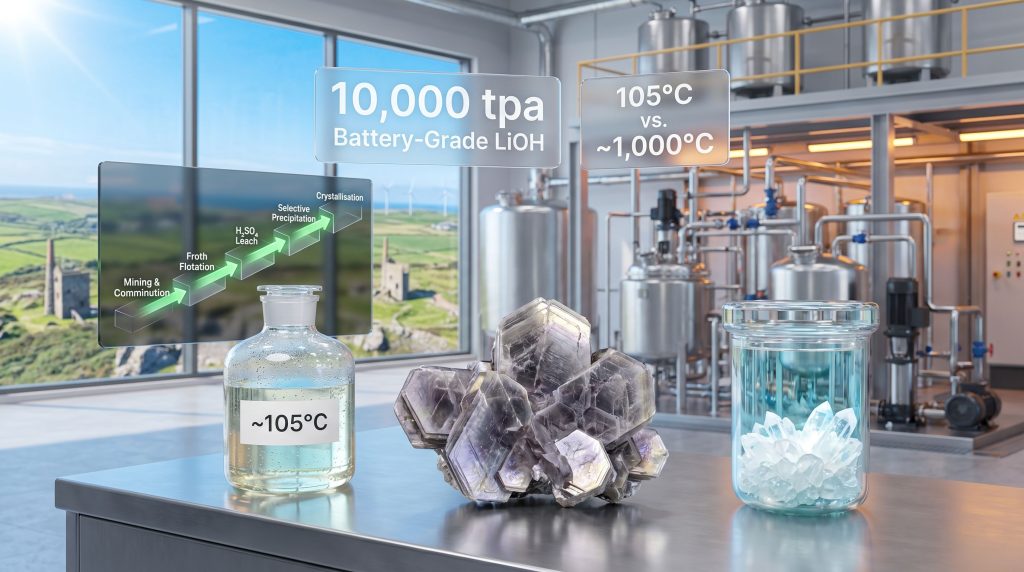
The Cornish Lithium mica processing technique is a five-stage hydrometallurgical flowsheet that distinguishes itself from conventional spodumene refining at almost every point. The defining engineering choice is the substitution of high-temperature roasting with low-temperature acid leaching, a decision that reshapes both the energy profile and the environmental footprint of the entire process.
Furthermore, direct lithium extraction technology developments more broadly have helped inform the type of innovative thinking underpinning this approach.
Core Technical Insight: By operating an acid leach at approximately 105°C rather than requiring calcination at close to 1,000°C, the flowsheet eliminates the single most energy-intensive step in conventional lithium processing. This is not an incremental efficiency improvement but a fundamental architectural difference in how lithium is liberated from its host mineral.
Stage 1: Mining and Comminution
Granite ore is extracted from the Trelavour open pit and processed through crushing and milling circuits designed to reduce particle size and liberate lithium-bearing mica minerals from the surrounding silicate gangue matrix. Effective comminution is not a routine step here: because lithium is distributed through the mica crystal lattice rather than occurring as discrete high-density mineral grains, particle size reduction must achieve genuine mineral liberation without over-grinding material to the point where downstream flotation becomes inefficient.
The degree of liberation achieved at this stage directly governs the recoverable lithium fraction in subsequent processing. Poor comminution translates directly to lower concentrate grades and ultimately lower lithium recovery rates at the end of the flowsheet.
Stage 2: Froth Flotation and Mica Concentration
Milled ore enters flotation circuits where reagent chemistry is applied to selectively separate lithium-rich mica minerals from lithium-barren silicates. Flotation in mica systems requires careful attention to the surface chemistry of phyllosilicate minerals, which behave differently from the oxide and sulfide minerals that most flotation circuit designs are originally calibrated for.
The output of this stage is a lithium-rich mica concentrate, representing a significantly upgraded feedstock compared to run-of-mine ore. Critically, this concentration step reduces the volume of material requiring chemical treatment in subsequent stages, directly affecting acid consumption rates and the scale of downstream processing infrastructure required.
Lithium-barren gangue minerals, primarily quartz and feldspar, are removed at this point. Their separation here rather than after acid treatment is an important economic consideration, as it avoids the unnecessary dissolution and subsequent disposal of large volumes of non-value-bearing material.
Stage 3: Concentrated Sulfuric Acid Leaching
The mica concentrate is treated with concentrated sulfuric acid (approximately 98% H₂SO₄) at a controlled temperature of approximately 105°C. This is the chemically defining step of the entire flowsheet. The acid attacks the phyllosilicate structure of the mica, dissolving lithium along with aluminium, iron, manganese, and other metals present in the mineral lattice into a pregnant leach solution (PLS).
The engineering variables at this stage that require precise control include:
- Acid-to-concentrate ratio, which affects both lithium recovery and impurity dissolution
- Residence time within the leach reactor, governing reaction completeness
- Temperature uniformity across the leach vessel, particularly important at industrial throughput where heat distribution becomes a more complex engineering problem
- Management of evolved gases, as the acid-rock interaction generates reaction products that must be safely handled
Operating at 105°C rather than 1,000°C is not just an energy-saving measure. It also means the process can be driven by lower-grade heat sources, potentially including industrial waste heat, and is compatible with electrically powered infrastructure, making the carbon intensity of the step highly sensitive to the composition of the local electricity grid.
Stage 4: Selective Precipitation and Impurity Removal
The pregnant leach solution at this point contains a complex mixture of dissolved metal sulfates. Before lithium can be isolated, the solution must be systematically purified. Selective precipitation chemistry is applied in a controlled sequence to remove aluminium, iron, manganese, and other impurity metals by adjusting solution pH and temperature to cause specific metals to precipitate as hydroxides, oxides, or sulfates at different points in the treatment sequence.
This stage is technically demanding because the selectivity of each precipitation step determines the purity of the final lithium product. Battery-grade lithium hydroxide must meet impurity specifications set by cathode material manufacturers that are extraordinarily stringent, typically requiring individual impurity elements to be below 20 parts per million (ppm) for calcium, magnesium, and sodium. Any failure to achieve the required selectivity at this stage propagates forward into the final product quality.
Notably, the dissolved aluminium recovered from this stage has potential value as an aluminium sulfate co-product, which could contribute meaningfully to the overall process economics.
Stage 5: Crystallisation to Battery-Grade Lithium Hydroxide
Following purification, the lithium-enriched solution undergoes crystallisation to produce lithium hydroxide monohydrate (LiOH·H₂O). The crystallisation parameters, including temperature, evaporation rate, seeding protocols, and residence time, govern both the purity and the physical characteristics of the final product. Crystal morphology and particle size distribution matter to cathode manufacturers, who require consistent material properties to optimise their own manufacturing processes.
Cornish Lithium's stated commercial production target is 10,000 tonnes per annum of battery-grade lithium hydroxide monohydrate, a volume that would make it a material contributor to European domestic supply if achieved at commercial scale.
The Lepidico Technology License: Why It Changes the Risk Profile
A critical but sometimes underappreciated aspect of the Cornish Lithium mica processing technique is that it is not being developed from first principles. The processing flowsheet, specifically the selective precipitation and crystallisation stages, is built on technology licensed from Lepidico, an Australian lithium technology company that developed its proprietary L-Max® process specifically for hydrometallurgical treatment of lithium-bearing mica minerals.
The strategic significance of this licensing arrangement extends beyond mere access to chemistry. Lepidico's L-Max® process has been tested and refined at multiple scales prior to Cornish Lithium's demonstration plant, providing an important base of engineering data on reagent consumption rates, leach kinetics, and impurity behaviour across different mica mineralogies. This body of prior work does not eliminate technical risk but meaningfully reduces the probability of encountering fundamental chemistry-level failures at the demonstration stage.
Key advantages the Lepidico technology brings to the Cornish Lithium flowsheet include:
- Commercially validated chemistry for dissolving lithium from phyllosilicate mineral matrices
- Established protocols for selective precipitation of the complex multi-metal leach solutions generated by mica acid treatment
- Demonstrated capability to produce battery-grade lithium hydroxide from mica feedstocks at sub-commercial scale
- Potential pathways to co-product recovery, including aluminium sulfate, that could improve overall process economics and reduce waste streams
- A degree of intellectual property protection around the core processing steps
The combination of Cornish Lithium's domestic ore body with Lepidico's processing chemistry creates a vertically integrated UK-based lithium production model in which ore extraction, concentration, chemical refining, and final product crystallisation all occur within Cornwall. This supply chain compression is itself a source of value in a regulatory environment that increasingly rewards traceable, low-carbon provenance.
The Industrial Demonstration Plant: Why This Step Cannot Be Skipped
Cornish Lithium has constructed an industrial-scale demonstration plant to validate the full processing flowsheet at commercially meaningful throughput. The internal characterisation of on-site processing as representing a significant milestone reflects the genuine operational weight of this step.
Why Demonstration Scale Matters: Laboratory chemistry and pilot-scale testing can validate reaction mechanisms and approximate recovery rates, but they cannot replicate the engineering challenges that emerge at industrial throughput. Heat transfer dynamics in large acid leach reactors, mixing efficiency in precipitation vessels, and crystallisation behaviour in large-scale evaporators all introduce variables that only become visible when processing volumes increase by orders of magnitude.
The demonstration plant must deliver against a specific set of performance criteria before the project can progress toward a bankable feasibility study and commercial project financing:
- Consistent production of battery-grade lithium hydroxide meeting cathode manufacturer purity specifications
- Validation of acid leaching parameters at industrial throughput, including acid consumption per tonne of lithium oxide produced
- Confirmation of selective precipitation efficiency across variable ore feed compositions
- Generation of verified environmental performance data covering effluent quality, reagent consumption, and direct carbon emissions
- Production of the engineering cost data required to underpin a credible capital expenditure estimate for a full commercial facility targeting 10,000 tpa LiOH
Demonstration plant results will also inform the design of acid management systems, impurity handling infrastructure, and waste stream processing facilities for any subsequent commercial plant, all of which are subject to regulatory approval and community scrutiny.
The next major ASX story will hit our subscribers first
Comparing Mica Hydrometallurgy to Conventional Lithium Processing
The differences between the Cornish Lithium mica processing technique and the conventional spodumene calcination route run deeper than temperature alone. They reflect fundamentally different relationships between ore mineralogy, processing chemistry, energy consumption, and supply chain geography.
| Processing Parameter | Conventional Spodumene Route | Cornish Lithium Mica Route |
|---|---|---|
| Key processing step | High-temperature calcination (~1,000°C) | Sulfuric acid leaching (~105°C) |
| Energy intensity | Very high | Significantly lower |
| Carbon footprint | High (roasting + transport) | Lower (no roasting, compressed supply chain) |
| Processing location | Typically offshore (often refined in China) | Designed for on-site UK processing |
| Supply chain length | Mine to ship to refinery to battery plant | Mine to on-site refinery to battery plant |
| Co-product potential | Limited | Aluminium sulfate recoverable |
| Technology maturity | Commercially proven at scale | At industrial demonstration stage |
| Geographic applicability | Spodumene-bearing pegmatites | Mica-bearing granites across Europe and UK |
The carbon intensity argument for the mica route is most persuasive when examined at the full supply chain level. Conventional spodumene processing involves multiple intercontinental shipping movements: ore from Western Australia travels to China for calcination and refining, before lithium hydroxide is shipped again to European battery manufacturers. Each leg carries transport emissions in addition to the substantial energy consumed in roasting. A UK-produced, domestically refined product eliminates most of these logistics emissions while simultaneously removing the highest-energy processing step.
This positioning becomes commercially significant under the EU's Battery Regulation, which requires carbon footprint declarations for battery-grade lithium starting in 2027 and will introduce maximum allowable carbon intensity thresholds that decrease annually. A demonstrably lower-carbon lithium hydroxide product carries tangible regulatory and commercial advantages in this environment.
Environmental and ESG Considerations: On-Site Processing in a Modern Context
The environmental profile of Cornish Lithium's approach is shaped by three interconnected factors: the absence of high-temperature calcination, the compression of the supply chain, and the location of processing within a jurisdiction with access to increasingly renewable grid electricity.
Cornwall has a deep mining heritage stretching back centuries, but contemporary lithium operations must navigate planning frameworks, environmental permitting requirements, and community engagement expectations that are qualitatively different from historical mining practice. On-site processing carries both advantages and responsibilities in this context.
On the positive side:
- Eliminating the need to transport ore to remote refining facilities reduces road traffic, associated dust and diesel emissions, and community amenity impacts
- Processing waste streams, including acid leach residues and flotation tailings, can be managed under direct regulatory oversight rather than being exported as a liability
- The potential recovery of aluminium sulfate and other co-products reduces the volume of material requiring disposal
On the regulatory challenge side, waste stream management will receive close scrutiny. Acid leach residues from sulfuric acid treatment of granite ore contain elevated concentrations of residual metals and require careful characterisation, containment, and potentially long-term monitoring. Community acceptance of a modern processing facility will depend significantly on the credibility of the environmental management data generated during the demonstration phase.
The demonstration plant's environmental performance data will therefore serve a dual purpose: it will inform process optimisation for commercial scale, and it will form part of the evidence base for any future permitting application.
Key Technical and Commercial Risks Investors Should Understand
No honest analysis of the Cornish Lithium mica processing technique can avoid its risk profile. Several categories of uncertainty are material to evaluating the project's commercial prospects.
Engineering risks at scale:
- Handling large volumes of concentrated sulfuric acid at industrial throughput introduces significant safety engineering and materials selection requirements, particularly for vessels, pipework, and pump systems exposed to corrosive conditions
- Natural variability in ore mineralogy across the Trelavour deposit may affect the consistency of pregnant leach solution composition, complicating the precision of selective precipitation chemistry
- Achieving consistent flotation concentrate grades across geologically heterogeneous ore domains is a known challenge in mica systems
- Crystallisation optimisation at industrial scale involves process control challenges that are genuinely different from bench-scale behaviour
Commercial and market risks:
- Battery-grade lithium hydroxide specifications are non-negotiable from the buyer's perspective; any product quality shortfall relative to cathode manufacturer requirements eliminates offtake potential regardless of price
- Lithium market prices have exhibited extraordinary volatility, moving from approximately $10,000 per tonne to near $80,000 per tonne and back within a 24-month window in recent years; project economics must be stress-tested across a wide range of price scenarios
- Capital expenditure for a full commercial facility capable of 10,000 tpa production will be substantial; demonstration plant success is a necessary but not sufficient condition for securing project financing
- Established spodumene producers in Australia and brine operators in South America represent entrenched competition with multi-decade cost optimisation behind them
Investor Perspective: The demonstration plant represents a genuine value inflection point for the project. Consistent production of on-specification battery-grade lithium hydroxide at industrial throughput would substantially de-risk the technology and strengthen the case for commercial project financing. Conversely, persistent quality or recovery rate challenges at this stage would signal more fundamental flowsheet issues that cannot be resolved simply by scaling up further.
This article contains forward-looking statements and analysis relating to project development timelines, production targets, and market conditions. These involve inherent uncertainties and should not be construed as financial advice. Readers should conduct independent due diligence before making any investment decisions.
Frequently Asked Questions: Cornish Lithium Mica Processing
What mineral does Cornish Lithium extract lithium from?
Cornish Lithium extracts lithium from lithium-bearing mica minerals hosted within micaceous granite at its Trelavour Pit in Cornwall, UK. These phyllosilicate minerals incorporate lithium within their crystal lattice structure, distinguishing the deposit from spodumene-bearing hard-rock projects that rely on a pyroxene-group mineral.
Why is the Cornish Lithium process considered lower in carbon intensity?
The process avoids the high-temperature calcination step required in conventional spodumene refining, which typically operates at approximately 1,000°C and is highly energy-intensive. Substituting a low-temperature acid leach at approximately 105°C significantly reduces thermal energy requirements and associated direct process emissions. The compressed supply chain, avoiding multiple intercontinental shipping legs, further reduces the total lifecycle carbon footprint compared to conventionally sourced and refined lithium.
What is the target production output?
Cornish Lithium's stated commercial production target is 10,000 tonnes per annum of battery-grade lithium hydroxide monohydrate (LiOH·H₂O).
What is the purpose of the industrial demonstration plant?
The demonstration plant validates the complete processing flowsheet from ore crushing through to crystallised lithium hydroxide at industrially meaningful throughput. It generates the engineering performance data, environmental baseline measurements, and process economics information required to advance the project toward a bankable feasibility study and commercial project financing.
How does the Lepidico L-Max® technology fit into the process?
Cornish Lithium has licensed Lepidico's L-Max® process to underpin the selective precipitation and crystallisation stages of its processing flowsheet. This technology was specifically developed for hydrometallurgical treatment of lithium-bearing mica minerals and has been tested at multiple scales, providing a base of technical validation that reduces fundamental chemistry risk for the Cornish project.
What are the five core processing stages?
The processing flowsheet involves: (1) open-pit mining and comminution of micaceous granite; (2) froth flotation to produce a lithium-rich mica concentrate; (3) concentrated sulfuric acid leaching at approximately 105°C to produce a pregnant leach solution; (4) selective precipitation to remove aluminium, iron, and manganese impurities; and (5) crystallisation to produce battery-grade lithium hydroxide monohydrate.
The Broader Significance for European Critical Minerals Supply Chains
The context in which Cornish Lithium is advancing its mica processing technique matters as much as the technology itself. Europe currently imports close to all of its battery-grade lithium requirements, with a significant proportion of refined material passing through Chinese processing facilities before reaching European battery manufacturers. This supply chain configuration creates exposure to geopolitical disruption, price volatility driven by distant market dynamics, and an increasing tension with the traceability and carbon intensity requirements embedded in the EU Battery Regulation framework.
Cornish Lithium's integrated model addresses this structural vulnerability directly. If the demonstration plant successfully validates consistent production of on-specification lithium hydroxide, it would establish proof of concept for a class of deposits that occurs widely across European geology, including lithium-bearing mica occurrences in Germany, the Czech Republic, and Portugal. In addition, the European raw materials strategy increasingly recognises the importance of domestically processed feedstocks in reducing import dependency.
The implications of success extend beyond Cornwall:
- A validated mica processing flowsheet would provide a replicable technical template for similar European deposits currently classified as sub-economic
- The battery passport and carbon border adjustment frameworks being developed at EU level would likely favour domestically processed, verifiably low-carbon lithium over equivalents with longer, less transparent supply chains
- Demonstrating viable hydrometallurgical extraction from phyllosilicate mineralogies could catalyse further investment in Europe's critical minerals supply chain during a period when battery supply chain resilience has become a policy priority across both the UK and EU
The Cornish Lithium mica processing technique is, ultimately, a bet that European geology contains the raw material for a domestic battery supply chain, provided the right processing chemistry can be deployed at commercial scale. The industrial demonstration plant now operating in Cornwall is the critical test of that proposition.
For readers seeking additional technical context on lithium processing chemistry and European critical minerals developments, The Chemical Engineer provides in-depth coverage of the Cornwall lithium revival and its implications for the UK's green energy future.
Want to Track the Next Major Mineral Discovery Before the Market Does?
Discovery Alert's proprietary Discovery IQ model delivers real-time alerts on significant ASX mineral discoveries — turning complex mineralogical data into actionable investment insights the moment they hit the exchange, ideal for investors watching the critical minerals space unfold in real time. Explore historic discoveries and the returns they generated, then begin your 14-day free trial to position yourself ahead of the broader market.