May 19, 2026
When Supply Cannot Keep Up With the Future
The energy transition has a long history of demand surges that proved shorter-lived than the hype surrounding them. Solar's early boom and bust, the first wave of EV enthusiasm in the early 2010s, and the rare earth frenzy of 2011 all followed a similar arc: explosive optimism, supply overshoot, price collapse, and investor fatigue. Against that backdrop, it is reasonable to ask whether Ganfeng Lithium orders booked through 2027 on energy storage demand and AI data centre boom represents yet another cycle playing out in slow motion, or something more durable and structurally embedded in the global economy.
The answer, increasingly, appears to be the latter. And nowhere is that signal more visible than in the order books of one of the world's most strategically positioned lithium producers.
When big ASX news breaks, our subscribers know first
The Demand Architecture Has Fundamentally Changed
For most of the past decade, lithium demand analysis began and ended with electric vehicles. Analyst models were built around EV penetration rates, battery gigafactory pipelines, and automaker production targets. Energy storage systems occupied a footnote. That framing is now obsolete.
The demand base for lithium has broadened significantly. Energy storage systems, which were once treated as a niche complement to renewable energy projects, have evolved into a primary demand driver in their own right. This shift did not happen overnight, but its acceleration since 2023 has been sharp enough to materially alter how lithium markets are priced, contracted, and planned.
Two distinct but reinforcing forces have driven this transition:
- The rapid battery storage expansion of renewable energy infrastructure, which requires battery storage to manage the intermittency of solar and wind generation.
- The exponential growth of artificial intelligence data centres, which consume enormous quantities of power and require reliable, uninterrupted electricity supply.
Together, these forces have created a demand environment that is far less dependent on consumer sentiment, vehicle affordability, or government EV subsidies than the previous cycle. ESS demand is driven by infrastructure investment and industrial necessity, categories that tend to be stickier and less volatile than consumer discretionary spending.
How Big Is the Energy Storage Boom? The Numbers Tell the Story
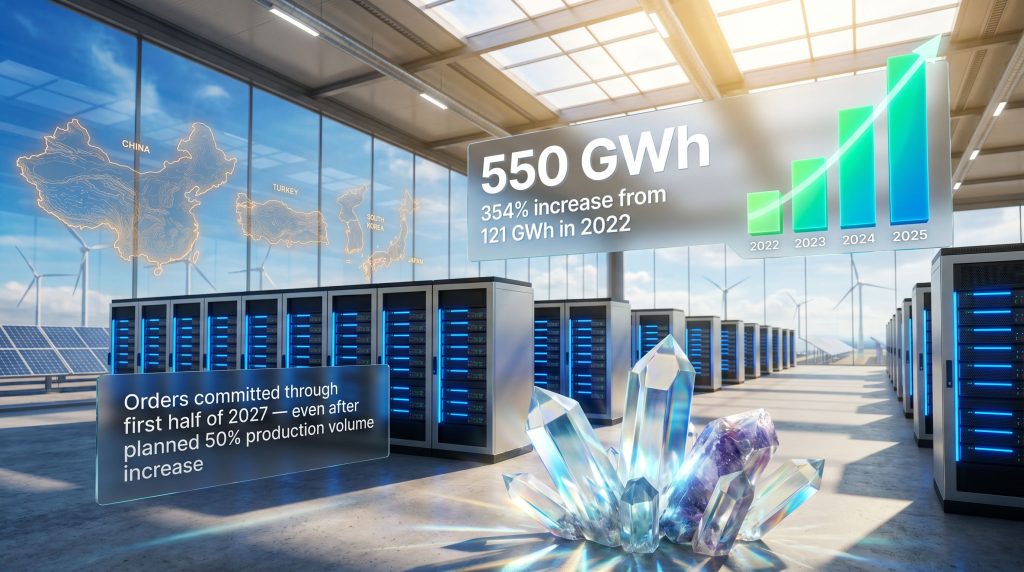
The scale of the ESS market expansion over recent years defies easy characterisation. Global lithium-ion battery energy storage shipments reached 550 gigawatt-hours (GWh) in 2025, compared to just 121 GWh in 2022, according to data from Seoul-based SNE Research. That represents an increase of more than 350 per cent in three years, a trajectory that is difficult to attribute to anything other than a genuine structural demand shift.
To place that in context, a single gigawatt-hour of battery storage capacity is roughly sufficient to power around 150,000 average homes for an hour. The leap from 121 GWh to 550 GWh represents not just growth, but the emergence of energy storage as a critical infrastructure category in its own right.
The pace at which energy storage deployment has scaled suggests this is not a demand spike driven by inventory restocking or policy incentives alone. It reflects the integration of battery storage into the core architecture of modern power systems.
What Is Driving the Surge?
The demand for large-scale battery energy storage is being shaped by a convergence of economic, geopolitical, and technological pressures. The table below summarises the primary drivers and their relative contributions:
| Demand Driver | Contribution to ESS Growth | Key Regions |
|---|---|---|
| Renewable energy grid stabilisation | High | China, Europe, United States |
| AI data centre power resilience | Rapidly rising | United States, China, Southeast Asia |
| Geopolitical energy price volatility | Moderate to high | Europe, Asia-Pacific |
| EV charging infrastructure support | Moderate | Global |
| Industrial and commercial energy resilience | Growing | China, Japan, South Korea |
Geopolitical energy disruption has played a more significant role in ESS adoption than many market observers anticipated. European utilities and industrial operators, rattled by energy price volatility linked to supply chain fragility and shifting trade dynamics, have accelerated investment in grid-scale battery storage as a hedge against external supply shocks. This dynamic has added a risk management dimension to ESS procurement that sits entirely outside the traditional EV demand narrative.
AI Data Centres: The Unexpected Catalyst Reshaping Battery Demand
Perhaps the most significant structural addition to the battery raw materials market in recent years is one that barely registered in analyst models five years ago: the power requirements of artificial intelligence infrastructure.
AI computing workloads are extraordinarily power-intensive. Training large language models and running inference at scale demands continuous, high-quality electricity. A single hyperscale AI data centre can draw hundreds of megawatts of power, and the number of such facilities being commissioned globally has grown dramatically since 2023.
Unlike traditional enterprise data centres, which can tolerate brief power interruptions with minimal consequence, AI infrastructure depends on computational continuity. Even milliseconds of power disruption can corrupt training runs or compromise inference accuracy. Consequently, large-format lithium-ion battery storage systems have become a non-negotiable component of AI data centre design.
For hyperscale AI operators, power quality is not a utility concern. It is a competitive infrastructure requirement. Battery storage has become as fundamental to AI data centre design as server racks or cooling systems.
The Battery-AI Demand Chain
According to UBS analysts, data centres are set to drive a significant energy storage boom over the next five years, reinforcing the pathway from AI investment to lithium demand. This operates through several interconnected steps:
- Technology companies and cloud operators commit capital to new AI data centre construction.
- Facility design specifications require integrated battery energy storage systems for both backup and grid stabilisation.
- ESS system manufacturers procure lithium-ion battery cells and modules at volume.
- Cell manufacturers contract upstream lithium compound supply to fulfil battery production commitments.
- Upstream lithium producers, including processors like Ganfeng Lithium, receive multi-year forward purchase orders that extend well beyond their current production capacity.
This chain explains why Ganfeng's order backlog extends not just through the current calendar year, but well into mid-2027 even after accounting for a significant planned capacity increase.
Ganfeng Lithium's Strategic Position: What Full Order Books Through 2027 Signal
Wang Xiaoshen, president and vice-chairman of Ganfeng Lithium, confirmed at the 4th BNP Paribas Global Electric Vehicle and Mobility Conference that the company's production capacity for the year is fully committed, with orders already scheduled through the first half of 2027. Critically, this backlog persists even after incorporating Ganfeng's plan to increase production volume by 50 per cent in 2026. Demand is originating from both domestic Chinese markets and international buyers.
This is a genuinely unusual market signal. It is common for commodity producers to book forward capacity during periods of price optimism. It is far less common for those forward orders to survive a planned production expansion of this magnitude and still extend well beyond the expansion timeline. That dynamic points to something more substantive than speculative procurement.
When a producer of Ganfeng's scale plans to lift output by half, and customers still book beyond that expanded capacity, the inference is not bullish sentiment. It is structural undersupply relative to committed demand.
Domestic vs. International Order Mix
The geographic composition of Ganfeng's order book matters for understanding the breadth of this demand cycle. The fact that orders are coming from both Chinese domestic buyers and international customers indicates that ESS demand is not a China-specific phenomenon. European utilities, American grid operators, and Asian industrial buyers are all competing for the same pool of lithium battery supply, reinforcing the structural rather than regional character of this demand surge.
Furthermore, Ganfeng Lithium has noted strong battery demand amid the China-US rivalry and the broader renewable energy buildout, highlighting how geopolitical competition is accelerating procurement timelines across regions.
China remains the dominant source of ESS deployment volume, with Chinese manufacturers accounting for the majority of global battery cell production and a significant share of grid-scale project installations. However, international demand is growing at a faster rate, as European and North American markets accelerate storage deployment to support renewable integration targets.
The Lithium Market Recovery: Cycle Rebound or Structural Realignment?
The lithium market downturn between 2023 and early 2024 was sharp, with benchmark prices falling dramatically from their 2022 peaks as EV demand growth slowed and supply expansions commissioned during the boom years came online simultaneously. That correction led many analysts to question whether the structural bull case for lithium had been fundamentally undermined.
The emergence of ESS as a primary demand driver has, however, complicated that bearish thesis considerably. The market phase comparison below illustrates how the demand composition has shifted:
| Market Phase | Primary Demand Driver | ESS Contribution | Market Sentiment |
|---|---|---|---|
| 2020 to 2022 | EV adoption surge | Minimal | Speculative optimism |
| 2022 to 2023 | EV correction and oversupply | Emerging | Bearish correction |
| 2024 to 2025 | Storage and AI infrastructure | Dominant | Structural recovery |
| 2026 to 2027 (Projected) | ESS, AI, and grid buildout | Central | Demand-led confidence |
Note: The 2026 to 2027 projections represent analytical scenarios based on current demand trends and should not be construed as guaranteed outcomes. Commodity markets are subject to significant volatility, and actual market conditions may differ materially from these projections.
How ESS Is Decoupling Lithium Demand From EV Volatility
The critical strategic implication of this market evolution is the diversification of lithium's demand base. When EV sales growth disappoints, as it did during 2023 and early 2024, the impact on lithium demand is now partially offset by continued ESS procurement. This counter-cyclical relationship between consumer-driven EV demand and infrastructure-driven ESS demand provides a degree of structural support for lithium markets that did not exist during the 2020 to 2022 cycle.
Industry observers who have framed the current recovery as reflecting an irreversible energy transition dynamic are pointing to this diversification as the key differentiator. The argument is not that EV demand has ceased to matter, but that it now represents one pillar of a multi-pillar demand structure rather than the entire load-bearing wall.
The next major ASX story will hit our subscribers first
Ganfeng's Global Expansion Strategy: Moving Down the Battery Value Chain
Ganfeng Lithium's strategic ambitions extend well beyond its upstream position as a lithium materials supplier. The company has been systematically building downstream capabilities in lithium-ion battery manufacturing, a strategic move that positions it to capture value at multiple points in the supply chain rather than remaining exposed purely to raw material price cycles.
The most significant expression of this downstream strategy is the company's planned battery manufacturing facility in Turkey, a project with an estimated investment value of approximately $500 million and a targeted annual production capacity of 5 GWh. The strategic rationale for this facility is multi-layered:
- Geographic access: A Turkish manufacturing base provides proximity to European energy storage procurement markets without the trade friction that can accompany direct imports of Chinese-manufactured battery systems.
- Vertical integration: By operating at both the materials and battery systems level, Ganfeng can offer integrated supply solutions to large ESS customers who prefer single-source procurement relationships.
- Trade risk hedging: Manufacturing within Turkey's geographic zone provides a degree of insulation from tariff regimes that specifically target Chinese-origin battery products.
- Customer relationship deepening: Battery system customers tend to develop longer-term, more committed supply relationships than raw material buyers, providing greater revenue stability.
If this facility reaches operational scale, it would represent a meaningful step in Ganfeng's transformation from a Chinese lithium materials exporter into a globally integrated battery supply chain participant.
Vertical Integration as a Competitive Moat
The strategic logic of vertical integration in battery supply chains has become increasingly compelling as downstream customers seek to reduce supply chain complexity and manage cost exposure across multiple input categories simultaneously. A supplier capable of delivering finished battery systems, rather than just lithium compounds, occupies a fundamentally different negotiating position with ESS developers and grid operators.
Ganfeng's move in this direction mirrors a broader trend among Chinese battery supply chain participants to establish manufacturing footholds in geographies that reduce their exposure to trade policy uncertainty. This is not a strategy unique to Ganfeng, but the scale of the Turkish project and its proximity to European markets suggests a deliberate and well-capitalised commitment to the approach.
Japan, South Korea, and China: The Manufacturing Triad Powering ESS Growth
The global energy storage supply chain is dominated by three manufacturing nations, each occupying a distinct and complementary role in the overall system:
| Country | ESS Manufacturing Role | Key Competitive Advantage | Strategic Focus |
|---|---|---|---|
| China | Dominant cell and system producer | Scale, cost efficiency, vertical integration | Domestic and export growth |
| South Korea | Premium cell technology leader | Energy density and cycle life innovation | Global OEM supply |
| Japan | High-reliability components and systems | Quality standards and industrial partnerships | Specialised industrial ESS |
China's position in this triad is the most comprehensive. Chinese manufacturers dominate not just cell production but also the upstream processing of lithium, cobalt, and other battery materials, as well as the assembly of complete ESS systems. This vertical depth gives Chinese producers a structural cost advantage that is difficult for competitors to replicate without decades of industrial investment.
South Korean producers, led by companies such as LG Energy Solution, Samsung SDI, and SK On, have carved out a premium segment by specialising in high-performance cells with superior energy density and cycle life characteristics. These attributes command price premiums in applications where performance specifications are critical rather than simply adequate.
Japan's contribution is more focused on precision components, quality assurance systems, and specialised industrial applications where reliability standards are particularly stringent. Japanese manufacturers have historically been less aggressive in pursuing high-volume commodity segments, preferring instead to serve markets where technical differentiation justifies premium pricing.
Geopolitical Trade Policy and Its Supply Chain Implications
The geographic concentration of battery manufacturing in these three nations has drawn increasing attention from Western governments seeking to reduce critical supply chain dependencies. Tariff measures targeting Chinese battery imports in both the United States and Europe have created uncertainty for procurement planners and accelerated interest in localised or near-shored manufacturing alternatives.
This trade policy environment is one of the reasons Ganfeng's Turkish manufacturing investment carries strategic significance beyond its headline capacity numbers. It represents an adaptation to a supply chain landscape where origin of manufacture has become a factor in procurement decisions that sits alongside cost and technical performance.
How Lithium-Ion Batteries Stabilise Renewable Energy Grids
The technical role of lithium-ion batteries in grid stabilisation is worth understanding in detail, as it clarifies why the ESS market is so deeply integrated with renewable energy deployment timelines. In addition, the critical minerals demand driving this buildout continues to intensify, reinforcing the scale of the supply challenge ahead.
Solar and wind generation are inherently variable. Solar output peaks at midday and falls to zero at night. Wind generation fluctuates with meteorological conditions that can shift dramatically over hours. Grid operators must balance electricity supply and demand in real time, and renewable variability creates significant balancing challenges that conventional generation alone cannot always address at adequate speed or scale.
Large-scale lithium-ion battery systems address this challenge through two primary mechanisms:
Frequency regulation: Batteries can inject or absorb power within milliseconds, providing the rapid response capability needed to maintain grid frequency within acceptable bounds when generation or demand shifts unexpectedly.
Energy shifting: Excess renewable generation during peak production periods can be stored and discharged during high-demand periods, effectively extending the economic value of renewable assets and reducing reliance on fossil fuel peaking plants.
For AI data centres specifically, batteries serve as a critical power quality layer. The computational integrity of AI workloads depends on receiving clean, stable, uninterrupted power, and battery systems provide precisely this assurance at the interface between the utility grid and the facility's internal power distribution.
Grid-Scale vs. Behind-the-Meter Deployments
The ESS market encompasses two distinct deployment models, each with different scale, ownership, and procurement characteristics:
Grid-scale storage is owned and operated by utilities or independent power producers and is connected to the transmission or distribution network. These systems are typically large, ranging from tens to hundreds of megawatt-hours, and are procured through long-term contracts with grid operators.
Behind-the-meter storage is installed on the customer side of the utility connection point and serves specific facility needs such as demand charge reduction, backup power, or power quality improvement. AI data centres primarily use behind-the-meter systems to manage their specific power quality and resilience requirements.
Both deployment categories are growing rapidly, and both draw from the same pool of lithium-ion battery supply, contributing to the demand pressure that is reflected in Ganfeng Lithium orders booked through 2027 on energy storage demand and AI data centre boom.
What Does This Mean for the Global Lithium Supply Chain?
The demand picture described above raises an important upstream question: can mining and processing output scale quickly enough to meet the commitments already embedded in the order books of producers like Ganfeng? The critical minerals demand underpinning these commitments shows no sign of easing as energy transition targets tighten globally.
The answer is genuinely uncertain, and that uncertainty carries both risk and opportunity for different participants in the supply chain.
Mining development timelines are long. A greenfield lithium project typically requires five to ten years from initial discovery through to nameplate production capacity. Processing facilities require significant capital investment and operational expertise that cannot be assembled quickly. The consequence is that supply responses to demand surges are inherently lagged, creating windows of structural undersupply that can persist for years even when investment intentions are strong.
The bottleneck risk in the current cycle is most acute at the lithium hydroxide processing stage. Battery-grade lithium hydroxide, which is the preferred chemical form for high-performance cathode materials, requires more refined processing than carbonate equivalents and is produced by a smaller number of qualified facilities globally. Furthermore, advances in direct lithium extraction technology may offer a partial solution, though commercial scale-up remains a work in progress.
Projected ESS Demand Growth Scenarios Through 2030
| Scenario | Annual ESS Shipments by 2030 | Key Assumptions |
|---|---|---|
| Conservative | 900 to 1,100 GWh | Moderate AI growth, policy delays |
| Base Case | 1,400 to 1,700 GWh | Continued AI buildout, steady renewable deployment |
| Accelerated | 2,000+ GWh | AI infrastructure surge, aggressive grid decarbonisation |
These scenarios represent analytical projections based on current growth trajectories and should be treated as indicative rather than predictive. Actual outcomes will depend on a wide range of economic, technological, regulatory, and geopolitical variables that cannot be forecast with precision.
How Buyers Are Repositioning Procurement Strategy
Large ESS buyers and battery manufacturers have begun shifting procurement practices in response to supply chain tightening. The just-in-time inventory model that characterised lithium procurement during periods of supply surplus is giving way to longer-term forward contracting and strategic stockpiling. This behavioural shift itself reinforces the demand signal visible in Ganfeng's order books, as buyers commit volumes well ahead of actual deployment timelines to secure supply certainty.
For upstream lithium producers and explorers, this shift in buyer behaviour is significant. It means that demand visibility is improving, that supply contracts are becoming longer in duration, and that the premium for reliable, consistent supply is rising relative to spot market availability.
Frequently Asked Questions
Why Are Ganfeng Lithium's Orders Booked Through 2027?
Ganfeng's order backlog extending to mid-2027 reflects the convergence of strong energy storage system demand and growing AI data centre procurement activity. According to Wang Xiaoshen at the 4th BNP Paribas Global Electric Vehicle and Mobility Conference, the company's production capacity is fully committed for the current year with orders extending beyond its planned 50 per cent production increase in 2026 (South China Morning Post, 19 May 2026). This level of advance commitment is unusual and indicates that buyers are competing for supply rather than simply placing orders against available inventory.
What Is Driving the Surge in Energy Storage System Demand Globally?
ESS demand is being driven by three primary forces: the need to stabilise electricity grids integrating large volumes of renewable energy, the power resilience requirements of AI data centre infrastructure, and geopolitical energy price volatility that has prompted utilities and industrial operators to reduce their dependence on real-time grid supply. SNE Research data shows global lithium-ion battery ESS shipments grew from 121 GWh in 2022 to 550 GWh in 2025, a more than 350 per cent increase.
How Are AI Data Centres Increasing Demand for Lithium Batteries?
AI data centres require uninterrupted, high-quality power supply for computationally intensive workloads. Battery storage systems are deployed both as backup power and as active power conditioning infrastructure, creating a demand channel for lithium-ion batteries that is separate from and additive to EV and grid-scale renewable storage demand.
What Is the Difference Between EV Battery Demand and ESS Battery Demand?
EV batteries are designed for high energy density, weight efficiency, and cycle performance under mobile conditions. ESS batteries prioritise cycle life, thermal stability, cost per kilowatt-hour, and calendar life under stationary conditions. While both use lithium-ion chemistry, the format, specification, and procurement dynamics differ meaningfully. Importantly, ESS demand is driven by infrastructure investment rather than consumer purchasing decisions, making it less susceptible to the demand volatility that has characterised EV markets.
Which Countries Are the Largest Consumers of Lithium-Ion Energy Storage Systems?
China is the dominant market for ESS deployment by volume, followed by the United States and Europe. The Asia-Pacific region broadly benefits from the ESS boom given the concentration of manufacturing capability in China, Japan, and South Korea. North American and European markets are growing rapidly as renewable energy targets and grid modernisation programmes drive procurement.
Is the Current Lithium Demand Surge Sustainable Beyond 2027?
The structural drivers of ESS demand — renewable integration requirements and AI infrastructure expansion — are unlikely to diminish significantly before 2030 and possibly beyond. However, sustainability beyond the near term depends on factors including lithium supply chain expansion, battery technology evolution, grid policy frameworks, and the pace of AI infrastructure investment. Investors and analysts should treat long-range demand projections as indicative scenarios rather than firm forecasts.
How Does Ganfeng's Production Expansion Affect Global Lithium Supply?
A 50 per cent production volume increase from one of the world's largest lithium producers represents a meaningful addition to global supply. However, the fact that this expanded output is already committed through forward orders suggests that the incremental supply will be fully absorbed rather than contributing to a surplus condition. The net effect on market balance will depend on how quickly competing supply sources also expand.
Key Takeaways for Investors, Analysts, and Energy Planners
The evidence assembled from Ganfeng's order book position, SNE Research shipment data, and the structural dynamics of both renewable energy and AI infrastructure investment points toward several conclusions that are relevant across investment, planning, and policy contexts.
The Three Forces Reshaping Lithium Demand
- Renewable energy integration has created a permanent, infrastructure-grade demand base for grid-scale battery storage that operates independently of EV market cycles.
- AI data centre expansion has added a new, rapidly growing demand channel that prioritises supply security and reliability over price, shifting procurement dynamics in favour of established, vertically integrated suppliers.
- Geopolitical energy risk management has accelerated ESS adoption among utilities and industrial operators who previously had limited strategic motivation to invest in battery storage.
Why ESS Is Now a Structural Pillar, Not a Supplementary Market
The transition from ESS as a complementary technology to ESS as a foundational infrastructure category has significant implications for how lithium markets should be analysed and priced. When demand is driven by infrastructure necessity rather than consumer preference, supply tightness tends to persist longer and be resolved more slowly, because the alternatives to lithium-ion storage at scale remain limited.
Strategic Implications
For battery supply chain participants, the current environment rewards scale, vertical integration, and geographic diversification. For energy planners, the supply chain constraints visible in Ganfeng's order books are a lead indicator of potential procurement challenges for ESS projects planned over the next two to three years.
For investors, the distinction between cyclical and structural demand dynamics is critical: companies positioned to serve ESS and AI infrastructure demand are operating in a fundamentally different risk environment than those primarily exposed to consumer EV markets. Ganfeng Lithium orders booked through 2027 on energy storage demand and AI data centre boom is, consequently, among the clearest available signals of how completely this structural shift has taken hold across global power and technology markets.
This article is for informational purposes only and does not constitute financial or investment advice. Commodity markets are inherently volatile, and past demand trends do not guarantee future outcomes. Readers should conduct independent due diligence before making any investment decisions.
Want to Capitalise on the Next Major Mineral Discovery Before the Broader Market Does?
Discovery Alert's proprietary Discovery IQ model delivers real-time alerts on significant ASX mineral discoveries — instantly transforming complex data across 30+ commodities into clear, actionable insights for both traders and long-term investors. Explore how historic discoveries have generated extraordinary returns on Discovery Alert's dedicated discoveries page, and start your 14-day free trial today to position yourself ahead of the market.