May 19, 2026
The Lithium Supply Cycle Is Turning: What Mine Restarts Reveal About Market Structure
Understanding how commodity cycles translate into operational decisions requires looking beyond price charts. In the lithium sector, the gap between a price signal and a production response is shaped by geology, infrastructure readiness, workforce availability, and corporate balance sheet discipline. When that gap narrows dramatically, it tells you something important: the market has shifted from defence to offence.
The announcement that MinRes restarts Bald Hill lithium mine in WA is precisely that kind of signal. It is not merely a single asset coming back online. It is a data point confirming that Western Australia's hard rock lithium sector is exiting its most severe correction in recent memory and entering a new operational phase, one defined by disciplined restarts, integrated production capabilities, and strategic downstream partnerships.
When big ASX news breaks, our subscribers know first
Why the 2024 Lithium Downturn Was Structurally Different
Not all commodity downturns are created equal. The lithium market downturn of 2024 was particularly severe because it followed an equally extreme upswing. Between 2021 and 2023, spodumene concentrate prices surged from below US$500 per tonne to above US$7,000 per tonne at their peak, driven by electric vehicle adoption accelerating faster than supply chains could respond. That spike triggered an aggressive wave of new mine development and expansion globally.
By late 2023 and into 2024, that new supply began hitting markets simultaneously with a temporary softening in EV demand growth rates in key markets, particularly China and Europe. The result was a brutal correction. Spodumene concentrate prices fell to levels that rendered many high-cost operations economically unviable.
Rather than continue burning cash, experienced operators made a calculated decision: transition assets to care and maintenance, preserve infrastructure, retain institutional knowledge, and wait for conditions to shift. This is not a passive strategy. It is an active capital allocation choice that distinguishes sophisticated mining companies from those that continue operating at a loss out of inertia or market pressure.
MinRes placed Bald Hill on care and maintenance in November 2024, roughly twelve months after acquiring the asset. At the time, the price environment made continued operation economically untenable. Crucially, the infrastructure was preserved rather than dismantled, a decision that now enables a compressed restart timeline measured in weeks rather than years.
Bald Hill's Geological and Technical Profile: Why This Asset Was Worth Preserving
Not every idled lithium mine warrants reactivation when prices recover. Asset quality determines restart viability, and Bald Hill's geological fundamentals are among the more compelling in Western Australia's Goldfields region.
Located approximately 50 kilometres south-east of Kambalda, the deposit sits within a well-understood lithium pegmatite geological setting. Pegmatite-hosted spodumene deposits in this part of Western Australia share characteristics with the broader Eastern Goldfields Superterrane, a geological province that has proven consistently productive across multiple commodities for over a century.
| Metric | Detail |
|---|---|
| Location | ~50km south-east of Kambalda, WA |
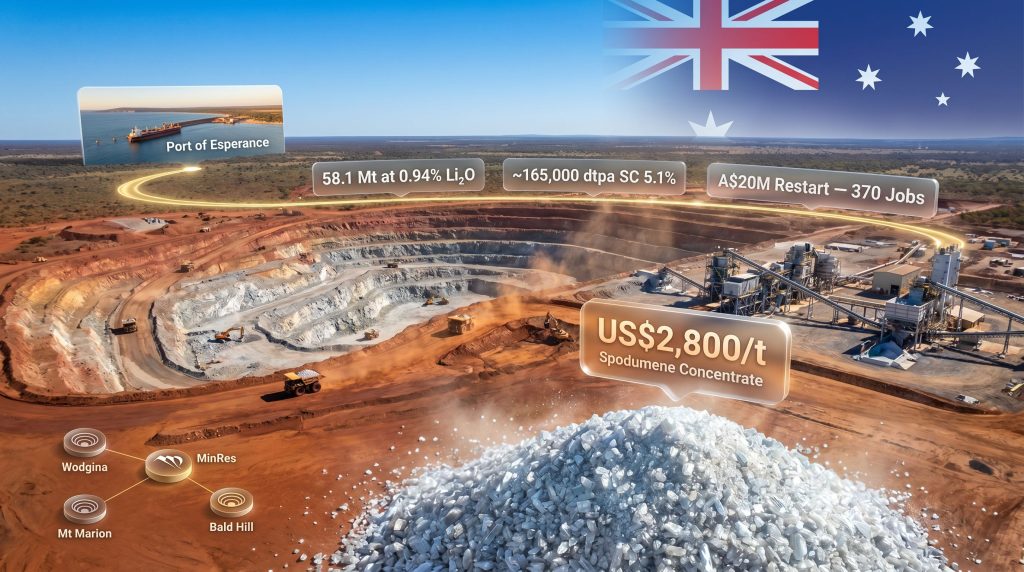
| Total Resource | 58.1 million tonnes at 0.94% Li₂O |
| Annual SC Capacity | ~165,000 dtpa (5.1% SC) |
| SC6 Equivalent Output | ~140,000 dmt per annum |
| Port of Export | Port of Esperance |
| Ownership | 100% Mineral Resources (MinRes) |
The deposit's 58.1 million tonne resource base grading 0.94% lithium oxide provides a long mine life runway. To contextualise that grade: while it sits below the headline grades seen at some Pilbara deposits, the processing circuit at Bald Hill is specifically engineered for this ore type, meaning recovery rates and concentrate quality are optimised for the resource rather than being applied generically.
The plant produces spodumene concentrate at approximately 5.1% lithium content, which when normalised to the industry benchmark of SC6 (6% spodumene concentrate) equates to roughly 140,000 dry metric tonnes per annum. This SC6 normalisation matters for market pricing and offtake contract negotiations, as most long-term contracts are structured around the SC6 benchmark.
Understanding SC6: The Industry's Pricing Benchmark
Spodumene concentrate is graded by its lithium oxide content. The industry standard benchmark, SC6, refers to a product containing 6% lithium oxide by weight. Most price indices and offtake agreements reference this grade, which means producers of lower-grade concentrates must apply a discount factor to determine effective realised pricing. Furthermore, spodumene extraction processes significantly influence which grade a given operation can achieve.
Bald Hill's 5.1% SC product sits below the SC6 benchmark, which requires buyers and analysts to apply a grade adjustment when comparing it to headline price indices. However, with spodumene concentrate prices recovering to approximately US$2,800 per tonne on an SC6-equivalent basis, even after grade adjustment, Bald Hill's economics have shifted materially back into viable territory.
"The recovery in spodumene prices to approximately US$2,800 per tonne represents a level more than triple the price floor that made continued operation uneconomic in late 2024, providing a substantial margin buffer for a lean restart operation."
The Restart Execution Plan: A Compressed Timeline Enabled by Infrastructure Readiness
One of the less-discussed advantages of care-and-maintenance strategies is the optionality they create. By maintaining infrastructure in a production-ready state rather than allowing it to deteriorate or be sold, operators retain the ability to respond rapidly when market conditions shift. Mineral Resources has confirmed that Bald Hill's restart timeline illustrates this principle in practice.
The phased restart sequence is structured as follows:
- Late May 2026 – Initial site mobilisation commences, with workforce and equipment deployment
- June 2026 – Mining and crushing operations resume at the pit and primary processing stage
- July 2026 – Spodumene concentrate production begins at the processing facility
- Q1 FY2027 – First export shipment departs from the Port of Esperance
- Q2 FY2027 – Full annual production capacity achieved
The transition from mobilisation to concentrate production in approximately four to six weeks reflects the advantage of preserved infrastructure. A greenfield project at equivalent scale would require years of construction, commissioning, and ramp-up before achieving comparable output.
Restart cost allocation:
- Total projected restart expenditure: approximately A$20 million (~US$14.3 million) in Q4 FY2026
- Cost category: inclusive of working capital requirements
- Capital intensity per tonne of annual SC6-equivalent capacity: approximately A$143 per tonne
That capital intensity figure is remarkably low compared to greenfield development benchmarks, where capital costs for new hard rock lithium projects typically range from several hundred to over one thousand dollars per tonne of annual capacity. This cost differential is the core economic argument for why care-and-maintenance restarts can generate superior near-term returns on capital compared to new mine development.
Workforce Strategy: Internal Redeployment as a Competitive Advantage
Labour availability is one of the most frequently underestimated constraints in Australian mining restarts. Western Australia's resources sector operates in a tight skilled labour market, and sourcing qualified personnel externally can add months and significant cost to a restart timeline.
MinRes has structured the Bald Hill workforce strategy to partially circumvent this constraint. Of the approximately 370 total positions the restart will create, around 110 roles will be filled through internal redeployment from other MinRes operations across its portfolio. Those vacated positions will then be backfilled externally. In addition, around 260 new workers are being recruited externally to support the broader restart effort.
This approach delivers several operational advantages:
- Redeployed personnel already understand MinRes's operating systems, safety protocols, and equipment standards
- Onboarding timelines for internal transfers are significantly shorter than external hires
- Institutional knowledge about the site from personnel who may have worked at Bald Hill previously is preserved within the workforce
- External recruitment can focus on backfilling lower-complexity roles rather than sourcing specialist operators
The remaining approximately 260 positions will generate new employment in the Western Australian Goldfields region, creating meaningful economic benefit for communities that depend on the resources sector for economic activity.
MinRes's Three-Mine Hard Rock Lithium Strategy: A Globally Unique Position
When Bald Hill reaches full production, MinRes will occupy a structurally unique position in the global lithium supply chain. No other company currently operates three independent hard rock lithium mines, each with its own dedicated spodumene concentrate processing facility. This multi-asset configuration creates compounding advantages that go beyond simple production volume.
| Mine | Location | Status (as at mid-2026) | Key Partner |
|---|---|---|---|
| Wodgina | Pilbara, WA | Active | Albemarle |
| Mt Marion | Goldfields, WA | Active | Jiangfeng Lithium |
| Bald Hill | Goldfields, WA | Restarting | POSCO (JV signed Nov 2025) |
Wodgina in the Pilbara is one of the world's largest hard rock lithium deposits by resource tonnage, operated through a joint venture with Albemarle, one of the largest lithium chemical producers globally.
Mt Marion, also in the Goldfields region, operates in partnership with Jiangfeng Lithium, providing a direct connection into Chinese battery materials supply chains.
Bald Hill's partnership with POSCO Holdings, formalised through a binding joint venture agreement signed in November 2025, opens a channel into Korean battery manufacturing supply chains. POSCO operates one of the world's most integrated battery materials businesses, spanning lithium chemical conversion through to cathode active materials. This creates a potential pathway for Bald Hill's spodumene concentrate to flow directly into POSCO's Korean refining operations, providing geographic diversification in MinRes's offtake relationships beyond the Chinese market.
"Having active supply relationships with major lithium processors in the United States' allied network, China, and South Korea simultaneously gives MinRes a degree of geopolitical supply chain flexibility that few pure-play lithium miners can match."
The Integrated Mining Services Model: Operational Self-Sufficiency
A dimension of the Bald Hill restart that deserves specific attention is the role of MinRes's internal Mining Services division in managing the restart execution. Rather than contracting external mining services providers, MinRes applies its own in-house division to manage mining-related activities.
This integrated model serves multiple functions. It reduces external contractor costs, maintains tighter operational control, and keeps the Mining Services division's workforce and equipment utilisation rates higher across the portfolio. It also means that the restart cost estimate of A$20 million reflects an internal cost structure rather than a third-party contractor margin, which typically adds 10–20% to comparable outsourced operations.
The next major ASX story will hit our subscribers first
What the Bald Hill Restart Signals About Lithium Market Psychology
Investor and operator behaviour during commodity cycles follows recognisable patterns, but the timing of when confidence converts into capital commitment varies significantly. The decision to restart Bald Hill within months of a price recovery, rather than waiting for multiple quarters of sustained elevated prices, reflects a specific reading of demand fundamentals.
The primary demand drivers underpinning this confidence are battery electric vehicle adoption and grid-scale energy storage deployment. The broader global lithium market continues to grow in absolute terms even as growth rates moderate from their peak. More importantly, stationary storage demand has emerged as a structurally new source of lithium consumption that was not meaningfully present during the previous lithium price cycle.
"Operators who waited for multi-quarter price confirmation in previous cycles frequently missed the most profitable production windows. The compressed restart timeline at Bald Hill suggests MinRes is positioning to capture early-cycle margins rather than late-cycle volumes."
When comparing hard rock vs brine lithium operations, hard rock spodumene mines in Western Australia hold a structural advantage in responding to price recovery signals. Brine operations typically have longer ramp-up timelines, higher water management complexity, and greater sensitivity to seasonal and environmental variables. Hard rock mines with preserved infrastructure can return to production within a matter of weeks, as the Bald Hill timeline demonstrates.
Furthermore, innovations such as direct lithium extraction may eventually alter competitive dynamics between brine and hard rock producers, though established hard rock assets with preserved infrastructure retain a near-term operational edge.
Frequently Asked Questions: Bald Hill Lithium Mine Restart
What is spodumene concentrate and why does it matter?
Spodumene is a lithium-bearing pyroxene mineral found primarily in granitic pegmatite rock formations. When mined and processed through crushing, dense media separation, and flotation circuits, it produces a concentrated product known as spodumene concentrate. This material serves as the primary feedstock for lithium chemical conversion facilities that produce lithium hydroxide and lithium carbonate for battery cathode manufacturing.
When was Bald Hill placed on care and maintenance?
The mine transitioned to care and maintenance in November 2024 after sustained low lithium prices made continued operations economically unviable. MinRes had acquired the asset approximately one year earlier, in November 2023.
What triggered the 2026 restart decision?
A significant and sustained recovery in spodumene concentrate prices to approximately US$2,800 per tonne, combined with thorough operational planning during the care-and-maintenance period, created the conditions for a commercially justified restart. MinRes restarts Bald Hill lithium mine in WA as a direct consequence of this price recovery.
How does Bald Hill's output compare to the SC6 benchmark?
Bald Hill produces spodumene concentrate at 5.1% lithium oxide content. The industry benchmark is SC6 at 6% lithium oxide. When normalised to SC6 equivalent, Bald Hill's annual capacity of approximately 165,000 dry tonnes converts to roughly 140,000 dry metric tonnes of SC6-equivalent output per year.
What is the POSCO joint venture?
In November 2025, MinRes and POSCO Holdings signed a binding agreement to form a lithium joint venture. POSCO is a major South Korean industrial conglomerate with significant battery materials processing operations, providing a strategic downstream connection for Bald Hill's spodumene concentrate production.
Key Takeaways: Bald Hill's Significance for the Australian Lithium Sector
- Price-driven reactivation at US$2,800/t SC6 confirms spodumene markets have entered a meaningful recovery phase after the 2024 correction
- 58.1 million tonne resource at 0.94% Li₂O provides long-duration production capacity with a known geological profile
- A$20 million restart cost represents an exceptionally low-capital pathway to approximately 140,000 dmt of SC6-equivalent annual supply
- 370 new positions, including 110 internal redeployments, support both operational efficiency and regional employment in WA's Goldfields
- Three-mine hard rock portfolio establishes MinRes as a structurally differentiated global operator with unmatched scale in the spodumene supply chain
- POSCO partnership diversifies MinRes's downstream exposure beyond China into South Korean battery materials supply chains
Disclaimer: This article contains forward-looking statements and market analysis based on publicly available information. It does not constitute financial advice. Readers should conduct their own due diligence before making investment decisions. Commodity price forecasts and production timelines are subject to change based on market conditions and operational factors.
Ready to Position Yourself Ahead of the Next Major ASX Mineral Discovery?
Discovery Alert's proprietary Discovery IQ model delivers real-time alerts the moment significant mineral discoveries are announced on the ASX, instantly turning complex geological and market data into actionable investment insights — explore the historic returns major discoveries have generated and begin your 14-day free trial to ensure you're never caught flat-footed when the next lithium or critical minerals opportunity emerges.