May 19, 2026
When Claim Boundaries Become the Biggest Obstacle in Lithium Development
In hard-rock lithium development, the geology is rarely the limiting factor. More often, it is the invisible administrative lines drawn across a district that determine whether a project reaches its full economic potential. For years, the James Bay lithium belt in Quebec has attracted serious geological attention, yet fragmented land ownership across the corridor has consistently prevented individual developers from translating outstanding resource endowments into bankable, large-scale mining operations. That dynamic is now shifting, and the Li-FT Winsome M&A Quebec lithium mine transaction sits at the centre of that change.
The deal between Li-FT Power (TSXV: LIFT; US-OTC: LIFFF) and Winsome Resources (ASX: WR1; US-OTC: WRSLF) is not simply a story about one company absorbing another. It is a case study in how a single claim boundary can artificially suppress the economic narrative of a genuinely world-class lithium asset, and how removing that boundary through strategic consolidation can fundamentally reframe the project's position within the global critical minerals hierarchy.
When big ASX news breaks, our subscribers know first
Quebec's James Bay Region: A Lithium Belt Built for Scale
The geological architecture of Quebec's James Bay region is, in technical terms, highly favourable for large-tonnage, open-pittable spodumene mineralisation. The region hosts a series of lithium-caesium-tantalum (LCT) pegmatite swarms, many of which have demonstrated lateral continuity across kilometres of strike length. Unlike brine-hosted lithium systems in South America, which require long evaporation cycles and produce variable-quality lithium, hard-rock spodumene extraction operations in Quebec benefit from consistent mineral chemistry and shorter processing pathways to battery-grade lithium hydroxide.
What makes the James Bay corridor particularly compelling is the combination of grade, tonnage, and infrastructure. Quebec's extensive hydroelectric grid provides access to low-cost, low-carbon power, which is increasingly valued by battery manufacturers and downstream customers seeking to reduce the embodied carbon intensity of their supply chains. Road access across much of the region, while still challenging by southern standards, is considerably more developed than comparable lithium districts in northern Canada or parts of West Africa.
Furthermore, the lithium carbonate market continues to evolve in ways that reward producers capable of delivering consistent, high-quality feed material. Spodumene concentrate produced from hard-rock pegmatites typically grades between 5.5% and 6% Li₂O before refining. The quality of the original ore, including its mineral liberation characteristics and the presence of deleterious elements, has a direct bearing on the efficiency of the downstream conversion process. Consistent grades above 1.1% Li₂O in the primary ore body are generally considered favourable for open-pit project economics.
The Adina Resource: What 77.9 Million Tonnes Actually Represents
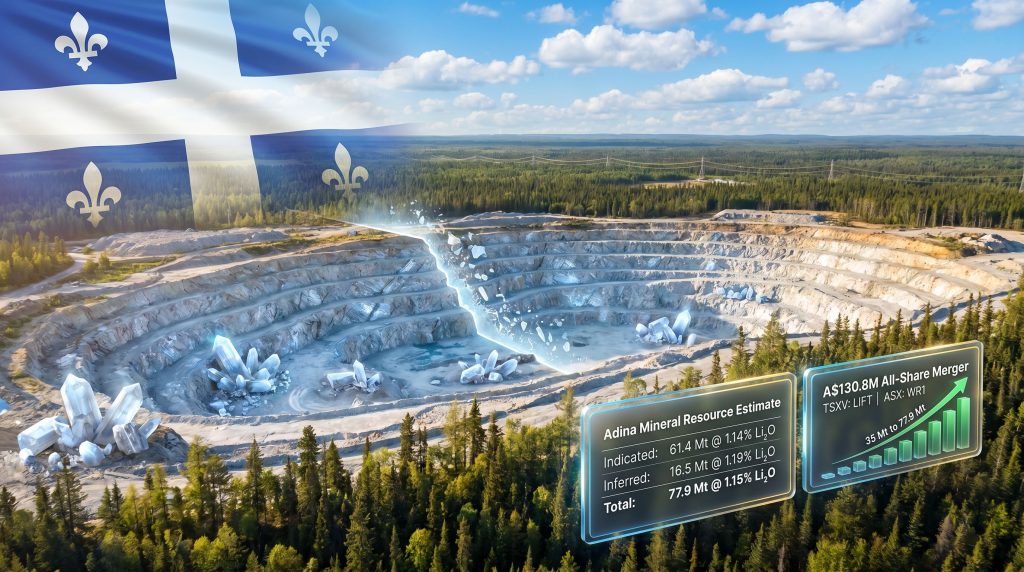
The Adina lithium project already holds a mineral resource estimate that places it among the more significant hard-rock lithium deposits in North America. The total resource of 77.9 million tonnes grading 1.15% Li₂O breaks down as follows:
| Resource Category | Tonnes | Grade (Li₂O%) |
|---|---|---|
| Indicated | 61.4 Mt | 1.14% |
| Inferred | 16.5 Mt | 1.19% |
| Total | 77.9 Mt | 1.15% |
To contextualise these numbers: a resource of this scale, at grades consistently above 1.1% Li₂O, would support a multi-decade open-pit operation under a conventional bulk mining scenario. The indicated category alone at 61.4 Mt provides sufficient confidence for pre-feasibility study work, and the relatively tight grade differential between indicated and inferred material suggests geological consistency across the deposit, rather than isolated high-grade pods that can complicate mine planning.
What makes the resource even more technically interesting is the implication that the mineralised system does not terminate at the current claim boundary. Pegmatite systems of this type rarely observe administrative lines drawn on maps, and the geological continuity into the adjacent Galinée property is precisely what underpins the commercial logic of the Li-FT Winsome M&A Quebec lithium mine transaction.
The Scoping Study Gap: Why 35 Million Tonnes Was Never the Whole Story
Winsome's September 2024 scoping study modelled an operation based on approximately 35 million tonnes, which represents less than 45% of the total existing resource. This was not a geological limitation. The pit shell in that study was forced to stop at the Adina claim boundary, preventing the optimisation algorithm from extending into the Galinée ground where mineralisation continues.
This type of boundary-constrained pit design is a well-understood problem in the mining industry, but it is rarely discussed openly because it tends to highlight the suboptimal nature of fragmented land holdings. In practice, when a resource geological model extends beyond a project's licence boundary, mine planners are forced to run pit optimisations on a truncated resource. This systematically understates the economically recoverable material, compresses the modelled mine life, and inflates the projected capital intensity on a per-tonne basis.
The consequence is a project that looks less compelling on paper than the geology warrants. Investors evaluating the 2024 scoping study at face value would have seen a study calibrated to 35 Mt, while the underlying resource already exceeded 77 Mt. Closing this analytical gap is arguably the single most important value unlock the merger enables.
Deal Structure: How the Li-FT and Winsome Transaction Is Constructed
The merger is structured as an all-share transaction, with Winsome shareholders entitled to receive 0.107 Li-FT shares (or CDIs) per Winsome share held. At the time of announcement in December 2025, this implied an offer price of A$0.501 per Winsome share and a total transaction value of approximately A$130.8 million (roughly USD $91.8 million). More detail on the deal rationale can be found via Li-FT's official announcement.
| Deal Parameter | Detail |
|---|---|
| Transaction Type | All-share merger |
| Offer Price per Winsome Share | A$0.501 |
| Total Deal Value | A$130.8M (~USD $91.8M) |
| Exchange Ratio | 0.107 Li-FT shares per Winsome share |
| Li-FT Listing | TSXV: LIFT / US-OTC: LIFFF |
| Winsome Listing | ASX: WR1 / US-OTC: WRSLF |
| Announced | December 2025 |
| Targeted Closing | Mid-2026 |
The cross-listing dimension of this transaction adds a layer of structural complexity that is worth understanding. Li-FT is listed on the TSX Venture Exchange and trades on the US OTC market, while Winsome is an ASX-listed company. Australian shareholders receiving Li-FT consideration will do so via CHESS Depositary Interests (CDIs), a mechanism that allows foreign securities to trade on the ASX in a domestically settled format.
By the time of the PDAC conference in Toronto in early 2026, the deal had already cleared a shareholder vote and two court hearings, placing it firmly on track for closing within approximately one month of those proceedings, subject to final regulatory conditions. Industry commentary from Mining.com highlighted the transaction as a notable consolidation move within Quebec's lithium sector.
The Galinée Property: The Acquisition That Changes the Geometry
Running parallel to the Winsome transaction, Li-FT separately secured a 75% interest in the Galinée property from Azimut Exploration and SOQUEM (Société québécoise d'exploration minière), Quebec's provincial mineral exploration entity. Galinée is directly contiguous with the Adina project, forming a unified land package that eliminates the claim boundary previously constraining the pit design.
This dual-track approach — simultaneously completing the Winsome merger and the Galinée acquisition — reflects a deliberate strategy to assemble a district-scale lithium platform rather than simply acquiring a single project. The involvement of SOQUEM as a vendor is also worth noting from a governance and community relations perspective, given SOQUEM's long-standing role as a stakeholder in Quebec's mineral development ecosystem.
Li-FT's management has stated that combining the two properties could at least double the pittable resource volume compared to what the 2024 scoping study modelled. If that assessment proves accurate when an updated mineral resource estimate and revised scoping study are completed, the Adina-Galinée district would potentially rank among the largest open-pit lithium development opportunities in the Western Hemisphere.
Capital Allocation: The C$30 Million Private Placement
To sustain exploration and development momentum through and beyond the merger close, Li-FT announced a C$30 million private placement. The strategic purpose of this raising is to fund continued drilling programs on the Galinée ground while simultaneously advancing Adina toward a pre-feasibility study (PFS) that reflects the expanded resource footprint.
This sequencing matters. An updated mineral resource estimate incorporating Galinée mineralisation is a prerequisite for any revised economic study, and that revised study is in turn the catalyst that would allow capital markets to reprice the combined asset based on its full geological potential rather than the constrained 2024 scoping study baseline.
The next major ASX story will hit our subscribers first
Comparative Context: Where Adina-Galinée Sits in the North American Lithium Landscape
| Project | Jurisdiction | Total Resource (Mt) | Grade (Li₂O%) | Development Stage |
|---|---|---|---|---|
| Adina (current MRE) | Quebec, Canada | 77.9 Mt | 1.15% | Pre-PFS / M&A |
| James Bay (Arcadium/Rio Tinto) | Quebec, Canada | Comparable scale | ~1.0-1.3% | Advanced |
| Separation Rapids | Ontario, Canada | Smaller scale | Variable | Exploration-PFS |
| Other James Bay assets | Quebec, Canada | Varies | Varies | Exploration |
Note: The Adina-Galinée combined resource incorporating Galinée mineralisation is pending an updated MRE following merger completion.
Key Risks That Investors Must Weigh Carefully
The investment thesis for the combined Li-FT Winsome M&A Quebec lithium mine platform rests on several assumptions that carry execution risk:
-
Resource expansion is unconfirmed: The Galinée ground has not yet been incorporated into a formal MRE. Management's expectation that the pittable resource at least doubles is geologically reasoned but commercially unproven until drilling and modelling confirm it.
-
Economic studies remain outstanding: The 2024 scoping study used a constrained 35 Mt pit. A revised study reflecting the combined land package will require significant technical work before project financing conversations can progress meaningfully.
-
Lithium price environment: Spodumene concentrate and lithium carbonate prices remain materially below their 2022–2023 peaks as of mid-2026. Financing large-scale lithium development in a depressed commodity price environment is demonstrably more challenging, and timelines to production for projects of this scale are measured in years.
-
Permitting and consultation requirements: Quebec's environmental assessment process for large open-pit operations is rigorous, and Indigenous consultation requirements across the James Bay region represent a substantive process that must be navigated thoughtfully and transparently.
Investor Caution: The current investment thesis is substantially forward-looking. The value creation narrative depends on technical deliverables — including updated resource estimates, revised economic studies, and ultimately a completed permitting pathway — none of which have yet been demonstrated for the combined asset base. Investors should treat speculative projections about resource doubling and mine scale as geological hypotheses requiring formal validation.
What Must Happen Next for the Thesis to Materialise
The pathway from current deal status to a fully derisked development asset involves several sequential milestones:
-
Completion of the merger close and confirmation of Li-FT CDI listing on the ASX for Australian shareholders.
-
Integration of exploration data from both Adina and Galinée into a unified geological model.
-
Drilling campaigns on the Galinée ground to define mineralisation continuity and support resource classification.
-
Publication of an updated mineral resource estimate for the combined Adina-Galinée system.
-
Completion of a revised scoping study or pre-feasibility study incorporating the expanded pit design. Innovations such as direct lithium extraction technology may also inform processing route selection at the pre-feasibility stage.
-
Engagement with potential offtake partners or strategic investors to anchor project financing.
-
Progression through Quebec's environmental and Indigenous consultation processes toward a project approval pathway.
Each of these steps is a necessary precondition for the next, and the sequence will likely span several years even under an optimistic scenario.
The Broader Significance for Canada's Critical Minerals Ambitions
Beyond the project-specific narrative, the Li-FT Winsome M&A transaction reflects a broader structural shift in how junior lithium developers are approaching the challenge of building bankable projects in a capital-constrained environment. Standalone development pathways have become increasingly difficult to finance for sub-scale projects, and institutional capital is gravitating toward larger, more consolidated asset bases with longer mine lives and more defensible capital efficiency metrics.
Canada's position as a preferred source of battery raw materials for North American and allied-nation supply chains adds a layer of strategic relevance to projects of this type. Quebec specifically benefits from a combination of political stability, established mining governance, hydroelectric power infrastructure, and a skilled workforce. Consequently, these factors collectively make it one of the most attractive jurisdictions globally for large-scale lithium development, independent of any project-specific designations or formal government support.
In addition, developments elsewhere on the continent — such as Australia's underground lithium mine operations — demonstrate that hard-rock lithium development at scale is technically achievable and increasingly commercially relevant, providing useful precedent for what consolidated district-scale assets can deliver.
The Adina-Galinée district, if the geological thesis is validated through drilling and formal resource estimation, could represent one of the more significant lithium development opportunities to emerge from the James Bay belt. Whether the combined entity can execute through the capital markets and regulatory complexities ahead will determine whether that geological potential translates into a producing Quebec lithium mine.
Disclaimer: This article is for informational purposes only and does not constitute financial or investment advice. Statements regarding resource expansion, project economics, and development timelines involve forward-looking assumptions that are subject to material uncertainty. Investors should conduct their own due diligence and consult qualified financial advisers before making investment decisions.
Want To Stay Ahead of Major Mineral Discoveries as They Happen?
Discovery Alert's proprietary Discovery IQ model delivers real-time alerts on significant ASX mineral discoveries, transforming complex geological data into actionable investment insights for both short-term traders and long-term investors — explore how historic discoveries have generated substantial returns and begin your 14-day free trial at Discovery Alert to position yourself ahead of the market.