June 21, 2026
What Makes Argentina the World's Fourth-Largest Lithium Producer?
The global battery revolution has fundamentally altered the strategic value of mineral resources, with few regions experiencing this transformation as dramatically as South America's lithium-rich highlands. Argentina's emergence within this new economic paradigm reflects a convergence of geological advantages, technological innovation, and policy frameworks that position the country at the center of the electric vehicle supply chain. Furthermore, argentina lithium insights highlight the strategic importance of this sector for global markets.
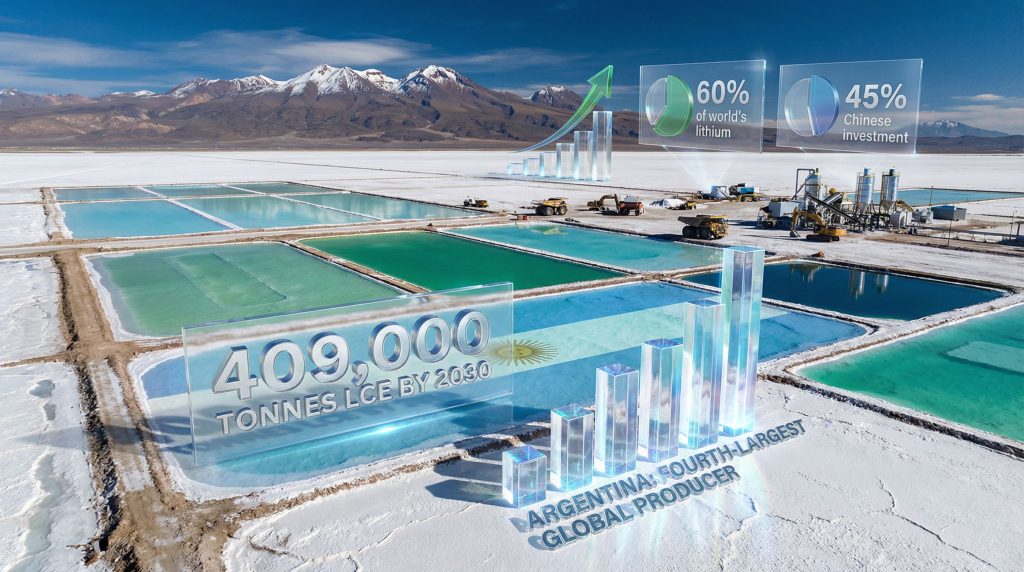
Argentina commands approximately 10% of global lithium output, establishing its position as the world's fourth-largest producer behind Australia, Chile, and China. This dominance stems from its strategic location within the Lithium Triangle, a geological formation spanning Argentina, Bolivia, and Chile that contains an estimated 60% of the world's identified lithium resources.
The country's production infrastructure concentrates in high-altitude salt flats across the Andes mountain range, particularly in Jujuy and Salta provinces. These brine-based operations leverage natural evaporation processes in one of the world's most arid environments, creating cost advantages that traditional hard-rock mining cannot match.
Key Strategic Advantages:
- Access to substantial lithium resources within the tri-national Lithium Triangle
- Over 40 active projects across multiple development stages
- Favourable geological conditions in northwestern provinces
- Government investment incentives through the RIGI framework
Geographic Distribution of Argentina's Lithium Resources
The concentration of argentina lithium projects across three primary provinces demonstrates the geological specificity required for commercial brine extraction. Each region presents distinct advantages in terms of resource grade, infrastructure access, and regulatory environment.
| Province | Key Characteristics | Major Salars | Development Status |
|---|---|---|---|
| Jujuy | Highest concentration of active projects | Olaroz, Cauchari | Multiple commercial operations |
| Salta | Largest individual project capacities | Hombre Muerto, Centenario | Major production hub |
| Catamarca | Emerging exploration region | Antofalla, Ratones | Early-stage development |
Current production capacity stands at approximately 159,000 tonnes of lithium carbonate equivalent (LCE) annually, providing the baseline for ambitious expansion plans targeting more than 400,000 tonnes by 2030. This growth trajectory would consolidate Argentina's position among the world's top three lithium producers.
When big ASX news breaks, our subscribers know first
How Do Argentina's Major Lithium Operations Compare Globally?
Argentina's operational landscape demonstrates remarkable diversity in scale, technology deployment, and international partnerships. The country's brine-based extraction model offers inherent advantages over hard-rock mining, including lower energy requirements and higher lithium concentrations in source materials.
Traditional evaporation pond systems dominate current operations, representing approximately 85% of installed capacity. However, Direct Lithium Extraction (DLE) technology adoption accelerates rapidly, driven by environmental considerations and faster production ramp-up capabilities. Moreover, geothermal brine extraction technologies offer additional insights into sustainable extraction methods.
Production Technology Breakdown:
- Traditional Evaporation: 85% of current operations with 18-24 month ramp periods
- Direct Lithium Extraction: 15% and expanding, offering 6-12 month commissioning
- Hybrid Approaches: Emerging solutions combining water conservation with cost efficiency
Current Production Leaders vs. Emerging Giants
The competitive landscape reveals a clear stratification between established operations and next-generation projects targeting unprecedented production scales. Argentina's largest individual project, Rio Tinto's Rincón development, will add 60,000 tonnes annually beginning in 2028, representing the country's most ambitious single-site operation.
Tier 1 Operations (20,000+ tonnes LCE annually):
- Established producers with proven track records
- International partnership structures
- Technology-proven extraction methods
Tier 2 Development Projects:
- Galan Lithium's Hombre Muerto West: 8,000 tonnes annual capacity
- Rio Tinto's Sal de Vida: 15,000 tonnes production target
- Advanced staged development strategies
A critical operational consideration distinguishes Argentina's expansion from other regions: brine projects typically require well over one year to reach full production capacity. This ramp-up reality means nameplate capacity significantly exceeds initial output, affecting investment return timelines and market supply projections.
What Investment Opportunities Are Driving Argentina's Lithium Expansion?
The convergence of pro-mining government policies and surging global lithium demand has catalysed unprecedented capital flows into Argentina's lithium sector. The developments will invest a combined $14 billion in Argentine lithium production across eight major projects commissioning by 2030. Additionally, australia lithium tax breaks provide comparative insights into regional policy frameworks.
President Javier Milei's administration has implemented the RIGI (Incentive Regime for Large Investments) framework, providing 30-year legal stability guarantees that address historical concerns about regulatory uncertainty in South American mining jurisdictions.
RIGI Programme Benefits:
- Exemptions from value-added and import-export taxes
- Legal protections allowing dispute resolution in international courts
- Guaranteed 30-year regulatory stability regardless of future political changes
- Streamlined permitting processes for qualified projects
Investment Flow Analysis by Source
Chinese companies maintain the strongest presence through joint ventures and direct investments, reflecting strategic integration with Asian battery supply chains. Ganfeng Lithium leads this engagement through multiple partnership structures, including the Pozuelos-Pastos Grandes project targeting 150,000 tonnes combined capacity by 2029.
Investment Distribution:
- Chinese Partnerships: Multiple JV structures with technology transfer components
- International Finance: Development finance institution backing for infrastructure
- European Players: Focus on downstream integration and sustainable extraction
- Australian Presence: ASX-listed companies leveraging mining expertise
At least two major projects have already received RIGI approval, with Rio Tinto's Rincón and Galan's Hombre Muerto West securing benefits. Additional developments from Lithium Argentina-Ganfeng and Rio Tinto await approval decisions, demonstrating the programme's selective approach to ensuring project quality and financial capacity.
How Are Environmental and Social Factors Shaping Argentina's Lithium Strategy?
Water resource management represents the most critical environmental challenge facing Argentina's lithium sector expansion. Traditional evaporation methods consume substantial water volumes in arid regions where local communities depend on the same aquifers for agriculture and domestic use. Consequently, sustainable mining transformation initiatives become increasingly crucial.
The adoption of Direct Lithium Extraction technology addresses these concerns through dramatic reductions in water consumption while improving lithium recovery rates. DLE systems achieve 90% reduction in water usage compared to conventional evaporation ponds, while delivering higher extraction efficiency and faster production timelines.
Environmental Challenge Matrix:
- Water Depletion: Monitoring programmes for salar ecosystem health
- Indigenous Consultation: Strengthened community engagement protocols
- Ecosystem Impact: Biodiversity preservation requirements for salt flat environments
Technology Solutions for Sustainable Development
The shift toward sustainable extraction technologies reflects both regulatory requirements and investor preferences for environmentally responsible operations. DLE implementation offers compelling operational advantages beyond environmental benefits.
Direct Lithium Extraction Advantages:
- 80-95% lithium recovery rates vs. 30-60% for traditional methods
- 6-12 month production ramp vs. 18-24 months for evaporation systems
- Minimal surface footprint reducing ecosystem disruption
- Year-round operation independent of seasonal weather patterns
Argentina's glacier protection reforms have created new compliance requirements for high-altitude operations, driving innovation toward more sustainable extraction methodologies while maintaining access to critical mineral resources.
Which Companies Control Argentina's Lithium Future?
The competitive landscape reflects a strategic balance between established mining companies, technology innovators, and financial partners positioned to capture value across the lithium supply chain. Chinese entities maintain the strongest market position through joint ventures that combine capital resources with guaranteed off-take agreements.
Ganfeng Lithium exemplifies this approach through multiple partnership structures, including operations at Cauchari-Olaroz and the planned Pozuelos-Pastos Grandes development. These arrangements provide technology transfer, operational expertise, and direct market access to Asian battery manufacturers.
Market Share by Strategic Focus:
- Chinese Companies: 45% through JVs emphasising supply chain integration
- Argentine Partners: 25% providing local expertise and regulatory navigation
- International Players: 30% focused on technology deployment and downstream value
Strategic Partnership Analysis
The evolving partnership structures demonstrate how international companies access Argentina's lithium resources while contributing specialised capabilities. Joint ventures between Revotech Asia and Xizang Zhufeng Resources will commission the 10,000 tonnes annually Sal de Los Ángeles project, illustrating new entrant strategies for market participation.
| Partnership Type | Strategic Value | Timeline Impact |
|---|---|---|
| Technology JVs | DLE implementation and process optimisation | 2026-2028 |
| Financial Backing | Development capital and infrastructure investment | Ongoing |
| Market Access | Asian battery supply chain integration | Long-term |
Rio Tinto's dual-project approach, with both Sal de Vida and Rincón developments, represents the largest single-company commitment to Argentine lithium production. The combined 75,000 tonnes annual capacity from these operations will establish Rio Tinto as Argentina's dominant individual producer.
What Production Targets Will Argentina Achieve by 2030?
Argentina's lithium expansion roadmap targets 409,000 tonnes LCE annual capacity by 2030, representing a 157% increase from current production levels. This ambitious growth relies on eight major greenfield projects transitioning from development to commercial production over the next four years. In parallel, global lithium investment trends support this expansion trajectory.
According to Argentina's mining secretary Luis Lucero, this production target would consolidate the country's position among the world's leading lithium producers, potentially advancing from fourth to third place globally depending on expansion rates in competing jurisdictions.
2030 Capacity Breakdown:
- Current Operations: 159,000 tonnes baseline capacity
- New Project Additions: 305,000 tonnes from eight developments
- Total Production Target: 409,000 tonnes by year-end 2030
Project Commissioning Timeline
The staged development approach spreads capital requirements and operational risk across multiple years while ensuring steady capacity additions. Near-term projects commissioning in 2026-2027 will provide proof-of-concept for larger developments scheduled for 2028-2030.
Phase 1 Commissioning (2026-2027):
- Galan Lithium's Hombre Muerto West: 8,000 tonnes beginning operation
- Rio Tinto's Sal de Vida: 15,000 tonnes initial production
Phase 2 Major Expansion (2028-2030):
- Rio Tinto's Rincón: 60,000 tonnes (Argentina's largest single project)
- Ganfeng-Lithium Argentina PPG: 150,000 tonnes combined capacity
- Lake Resources Kachi and Lithium Chile Arizaro: 25,000 tonnes each
The development timeline incorporates lessons learned from existing operations regarding brine project ramp-up requirements. Actual production will initially lag nameplate capacity as operations optimise extraction processes and achieve steady-state performance.
The next major ASX story will hit our subscribers first
How Does Argentina Compare to Global Lithium Leaders?
Argentina's strategic positioning within the global lithium market combines resource advantages with cost competitiveness and technological innovation. The country's brine-based extraction model delivers 15-20% lower production costs compared to Australian hard-rock operations while offering superior resource longevity.
Resource endowment represents Argentina's most significant competitive advantage. While currently ranking fourth in production behind Australia, Chile, and China, Argentina's resource base positions the country second globally in terms of identified lithium reserves, providing decades of expansion potential.
Competitive Positioning Analysis:
- Resource Base: Second globally in identified reserves after Chile
- Production Costs: 15-20% below Australian spodumene operations
- Technology Adoption: Accelerating DLE implementation for sustainability
- Market Integration: Direct connections to Asian battery supply chains
Global Supply Chain Integration
Argentina's argentina lithium projects increasingly target direct integration with battery manufacturers, bypassing traditional commodity markets to capture higher margins. Chinese partnerships facilitate this approach through guaranteed off-take agreements and technology sharing arrangements.
The country's geographic position offers logistical advantages for both Pacific and Atlantic shipping routes, providing supply chain flexibility that landlocked competitors cannot match. This positioning becomes increasingly valuable as global battery production diversifies across multiple regions.
Strategic Differentiators:
- Dual-ocean shipping access reducing transportation costs
- Year-round production capability in stable climate conditions
- Established mining infrastructure and experienced workforce
- Pro-investment regulatory framework with long-term stability guarantees
What Risks and Opportunities Define Argentina's Lithium Outlook?
The Argentine lithium sector presents a complex risk-reward profile combining significant upside potential with operational, environmental, and geopolitical considerations. The Milei administration's pro-mining stance provides political stability, while global demand growth creates favourable long-term market conditions.
Regulatory risk remains manageable under current government policies, with the RIGI framework providing unprecedented investment protection. However, environmental compliance requirements continue evolving, particularly regarding water usage and Indigenous community consultation protocols.
Risk Assessment Framework:
- Political Risk: Low under current pro-mining administration with RIGI protections
- Environmental Risk: Moderate but manageable through technology adoption
- Market Risk: Low given structural lithium demand growth projections
- Operational Risk: Moderate, improving with accumulated sector experience
Critical Success Factors for Investment
Investment success in Argentina's lithium sector depends on navigating regulatory requirements, implementing sustainable technologies, and establishing strong community relationships. RIGI participation provides essential legal protections for large-scale developments.
Investment Decision Matrix:
- RIGI Qualification: Essential for tax benefits and legal stability
- Technology Selection: DLE preference for environmental compliance
- Community Engagement: Indigenous consultation protocols mandatory
- Water Management: Sustainable extraction methods required for permitting
Argentina's lithium expansion occurs within a global context where battery demand growth substantially exceeds current supply capacity, creating sustained pricing support for efficient producers with reliable operation profiles.
The convergence of resource endowment, cost competitiveness, and regulatory support positions Argentina to capture increasing market share as global lithium demand accelerates through the electric vehicle transition. Success will depend on executing sustainable development practices while maintaining the operational efficiency that defines competitive advantage in commodity markets.
Disclaimer: This analysis incorporates forward-looking statements regarding production targets, investment flows, and market dynamics. Actual results may vary due to operational, regulatory, or market factors beyond current projections. Investors should conduct independent due diligence before making investment decisions in the lithium sector.
Interested in Capitalising on Global Lithium Market Opportunities?
Discovery Alert's proprietary Discovery IQ model delivers real-time alerts on significant lithium and mineral discoveries across the ASX, instantly empowering subscribers to identify actionable opportunities ahead of the broader market. Understand why major mineral discoveries can lead to substantial market returns by exploring Discovery Alert's dedicated discoveries page, showcasing historic examples of exceptional outcomes, and begin your 14-day free trial today to position yourself ahead of the market.