June 30, 2026
Argentina's Position in the Global Lithium Triangle
The global lithium sector stands at a critical juncture where regional dominance patterns are shifting rapidly. While Australia maintains its position as the world's largest lithium producer through hard-rock operations, South America's brine-based extraction continues to reshape cost structures and supply chain dynamics across the industry.
Argentina has emerged as a formidable force within the Lithium Triangle, a geological formation spanning Argentina, Bolivia, and Chile that contains approximately 58% of the world's known lithium reserves. According to the United States Geological Survey (USGS) Mineral Commodity Summaries 2025, Argentina ranks as the fourth-largest lithium producer globally by refined lithium carbonate equivalent production, trailing only Chile, Australia, and China.
The country's competitive advantage stems from its lithium brine mining process, which typically achieve cash operating costs ranging from $4,000 to $7,000 per tonne of lithium carbonate equivalent (LCE). Furthermore, this cost differential has positioned Argentine projects as increasingly attractive to global lithium consumers seeking supply chain diversification.
Jujuy Province has become Argentina's primary lithium extraction hub, hosting multiple operating and development-stage brine lithium projects. The region's natural salt flats, or salars, feature accumulated brines with significant lithium content, reducing extraction costs compared to hard-rock mining that requires physical crushing and chemical leaching processes.
Regulatory Environment and Investment Incentives
Argentina's investment climate for lithium projects has evolved significantly to encourage foreign participation through structured incentive programs. The RIGI (Régimen de Incentivo para Grandes Inversiones) framework provides tax and tariff incentives for large-scale mining investments exceeding specified capital thresholds.
Environmental permitting processes in Argentina require comprehensive baseline studies, impact assessments, and community consultation, particularly in high-altitude ecosystems. The regulatory framework balances development objectives with environmental protection requirements, establishing protocols for sustainable resource extraction in sensitive ecological zones.
For instance, recent policy developments have streamlined approval processes while maintaining environmental oversight, creating more predictable timelines for project development. However, specific approval durations remain subject to administrative processes and the complexity of individual project assessments.
When big ASX news breaks, our subscribers know first
Exceptional Resource Characteristics of Cauchari-Olaroz
The Cauchari-Olaroz lithium expansion in Jujuy represents one of Argentina's most significant brine resources, with recent geological assessments revealing substantial resource expansion potential. Updated resource estimates effective December 31, 2025, demonstrate the project's scale and long-term viability for industrial production.
Updated Resource Estimates and Geological Expansion
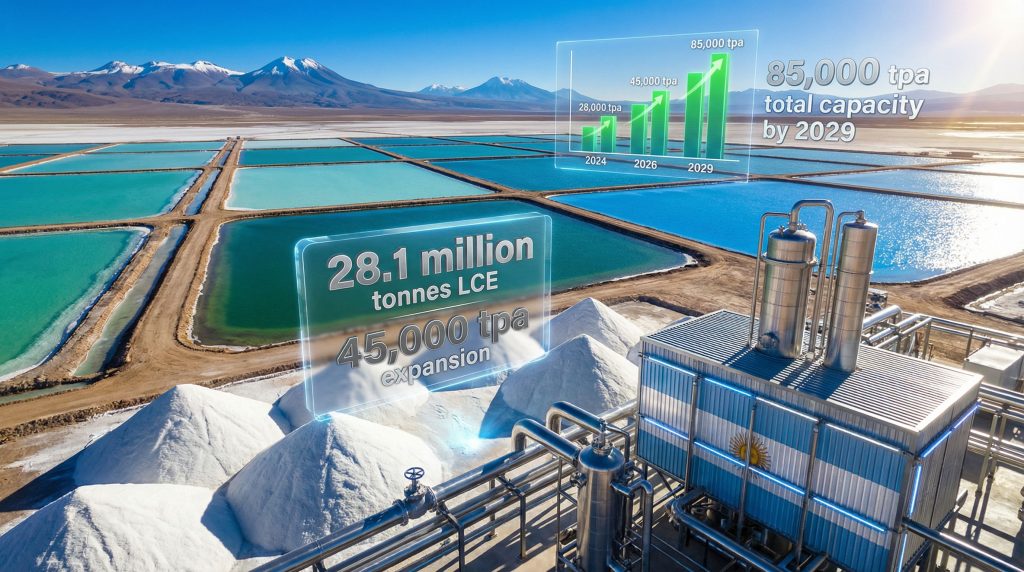
The most recent resource calculation reveals a 42% increase in measured and indicated resources, reaching 28.1 million tonnes LCE. Combined with inferred resources of 9.6 million tonnes LCE, the total resource base extends to 37.7 million tonnes LCE, establishing Cauchari-Olaroz among the world's largest lithium brine deposits.
| Resource Category | Volume (Mt LCE) | Grade (mg/L) |
|---|---|---|
| Measured & Indicated | 28.1 | 562 |
| Inferred | 9.6 | – |
| Total Resources | 37.7 | 562 average |
The updated assessment incorporated new drilling information, operational data, and basin-scale hydrological modelling conducted by Aquatec and Groundwater Insight. This comprehensive approach significantly refined technical understanding from the 2019 baseline assessment, providing enhanced confidence in resource continuity and extraction sustainability.
Geographic expansion represents a critical component of the resource update, with the defined area extending approximately 20 kilometres southward from previous boundaries. Consequently, this southern extension substantially increases long-term production optionality and provides operational flexibility for future development phases.
Brine Chemistry and Processing Advantages
The average lithium concentration of 562 mg/L positions Cauchari-Olaroz competitively within the global brine lithium sector, though slightly below the previous estimate of 592 mg/L. This grade decline reflects resource definition expansion into lower-concentration peripheral areas, typical of resource extension programs.
Brine-hosted lithium resources depend critically on several technical factors:
- Lithium concentration: Higher concentrations reduce evaporation pond surface area requirements and processing costs
- Aquifer permeability: Enables sustainable extraction rates over multi-decade operational periods
- Aquifer recharge capacity: Essential for maintaining long-term resource sustainability
- Brine chemistry ratios: The relationship between lithium and competing ions determines processing efficiency
The 35-year operational timeline from 2026 to 2060 reflects hydrogeological modelling that supports sustainable extraction without aquifer depletion. This reserve life calculation provides substantial confidence for long-term investment planning and operational continuity.
Production Economics Through Expansion
The transformation from a 40,000 tonnes per annum operation to an 85,000 tpa facility represents more than simple capacity addition. This expansion fundamentally alters the project's position within global lithium supply chains and establishes new benchmarks for operational scale in South American brine operations.
Current Operations and Performance Metrics
Stage 1 operations have achieved 97% capacity utilisation, demonstrating strong operational execution and market demand alignment. This utilisation rate indicates near-nameplate production performance and validates the technical approaches employed in brine processing and crystallisation systems.
Current cash operating costs maintain trajectories below $6,000 per tonne LCE, reflecting the inherent cost advantages of brine-based extraction compared to hard-rock alternatives. These cost structures benefit from:
- Natural brine concentration through evaporation in high-altitude desert environments
- Reduced energy requirements compared to crushing and grinding operations
- Lower reagent consumption in chemical processing steps
- Economies of scale in processing infrastructure utilisation
Strategic Expansion Impact
The additional 45,000 tpa capacity more than doubles current output, positioning the Cauchari-Olaroz lithium expansion in Jujuy among the world's largest single-site lithium operations. This scale transformation creates significant competitive advantages through:
- Operational synergies: Shared infrastructure reduces per-unit capital and operating costs
- Market positioning: Large-scale production enhances negotiating power with global customers
- Supply chain optimisation: Consolidated logistics improve transportation efficiency
- Technical learning: Experience transfer from Stage 1 reduces Stage 2 execution risks
The phased commissioning approach mitigates construction and operational risks while allowing systematic integration between existing and expanded processing facilities. This methodology has proven successful in comparable South American lithium expansions, particularly in Chile's Atacama operations.
Strategic Partnerships and Market Access
The Cauchari-Olaroz ownership structure reflects strategic international partnerships designed to optimise market access, technology transfer, and capital allocation. These relationships extend beyond simple joint venture arrangements to encompass integrated supply chain positioning.
Joint Venture Configuration
| Partner | Ownership | Strategic Contribution |
|---|---|---|
| Lithium Argentina | 44.8% | Operational leadership and project management |
| Ganfeng Lithium | 46.7% | Technology expertise and offtake agreements |
| JEMSE (Provincial) | 8.5% | Local stakeholder representation |
This partnership structure balances operational control with market access and technological capability. Ganfeng Lithium's involvement provides direct access to Chinese lithium processing and battery manufacturing markets, while JEMSE ensures provincial government alignment with development objectives.
Offtake Strategy and Geographic Diversification
The current offtake allocation directs 80% of production to China through Ganfeng partnerships, with 20% diversification to Thailand markets. This geographic distribution strategy provides:
- Market security: Long-term agreements reduce price volatility exposure
- Supply chain integration: Direct connections to battery manufacturing facilities
- Risk mitigation: Geographic diversification reduces dependence on single markets
- Growth optionality: Relationships facilitate expansion into additional Asian markets
The expansion represents more than doubling current output, positioning Cauchari-Olaroz among the world's largest single-site lithium operations by 2029.
Argentina's Evolving Market Position
The Cauchari-Olaroz lithium expansion in Jujuy contributes to Argentina's trajectory toward top-three global producer status, challenging traditional dominance patterns in international lithium markets. This positioning shift creates implications for global pricing dynamics and supply security considerations.
Argentina's emergence as a major lithium producer diversifies global supply chains previously concentrated in Australia and Chile. In addition, the country's brine-based operations offer cost advantages that improve competitiveness against both Australian hard-rock and Chilean brine competitors.
Regional Development and Infrastructure
Jujuy Province's lithium sector development requires substantial infrastructure investments to support high-altitude operations. Transportation logistics from 3,600-4,200 metre elevations present unique challenges requiring specialised solutions for:
- Road infrastructure: All-weather access to remote salar locations
- Power supply: Grid connections or renewable energy installations
- Water management: Sustainable usage in arid environments
- Workforce development: Technical training for specialised operations
Local economic impact extends beyond direct employment to encompass service industries, infrastructure development, and provincial revenue generation. The long-term nature of lithium operations creates sustained economic development opportunities for regional communities.
Technical and Environmental Sustainability
Operating in high-altitude desert environments requires sophisticated environmental management and technical optimisation to ensure sustainable long-term extraction. The Cauchari-Olaroz expansion incorporates advanced approaches to address these challenges.
Processing Technology and Efficiency
Evaporation pond systems benefit from Jujuy's high-altitude desert climate, characterised by minimal precipitation (200-300mm annually) and high evaporation rates. These natural conditions maximise brine concentration efficiency while minimising freshwater requirements.
Advanced processing technologies incorporate:
- Closed-loop brine recycling: Minimises freshwater extraction and environmental impact
- Solar energy integration: Takes advantage of high-altitude solar irradiation
- Automated monitoring systems: Optimises brine chemistry and processing parameters
- Waste heat recovery: Improves energy efficiency in crystallisation processes
Environmental Monitoring and Conservation
Basin-scale hydrological modelling ensures sustainable aquifer management throughout the 35-year operational timeline. Environmental protocols address:
- Biodiversity conservation in high-altitude ecosystems
- Water resource protection and monitoring
- Air quality management in desert environments
- Community engagement and indigenous rights considerations
However, comprehensive environmental impact assessments incorporate climate change projections and cumulative regional extraction effects, ensuring sustainable operations despite multiple lithium projects drawing from shared aquifers.
The next major ASX story will hit our subscribers first
Market Dynamics and Long-Term Viability
Global lithium demand projections support long-term investment confidence in Argentine production capacity. Electric vehicle adoption rates, battery chemistry evolution, and energy storage requirements drive sustained demand growth through the next decade and beyond.
Supply Security and Diversification
Major lithium consuming regions increasingly prioritise supply chain diversification to reduce dependence on single-country sources. Argentina's emergence as a significant producer addresses these security concerns while providing cost-competitive alternatives to existing suppliers.
Investment risk assessment encompasses political stability, regulatory continuity, and economic factors affecting project returns. Furthermore, Argentina's established mining sector and improving investment frameworks reduce political and regulatory risks compared to emerging lithium jurisdictions.
For instance, similar geothermal brine extraction projects in Italy demonstrate how international experience transfers technical knowledge across different geological settings.
Financial Performance Indicators
The 35-year operational timeline through 2060 provides substantial visibility for financial planning and investor confidence. Key performance metrics include:
- Net debt reduction capabilities through operational cash flow generation
- Reinvestment capacity for technology upgrades and efficiency improvements
- Dividend potential aligned with long-term shareholder value creation
- Reserve life extension through exploration and development activities
Global Comparative Analysis
The Cauchari-Olaroz lithium expansion in Jujuy operates within a global context where different regions compete through distinct technological and economic advantages. Comparing Argentine operations with international counterparts reveals strategic positioning opportunities.
For example, australia lithium tax breaks demonstrate how government policy influences competitive positioning across different jurisdictions. Meanwhile, projects like the thacker pass lithium update in the United States show how various extraction methods compete globally.
Cost Structure Comparisons
Argentine brine operations maintain cost advantages over hard-rock alternatives, with processing costs typically 30-50% lower than spodumene-based production. This cost differential stems from:
- Natural evaporation processes requiring minimal energy input
- Simplified chemical processing compared to hard-rock methods
- Lower infrastructure requirements for brine extraction
- Reduced transportation costs due to proximity to ports
Consequently, these advantages position Argentina favourably in price-sensitive markets whilst maintaining healthy operating margins during commodity price cycles.
Long-Term Value Creation Implications
The Cauchari-Olaroz expansion represents more than capacity addition; it establishes a platform for sustained value creation through technological advancement, operational optimisation, and market development. The 35-year operational timeline provides substantial flexibility for adaptation to evolving market conditions and technological progress.
Reserve life extending through 2060 creates opportunities for continuous improvement in processing efficiency, environmental performance, and cost optimisation. Technology evolution in lithium extraction and processing may enhance resource recovery and reduce environmental footprint over the operational timeline.
Understanding broader market trends through argentine lithium insights provides context for long-term strategic planning. The comprehensive analysis reveals how projects like Cauchari-Olaroz contribute to Argentina's emergence as a lithium superpower.
Succession planning and operational continuity strategies ensure sustained performance throughout the project lifecycle, whilst expansion optionality provides growth potential as market conditions and resource understanding evolve.
The integration of the Cauchari-Olaroz lithium expansion in Jujuy within Argentina's broader lithium development strategy positions the country as a reliable, long-term supplier to global markets seeking diversification and cost optimisation. This strategic positioning supports sustained value creation for stakeholders whilst contributing to global lithium supply security in an increasingly electrified economy.
Finally, the successful execution of this expansion project demonstrates Argentina's capability to deliver world-class lithium operations, establishing benchmarks for future developments across the region and reinforcing the country's position as a critical component of global battery supply chains through 2060 and beyond.
Ready to Capitalise on the Next Major Lithium Discovery?
Discovery Alert instantly alerts investors to significant ASX mineral discoveries using its proprietary Discovery IQ model, transforming complex mining announcements into actionable insights for both short-term traders and long-term investors. Understand why major mineral discoveries can generate exceptional returns by exploring Discovery Alert's dedicated discoveries page, showcasing historic examples of substantial market outcomes, and begin your 14-day free trial today to position yourself ahead of the market.