August 5, 2026
The Case for Rethinking South America's Critical Minerals Hierarchy
Commodity supercycles rarely arrive with clear signals. They tend to build quietly beneath the surface, shaped by geological endowment, policy innovation, and shifting capital preferences, before erupting into visibility when export numbers become impossible to ignore. That is precisely what is happening across Argentina's mining sector right now, and the Argentina mining exports jump 49% forecast for 2026 suggests the momentum is far from exhausted.
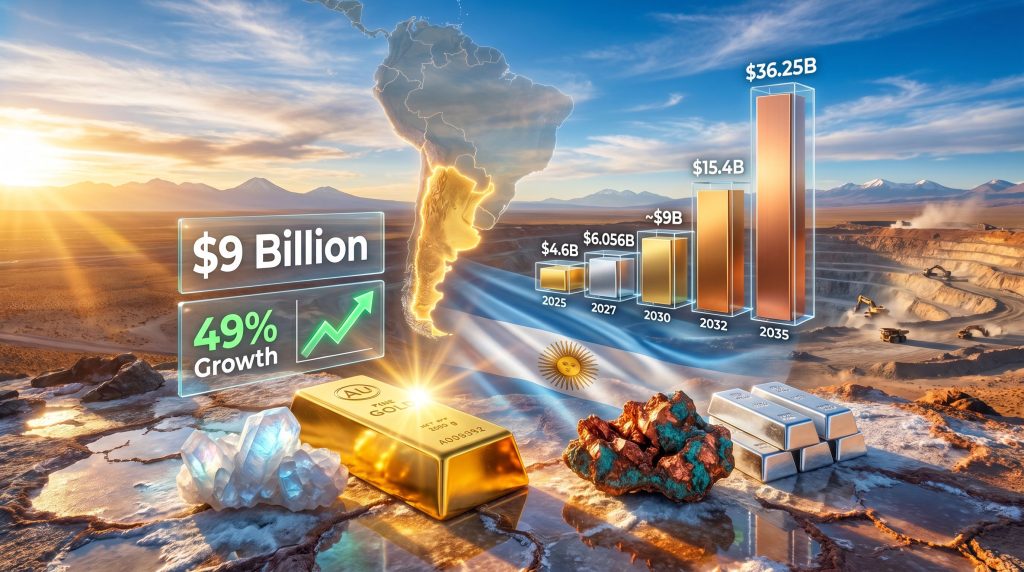
Argentina's mining exports are forecast to surge by 49% in 2026, reaching approximately $9 billion, according to Roberto Cacciola, president of the Argentine Chamber of Mining Companies. Significantly, Cacciola framed that figure not as an optimistic ceiling but as a conservative baseline, suggesting that sustained commodity prices could push actual outcomes meaningfully higher. When an industry body characterises its own headline projection as cautious, it is worth understanding the structural forces making that confidence possible.
When big ASX news breaks, our subscribers know first
From Overlooked Geology to Global Contender: Argentina's Repositioning
For most of the past two decades, Argentina sat as an underutilised geological opportunity in the global mining investment landscape. The country holds world-class endowments across lithium, copper, gold, and silver, yet consistently failed to translate resource quality into consistent export performance. Macroeconomic instability, currency controls, and inconsistent regulatory policy created a risk premium that made many global mining majors reluctant to commit large-scale capital, despite the attractiveness of the underlying geology.
That dynamic has shifted materially. Argentina has advanced from 12th to 7th place in the global exploration destination rankings, according to the Argentine Chamber of Mining Companies. This movement is not incidental. It reflects a deliberate repricing of investment risk driven by structural policy reform under President Javier Milei's administration, combined with a broader commodity environment that is rewarding jurisdictions capable of delivering production at scale.
The four commodity pillars underpinning this shift are not interchangeable in terms of their development timelines or demand drivers. Gold and silver provide the near-term revenue foundation, their export contributions visible already in current data. Lithium is scaling rapidly, powered by the global energy transition. Copper sits at the far end of the development curve, carrying the largest long-range export potential but requiring patience from both operators and capital allocators.
Understanding Argentina's mining export acceleration requires engaging with each of these pillars individually, while also appreciating the policy architecture that is enabling their simultaneous development.
What Is RIGI and Why Is It Attracting the World's Largest Mining Companies?
Breaking Down Argentina's Large Investment Incentive Regime
The centrepiece of Argentina's investment reform is the Regime for the Incentivization of Large Investments, known by its Spanish acronym RIGI. Introduced under the Milei administration, RIGI is structured to provide qualifying large-scale projects with the fiscal predictability that multi-billion dollar capital commitments require. Its core components include long-term tax stability guarantees, capital repatriation rights, and customs duty benefits that materially reduce the cost burden on large capital-intensive operations.
What distinguishes RIGI from superficially similar frameworks in other jurisdictions is the comprehensiveness of its fiscal certainty provisions. Mining project developers typically operate on 20 to 30-year time horizons, and their willingness to commit capital depends heavily on confidence that the fiscal and regulatory conditions prevailing at the time of investment decision will not be arbitrarily altered by future administrations. RIGI attempts to address this concern directly.
The framework has attracted participation from BHP and Rio Tinto, two of the most capital-disciplined and jurisdictionally selective mining companies operating globally. Their engagement with the RIGI framework functions as an implicit endorsement of its structural credibility, providing a signal to mid-tier operators and junior explorers that major capital allocators have conducted due diligence and found the framework satisfactory.
The RIGI Pipeline: Projects, Capital, and Approvals
The current state of the RIGI pipeline provides a useful measure of both the framework's success and its remaining capacity for growth.
| Metric | Current Status |
|---|---|
| Total projects submitted to RIGI | 13 |
| Total capital value submitted | $42 billion |
| Projects approved to date | 7 |
| Capital approved to date | $7.9 billion |
The gap between submitted capital ($42 billion) and approved capital ($7.9 billion) is striking. Approximately $34.1 billion in project capital remains in the approval pipeline, representing a substantial runway of potential investment commitments that have not yet been formalised. The approval rate by capital value stands at roughly 18.8%, indicating either a selective approval process, lengthy assessment timelines, or a concentration of very large projects among the pending applications.
For investors and analysts tracking Argentina's mining trajectory, the progression of these pending approvals is arguably the most important near-term variable. Each approval announcement represents a capital commitment that translates into future production capacity and, ultimately, future export revenue. Furthermore, policy changes in Argentina are increasingly seen as a positive catalyst for the broader copper mining sector specifically.
"The $42 billion RIGI project pipeline, if fully executed, would represent one of the largest single-country mining investment programs undertaken globally over the coming decade, with the capacity to transform Argentina's position in the critical minerals supply chain well beyond what current export projections capture."
How Fast Is Argentina's Mining Export Growth? A Statistical Deep Dive
Year-on-Year Export Performance: From $4.6 Billion to $9 Billion in Two Years
The trajectory of Argentina's mining export performance over the 2024 to 2026 period is striking in both its pace and its consistency. Working backwards from confirmed 2025 data, the progression looks as follows:
| Year | Export Value | Year-on-Year Change |
|---|---|---|
| 2024 (estimated) | ~$4.66 billion | Baseline |
| 2025 (actual) | $6.056 billion | +30% |
| 2026 (forecast) | ~$9 billion | +49% |
What makes this growth trajectory particularly meaningful is the acceleration of the growth rate itself. A 30% increase in 2025 was already a significant performance. A forecast 49% increase in 2026 suggests that the structural drivers are intensifying rather than moderating.
Monthly and Quarterly Granularity: The Data Behind the Headline
Monthly export data provides additional texture to the headline annual figures. January 2025 established a new monthly record at $812 million, representing an 82.1% year-on-year increase from January 2024. Across the first eight months of 2025, Argentina generated $4.21 billion in mining exports, a 32.9% year-on-year growth rate that confirmed the annual trajectory.
The commodity breakdown of that January 2025 record provides important insight into where Argentina's export revenue is currently concentrated:
| Commodity | Export Value (Jan 2025) | Notable Detail |
|---|---|---|
| Gold | $581 million | Dominant metallic mineral contributor |
| Silver | $116 million | Secondary precious metals driver |
| Lithium | $96 million | 74.5% year-on-year growth rate |
| Total Metallic Minerals | $707 million | Core of monthly record |
Gold's $581 million single-month contribution is particularly notable. It represents 71.5% of total metallic mineral exports in January 2025, establishing precious metals as the dominant near-term revenue driver and indicating that Argentina's existing operational gold mines are performing at a scale that makes them globally significant export contributors.
Lithium's 74.5% year-on-year growth rate, while contributing a smaller absolute value, is the figure that warrants the most attention from a long-range perspective. Compounding at that pace, lithium has the potential to displace precious metals as the primary export contributor within a medium-term horizon, particularly as new production capacity enters operation.
Which Commodities Are Driving Argentina's Export Acceleration?
Lithium: The Electromobility Multiplier
Argentina occupies a geologically privileged position within what the global mining industry calls the Lithium Triangle, a region shared with Bolivia and Chile that collectively contains some of the world's largest known lithium brine deposits. Unlike hard-rock lithium deposits found elsewhere, understanding how lithium brine mining works reveals that brine-based processing in the Puna region of northwest Argentina can achieve lower production costs per tonne of lithium carbonate equivalent under favourable operating conditions.
The long-range projection for Argentine lithium exports reaches $11.89 billion annually by 2036, a figure that would represent a transformation from lithium being a secondary commodity contributor today to a dominant revenue pillar within a decade. The structural demand driver underpinning this projection is the ongoing global transition toward electric mobility and grid-scale battery storage, both of which require lithium at volumes that existing global supply chains are not yet positioned to deliver at forecast rates.
A less commonly appreciated dimension of Argentina's lithium positioning is the grade variability across its brine deposits. Not all brines are created equal, and the lithium concentration, magnesium-to-lithium ratio, and potassium content of a given deposit materially affect both processing cost and recoverable yield. Consequently, the Argentina lithium brine market reflects considerable variation in project economics across the Jujuy and Salta provinces, even where underlying resource quality is broadly favourable.
Gold and Silver: The Near-Term Revenue Anchors
With gold trading above $2,800 per ounce in early 2026, Argentina's existing gold operations are generating export revenues at a scale that would have been difficult to model even three years ago. The $581 million single-month gold export figure from January 2025 reflects both operational capacity and the price environment simultaneously. Price sensitivity is acute: every sustained $100/oz increase in the gold price, applied across Argentina's current production profile, translates into hundreds of millions of dollars in additional annual export revenue.
Silver's contribution, while smaller in absolute terms, is supported by a broadening industrial demand base. Solar panel manufacturing has become one of the largest industrial consumers of silver globally, as photovoltaic cell design relies on silver's electrical conductivity properties. The accelerating installation of solar capacity worldwide creates a structural demand tailwind for silver that is distinct from its traditional safe-haven and monetary roles.
Copper: The Long-Duration Growth Engine
Copper occupies a unique position in Argentina's export roadmap. Its projected contribution of $18.71 billion annually by 2035 would make it the single largest commodity driver in the country's long-range export model, surpassing even lithium in absolute revenue terms. However, reaching that potential requires navigating development timelines that are substantially longer than those for precious metals.
Large-scale copper deposits, particularly porphyry-type systems that characterise much of the Andes region, require extensive exploration, feasibility studies, environmental assessment, community consultation, and infrastructure development before reaching commercial production. From discovery to first production, timelines of ten to fifteen years are not unusual. For instance, identifying a major copper system in Argentina represents only the beginning of a lengthy pathway to production. This means that the copper projects entering the RIGI framework today are, in most cases, building the foundation for production capacity that will drive the 2030 to 2035 export numbers.
RIGI's role in this process is to de-risk the capital commitment at the pre-production stage, where uncertainty is highest and investor patience is most severely tested. By providing fiscal certainty over the full project lifecycle, the framework allows copper project developers to present bankable economics to project finance lenders and institutional investors. In addition, ongoing Argentina copper exploration activity is steadily expanding the pipeline of potential projects that could advance through the RIGI framework in coming years.
What Does Argentina's Long-Range Mining Export Roadmap Look Like?
Government Projections: 2026 to 2035
| Year | Projected Mining Export Value |
|---|---|
| 2025 (Actual) | $6.056 billion |
| 2026 (Forecast) | ~$9 billion |
| 2030 (Government Target) | $15.4 billion |
| 2035 (Government Target) | $36.25 billion |
The progression from $9 billion in 2026 to $36.25 billion in 2035 implies a roughly four-fold increase over nine years, a trajectory that would require sustained commodity prices, successful execution of RIGI-approved projects, and continued regulatory stability across multiple election cycles. The $57 billion capital investment requirement underpinning the 2035 scenario provides a sense of the physical infrastructure buildout implied by these numbers.
Several embedded assumptions bear scrutiny:
- Commodity price floors across gold, silver, lithium, and copper that justify ongoing capital deployment
- Successful transition of RIGI-approved projects from approval to construction to production within projected timelines
- Regulatory continuity across the RIGI framework regardless of future political transitions
- Resolution of environmental and community concerns, particularly in glacier-adjacent regions
- Infrastructure development, including road, water, energy, and processing facilities, keeping pace with production growth
Any material deterioration in these conditions would create downside risk to the long-range projections. Argentina's history of policy discontinuity across administrations means that the political continuity assumption carries particular weight.
Where Is Argentina's Mining Capital Going? Key Export Markets
Argentina's mining export destinations reflect the distinct characteristics of each commodity:
- United States: A major destination for copper and increasingly a strategic partner in critical minerals supply chain development
- Switzerland: Features prominently due to its role as a global precious metals refining and trading hub, with major gold refineries processing output from South American operations
- India: An emerging market for industrial metals, with growing steel and manufacturing demand creating import requirements
- China: Strategically interested in Argentine lithium and copper as inputs to its electric vehicle and renewable energy manufacturing base, representing a supply chain diversification consideration from China's perspective
The China dimension of Argentina's export markets carries strategic complexity. While Chinese industrial demand represents a reliable and substantial offtake channel for both lithium and copper, it also raises questions about pricing dynamics and the concentration of export market dependency.
The next major ASX story will hit our subscribers first
Is Argentina's Mining Boom Without Risk? The Environmental and Political Fault Lines
The Glacier Law Reform: A Flashpoint Between Investment and Conservation
In April 2026, Argentine lawmakers approved a reform affecting mining activity in glacier regions. The change modified existing protections to allow investment promotion in areas containing or adjacent to glacial formations, a measure that the scientific and environmental communities have characterised as weakening a critical ecological safeguard.
The concern centres on water resources. In the arid Andean regions where many of Argentina's most significant mineral deposits are located, glaciers function as the primary freshwater storage and release mechanism for downstream agricultural and community water supplies. Critics of the reform argue that mining-related water consumption and contamination risk in these zones could have irreversible consequences for regional water security.
The economic counterargument focuses on the geological reality that some of Argentina's highest-grade mineral deposits, particularly copper and gold, are located at elevations where glacier proximity is unavoidable. Proponents of the reform contend that modern mining techniques and environmental management systems can adequately mitigate water-related risks while generating economic returns of national strategic significance.
For institutional investors operating under ESG frameworks, this tension introduces a monitoring obligation. International lenders and equity investors with environmental and social governance commitments will require detailed environmental impact assessments, community consultation records, and ongoing water monitoring data before participating in projects operating in or near glacier regions.
Political and Macroeconomic Risk Factors
Beyond the environmental dimension, several structural risk factors warrant consideration:
- Currency risk: Argentina's history of peso volatility and capital controls creates ongoing uncertainty for mining operators whose costs are predominantly peso-denominated but whose revenues are USD-denominated. Exchange rate movements can materially affect reported profitability and the attractiveness of repatriated earnings
- Political continuity: RIGI's credibility depends on sustained support across legislative and executive branches over time horizons that extend well beyond any single electoral cycle
- Inflation and operating costs: Domestic inflation affects the peso-denominated cost base for mining operations, potentially compressing margins if cost escalation outpaces commodity price appreciation
- Approval process predictability: The gap between submitted and approved RIGI capital suggests that administrative processes may not be operating at the speed that project developers require
The participation of BHP and Rio Tinto in RIGI provides a partial risk mitigation signal. These companies are among the most sophisticated political risk assessors in the global mining industry, and their engagement implies that they have assessed Argentina's current risk profile as acceptable. However, their involvement does not eliminate sovereign risk; it merely indicates a conditional tolerance for it at current investment levels.
How Does Argentina's Mining Growth Compare to Global Peers?
Comparative Framework: Emerging Mining Jurisdictions in 2026
| Country | Key Minerals | Investment Regime Strength | 2026 Export Outlook |
|---|---|---|---|
| Argentina | Lithium, Copper, Gold | High (RIGI framework) | ~$9 billion (49% growth) |
| Chile | Lithium, Copper | Moderate (policy uncertainty) | Stable, slower growth |
| Peru | Copper, Gold, Silver | Moderate (political instability) | Constrained |
| DRC | Cobalt, Copper | Low-Moderate (governance risk) | Volatile |
| Australia | Lithium, Iron Ore, Gold | Very High (established framework) | Mature, incremental growth |
Argentina's reform-driven growth rate is structurally different from the incremental production growth visible in more mature mining jurisdictions like Australia. What Argentina is experiencing is a step-change in investor confidence rather than organic production expansion, which creates a different risk-return profile for capital allocators evaluating the jurisdiction.
The competitive implications for Chile are particularly notable. Chile has historically been the default destination for South American copper and lithium investment, benefiting from decades of established institutional credibility. However, recent policy uncertainty surrounding Chile's mining royalty reforms and the government's approach to lithium nationalisation has created hesitation among major capital allocators. Argentina's RIGI, by contrast, offers explicit fiscal certainty provisions that Chile's current framework does not match, potentially redirecting capital flows that would previously have defaulted to Chilean projects.
Peru faces a different set of challenges, with persistent political instability at the executive level and community opposition to large mining projects in several key production regions creating operational and approval delays that have constrained new investment. For capital allocators comparing South American mining jurisdictions, Argentina's improving risk-adjusted return profile stands in increasingly favourable contrast. The broader copper supply crunch trends playing out globally only reinforce why Argentina's copper development pipeline is attracting intensifying attention from major miners.
"Argentina's advancement from 12th to 7th in global exploration rankings within a compressed timeframe is not simply a reputational metric. It reflects actual capital allocation decisions by exploration companies that have repriced the jurisdiction's risk-reward balance and voted with their drilling budgets."
Frequently Asked Questions: Argentina Mining Exports 2026
What is driving Argentina's 49% mining export growth forecast for 2026?
The projected increase from $6.056 billion in 2025 to approximately $9 billion in 2026 reflects the combined effect of newly approved large-scale projects under the RIGI investment framework, sustained strength in gold prices, accelerating lithium production volumes, and growing copper development activity entering earlier production phases. Industry leadership has characterised the $9 billion figure as a conservative floor rather than an upper bound. Argentina's mining exports are forecast to jump 49% in 2026, according to the president of the Argentine Chamber of Mining Companies.
What is RIGI and how does it work?
RIGI is Argentina's Regime for the Incentivization of Large Investments, introduced under President Javier Milei's administration. It provides qualifying large-scale projects with long-term fiscal stability, tax incentives, and capital repatriation rights that reduce investment risk for major mining operators over the extended timeframes that large project development requires.
Which commodities are most important to Argentina's mining export growth?
In the near term, gold dominates export revenues, contributing $581 million in January 2025 alone. Silver provides secondary precious metals revenue. Lithium is growing at 74.5% year-on-year and is positioned as a medium-term growth driver. Copper carries the largest long-term revenue potential, projected to generate $18.71 billion in annual export value by 2035.
What are the main risks to Argentina's mining export targets?
Key risks include political and regulatory continuity across election cycles, environmental opposition to mining in glacier-adjacent regions, commodity price volatility particularly in gold and lithium, Argentina's complex monetary environment affecting cost structures and revenue repatriation, and execution risk associated with large capital projects operating in challenging high-altitude environments.
How does Argentina rank globally as a mining destination?
Argentina has advanced from 12th to 7th in the global exploration destination ranking, according to the Argentine Chamber of Mining Companies, reflecting significantly improved investor confidence driven by RIGI and the broader economic reform agenda of the current administration. Furthermore, mining companies are discovering massive breakthroughs in Argentina, reinforcing the country's rising status among exploration-focused capital allocators.
Key Takeaways: What Argentina's Export Surge Means for the Global Mining Industry
The Argentina mining exports jump 49% forecast for 2026 is not an isolated data point. It represents the quantified output of a structural repositioning that has been building across multiple dimensions simultaneously.
- Argentina's advance from 12th to 7th in global exploration rankings reflects real capital allocation decisions, not sentiment surveys
- The $42 billion RIGI project pipeline represents a generational investment opportunity if approvals and execution proceed on schedule
- Gold and silver provide the near-term revenue certainty that sustains operational momentum while copper and lithium scale toward their long-range potential
- The $36.25 billion export target for 2035 implies a transformation of Argentina's economic profile that would make mining one of the country's dominant foreign exchange earning sectors
- Environmental governance around glacier-adjacent mining remains the single most complex non-commercial variable in the trajectory
- BHP and Rio Tinto's RIGI participation provides a partial sovereign risk signal but does not eliminate the political continuity dependency that all long-range Argentine projections carry
For global mining capital allocators, Argentina has completed the transition from a high-risk frontier consideration to a monitored high-conviction opportunity. The quality of that conviction will be determined, over the next three to five years, by the pace of RIGI approvals, the execution fidelity of approved projects, the government's management of environmental governance concerns, and the durability of the policy framework across whatever political transitions lie ahead.
This article is intended for informational purposes only and does not constitute financial or investment advice. Forward-looking projections, including government and industry export forecasts, are subject to material uncertainty and should not be relied upon as guarantees of future performance. Readers should conduct independent research and consult qualified financial advisors before making investment decisions.
Want To Capitalise on the Next Major Mineral Discovery Before the Market Does?
Argentina's mining boom is reshaping global critical minerals supply chains, and the ASX is home to explorers and developers positioned to benefit directly from this shift — Discovery Alert's proprietary Discovery IQ model scans ASX announcements in real time, delivering instant alerts on significant mineral discoveries across lithium, copper, gold, and beyond, so subscribers can act on actionable opportunities ahead of the broader market. Explore historic examples of what major discoveries can return and begin your 14-day free trial today to secure a market-leading advantage.