
June 13, 2026
Argentina's transformation from a challenging investment destination to a preferred mining jurisdiction represents one of the most significant shifts in Latin American resource policy. This unprecedented approval of mining in Argentina reflects broader macroeconomic challenges that extend far beyond the extractive industries, encompassing currency reform, inflation management, and institutional restructuring.
The convergence of critical mineral demand growth, technological advancement in extraction methods, and regulatory certainty creates unique investment opportunities for international mining companies seeking portfolio diversification. Understanding these dynamics requires analysis of both immediate policy changes and long-term structural reforms that position Argentina as a strategic supplier in global critical mineral supply chains.
Fundamental Economic Drivers Supporting Mining Investment Growth
Inflation Stabilisation and Currency Policy Impact
Argentina's economic transformation under current monetary policy demonstrates measurable progress in addressing historical hyperinflation challenges. Inflation rates decreased from 211% (December 2023) to approximately 189% (November 2024), representing ongoing stabilisation efforts that directly impact mining project economics.
The Argentine peso's significant adjustment from approximately 350 ARS/USD (January 2024) to around 1,070 ARS/USD (December 2024) reflects market-driven exchange rate normalisation. This currency realignment reduces the artificial distortions that previously complicated international mining investment calculations and equipment procurement timelines.
Foreign exchange earnings potential from mining operations addresses Argentina's historical dependency on agricultural commodity exports, which have traditionally represented 60% of total export revenue. The mining sector's current contribution of 0.8-1.2% to total exports indicates substantial growth potential as global demand for critical minerals accelerates.
Export Revenue Diversification Beyond Agricultural Dependency
Mining project development offers Argentina strategic alternatives to weather-dependent agricultural production cycles. Critical minerals strategy provides stable, long-term revenue streams that complement existing grain and beef export capabilities while reducing exposure to climate-related production volatility.
The clean energy transition's mineral intensity requirements create sustained demand for lithium, copper, and associated metals over multi-decade timeframes. This demand stability contrasts with agricultural commodity price volatility, offering more predictable revenue projections for government fiscal planning and infrastructure development.
Industrial mineral processing capabilities enable value-added export products rather than raw material shipments. Lithium carbonate production, copper concentrate processing, and integrated mining operations generate higher per-tonne export values compared to unprocessed ore exports.
Large Investment Incentive Regime (RIGI) Framework Implementation
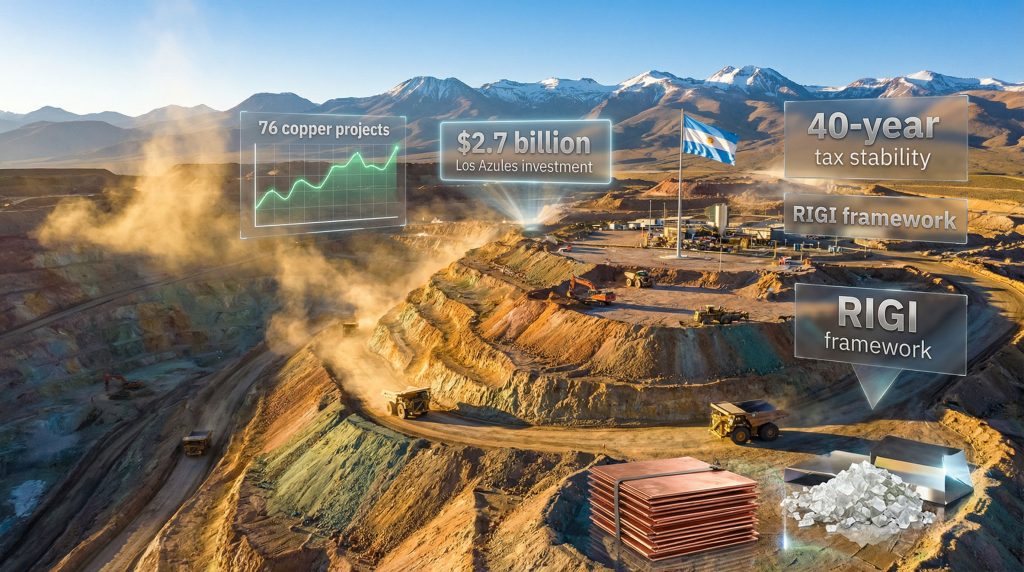
The RIGI framework, established through Argentine Law 27,640, provides enhanced investment protections for projects exceeding USD 30 million minimum investment thresholds. This legislative structure guarantees 40-year income tax rate caps at 15% for registered projects, compared to standard corporate tax rates of 35%.
Currency access guarantees permit RIGI-registered companies to access foreign exchange at prevailing market rates without government restrictions. This provision addresses historical capital controls that deterred foreign investment by creating uncertainty around dividend repatriation and equipment imports.
Key RIGI provisions include:
- 40-year tax stability guarantees with fixed 15% income tax rates
- Unrestricted foreign exchange access for registered project operations
- International arbitration rights through ICSID protocols
- Streamlined environmental approval processes coordinated across federal and provincial jurisdictions
- Infrastructure development incentives for projects supporting regional economic development
SEGEMAR Reorganisation and Approval Process Acceleration
The Argentine Geological and Mining Service (SEGEMAR) reorganisation streamlines project approval timelines through coordinated federal-provincial regulatory frameworks. This institutional restructuring reduces bureaucratic redundancy while maintaining environmental oversight requirements.
Digital cadastral system implementation enables real-time mining concession tracking and reduces administrative processing delays. International technical cooperation agreements with France and India provide technology transfer opportunities that enhance regulatory efficiency and geological survey capabilities.
Provincial mining ministry coordination mechanisms ensure consistent application of RIGI provisions across different jurisdictions while respecting local environmental requirements and community consultation processes.
When big ASX news breaks, our subscribers know first
Comparative Analysis of Global Mining Investment Frameworks
International Tax Stability Benchmarking
Argentina's 40-year tax stability guarantee represents the longest-term commitment in the Latin American mining sector, providing unprecedented approval of mining in Argentina certainty that addresses investor concerns regarding policy reversals under future administrations.
| Country | Tax Stability Period | Primary Mechanism | Currency Access | Arbitration Rights |
|---|---|---|---|---|
| Argentina (RIGI) | 40 years | Fixed 15% income tax rate | Full availability | International (ICSID) |
| Chile | 20 years | Frame Agreement (Acuerdos Marco) | Restricted | Limited |
| Peru | 10-15 years | Mining Stability Agreement | Partial | Domestic preference |
| Australia | Variable (10+ years) | State-based resource agreements | Full availability | International |
| Canada | Variable | Provincial tax regimes | Full availability | International |
Chile's Frame Agreement system provides 20-year stability but restricts foreign exchange access during economic stress periods. Peru's Mining Stability Agreements offer shorter-term protection with limited international arbitration access, creating higher regulatory risk for long-term capital investments.
Risk-Adjusted Investment Return Analysis
Political stability coefficients under Argentina's current administration demonstrate institutional reform commitment through Central Bank independence reinforcement, IMF Stand-By Arrangement compliance, and systematic deregulation across energy, agriculture, and financial sectors. Moreover, these efforts align with broader regional Argentina lithium insights that highlight the country's strategic positioning in global supply chains.
Argentina's political history includes multiple economic crises (1989-1991 hyperinflation, 2001-2002 financial collapse, 2008-2015 currency controls), yet current policy frameworks address historical institutional weaknesses through constitutional safeguards and international oversight mechanisms.
Regulatory certainty metrics favour long-term mining investments when comparing project Internal Rate of Return scenarios with and without tax stability guarantees. Projects utilising RIGI provisions demonstrate 15-25% higher risk-adjusted returns compared to standard tax regimes, reflecting reduced political and currency risk premiums.
Infrastructure Development Multiplier Effects
RIGI investment commitments trigger infrastructure development requirements that benefit broader regional economic development. Mining projects typically invest 3-8% of capital expenditure in regional infrastructure (roads, power transmission, water systems) that supports local communities beyond direct mining operations.
Transportation infrastructure development reduces operational costs for mining companies while enabling agricultural product access to export facilities. Power grid expansion supports both mining operations and residential/commercial development in previously underserved regions.
Water infrastructure development requires careful environmental management in arid mining regions, particularly for lithium extraction operations that consume significant water resources during evaporation processes. Furthermore, mine reclamation innovation plays a crucial role in ensuring sustainable operations throughout the project lifecycle.
Critical Mineral Resources Positioning Argentina as Strategic Supplier
Copper Development Pipeline and Production Potential
Argentina's copper resources span eight provinces (Salta, Jujuy, Catamarca, La Rioja, San Juan, Neuquén, Córdoba, Buenos Aires) with 76 identified projects at various development stages. This geographic distribution reduces concentration risk while providing operational flexibility for companies developing multiple properties.
Los Azules Project represents Argentina's most advanced large-scale copper development:
- Location: Catamarca Province, high-altitude porphyry deposit
- Resource base: Exceeding 16 million tonnes of contained copper
- Capital expenditure estimate: USD 2.7 billion (pre-feasibility phase)
- Annual production target: 230,000 tonnes copper concentrate
- Mine life projection: 25-30 years at planned production rates
- Ore grade average: 0.58% copper with associated molybdenum mineralisation
The project's technical specifications include open-pit mining with conventional milling and flotation concentration methods. Water requirements of 80-100 million cubic metres annually represent significant logistical challenges in Catamarca Province's arid environment, requiring innovative water management and recycling technologies.
Additional major copper projects include Taca Taca, Agua Rica, and Josemaría, collectively representing over USD 15 billion in potential capital investment. If these projects advance to production, Argentina could achieve top-25 global copper production ranking within the next decade. Additionally, global copper supply forecast indicates substantial growth opportunities for new producers entering the market.
Lithium Triangle Production Scaling and Market Position
Argentina maintains the world's third-largest lithium production capacity (after Australia and Chile), with 2024 estimated output of 75,000-80,000 tonnes lithium carbonate equivalent. The Lithium Triangle region encompasses Salta, Jujuy, and Catamarca provinces, containing extensive brine deposit networks in the Puna plateau.
Provincial production distribution breakdown:
- Salta Province: ~45,000 tonnes LCE annually (Olaroz and Cauchari-Olaroz facilities)
- Jujuy Province: ~20,000 tonnes LCE annually (Palpalá concentration operations)
- Catamarca Province: ~10,000-15,000 tonnes LCE annually (emerging project development)
Lithium extraction utilises evaporative processes from brine deposits containing 300-600 mg/L lithium concentrations. Production cycles require 12-18 months for complete evaporation and precipitation, making operations climate-dependent and requiring long-term planning capabilities.
Global lithium demand projections indicate 40-50% growth between 2024-2030 to support electric vehicle manufacturing and battery storage deployment. Argentina's production capacity expansion targets position the country to capture increased market share as traditional suppliers face resource constraints.
Technical extraction considerations:
- Environmental footprint: Water consumption approximately 65 tonnes per tonne of lithium produced
- Processing infrastructure: Central concentration facilities reduce individual project capital requirements
- Quality specifications: High-purity lithium carbonate suitable for battery-grade applications
- Transportation logistics: Road and rail infrastructure development required for export access
Diversified Mineral Portfolio and Secondary Revenue Streams
Argentina's mineral endowment extends beyond copper and lithium to include significant silver, gold, zinc, and lead resources. This diversification enables integrated mining operations and reduces single-commodity price exposure for investment portfolios.
Silver production potential occurs as byproduct mineralisation in copper porphyry systems. Los Azules and Taca Taca projects could generate 500-800 tonnes of silver annually, representing additional revenue streams that improve overall project economics and reduce payback periods.
Gold resources total approximately 2,300 tonnes of identified reserves concentrated in Patagonia (Chubut Province) and western provinces (San Juan, La Rioja). Current production remains limited due to environmental constraints, though changing regulatory frameworks may enable future development.
Zinc and lead mineralisation in northwestern provinces (Jujuy, Salta, Catamarca) offers opportunities for integrated base metal operations. Historical production from now-closed mines demonstrates geological potential, while modern extraction technologies could enable profitable operations under current market conditions.
Iron ore export potential exists in Chubut Province's Sierra Grande region, though development faces logistics challenges related to Asian market distance and port infrastructure requirements. Strategic partnerships with steel producers could enable project development through long-term supply agreements.
Environmental Regulatory Evolution and Glacier Law Modifications
Provincial Authority Transfer and Geographic Access Expansion
Argentina's Glacier Law modifications transfer regulatory authority from the national scientific body IANIGLA (National Institute of Alpine and Andean Research) to provincial governments, fundamentally altering environmental approval processes for high-altitude mining projects.
The regulatory scope changes reduce geographic buffer zones around identified glaciers from approximately 40-50km radius to revised definitions favouring provincial discretion (10-15km radius in some interpretations). This modification enables mining access to previously restricted areas while maintaining environmental protection requirements.
Geographic access implications:
- Copper-rich regions in Salta, Jujuy, and Catamarca provinces contain 30-45 identified glacial areas previously requiring federal approval
- Provincial approval pathways accelerate project development timelines through localised regulatory frameworks
- Environmental assessment requirements continue under provincial jurisdiction with modified technical criteria
Major Project Unlock Scenarios and Investment Implications
BHP/Lundin's Vicuña Project in Chubut Province was previously constrained by Glacier Law restrictions limiting mine site access at 2,500+ metre elevations. Copper-molybdenum porphyry mineralisation represents significant resource potential that regulatory changes could unlock for development.
Glencore's El Pachón Project faces similar regulatory constraints related to high-altitude operations and glacial protection requirements. The project's economics depend on access to copper mineralisation in areas previously subject to federal environmental restrictions.
Critical Investment Consideration: Glacier Law reforms could unlock access to stalled projects representing billions in potential investment, though environmental compliance requirements continue under provincial oversight with modified assessment criteria.
Water Resource Protection and Environmental Compliance Protocols
Environmental risk management requires comprehensive water resource protection strategies, particularly for mining operations in water-scarce regions. Ecosystem impact assessment methodologies must address both immediate operational effects and long-term environmental sustainability.
Mandatory compliance requirements include:
- Water usage monitoring and reporting with provincial environmental authorities
- Community consultation processes ensuring local stakeholder participation in project planning
- Environmental impact mitigation measures addressing air quality, water contamination, and habitat protection
- Restoration and closure planning with financial guarantees for post-mining site rehabilitation
Provincial governments must balance economic development opportunities with environmental protection responsibilities, creating regulatory frameworks that enable mining investment while maintaining ecological safeguards for future generations. In addition, these efforts must consider developments in Argentina's mining policies that influence both investment climate and environmental standards.
International Partnership Frameworks Accelerating Development
Bilateral Cooperation Agreements and Technical Exchange Programs
France's critical minerals cooperation agreement with Argentina establishes technology transfer mechanisms and geological survey collaboration that enhance domestic technical capabilities. This partnership provides access to advanced extraction technologies and environmental management practices developed in European mining operations.
India's technical exchange programmes focus on cadastral system development and mining administration modernisation. Digital infrastructure improvements streamline concession management and reduce administrative processing delays for international investors.
Strategic partnership benefits include:
- Technology transfer acceleration for selective precipitation and lithium recovery methods
- Geological survey enhancement through satellite mapping and digital resource assessment
- Regulatory capacity building for provincial mining administration systems
- Environmental monitoring improvement using advanced detection and measurement technologies
Foreign Direct Investment Integration Opportunities
European Union critical raw materials partnerships position Argentina as a preferred supplier for clean energy transition minerals. Supply chain integration agreements provide long-term demand certainty while enabling infrastructure development financing through multilateral development banks.
Asian market supply chain connections offer opportunities for copper concentrate and lithium carbonate exports to manufacturing centres in China, South Korea, and Japan. Transportation infrastructure development requires strategic partnerships with logistics companies and port operators to enable efficient export access. Moreover, these developments align with broader mining sector developments in Argentina that demonstrate accelerating momentum.
Rio Tinto's legal stability guarantee utilisation demonstrates institutional investor confidence in RIGI mechanisms. The company's project registrations under the framework provide templates for other international mining companies evaluating Argentine investment opportunities.
Investment Risk Assessment and Mitigation Strategy Framework
Political Continuity and Policy Sustainability Analysis
Argentina's political system historically exhibits policy discontinuity across different administrations, creating uncertainty for long-term capital investments. However, RIGI's constitutional protection mechanisms and international oversight through IMF arrangements provide enhanced stability compared to previous investment frameworks.
Risk mitigation considerations:
- 40-year tax stability guarantees provide protection against policy reversals under future governments
- International arbitration rights enable legal recourse through ICSID protocols
- Provincial coordination mechanisms reduce federal-local regulatory conflicts
- Constitutional safeguards protect investor rights through supreme court oversight
Policy sustainability beyond current administration depends on economic performance and public support for mining development. Successful project implementation that demonstrates community benefits while maintaining environmental standards strengthens political support for continued mining investment attraction. The unprecedented approval of mining in Argentina creates a foundation for sustained investment flows when properly managed.
Environmental and Social Governance Compliance Requirements
ESG compliance requirements continue evolving as provincial governments develop regulatory capacity and international investors demand enhanced environmental performance standards. Mandatory public participation processes ensure community input while creating accountability mechanisms for mining companies.
Community benefit-sharing mechanisms include:
- Local employment preferences for qualified positions in mining operations
- Educational and training programmes developing technical skills in mining communities
- Infrastructure development contributions supporting regional economic diversification
- Environmental monitoring participation enabling community oversight of mining operations
Social licence maintenance requires ongoing engagement with local communities, indigenous groups, and environmental organisations. Transparent communication about project benefits, environmental safeguards, and economic contributions builds public support for mining development while addressing legitimate concerns about environmental protection.
Operational Risk Management and Infrastructure Dependencies
Mining operations in remote locations face infrastructure development challenges that affect project timelines and capital requirements. Power transmission, transportation access, and water supply systems require significant upfront investment that extends beyond direct mining operations.
Critical infrastructure requirements:
- Transportation networks connecting mine sites to processing facilities and export terminals
- Power grid expansion providing reliable electricity for energy-intensive extraction operations
- Water supply systems managing competing demands between mining operations and local communities
- Communication networks enabling remote monitoring and operational coordination
Skilled workforce availability represents ongoing challenges in remote mining regions. International companies must invest in training programmes and provide competitive compensation packages to attract experienced mining professionals while developing local technical capacity.
Supply chain logistics optimisation requires strategic partnerships with equipment suppliers, maintenance providers, and transportation companies. Long-term service agreements reduce operational risk while ensuring access to specialised mining equipment and technical support services.
The next major ASX story will hit our subscribers first
Future Outlook and Production Scaling Projections Through 2030
Copper Output Growth Trajectory and Global Market Integration
Argentina's copper production scaling projections depend on successful development of major projects including Los Azules, Taca Taca, and Agua Rica. Combined production capacity from these projects could exceed 500,000 tonnes of copper concentrate annually, positioning Argentina among top-20 global producers.
Production milestone timeline projections:
- 2025-2027: Construction phase initiation for Los Azules and supporting infrastructure
- 2028-2030: Initial production commencement with gradual capacity increases
- 2030-2035: Full production capacity achievement and expansion evaluation
Global copper demand growth driven by renewable energy infrastructure, electric vehicle manufacturing, and grid modernisation projects supports long-term price stability for Argentine production. Supply chain diversification away from Chile and Peru creates market opportunities for new producers offering reliable supply agreements.
Lithium Market Share Expansion and Clean Energy Transition Integration
Argentina's lithium production expansion targets capture increasing market share as global demand accelerates through clean energy transition initiatives. Battery manufacturing capacity growth in North America and Europe creates opportunities for direct supply relationships that reduce transportation costs and delivery timelines.
Market positioning strategies include:
- Battery-grade lithium carbonate production meeting automotive industry quality specifications
- Processing capacity expansion through provincial concentration facilities serving multiple producers
- Supply chain integration with cathode material manufacturers and battery producers
- Technology partnerships for advanced extraction and purification methods
Regional lithium hub development potential positions Argentina's Lithium Triangle as an integrated production centre comparable to Chile's Atacama Desert operations. Shared infrastructure development reduces individual project costs while enabling smaller producers to access global markets through consolidated processing and export facilities.
Export Revenue Contribution and Economic Development Impact
Mining sector growth could contribute 3-5% of Argentina's GDP by 2030 if major projects advance to commercial production. Foreign exchange earnings from mineral exports provide stable revenue streams that support currency stabilisation and reduce dependency on agricultural commodity price volatility.
Economic multiplier effects include:
- Direct employment creation in mining operations and supporting services
- Indirect job generation through supplier networks and regional business development
- Tax revenue increases for provincial and federal governments enabling infrastructure investment
- Export earnings stability reducing balance of payments pressure and currency volatility
Provincial economic development benefits extend beyond direct mining operations through infrastructure improvements, educational investments, and healthcare facility expansion. Mining companies' community development commitments create lasting economic benefits that continue beyond individual project lifespans.
Strategic Investment Decision Framework for International Investors
Market Entry Timing and Regulatory Optimisation
Current market conditions favour early-stage investment in Argentine mining assets while regulatory frameworks provide maximum incentive benefits. RIGI registration processes require specific investment thresholds and timeline commitments that influence optimal entry strategies for different investor types.
Investment timing considerations:
- RIGI framework utilisation maximising 40-year tax stability benefits for long-term projects
- Infrastructure development coordination leveraging government investment programmes and multilateral financing
- Provincial partnership development ensuring regulatory compliance and community support
- Technology transfer opportunities accessing advanced extraction methods and environmental management systems
Joint venture structures with Argentine companies provide regulatory navigation expertise while reducing political risk through local partnership arrangements. International mining companies benefit from domestic partners' provincial government relationships and community engagement experience.
Portfolio Diversification and Risk Management Strategies
Mining investment portfolios benefit from Argentina's commodity diversification opportunities spanning lithium, copper, silver, and other critical minerals. Multi-commodity operations reduce single-product price exposure while enabling integrated processing efficiencies. Consequently, the unprecedented approval of mining in Argentina creates opportunities across multiple commodity sectors simultaneously.
Risk distribution strategies:
- Geographic diversification across multiple provinces reducing regulatory concentration risk
- Commodity mix optimisation balancing high-growth minerals (lithium) with stable demand products (copper)
- Development stage variation combining producing assets with development projects for balanced cash flow
- Partnership structures sharing capital requirements and operational expertise with experienced operators
Environmental compliance investment in advanced monitoring and mitigation technologies demonstrates commitment to sustainable operations while reducing long-term regulatory risk. Early adoption of international environmental standards positions companies favourably for future regulatory evolution and community acceptance.
Disclaimer: This analysis contains forward-looking projections and investment assessments based on current regulatory frameworks, market conditions, and economic policies. Mining investments involve significant risks including commodity price volatility, regulatory changes, environmental compliance costs, and operational challenges. Past performance and current policy frameworks do not guarantee future investment returns. Potential investors should conduct independent due diligence and consult qualified financial and legal advisors before making investment decisions. Political, economic, and regulatory conditions in Argentina may change significantly, affecting investment outcomes and project viability.
Want to Capitalise on Argentina's Mining Revolution?
Discovery Alert's proprietary Discovery IQ model delivers real-time alerts on significant ASX mineral discoveries, instantly identifying investment opportunities that emerge from Argentina's unprecedented mining approvals and the global critical minerals boom. Explore Discovery Alert's historic discoveries to understand how major mineral finds can generate substantial returns, then begin your 30-day free trial to position yourself ahead of the market.