July 19, 2026
Argentina's recent legislative developments represent a pivotal transformation in regional resource governance, particularly as Argentina mining legislation reshapes the balance between environmental protection and economic development. The intersection of climate policy, mining regulation, and federal-provincial jurisdiction creates complex legal environments where resource extraction operates under competing pressures. Understanding these dynamics requires examining how legislative changes reshape investment flows, environmental safeguards, and strategic mineral access across major mining jurisdictions.
Argentina Mining Legislation: A Jurisdictional Revolution in Resource Governance
Argentina's 2026 Glacier Law amendment represents a fundamental restructuring of environmental authority that extends far beyond simple regulatory adjustment. The legislation transfers responsibility for defining protected glacier areas from the centralised Argentine Institute for Snow, Ice and Environmental Sciences to provincial governments, creating a new framework for resource extraction decisions across the Andes.
The voting results illuminate significant political division despite legislative passage. After nearly 12 hours of debate, the Chamber of Deputies approved the amendment with 137 votes in favour, 111 against, and three abstentions. This narrow margin of 26 votes reveals substantial opposition to the jurisdictional transfer, suggesting ongoing political volatility around mining policy.
Provincial authority expansion fundamentally alters environmental governance mechanisms. Previously, Ianigla maintained centralised scientific authority over glacier protection determinations. Under the amended framework, provincial governments now define "protected hydrological functions" criteria, effectively decentralising environmental decision-making to subnational jurisdictions with varying technical capacities and economic incentives.
| Governance Aspect | Pre-2026 Framework | Post-Amendment Structure |
|---|---|---|
| Authority Body | Argentine Institute for Snow, Ice and Environmental Sciences | Provincial Governments |
| Decision Criteria | Scientific Assessment | Provincial Determination |
| Geographic Scope | National Standards | Provincial Boundaries |
| Technical Capacity | Centralised Expertise | Distributed Capacity |
The constitutional implications of this jurisdictional shift remain complex and contested. Article 41 of Argentina's Constitution establishes federal environmental protection standards, creating potential tension with expanded provincial resource authority. Legal challenges from environmental organisations are anticipated, focusing on whether provincial governments possess adequate technical capacity for glacier protection determinations previously managed by specialised scientific institutions.
When big ASX news breaks, our subscribers know first
Investment Climate Transformation and International Mining Interest
Argentina's strategic repositioning targets major multinational mining corporations through comprehensive incentive restructuring. Furthermore, the government explicitly aims to attract companies like Glencore and BHP through tax, currency, and legal incentives designed to overcome previous regulatory barriers that limited large-scale mining projects.
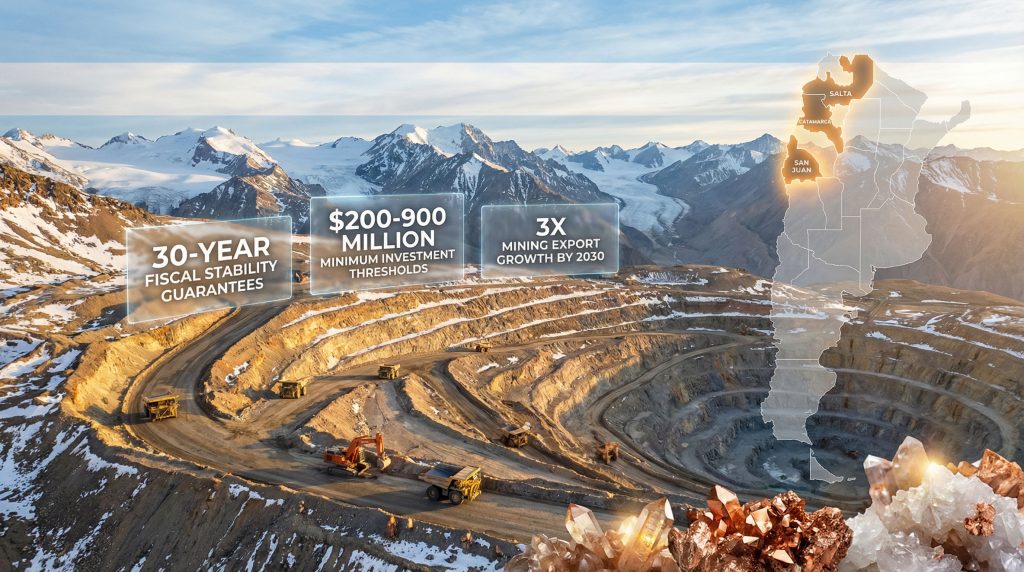
Economic projections demonstrate ambitious expansion targets. The Central Bank of Argentina estimates that mining exports could triple by 2030, while Economy Minister Luis Caputo projects US$165 billion in exports by 2035.
These projections assume successful implementation of the Régimen de Incentivo a Grandes Inversiones (RIGI) framework, though specific threshold requirements and incentive mechanisms require verification through additional regulatory analysis. Moreover, the government's strategy involves creating fiscal stability guarantees and exchange rate protections to address historical concerns about Argentine monetary policy volatility.
Northern Andean provinces with established mining sectors have provided crucial political support for the legislative change. Governors from Mendoza, San Juan, Catamarca, and Salta backed the amendment, representing regions with significant mineral endowments and existing mining infrastructure. This provincial coalition suggests alignment between subnational political leadership and mining industry interests as part of broader mining industry evolution trends.
Key Investment Attraction Strategies:
- Tax incentive structures targeting major mining corporations
- Currency exchange protections for foreign investors
- Legal stability guarantees addressing regulatory uncertainty
- Provincial-level development agreements
- Accelerated permitting processes for qualifying projects
In addition, the investment climate transformation occurs within broader South American mining competition. Argentina seeks to position itself advantageously against established mining jurisdictions including Chile, Peru, and Brazil, each offering distinct regulatory frameworks and incentive structures. This regional competition intensifies as energy transition mineral demand increases globally.
Strategic Mineral Resources and Geographic Advantages
The amended legislation specifically enables expanded access to copper, lithium, and silver deposits across previously restricted Andean regions. These commodities represent critical components of global energy transition infrastructure, positioning Argentina within essential supply chains for renewable energy and electric vehicle manufacturing. Consequently, this aligns with broader critical minerals strategy initiatives across the region.
Regional mineral endowments align with provincial political support for the legislative change. San Juan focuses on copper and gold projects, while Catamarca contains significant lithium and copper deposits. Salta's lithium brine operations represent substantial expansion potential, particularly considering Argentina lithium brine insights for market development, and Mendoza offers precious metals exploration opportunities across high-altitude Andean terrain.
Provincial Resource Distribution:
| Province | Primary Resources | Development Potential |
|---|---|---|
| San Juan | Copper, Gold | Existing Infrastructure |
| Catamarca | Lithium, Copper | High-Grade Deposits |
| Salta | Lithium Brine | Expansion Capacity |
| Mendoza | Precious Metals | Exploration Stage |
Furthermore, energy transition security demand provides strategic context for Argentina's resource positioning. Global copper demand for electrical transmission infrastructure and lithium requirements for battery technology create expanding markets for Argentine mineral production. The country's geographic position within the "Lithium Triangle" alongside Chile and Bolivia provides comparative advantages in brine extraction operations.
Argentina's approximately 17,000 glaciers and rock glaciers previously created extensive restrictions on mining activities. The amended Argentina mining legislation theoretically enables access to mineral deposits in high-altitude regions where glacier protection previously prohibited extraction activities, though specific implementation mechanisms remain unclear.
However, technical considerations include transportation infrastructure development requirements for remote Andean mining operations. Processing capacity expansion needs and environmental compliance costs will influence project economics as companies evaluate investment opportunities under the new regulatory framework.
Environmental Safeguards and Water Resource Protection
Despite jurisdictional transfer, the amended legislation maintains assertions of environmental protection through provincial governance mechanisms. Chamber of Deputies President Martín Menem explicitly stated that reforms guarantee protection of natural resources while respecting federalism, suggesting that safeguards persist despite authority decentralisation.
Glacial reserve reduction provides concerning baseline data for environmental impact assessment. Northwest mining regions have experienced a documented 17% reduction in glacial reserves over the previous decade, establishing substantial pre-existing environmental change prior to expanded mining access.
Water resource concerns dominate environmental opposition arguments. Congresswoman Natalia de la Sota emphasised that "without water, we can't even think about a growth and development project," positioning water security as a prerequisite rather than competing interest against mining development.
Environmental monitoring mechanisms under the amended framework require clarification through additional regulatory development. Provincial governments must establish environmental impact assessment protocols, water resource monitoring systems, and compliance reporting structures to fulfil protection obligations previously managed by centralised federal institutions. This connects to broader mine reclamation innovation practices becoming essential across the industry.
Remaining Environmental Considerations:
- Provincial environmental impact assessment requirements
- Water resource availability and allocation protocols
- Community consultation and consent processes
- Transparency reporting through extractive industry standards
- Federal minimum environmental standards enforcement
Civil society mobilisation reflects public concern about competing resource priorities. Protesters outside Parliament carried signs stating "water is more precious than gold," crystallising opposition sentiment around water resource protection versus mining economic benefits.
Nonetheless, legal challenge pathways remain available for environmental organisations questioning provincial authority expansion or specific project approvals under the amended framework. Constitutional interpretation of federal environmental standards versus provincial resource rights will likely require judicial resolution through Argentina's court system.
Economic Projections and Financial Impact Analysis
Government economic projections establish ambitious quantified targets for mining sector expansion. The US$165 billion export target by 2035 represents substantial growth from current mining export levels, requiring successful attraction of major international mining investments and development of multiple large-scale mining projects.
Employment generation forecasts reference "thousands of jobs" creation across affected provinces, though specific employment estimates by sector, skill level, or temporal distribution require additional analysis. Mining employment typically involves both direct extraction jobs and indirect economic activity through supply chains and regional economic multiplier effects.
Central Bank projections for tripled mining exports by 2030 assume successful implementation of regulatory incentives, infrastructure development, and international market conditions favourable to Argentine mineral exports. These assumptions involve substantial uncertainty regarding global commodity prices, trade relationships, and domestic political stability.
Financial Impact Projections:
| Metric | Timeline | Projected Change |
|---|---|---|
| Mining Exports | 2030 | Triple Current Levels |
| Total Exports | 2035 | US$165 Billion |
| Employment | Ongoing | Thousands of Jobs |
| Provincial Development | Long-term | Transformational |
Furthermore, revenue distribution mechanisms between federal and provincial governments require clarification for understanding how mining economic benefits reach affected communities. Royalty structures, tax allocation formulas, and local content requirements will influence how mining expansion translates into regional development outcomes.
International commodity price volatility creates substantial uncertainty for long-term economic projections. Copper, lithium, and silver markets experience significant price fluctuations based on global economic conditions, technological developments, and supply chain disruptions that could affect projected export revenues.
What Are the Key Financial Risks?
Several critical factors could impact projected economic benefits. Currency volatility remains a persistent concern for international investors considering long-term commitments. Additionally, regulatory uncertainty at provincial levels may create implementation delays affecting revenue timelines.
Infrastructure development costs represent significant upfront investments required before projects generate returns. Transportation networks, processing facilities, and utility connections require substantial capital expenditure that could affect project economics across remote Andean locations.
Global Supply Chain Positioning and Strategic Resource Diplomacy
Argentina's amended mining legislation positions the country within critical mineral supply chains essential for energy transition infrastructure. As global demand for copper and lithium increases to meet renewable energy and electric vehicle manufacturing requirements, Argentine resources could provide strategic supply diversification for international markets.
Regional competitive dynamics intensify as major economies seek supply chain resilience through diversified sourcing strategies. China's Belt and Road Initiative, United States critical minerals partnerships, and European Union raw materials security considerations create opportunities for Argentine resource diplomacy across multiple geopolitical frameworks.
Strategic Supply Chain Considerations:
- Diversification away from traditional suppliers (Chile, Australia)
- Transportation infrastructure development for export capacity
- Processing capacity expansion for value-added production
- International partnership opportunities across multiple markets
- Geopolitical risk mitigation through supplier diversification
Moreover, Argentina's position within the "Lithium Triangle" provides particular advantages for battery supply chain participation. Alongside Chile and Bolivia, Argentina contains substantial lithium brine resources essential for electric vehicle and energy storage manufacturing, creating potential for regional coordination or competition depending on policy approaches.
Supply chain resilience considerations favour multiple supplier relationships for critical minerals. International companies and governments increasingly prioritise diversified sourcing to reduce dependency on single suppliers or regions, creating opportunities for Argentina to capture market share through reliable production and stable regulatory frameworks.
The next major ASX story will hit our subscribers first
Implementation Timeline and Regulatory Development
Provincial regulation harmonisation represents the immediate implementation challenge following legislative passage. Provincial governments must develop environmental assessment protocols, permitting procedures, and compliance monitoring systems to assume responsibilities previously managed by federal institutions.
Mining companies face due diligence requirements for evaluating investment opportunities under the amended framework. Environmental, social, and governance compliance planning becomes essential as companies assess provincial regulatory capacity and community engagement requirements across different jurisdictions.
Critical Implementation Phases:
- Provincial environmental protocol development
- Permitting system updates and staff training
- Community consultation framework establishment
- Federal-provincial coordination mechanism creation
- International investor outreach and project pipeline development
Long-term political risk assessment requires evaluation of potential policy reversals under future administrations. Argentina's political volatility creates uncertainty for multi-decade mining investments, necessitating risk mitigation strategies and political stability assessments for international investors.
How Will Provincial Capacity Building Proceed?
Technical assistance programmes will likely be necessary to support provincial governments in developing adequate regulatory frameworks. International development organisations and mining industry associations may provide expertise transfer to ensure effective environmental governance transitions.
Regulatory rollout phases will determine practical implementation timelines for mining project development. Provincial governments require time for capacity building, regulatory framework development, and institutional restructuring to effectively manage expanded environmental governance responsibilities.
Investment decision frameworks must incorporate community engagement requirements and social licence considerations alongside technical and economic factors. Mining projects require ongoing community support and stakeholder management throughout development and operational phases, particularly in environmentally sensitive regions.
Consequently, this Argentina mining legislation represents a transformational shift that will require careful monitoring as implementation proceeds. The balance between economic development objectives and environmental protection will determine long-term success across affected provinces and mining operations.
Disclaimer: This analysis contains forward-looking projections and government estimates that involve substantial uncertainty. Investment decisions should incorporate comprehensive due diligence regarding regulatory, environmental, and political risks. Argentina mining legislation continues evolving through implementation phases that may affect projected outcomes.
Want to Stay Ahead of Emerging Mining Opportunities?
Discovery Alert's proprietary Discovery IQ model delivers instant notifications on significant ASX mineral discoveries, helping investors identify actionable opportunities as they emerge across the mining sector. With global mining legislation reshaping investment landscapes like Argentina's recent reforms, subscribers receive the critical market intelligence needed to capitalise on major discovery opportunities before the broader market reacts.