June 30, 2026
Argentina's transformation into argentina as a net fuel exporter represents one of South America's most significant energy sector developments, driven by comprehensive policy reforms, unconventional resource development, and favourable market conditions. The convergence of subsidy elimination, power sector restructuring, and Vaca Muerta production growth created conditions enabling this historic transition from import dependency to export capacity.
The sustainability of Argentina's export position depends critically on managing the relationship between economic recovery and fuel demand growth. Furthermore, understanding oil price dynamics becomes essential as international commodity markets influence export margins and competitiveness. Historical correlations suggest that robust GDP expansion could eliminate current export surpluses through domestic consumption increases, requiring continued production capacity growth and infrastructure investment to maintain export capabilities during economic expansion phases.
Policy Reform Architecture Behind Argentina's Energy Market Transformation
Argentina's journey toward becoming argentina as a net fuel exporter originated from comprehensive policy restructuring that addressed fundamental market distortions accumulated over decades. The elimination of fuel subsidies, implemented gradually from late 2023 onward, represented the cornerstone of reforms that revealed authentic demand patterns previously obscured by artificial pricing mechanisms.
The subsidy removal framework generated immediate demand adjustment responses that created exportable fuel surpluses. Domestic diesel and gasoline consumption declined by 9% during 2024, the initial year of policy implementation, while neighbouring Paraguay experienced a 10% increase in fuel consumption as cross-border price differentials normalised and smuggling activities diminished.
Market-based pricing mechanisms exposed the extent to which subsidised fuel had distorted regional trade flows. Historical data indicates that subsidised Argentine fuel prices had been substantially below market rates in Brazil, Paraguay, and Uruguay, creating arbitrage opportunities that manifested through informal cross-border fuel movements. When domestic prices adjusted toward international parity, legitimate trade channels replaced these informal flows.
The demand restructuring process continued through 2025, with fuel consumption increasing 1% compared to 2024 levels but remaining 8% below 2023 baseline figures. This sustained demand suppression relative to pre-reform levels indicates that market-clearing prices have established a new equilibrium point for Argentine fuel consumption, creating persistent exportable surplus capacity.
Import dependency reductions provided quantitative validation of the policy framework's effectiveness. Argentina's gasoline and diesel imports decreased by 50% during Milei's first year in office, followed by recovery in 2025 that nonetheless maintained import levels 25% below 2023 figures. This import substitution created foreign exchange savings while simultaneously generating exportable product volumes.
The correlation between subsidy elimination and neighbouring country consumption patterns suggests that Argentina's policy changes influenced regional fuel distribution mechanisms beyond national borders. In addition, Paraguay's increased official fuel consumption likely reflects demand previously satisfied through informal cross-border supply channels now redirected toward legitimate export transactions.
"The transformation of Argentina's fuel market from subsidy-dependent consumption to market-driven demand represents one of South America's most significant energy policy experiments in recent years, with implications extending throughout regional commodity markets."
When big ASX news breaks, our subscribers know first
Power Sector Restructuring and Fuel Demand Optimisation
Argentina's electricity generation sector underwent institutional reforms that significantly reduced liquid fuel consumption, contributing to the country's emergence as argentina as a net fuel exporter. The redefinition of CAMMESA's operational mandate eliminated its role in coordinating subsidised fuel purchases for thermal power plants, fundamentally altering the sector's fuel procurement patterns.
Previously, CAMMESA had maintained steady demand for imported gas oil through its thermal plant fuel coordination responsibilities. The institutional restructuring limited CAMMESA's mandate to grid management functions, transferring fuel procurement decisions to individual power generation operators operating under market-based pricing mechanisms.
This reform coincided with accelerated natural gas utilisation from Vaca Muerta unconventional resources for power generation. Gas oil consumption by thermal plants declined by 56% between 2023 and 2025, while domestic natural gas utilisation increased by 13% during the same period. The fuel substitution from liquid petroleum products to domestic natural gas reduced import requirements while releasing gas oil volumes for potential export.
Renewable energy integration contributed additional pressure for thermal fuel demand reduction. Wind and solar generation capacity expanded from 14% to 18% of Argentina's electrical system between 2023 and 2025, representing substantial renewable penetration growth within a compressed timeframe. This renewable capacity addition displaced thermal generation requirements, further reducing liquid fuel consumption in the power sector.
Moreover, the natural gas price forecast indicates continued volatility in energy markets, which influences the economics of fuel substitution between liquid petroleum products and natural gas in power generation.
| Power Generation Fuel Mix Evolution | 2023 Baseline | 2025 Performance | Change |
|---|---|---|---|
| Gas Oil Thermal Consumption | 100% (Index) | 44% (Index) | -56% |
| Natural Gas Utilisation | 100% (Index) | 113% (Index) | +13% |
| Renewable Capacity Share | 14% | 18% | +4 percentage points |
The technical feasibility of fuel switching from gas oil to natural gas in existing thermal plants facilitated this transition. Many Argentine thermal facilities operate dual-fuel capable turbines that can accommodate both liquid and gaseous fuel inputs through burner system modifications. This operational flexibility enabled rapid fuel substitution as Vaca Muerta gas production increased and subsidised fuel procurement arrangements ended.
Grid stability considerations influenced the pace of fuel substitution within the power sector. Natural gas supply from Vaca Muerta provides more reliable fuel security compared to imported gas oil, reducing supply chain risks associated with international commodity price volatility and import logistics constraints. This enhanced fuel security contributed to power system reliability while simultaneously reducing liquid fuel demand.
The renewable energy capacity additions during 2023-2025 represented accelerated deployment compared to historical expansion rates. Wind power projects in Patagonia and solar installations in northern provinces contributed to the capacity growth, supported by favourable regulatory frameworks and international financing mechanisms. These renewable additions provide ongoing displacement pressure on thermal generation requirements.
Vaca Muerta's Role in Export Capacity Development
The Vaca Muerta shale formation has become Argentina's primary engine for achieving argentina as a net fuel exporter status through unprecedented unconventional hydrocarbon production growth. Located in Neuquén Province, this formation represents one of the world's largest shale oil and gas resources, with production increases creating the foundation for sustained export capability.
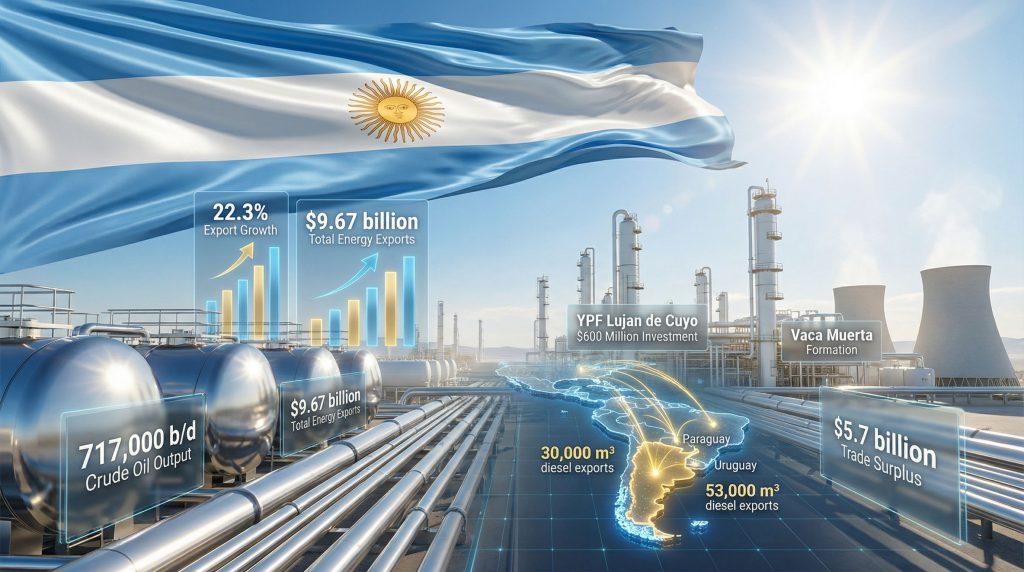
Crude oil production from Vaca Muerta and other Argentine fields increased from 645,000 barrels per day in 2023 to 717,000 barrels per day in 2024, representing 11% annual growth. This production expansion of 72,000 barrels per day provided substantial additional feedstock for domestic refineries, enabling increased refined product output without relying on crude oil imports.
Natural gas production grew from 133 million cubic metres per day in 2023 to 139 million cubic metres per day in 2024, achieving 4.5% annual growth. This gas production increase enabled the power sector fuel substitution described previously while providing domestic energy security and potential export capabilities through pipeline infrastructure to neighbouring countries.
The total value of Argentina's energy exports reached $9.67 billion in 2024, representing 22.3% growth from the $7.9 billion recorded in 2023. However, this export revenue growth reflected both increased production volumes and favourable international commodity pricing conditions, contributing to Argentina's overall trade balance improvement.
Understanding global oil futures becomes crucial for assessing the sustainability of export revenues as international pricing volatility affects Argentina's competitive position in regional markets.
| Vaca Muerta Production Metrics | 2023 | 2024 | Growth Rate |
|---|---|---|---|
| Crude Oil Output (b/d) | 645,000 | 717,000 | +11% |
| Natural Gas Production (MMcm/d) | 133 | 139 | +4.5% |
| Total Energy Export Value | $7.9 billion | $9.67 billion | +22.3% |
Refinery Infrastructure Investments
Refinery infrastructure investments have focused on processing Vaca Muerta crude grades, particularly the lighter Medanito crude that yields higher proportions of valuable refined products. YPF invested $600 million in its Lujan de Cuyo refinery, installing a hydrotreating reactor to reduce diesel sulfur content to 10 parts per million, meeting ultra-low sulfur diesel specifications required by export markets.
The hydrotreating technology enables production of export-quality diesel that complies with increasingly stringent environmental regulations in regional and international markets. Ultra-low sulfur diesel production capability positions Argentina to access premium export markets rather than competing solely on price in commodity-grade fuel segments.
Pan American Energy has planned significant refinery expansion through a new distillation tower scheduled for installation in 2029, specifically designed to process lighter crude grades such as Medanito from Vaca Muerta. This investment represents recognition that refining capacity constraints currently limit Argentina's ability to process additional crude oil into exportable refined products.
Current refinery utilisation rates approach maximum capacity across Argentina's processing network, indicating that crude oil production growth exceeds refining capability expansion. Refineries are operating near full capacity in 2025, constraining the ability to convert additional crude oil production into refined product exports without substantial infrastructure investment.
The geological characteristics of Vaca Muerta crude grades influence refinery processing strategies. Medanito crude exhibits lighter properties compared to conventional Argentine crude oil, yielding higher proportions of gasoline, kerosene, and diesel during fractional distillation. This lighter crude composition improves refinery economics and export product mix optimisation.
Technical drilling advances and enhanced hydraulic fracturing techniques have enabled sustained production growth from Vaca Muerta wells. Operators have achieved improved recovery rates and reduced drilling costs through technological refinements, supporting the economic viability of continued field development. These operational improvements contribute to sustained production growth that underpins Argentina's export capacity.
Regional Export Market Dynamics and Trade Relationships
Argentina's evolution toward argentina as a net fuel exporter occurs within specific regional market constraints that influence both opportunity and sustainability of export growth. Neighbouring countries provide natural markets for Argentine fuel exports, but their import absorption capacity and competitive dynamics create limitations on potential export volume expansion.
Between January and October 2025, Pan American Energy exported nearly 30,000 cubic metres of ultra-low sulfur diesel to Paraguay and over 53,000 cubic metres to Uruguay. These export volumes, while modest in absolute terms, represent significant milestones for a country that historically relied on fuel imports to meet domestic demand.
Paraguay's fuel market characteristics make it particularly suitable for Argentine exports. With a population of approximately 7.1 million and limited domestic refining capacity, Paraguay depends heavily on fuel imports. The country's 10% increase in fuel consumption during 2024 partly reflected substitution from previously smuggled Argentine fuel toward legitimate trade channels as price differentials normalised.
Uruguay provides another strategic export market, with its sophisticated fuel distribution infrastructure and stable regulatory environment supporting reliable trade relationships. Consequently, the 53,000 cubic metres of ultra-low sulfur diesel exported to Uruguay during the first ten months of 2025 established Argentina as a consistent supplier to this market, displacing traditional import sources.
| Argentine Fuel Export Destinations | Product Type | Volume (Jan-Oct 2025) | Market Significance |
|---|---|---|---|
| Paraguay | Ultra-Low Sulfur Diesel | 30,000 m³ | Border market penetration |
| Uruguay | Ultra-Low Sulfur Diesel | 53,000 m³ | Premium market access |
| Multiple Markets | Premium Gasoline | Variable volumes | Product diversification |
YPF and Pampa Energía have also exported premium gasoline to various regional destinations, demonstrating Argentina's capability to compete in higher-value fuel segments beyond basic diesel exports. Premium gasoline exports require meeting stringent octane and additive specifications, indicating that Argentine refineries have achieved technical capabilities necessary for quality-sensitive export markets.
Regional market absorption capacity constraints represent the primary limitation on Argentina's export expansion potential. Paraguay and Uruguay, despite providing natural markets, have finite fuel consumption that limits their ability to absorb substantial increases in Argentine exports. Brazil, as the region's largest fuel market, presents potential opportunities but also faces competition from domestic refiners and established international suppliers.
Transportation infrastructure influences export logistics and competitiveness. Pipeline capacity, trucking routes, and storage terminal availability affect the economics of Argentine fuel exports to neighbouring countries. Border crossing procedures and customs regulations add complexity to export operations, particularly for time-sensitive refined products.
Competitive Positioning and Pricing Dynamics
Price competitiveness remains crucial for sustained export market penetration. Argentina must compete with established suppliers including Brazilian refiners, international commodity traders, and regional fuel distributors. The elimination of domestic subsidies improved export competitiveness by bringing Argentine production costs closer to market prices, but ongoing cost management remains essential.
Currency stability affects export competitiveness and revenue predictability. Argentina's historical currency volatility creates challenges for long-term export contract commitments, as peso depreciation can improve competitiveness while peso appreciation may reduce export margins. Exchange rate management policies influence the sustainability of export programmes.
Regulatory harmonisation between Argentina and importing countries affects trade relationships. Ultra-low sulfur diesel specifications, octane requirements for gasoline, and environmental standards must align between exporting and importing countries. Argentina's investments in hydrotreating technology specifically addressed these regulatory alignment requirements.
Furthermore, understanding energy export challenges provides valuable insights into common obstacles faced by emerging energy exporters navigating international markets and regulatory frameworks.
Economic Indicators and Long-Term Export Sustainability
The durability of argentina as a net fuel exporter depends on macroeconomic factors that influence both domestic demand recovery and continued production capacity growth. Historical correlations between economic expansion and fuel consumption suggest that Argentina's export surplus faces vulnerability during periods of strong GDP growth.
Economic growth projections for Argentina indicate potential challenges to sustained fuel export capacity. Historical data demonstrate clear correlations between GDP growth and diesel demand in Argentina, suggesting that economic recovery could increase domestic fuel consumption and reduce exportable surpluses. This correlation reflects transportation sector activity, industrial production requirements, and commercial activity levels that drive fuel demand.
The relationship between economic performance and fuel consumption operates through multiple transmission mechanisms. Transportation activity increases during economic expansion as freight movements, commercial vehicle utilisation, and passenger travel grow. Industrial production recovery raises diesel demand for manufacturing processes, equipment operation, and facility heating requirements.
The GDP-fuel demand elasticity in Argentina suggests that each 1% of economic growth typically correlates with 0.8% to 1.2% increase in diesel consumption, based on historical data from previous economic cycles. This correlation implies that robust economic recovery could eliminate Argentina's current fuel export surplus through domestic demand growth rather than production constraints.
Investment pipeline indicators provide insight into Argentina's ability to maintain export capacity during economic recovery. The RIGI (Regime of Investment Incentives for Large Investments) has approved $7.9 billion in energy sector investments, primarily targeting Vaca Muerta development and associated infrastructure. These investments should support production growth that could offset demand increases from economic recovery.
| Economic Recovery Risk Factors | Current Status | Potential Impact |
|---|---|---|
| GDP-Fuel Demand Correlation | 0.8-1.2% elasticity | High demand growth risk |
| RIGI Investment Pipeline | $7.9 billion approved | Production capacity support |
| Refinery Capacity Constraints | Near maximum utilisation | Processing bottleneck risk |
| Regional Market Absorption | Limited capacity | Export volume ceiling |
Infrastructure and Investment Requirements
Refinery capacity constraints represent the primary bottleneck for sustained export growth. Despite crude oil production increases from Vaca Muerta, Argentina's refining capacity of approximately 645,000 barrels per day creates processing limitations that constrain refined product availability for export. New refinery construction requires substantial capital investment and multi-year development timelines.
Infrastructure development needs extend beyond refining capacity to include pipeline networks, storage terminals, and export logistics facilities. Pipeline capacity expansion and LNG terminal construction represent critical infrastructure investments necessary to support sustained export capabilities as production continues growing from unconventional resources.
Financing availability for energy sector expansion affects the sustainability of Argentina's export transformation. International capital markets, multilateral development banks, and domestic financial institutions must provide funding for continued Vaca Muerta development and infrastructure expansion. Credit ratings, political risk assessments, and regulatory stability influence financing costs and availability.
Currency considerations affect the economics of sustained export activities. Fuel exports generate US dollar revenues while domestic production costs occur primarily in Argentine pesos. Exchange rate stability and predictability influence the long-term economic viability of export operations and investment decisions by energy companies.
Regulatory sustainability of current policies affects export durability. The subsidy elimination framework and power sector reforms that enabled Argentina's export transformation require continued political support and implementation consistency. Changes in government priorities or policy reversals could undermine the structural foundations supporting export capacity.
"The transformation of Argentina from a net fuel importer to an exporter reflects broader global shifts in energy markets, where policy reforms and technological advancement can rapidly reshape national energy profiles." – Argentina's Energy Transformation Report.
International Benchmarking and Global Energy Context
Argentina's transformation positions the country among a select group of nations that successfully transitioned from energy import dependency to export capacity within compressed timeframes. This transition places argentina as a net fuel exporter within a global context of energy security concerns and regional market rebalancing following geopolitical disruptions.
Argentina achieved a $5.7 billion energy trade surplus in 2024, representing the highest positive balance in 18 years. This trade surplus reflects both increased export revenues and reduced import expenditures, contributing substantially to Argentina's overall current account improvement and foreign exchange position.
The energy sector's contribution to Argentina's export portfolio has expanded significantly. Crude petroleum exports valued at $3.67 billion in 2024 represent approximately one-eighth of Argentina's total export revenues, establishing energy as a cornerstone of the country's trade performance. This export concentration creates both opportunities and risks depending on international commodity price movements.
International comparisons reveal the exceptional nature of Argentina's energy transition speed. Few countries have achieved comparable import-to-export reversals within such compressed timeframes without major oil discoveries or substantial foreign investment programmes. Argentina accomplished this transformation primarily through policy reforms and technological application to existing resources rather than new resource discovery.
The United States provides a relevant benchmark, having achieved energy independence and net export status through shale oil and gas development. However, the US transformation occurred over approximately 15 years with massive private investment and established technological capabilities. Argentina's transition timeline represents accelerated achievement with more limited financial resources and technological infrastructure.
Regional positioning within South America establishes Argentina as an emerging energy hub with potential for expanded export capabilities. Brazil's refining capacity exceeds 2 million barrels per day compared to Argentina's 645,000 barrels per day, indicating substantial potential for capacity expansion if financing and market conditions support investment.
In addition, examining energy security insights reveals how Argentina's transformation contributes to broader regional energy resilience and strategic planning considerations.
| International Energy Transition Comparison | Timeline | Primary Driver | Current Status |
|---|---|---|---|
| United States | 2008-2018 | Shale revolution | Major net exporter |
| Argentina | 2023-2025 | Policy reform + Vaca Muerta | Emerging net exporter |
| Brazil | Ongoing | Pre-salt offshore | Crude exporter, refined product importer |
| Canada | Historical | Oil sands development | Established exporter |
Global Market Position and Competitive Analysis
Global energy market conditions influence Argentina's export opportunities and competitiveness. International crude oil and refined product prices affect Argentine export margins and investment incentives. Demand growth in Asia, supply disruptions in other regions, and climate policy implementations in developed countries create market dynamics that influence Argentine export prospects.
Geopolitical considerations affect Argentina's strategic positioning as an energy supplier. Regional relationships with Brazil, Chile, Paraguay, and Uruguay influence trade agreements, infrastructure development priorities, and market access negotiations. Argentina's political stability and regulatory predictability affect international perceptions of supply security and investment attractiveness.
Environmental considerations increasingly influence international energy trade relationships. Argentine efforts to produce ultra-low sulfur diesel and meet environmental specifications reflect recognition that export markets increasingly demand cleaner fuel products. Climate policy developments globally may affect long-term demand for fossil fuel exports.
Technological advancement requirements for sustained competitiveness include enhanced oil recovery techniques, refinery efficiency improvements, and environmental compliance technologies. Argentina must continue investing in technological capabilities to maintain cost competitiveness with international suppliers and meet evolving product specifications.
Furthermore, Argentina's energy sector outlook suggests significant potential for continued growth and technological development in unconventional resources and renewable energy integration.
The next major ASX story will hit our subscribers first
Risk Factors Threatening Export Position Sustainability
Several interconnected risks could potentially reverse Argentina's achievement of argentina as a net fuel exporter status, ranging from macroeconomic demand recovery to infrastructure constraints and regional competitive pressures. Understanding these risk factors provides essential context for assessing the durability of Argentina's energy transformation.
Economic recovery scenarios present the most significant threat to sustained export capacity. Historical data indicating strong correlations between GDP growth and fuel consumption suggest that robust economic expansion could eliminate Argentina's export surplus through domestic demand increases rather than production constraints. The current fuel export surplus exists partly because economic weakness has suppressed domestic consumption below historical norms.
Demand elasticity calculations suggest that each percentage point of GDP growth typically correlates with 0.8% to 1.2% increase in diesel consumption, based on patterns from previous economic cycles. If Argentina achieves projected economic growth rates of 3-5% annually over the medium term, domestic fuel demand could increase substantially, potentially eliminating current export surplus volumes.
Infrastructure bottlenecks represent persistent constraints on sustained export growth. Refining capacity limitations at approximately 645,000 barrels per day create processing constraints that prevent Argentina from converting additional crude oil production into exportable refined products. Without major refinery expansion investments, crude oil production growth may not translate into proportional refined product export increases.
Transportation and logistics infrastructure constraints limit market access and export competitiveness. Pipeline capacity between production regions and export terminals, trucking availability for cross-border movements, and storage terminal capacity at export points create operational bottlenecks that constrain export volumes and increase logistics costs.
| Primary Risk Categories | Risk Level | Mitigation Requirements |
|---|---|---|
| Economic Growth Demand Recovery | High | Production capacity expansion |
| Refinery Processing Constraints | High | Major capital investment |
| Regional Market Saturation | Medium | Market diversification |
| Policy Reversal Risk | Medium | Political consensus building |
Market and Competitive Risks
Regional market absorption limitations create volume ceilings for sustained export growth. Paraguay and Uruguay, despite providing natural markets, have finite fuel consumption capacity that limits their ability to absorb substantial increases in Argentine exports. Market saturation in neighbouring countries would require Argentina to seek more distant export markets with higher transportation costs and increased competition.
Competitive pressures from established suppliers could erode Argentina's market share in regional export markets. Brazilian refiners, international commodity traders, and other regional suppliers maintain competitive advantages through established distribution networks, long-term customer relationships, and potentially lower production costs. Argentina must continuously improve cost competitiveness and service quality to maintain export market positions.
Political risk factors include potential policy reversals that could undermine the structural foundations enabling Argentina's export capacity. Future governments might reintroduce fuel subsidies, alter CAMMESA's operational mandate, or implement other policies that increase domestic fuel demand or reduce export competitiveness. Policy consistency and political consensus building represent critical factors for sustained export capability.
Currency volatility affects export economics and investment decisions. Substantial peso appreciation could reduce export competitiveness by increasing dollar-denominated production costs, while extreme peso depreciation might increase domestic fuel demand as consumers substitute away from imported goods. Exchange rate stability influences both short-term export margins and long-term investment planning.
Investment and Regulatory Challenges
Investment financing constraints could limit continued Vaca Muerta development and infrastructure expansion necessary to maintain export capacity during economic recovery. International capital market conditions, credit rating changes, and political risk assessments affect financing availability and costs for energy sector investments. Insufficient investment could constrain production growth needed to offset demand increases.
Environmental regulatory changes could affect export market access and production costs. Increasingly stringent sulfur content requirements, carbon emissions regulations, or other environmental standards may necessitate additional refinery investments or limit access to specific export markets. Compliance costs could affect export competitiveness and profitability.
Consequently, technological obsolescence risks emerge as global energy markets evolve toward cleaner alternatives and more efficient production methods. Argentina must maintain technological competitiveness in extraction, refining, and distribution technologies to preserve market position against international competitors.
Strategic Implications for Regional Energy Architecture
Argentina's emergence as argentina as a net fuel exporter creates ripple effects throughout South American energy markets, influencing regional trade patterns, investment flows, and energy security considerations that extend far beyond national boundaries. This transformation reshapes continental energy architecture with implications for multiple countries and market participants.
Regional trade pattern modifications reflect Argentina's changing role from fuel importer to supplier. Traditional fuel supply routes serving Paraguay, Uruguay, and potentially other neighbouring countries now face competition from Argentine exports. This supply diversification provides consuming countries with enhanced energy security through reduced dependence on single suppliers or distant import sources.
Competitive dynamics within South American fuel markets have intensified as Argentina challenges established suppliers. Brazilian refiners, historically dominant in regional fuel trade, now face increased competition in markets they previously served with limited alternatives. This competitive pressure may drive efficiency improvements and price reductions throughout regional fuel supply chains.
Investment attraction effects extend beyond Argentina's borders as the demonstration of successful policy reform and resource development creates precedents for other regional countries. The effectiveness of subsidy elimination, institutional restructuring, and unconventional resource development provides a policy framework that other governments may consider adapting to their circumstances.
"Argentina's energy transformation demonstrates how comprehensive policy reforms combined with resource development can fundamentally alter a country's position within regional commodity markets, creating opportunities for policy replication and competitive responses throughout South America."
Infrastructure and Market Integration Effects
Infrastructure development implications affect regional connectivity and trade facilitation. Argentina's export capacity may incentivise investments in cross-border pipeline infrastructure, storage facilities, and transportation networks that benefit multiple countries. Enhanced energy infrastructure connectivity improves regional energy security and market integration.
Energy security enhancement for importing countries results from supply source diversification as Argentina provides alternative to traditional suppliers. Paraguay and Uruguay benefit from reduced dependence on Brazilian or international suppliers, potentially improving their negotiating positions and supply security. This diversification effect strengthens regional energy resilience.
Foreign investment considerations influence capital allocation decisions across South American energy sectors. Argentina's successful transformation may attract increased investment interest in energy infrastructure and production capacity, potentially diverting capital from other regional projects or creating demonstration effects that benefit neighbouring countries.
Regional integration implications include potential expansion of energy trade agreements, regulatory harmonisation initiatives, and infrastructure coordination projects. Argentina's export capacity may catalyse broader South American energy market integration discussions, similar to European energy union concepts adapted to regional circumstances and capabilities.
Market Dynamics and Geopolitical Considerations
Price discovery mechanism influences throughout regional fuel markets result from increased competition and alternative supply sources. Argentine exports may affect regional price formation for diesel, gasoline, and other petroleum products, potentially reducing price premiums in markets previously served by limited suppliers. This price competition benefits consuming countries and end-users.
Geopolitical considerations include Argentina's enhanced influence within regional energy discussions and international energy organisations. Export capacity provides Argentina with greater energy diplomacy capabilities and potentially stronger positions in regional trade negotiations and energy cooperation initiatives.
Environmental implications extend across borders as Argentina's ultra-low sulfur diesel production and exports may accelerate adoption of cleaner fuel specifications throughout the region. Regional environmental improvement results from Argentina's investments in fuel quality enhancement, benefiting air quality and public health across multiple countries.
Long-term strategic positioning establishes Argentina as a potential regional energy hub with growth possibilities extending beyond current export volumes. Success in fuel exports may provide foundation for expanded energy services, including refined product trading, storage services, and technical expertise export to other regional countries.
Conclusion: Evaluating Argentina's Energy Export Future
Argentina's transformation into argentina as a net fuel exporter represents one of South America's most significant energy sector developments, driven by comprehensive policy reforms, unconventional resource development, and favourable market conditions. The convergence of subsidy elimination, power sector restructuring, and Vaca Muerta production growth created conditions enabling this historic transition from import dependency to export capacity.
The sustainability of Argentina's export position depends critically on managing the relationship between economic recovery and fuel demand growth. Historical correlations suggest that robust GDP expansion could eliminate current export surpluses through domestic consumption increases, requiring continued production capacity growth and infrastructure investment to maintain export capabilities during economic expansion phases.
Structural challenges including refinery capacity constraints, regional market absorption limitations, and infrastructure bottlenecks create ongoing obstacles to export expansion. Argentina's processing capacity limitations prevent full utilisation of crude oil production growth for refined product exports, while neighbouring country import capacity limits provide volume ceilings for sustained export growth.
The regional implications of Argentina's transformation extend throughout South American energy markets, enhancing supply diversification, intensifying competitive dynamics, and creating precedents for policy reform effectiveness. These broader impacts strengthen regional energy security while challenging established market participants and trade patterns.
Investment and Policy Requirements
Investment requirements for sustaining Argentina's export position encompass continued Vaca Muerta development, refinery capacity expansion, and infrastructure enhancement. The $7.9 billion in approved RIGI investments provide foundation for production growth, but additional capital deployment will be necessary to address processing and transportation constraints that currently limit export potential.
Policy consistency represents a critical factor for long-term export sustainability. The structural reforms enabling Argentina's transformation require continued implementation and political support across potential government transitions. Reversal of subsidy elimination, CAMMESA mandate changes, or other policy modifications could undermine the foundations supporting export capacity.
Argentina's achievement demonstrates the potential for comprehensive energy sector transformation through coordinated policy reform and resource development. However, the durability of this transformation depends on continued investment, infrastructure development, and careful management of demand growth pressures that accompany economic recovery.
The evolution of argentina as a net fuel exporter will likely influence broader discussions of energy independence, regional integration, and policy reform effectiveness throughout Latin America. Argentina's experience provides valuable insights for other countries seeking to optimise their energy trade positions through domestic resource development and market-oriented reforms.
This analysis reflects market conditions and policy frameworks as of January 2026. Energy market dynamics, policy environments, and production capacities may change substantially over time, affecting the sustainability and growth potential of Argentina's fuel export position.
Want to Identify the Next Major Energy Discovery?
Discovery Alert's proprietary Discovery IQ model delivers real-time alerts on significant ASX mineral discoveries, instantly empowering subscribers to identify actionable opportunities ahead of the broader market. Understand why major mineral discoveries can lead to substantial market returns by exploring historic examples of exceptional investment outcomes.