August 11, 2026
When the World's Energy Arteries Tighten, New Sources Rise
Global hydrocarbon markets are built on a fragile geography. Roughly one-fifth of the world's liquefied natural gas has historically flowed through a single chokepoint, and when that chokepoint closes, the consequences cascade across every import-dependent economy on earth. The disruption of flows through the Strait of Hormuz, compounded by damage to Qatari LNG infrastructure, has exposed just how narrow the margin for error in global energy supply really is.
Against that backdrop, a formation of rock sitting beneath the windswept steppe of Argentine Patagonia has moved from a compelling long-term story to an immediately relevant strategic asset. The Argentina shale boom, centred on the Vaca Muerta formation in the Neuquén Basin, is now one of the most consequential developments in global hydrocarbon supply. Understanding why requires examining not just the geology, but the economics, the policy environment, and the regional dynamics that make this moment unique.
When big ASX news breaks, our subscribers know first
What Makes Vaca Muerta a Tier-One Geological Asset
The Formation Itself
Vaca Muerta translates literally to "dead cow" in Spanish, a prosaic name for what geologists increasingly regard as one of the most significant unconventional hydrocarbon repositories ever identified. Covering approximately 8.6 million acres in the Neuquén Basin of Patagonia, the formation holds an estimated 16 billion barrels of technically recoverable shale oil and condensate, alongside roughly 308 trillion cubic feet of shale gas. The U.S. Energy Information Administration ranks Argentina among the world's top five holders of both resources, with Vaca Muerta specifically classified as the planet's fourth-largest shale oil deposit and second-largest shale gas repository.
What elevates Vaca Muerta beyond raw scale is crude quality. The formation produces light sweet crude with an API gravity of 39 to 42 degrees and sulfur content below 0.5%, characteristics that place it firmly in premium territory. This is not heavy, high-sulfur barrel that requires expensive downstream processing. It is immediately refinery-friendly crude that commands strong market prices and attracts straightforward logistics planning.
How Vaca Muerta Compares to Other Major Global Shale Plays
| Metric | Vaca Muerta (Argentina) | Permian Basin (USA) | Eagle Ford (USA) |
|---|---|---|---|
| Estimated Recoverable Oil | ~16 billion barrels | ~70+ billion barrels | ~10 billion barrels |
| Shale Gas Resources | ~308 trillion cubic feet | Large | Moderate |
| Crude API Gravity | 39-42 degrees | 40-45 degrees | 40-50 degrees |
| Lifting Cost (Shale Oil) | ~$4/barrel (YPF) | ~$10-$15/barrel | ~$12-$18/barrel |
| Breakeven Cost | $36-$45/barrel | $40-$55/barrel | $45-$60/barrel |
| Global Shale Ranking | 4th largest oil / 2nd largest gas | 1st | Top 5 |
The comparison to U.S. shale plays is instructive. While the Permian Basin dwarfs Vaca Muerta in total recoverable volume, the Argentine formation competes strongly on cost structure and crude quality. YPF-reported shale oil lifting costs of just $4 per barrel are among the lowest unconventional lifting costs recorded anywhere globally. The formation's breakeven range of $36 to $45 per barrel sits comfortably below many U.S. shale benchmarks, a structural advantage that becomes more pronounced as infrastructure investment matures.
One dimension that is rarely discussed in mainstream coverage is the thickness and consistency of the Vaca Muerta's productive intervals. Unlike some U.S. shale plays where productive zones are relatively thin or laterally inconsistent, Vaca Muerta presents operators with exceptionally thick organic-rich intervals in many parts of the basin. This translates to higher per-well productivity and lower development risk per dollar invested.
Argentina's Production Numbers Tell a Remarkable Story
Record Output Driven Almost Entirely by Unconventional Growth
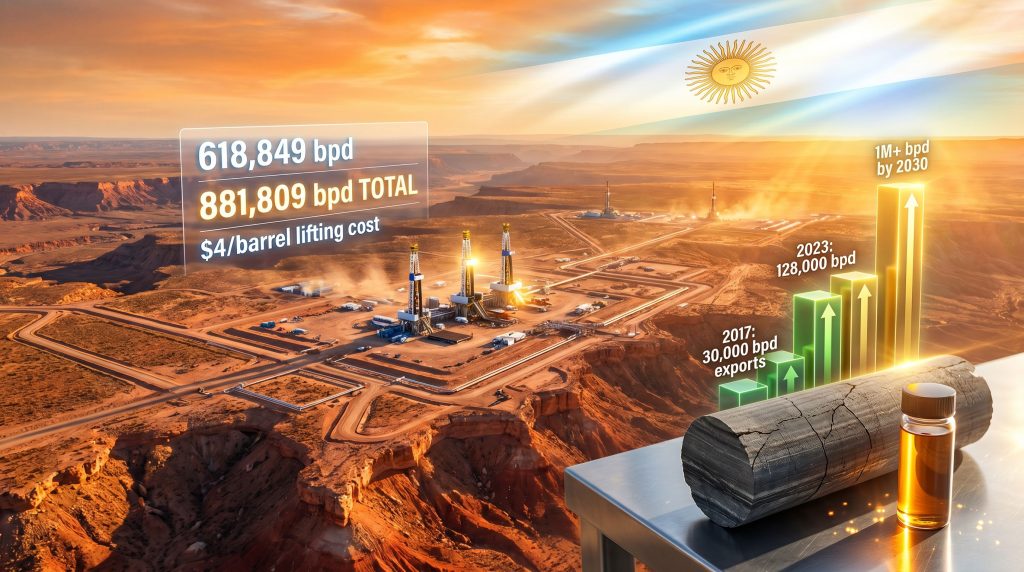
Argentine government production data for April 2026 shows national crude output reaching 881,809 barrels per day, a figure that is 19% higher year-on-year and 1.4% above the prior month. The driver is unmistakable: Vaca Muerta shale oil output climbed to an all-time high of 618,849 barrels per day in the same period. Unconventional crude now accounts for more than 70% of Argentina's total petroleum production, the highest proportion in the country's history.
Natural gas production followed a similar trajectory, recovering to a nine-month high of nearly 5 billion cubic feet per day in April 2026, up 1.4% month-on-month and 1.5% year-on-year. These are not cyclical fluctuations. They represent a structural transformation in how Argentina produces energy. Furthermore, the Argentina shale boom is actively offsetting decades of conventional field decline, repositioning the country's entire energy identity.
The Decade-Long Unconventional Transition
The scale of change only becomes visible in longer time horizons. Consider the export trajectory:
- Export volumes grew from roughly 30,000 barrels per day in 2017 to approximately 128,000 barrels per day in 2023
- Shale crude accounted for around 70% of exported volumes by 2023
- Argentina reached 738,000 barrels per day in September 2024, its highest monthly output since 2003, with Vaca Muerta supplying 58% of that total
- By the end of 2024, Argentina had become South America's fourth-largest crude oil producer
- Current trajectories place Argentina on course to surpass 1 million barrels per day before the end of this decade
This shift is not merely a volume story. It represents a fundamental change in the structure of Argentina's external accounts. Hydrocarbon exports are becoming a genuine engine of trade balance improvement, not simply a commodity windfall that evaporates when prices correct. In addition, the broader implications for crude oil price trends suggest growing Argentine supply could meaningfully influence Atlantic Basin benchmarks over the coming years.
YPF's Strategic Pivot and the Capital Behind the Boom
Becoming a Pure Shale Operator
YPF, the state-controlled national oil company nationalised under President Cristina Fernández de Kirchner in 2012, holds the largest acreage position across the Vaca Muerta and is responsible for approximately 32% of Argentina's oil output and 27% of its natural gas production. The company has announced a deliberate strategic exit from legacy conventional assets, which are mature fields with rising per-barrel operating costs, to concentrate capital and technical resources entirely on unconventional development.
The financial commitment behind this pivot is substantial:
- $25 billion committed over 15 years under President Javier Milei's Large Investment Incentive Regime (RIGI), targeting 1,152 new wells across Vaca Muerta acreage
- $40 billion in total capital budgeted from 2025 through 2030
- $6 billion allocated specifically to 2026 operations
- Production target of 2.1 million barrels of oil equivalent per day by 2030, representing a 130% increase over 2026 output levels, comprising 820,000 barrels of oil and 6.1 billion cubic feet of natural gas per day
The RIGI framework is specifically designed to attract long-cycle capital to Argentina by providing regulatory and fiscal stability over extended investment horizons. It addresses one of the country's most persistent deterrents to foreign capital: the perception that policy settings could change unfavourably mid-project.
Who Else Operates in Vaca Muerta?
The operator landscape extends well beyond YPF:
- Pan American Energy, 50% owned by BP, is Argentina's second-largest oil producer
- Vista Energy, a local independent, ranks third nationally in crude output
- U.S. and European companies are increasingly dominant in capital deployment, a notable contrast to other South American resource plays where Chinese state-backed entities have historically led
This Western capital orientation matters. It signals confidence in Argentina's evolving regulatory environment and tends to bring operational technology and drilling efficiency practices that accelerate productivity improvements over time.
Milei's Reform Architecture and Its Impact on Energy Investment
The Policy Shift from 2012–2023 to Post-2024
The investment climate transformation under President Milei is difficult to overstate when viewed against the prior decade. The 2012–2023 period was characterised by nationalisation, capital controls, foreign ownership restrictions, and fiscal unpredictability. Under Milei's administration, the direction has reversed sharply, with capital controls eased, foreign ownership rules reformed, and the RIGI framework established to provide contractual certainty for large, long-dated investments. The geopolitical landscape for metals and mining provides useful parallel context, as resource nationalism versus liberalisation dynamics play out similarly across South American commodity sectors.
The structural shift in Argentina's policy orientation since 2024 has repositioned the country from a cautionary tale in resource nationalism to one of the more compelling frontier investment destinations for hydrocarbon capital. Whether that repositioning endures across future administrations remains the central long-term investor question.
Milei's macroeconomic stabilisation programme is directly linked to hydrocarbon sector expansion. Rising oil and gas exports improve the current account deficit, royalties and export duties generate fiscal revenue, and the multiplier effects of large-scale drilling programmes support broader economic activity. Energy is not incidental to Argentina's recovery narrative; it is structural to it.
Carbon Intensity as a Competitive Differentiator
Why 12 Kilograms Per Barrel Matters to Global Capital
One of Vaca Muerta's least-discussed competitive advantages is its carbon intensity profile. YPF estimates emissions of approximately 12 kilograms of CO2 per barrel produced from its Vaca Muerta operations. This compares favourably to the global average and stands in stark contrast to regional peers.
| Region / Producer | Estimated CO2 Emissions per Barrel |
|---|---|
| Vaca Muerta (Argentina) | ~12 kg/barrel |
| Global Average | ~18 kg/barrel |
| Colombia (heavy sour crude) | Up to 25 kg/barrel |
| Venezuela | Up to 1,460 kg/barrel |
As European and institutional energy investors apply increasingly rigorous carbon intensity screens to capital allocation decisions, Vaca Muerta's emissions profile becomes a genuine differentiator. A barrel that costs less to produce, commands a premium price, and carries a below-average carbon footprint is precisely the type of hydrocarbon asset that survives in a tightening ESG investment framework.
The next major ASX story will hit our subscribers first
Regional Energy Security and South America's Supply Gap
The Structural Vacuum Argentina Is Filling
The regional context amplifies the significance of the Argentina shale boom. Trinidad and Tobago's hydrocarbon sector is in structural decline, removing a historically important source of regional gas supply. Colombia and Peru face growing natural gas import dependence. The disruption of Middle Eastern LNG flows has exacerbated what were already tightening regional balances, with severe gas shortages having affected multiple South American economies in recent years.
Argentina's growing unconventional output addresses this vacuum directly. Rising gas production reduces the country's own import requirements while creating surplus capacity that could, over time, be directed toward regional neighbours. Should LNG export infrastructure development proceed, Argentina's influence could extend beyond South America to Atlantic Basin markets. Consequently, OPEC's influence on global oil markets may increasingly need to account for Argentina as a meaningful non-OPEC swing supplier.
Key Risks That Investors Must Weigh
Infrastructure Bottlenecks Remain the Primary Constraint
Production growth in the Neuquén Basin is currently running ahead of takeaway capacity. Pipeline, processing, and export terminal infrastructure has historically lagged drilling activity in Argentine shale development, and this pattern has not been fully resolved. The investment required to close the midstream gap is substantial, and delays in infrastructure development represent the most immediate binding constraint on realising Vaca Muerta's full production potential.
Political and Macro Risk Factors
Argentina's history of abrupt policy reversals is a legitimate investor concern that cannot be dismissed by pointing to current reform momentum. The risks include:
- Potential fiscal or regulatory regime changes under future administrations that reverse RIGI protections
- Currency volatility affecting the real cost of imported drilling equipment and services
- Argentina's track record of economic crises creating unpredictable operating environments
- The RIGI framework's 15-year investment horizon provides some contractual protection, but its enforceability under future administrations has not been stress-tested
Global Market Sensitivity
Vaca Muerta economics remain sensitive to sustained oil price weakness. A prolonged period of prices below the $36 to $45 per barrel breakeven range would compress investment returns and slow drilling programmes. However, Trump-era tariff dynamics affecting oil prices and broader commodities market volatility add further layers of uncertainty that operators must price into their long-range planning assumptions.
Disclaimer: This article is for informational purposes only and does not constitute financial or investment advice. Forecasts, projections, and scenario analyses involve inherent uncertainty and should not be relied upon as predictions of future outcomes.
Scenario Analysis: Three Pathways Through 2030
| Scenario | Key Assumption | Projected Output by 2030 | Export Impact |
|---|---|---|---|
| Base Case | RIGI investment proceeds as planned, infrastructure expands on schedule | ~1.0-1.2 million bpd crude | Significant export growth, improved trade balance |
| Accelerated Case | Additional foreign capital inflows, LNG export terminals approved | ~1.5+ million bpd crude equivalent | Argentina becomes top-3 South American producer |
| Constrained Case | Infrastructure delays, policy uncertainty, oil price weakness | ~800,000-900,000 bpd crude | Modest export growth, fiscal targets missed |
The base case trajectory is the most credible given current operator commitments and infrastructure investment pipelines. The accelerated case hinges on LNG export terminal development proceeding within the decade, which would be genuinely transformative for Argentina's position in global energy markets. The constrained case reflects a scenario in which Argentina's chronic infrastructure execution challenges persist and global price conditions deteriorate. Bloomberg's analysis of Milei's shale-driven reforms suggests the accelerated pathway, whilst ambitious, carries more credibility today than at any prior point in the formation's development history.
Frequently Asked Questions: Argentina Shale Boom and Vaca Muerta
What is the Vaca Muerta shale formation?
Vaca Muerta is an 8.6-million-acre unconventional hydrocarbon formation located in the Neuquén Basin of Patagonia, Argentina. It holds an estimated 16 billion barrels of technically recoverable shale oil and 308 trillion cubic feet of shale gas, making it the world's fourth-largest shale oil deposit and second-largest shale gas repository.
How much oil is Argentina producing from Vaca Muerta?
As of April 2026, Vaca Muerta produced approximately 618,849 barrels of shale oil per day, representing over 70% of Argentina's total crude output of 881,809 barrels per day.
What is Argentina's oil production target by 2030?
YPF projects total output of 2.1 million barrels of oil equivalent per day by 2030, a 130% increase over 2026 production levels, comprising 820,000 barrels of oil and 6.1 billion cubic feet of natural gas per day.
Why is Vaca Muerta attractive to foreign investors?
The formation offers lifting costs as low as $4 per barrel, a breakeven range of $36 to $45 per barrel, premium light sweet crude quality at API 39-42 degrees, and relatively low carbon intensity at approximately 12 kilograms of CO2 per barrel, supported by Argentina's RIGI investment framework.
What are the main obstacles to Argentina's shale growth?
The primary constraints are pipeline and export infrastructure bottlenecks, the scale of capital investment required, and Argentina's historical macroeconomic and political instability, which creates long-term investment risk despite current reform momentum.
How does the Argentina shale boom affect regional energy supply?
Argentina's growing gas and oil output is increasingly important to South American energy security, particularly as regional producers like Trinidad and Tobago experience structural decline, and as countries like Colombia and Peru face growing natural gas import dependence.
Want to Track the Next Major Energy or Resource Discovery Before the Market Does?
Discovery Alert's proprietary Discovery IQ model scans ASX announcements in real time, instantly identifying significant mineral and resource discoveries across more than 30 commodities — turning complex data into clear, actionable opportunities for both traders and long-term investors. Explore historic discoveries and their returns, then start your 14-day free trial at Discovery Alert to position yourself ahead of the market.