July 14, 2026
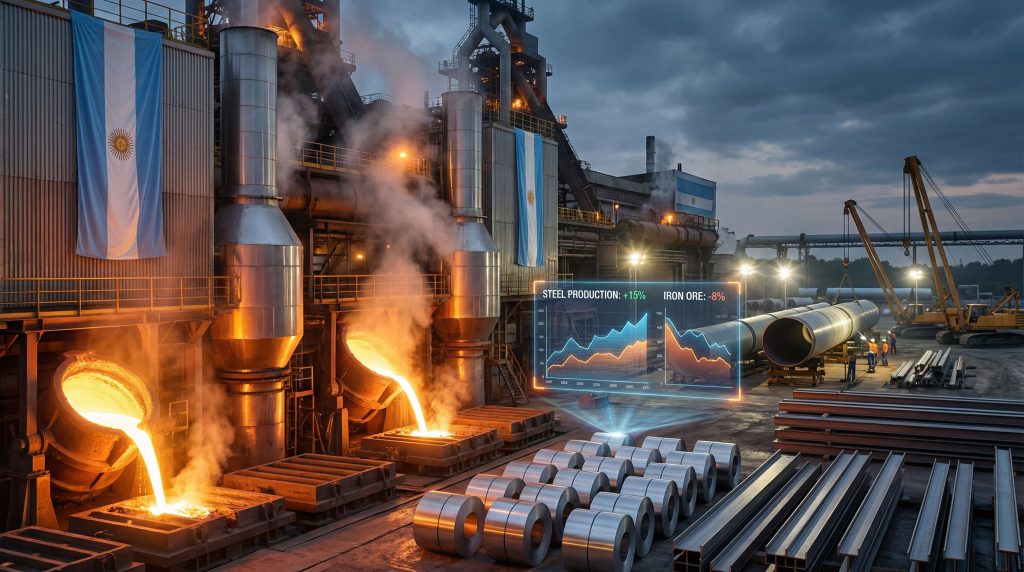
Argentina's steel industry demonstrates complex dynamics as argentina steel output up iron down trends reshape the nation's metallurgical landscape. This phenomenon reflects broader structural shifts where energy infrastructure demands drive finished steel production growth while primary iron output contracts amid economic headwinds. Understanding these divergent trends reveals critical insights into how steel markets adapt to evolving industrial priorities and macroeconomic challenges.
Energy Infrastructure Driving Steel Demand Recovery
Argentina's steel output up iron down trend reflects the nation's expanding energy infrastructure requirements, particularly within the Vaca Muerta shale formation. This massive hydrocarbon reserve, containing an estimated 600 trillion cubic feet of natural gas and 16 billion barrels of oil equivalent, demands substantial steel inputs for pipeline systems and structural applications.
Crude steel production reached 374,900 metric tonnes in November 2025, representing a 10.7% year-over-year increase despite broader economic headwinds affecting traditional steel-consuming sectors. This growth occurred whilst primary iron output declined 21.6% to 214,900 tonnes, highlighting the divergent forces shaping Argentina's steel value chain.
Pipeline and Infrastructure Steel Applications
Vaca Muerta development projects require specialised steel products designed for high-pressure, corrosion-resistant environments. These applications include:
- Steel tubes for pipeline transportation systems handling oil and natural gas under extreme conditions
- Structural steel plates for welded critical infrastructure components requiring precise metallurgical properties
- Speciality alloys for downstream processing facilities supporting hydrocarbon extraction and refinement
- Heavy-duty structural shapes for drilling platforms and production equipment installations
The multi-year nature of these infrastructure investments provides sustained demand visibility for Argentine steelmakers, offsetting weakness in traditional sectors like automotive and construction. Government investment allocations within Argentina's 2026-2028 development plan specifically target Vaca Muerta pipeline projects, reinforcing long-term steel consumption forecasts.
Hot-Rolled Production Maintaining Stability
Hot-rolled steel output increased 0.7% to 334,300 tonnes in November 2025, demonstrating resilience amid broader manufacturing sector challenges. This stability reflects hot-rolled products' broader application range, including energy infrastructure, general industrial use, and machinery manufacturing.
Hot-rolled steel's production advantages include less processing complexity compared to cold-rolled products, enabling rapid capacity reallocation toward resilient demand segments. Mills can efficiently redirect output from declining automotive applications toward energy sector requirements without significant capital investment or process modifications.
When big ASX news breaks, our subscribers know first
Manufacturing Sector Performance Variations
Traditional steel-consuming industries in Argentina face significant contraction, with automotive production declining 29.3% in November 2025 compared to the previous year. This sharp reduction directly impacts cold-rolled steel demand, as automotive manufacturers represent primary consumers of precision-processed steel products.
Cold-rolled steel production decreased 1.1% to 82,800 tonnes, reflecting reduced demand from automotive, household appliance, and light fabrication sectors. The divergence between hot-rolled stability and cold-rolled decline demonstrates how product mix optimisation helps steel producers navigate uneven market conditions.
Construction Sector Weakness Indicators
Cement shipment declines of 4.2% year-over-year signal broader construction sector weakness affecting structural steel demand. This reduction reflects:
- Reduced residential building activity due to financing constraints and economic uncertainty
- Delayed commercial construction projects as businesses postpone capital expenditure decisions
- Infrastructure project deferrals amid government fiscal consolidation efforts
- Limited foreign investment in property development given currency volatility concerns
Import Competition Pressures
Domestic steel producers face intensified competition from imported finished goods, particularly in household appliances and heavy machinery segments. Apparent steel consumption in 2025 remains 15% below 2024 levels of 3.7 million tonnes, marking the weakest performance since 2015.
Import competition particularly affects manufacturers of steel-intensive consumer goods, forcing them to reduce domestic steel feedstock orders whilst substituting imported finished products. This dynamic creates downward pressure on domestic steel demand even as primary production maintains relative stability.
Raw Material Supply Chain Disruptions
Primary iron output's 21.6% decline versus crude steel's growth illustrates fundamental shifts in Argentina's steel value chain structure. This divergence suggests increased reliance on alternative feedstock sources, including scrap-based electric arc furnace (EAF) production and imported intermediate materials.
Iron Production Constraints Analysis
Several factors contribute to reduced primary iron output:
| Constraint Factor | Impact Description | Mitigation Strategy |
|---|---|---|
| Raw Material Costs | Iron ore and coke pricing pressures | Alternative feedstock sourcing |
| Energy Expenses | High electricity and gas costs for blast furnaces | EAF capacity expansion |
| Import Competition | Cost-competitive pig iron and DRI imports | Process efficiency improvements |
| Environmental Compliance | Stricter emissions standards | Technology upgrades |
Feedstock Substitution Strategies
Argentine steel mills increasingly utilise scrap-based production methods to compensate for reduced primary iron availability. EAF technology offers several advantages:
- Lower capital investment requirements compared to integrated blast furnace operations
- Flexible feedstock options including domestic and imported scrap materials
- Reduced environmental impact through recycling-based production processes
- Shorter production cycles enabling responsive capacity management
This transition aligns with global industry innovation trends toward circular economy principles whilst addressing Argentina's specific raw material challenges.
Economic Factors Influencing Market Trajectory
Argentina's macroeconomic environment significantly impacts steel sector performance through multiple transmission mechanisms. Annual inflation reached 31.4% in November 2025, down from a peak of 292% in April 2024, demonstrating progress in economic stabilisation under President Javier Milei's administration.
Currency and Trade Dynamics
Peso depreciation of approximately 29% during 2025 affects steel market dynamics through:
- Increased import costs for raw materials and finished steel products
- Enhanced export competitiveness for domestic steel producers in regional markets
- Currency hedging challenges for long-term supply contracts
- Working capital pressures due to inventory revaluation effects
The $20 billion IMF agreement provides external financing support whilst requiring continued fiscal discipline and structural reforms. These conditions influence steel demand through government infrastructure spending priorities and private sector investment decisions.
Investment and Credit Market Conditions
High borrowing costs continue constraining industrial capital expenditure across steel-consuming sectors. Companies delay equipment purchases, facility expansions, and inventory buildups pending improved financing conditions and economic stability.
Steel plant capacity utilisation remains below 60% according to industry estimates, reflecting subdued demand and competitive pressures. This underutilisation creates potential for rapid production increases once economic conditions improve and demand recovers.
Steel-Consuming Industry Resilience Assessment
Different sectors within Argentina's economy demonstrate varying resilience to current economic challenges, directly affecting steel demand patterns. Furthermore, understanding these variations helps predict future recovery trajectories across different applications.
Energy Sector Demand Sustainability
| Demand Driver | 2025 Performance | 2026 Outlook | Steel Intensity |
|---|---|---|---|
| Vaca Muerta Development | Positive growth | Multi-year projects | High structural demand |
| Pipeline Construction | Active investment | Government priority | Specialised steel tubes |
| Production Facilities | Steady expansion | Technology upgrades | Heavy structural applications |
| Export Infrastructure | Planning phase | Port and terminal development | Long-term visibility |
Energy sector steel demand provides crucial stability during economic transition periods. These projects typically involve multi-year development cycles with predetermined material requirements, offering predictable revenue streams for domestic producers.
Manufacturing Sector Challenges
Traditional manufacturing faces multiple headwinds affecting steel consumption:
- Automotive industry: 29.3% production decline reflects reduced domestic demand and export challenges
- Household appliances: Import competition erodes domestic production and steel feedstock requirements
- Heavy machinery: Economic uncertainty delays capital equipment purchases across industries
- Construction equipment: Real estate sector weakness reduces demand for building-related machinery
Recovery in these sectors requires broader economic stabilisation, improved credit conditions, and restored consumer confidence. The timeline for meaningful recovery likely extends into 2026-2027 based on historical patterns following major economic adjustments.
Regional Steel Production Comparisons
Argentina's performance within the Latin American steel context reveals both competitive advantages and structural challenges affecting long-term market positioning. However, recent steel market data demonstrates modest recovery across the region during Q1, suggesting broader recovery potential.
MERCOSUR Integration Opportunities
Regional trade integration within MERCOSUR creates opportunities for Argentine steel exporters to access Brazilian, Paraguayan, and Uruguayan markets. However, competition from Brazilian integrated producers with cost advantages in iron ore and energy inputs poses challenges for Argentine steelmakers.
Export development potential exists in specialised steel products where Argentine producers maintain technological capabilities or proximity advantages. These niche markets include:
- Energy sector speciality steels leveraging Vaca Muerta development expertise
- Agricultural equipment components serving regional farming operations
- Mining industry applications supporting lithium and copper extraction projects
- Infrastructure project materials for cross-border development initiatives
Technology Transfer and Efficiency Improvements
International partnerships offer pathways for Argentine steel producers to enhance competitiveness through:
- Process optimisation technologies reducing energy consumption and production costs
- Environmental compliance systems meeting evolving sustainability standards
- Quality management protocols ensuring consistent product specifications
- Digital monitoring capabilities enabling predictive maintenance and operational efficiency
These improvements require capital investment but provide long-term competitive advantages in both domestic and export markets.
The next major ASX story will hit our subscribers first
Strategic Implications for Industry Stakeholders
Current market dynamics create distinct strategic priorities for different participants in Argentina's steel value chain. Moreover, understanding global iron ore price trends remains crucial for strategic planning.
Investment Priority Assessment
Capital allocation toward energy-focused applications represents the highest-return opportunity given Vaca Muerta's multi-year development timeline and government investment priorities. Steelmakers should prioritise:
- Pipeline steel production capabilities including specialised coating and sizing equipment
- Heavy structural steel capacity for drilling platforms and processing facilities
- Quality certification systems meeting international energy industry standards
- Logistics infrastructure supporting delivery to remote Vaca Muerta locations
Market Positioning Strategies
Successful navigation of current conditions requires differentiated positioning strategies:
Domestic market protection through quality differentiation and service excellence, particularly in applications where imported products face technical or logistical disadvantages.
Export development in specialised products where Argentine producers maintain competitive advantages or proximity benefits within regional markets.
Strategic partnerships with international energy companies operating in Vaca Muerta, potentially including long-term supply agreements or joint venture arrangements.
Raw material security through diversified sourcing strategies, including increased scrap utilisation and alternative feedstock development.
Future Outlook and Recovery Scenarios
Steel consumption projections for 2026 indicate potential 13% growth compared to 2025 levels, supported by expected economic stabilisation and infrastructure investment programmes. However, recovery timing and magnitude depend on several key factors.
Economic Stabilisation Prerequisites
Sustained steel demand recovery requires:
- Continued inflation reduction below 20% annually to restore business planning confidence
- Currency stability reducing import cost volatility and supporting long-term contracts
- Credit market normalisation enabling increased capital expenditure across steel-consuming sectors
- Political continuity maintaining reform momentum and investor confidence
Argentina's economy is projected to grow 3% in 2026 following estimated 4.2% growth in 2025, according to OECD forecasts. This recovery trajectory supports optimistic steel demand scenarios whilst acknowledging ongoing risks.
Sectoral Recovery Timing
Different steel-consuming sectors face varying recovery timelines:
- Energy infrastructure: Continued growth through 2026-2028 based on existing project commitments
- Construction: Gradual recovery beginning mid-2026 as financing conditions improve
- Automotive: Potential rebound in 2027 pending broader economic stabilisation and export market recovery
- Manufacturing: Mixed performance depending on import competition resolution and domestic demand recovery
Furthermore, analysing global trends in iron ore and coal trends provides additional context for Argentina's strategic positioning within global commodity markets.
Global Context and Comparative Analysis
Argentina's steel sector performance should be viewed within the broader context of global steel production trends. Consequently, understanding developments at the world's largest iron ore mines helps frame Argentina's position in global supply chains.
Recent data from the World Steel Association indicates that global crude steel production patterns continue evolving, with emerging markets showing resilience despite developed market challenges.
Frequently Asked Questions
What explains the divergence between Argentina steel output up iron down production trends?
The contrast reflects downstream demand patterns where finished steel benefits from specific energy sector requirements, whilst primary iron faces broader industrial weakness and import competition pressures. Steel mills compensate through increased scrap-based production and alternative feedstock strategies.
How sustainable is energy sector support for steel demand?
Vaca Muerta development represents long-term infrastructure investment providing multi-year demand visibility for pipeline and structural steel applications. Government investment commitments and international energy company participation support sustained demand through 2028 despite broader economic challenges.
What factors could reverse current production trends?
Economic stabilisation, reduced import competition, and recovery in automotive and construction sectors could realign iron and steel production trajectories. Improved financing conditions and restored business confidence would support increased raw material investment and capacity utilisation.
How do capacity utilisation rates affect future investment decisions?
Current utilisation below 60% provides flexibility for increased production without major capital expenditure. However, sustained demand growth would eventually require investment in specialised equipment for energy sector applications and environmental compliance systems.
Argentina's steel industry demonstrates remarkable adaptability amid economic transition, with production gains occurring despite raw material constraints and broader manufacturing sector challenges. Energy infrastructure demands provide crucial support whilst traditional steel-consuming industries navigate significant headwinds.
Success requires strategic focus on resilient demand segments whilst building capacity for eventual economic recovery. The sector's performance reflects broader themes affecting commodity-dependent economies: the necessity of diversification, the importance of value-added production, and the critical role of infrastructure investment in sustaining industrial competitiveness.
Market participants should monitor government investment execution, energy sector project progress, and macroeconomic indicators for early signals of demand trajectory changes. The steel industry's evolution will likely mirror Argentina's broader economic transformation, with successful companies positioning themselves to capitalise on emerging opportunities whilst managing transitional risks.
Disclaimer: This analysis is based on available market data and industry reports. Steel market conditions remain subject to rapid change due to economic, political, and commodity price volatility. Investment decisions should consider multiple information sources and professional consultation.
Looking to Invest in Argentina's Steel and Mining Opportunities?
Discovery Alert's proprietary Discovery IQ model delivers real-time alerts on significant ASX mineral discoveries, helping investors identify actionable opportunities in commodities markets before the broader market responds. With Argentina's steel sector demonstrating resilient adaptation and significant infrastructure investment driving demand, understanding when major mineral discoveries occur can provide crucial market advantages for informed investment decisions.