June 27, 2026
Argentina's Super RIGI: The Investment Architecture Reshaping a Nation's Industrial Future
When sovereign nations attempt to attract long-horizon foreign capital, they typically face a fundamental credibility problem. Investors with multi-decade time horizons demand policy certainty that short electoral cycles struggle to guarantee. This tension is especially acute in emerging markets with histories of macroeconomic turbulence. Argentina, a country that has navigated eight sovereign debt defaults and multiple currency crises, is attempting to resolve this tension through one of the most structurally ambitious investment incentive frameworks in Latin American history: the Super RIGI.
Understanding why the Argentina super RIGI initial drivers matter requires moving beyond the headline incentives and examining the industrial logic embedded in the regime's architecture. Furthermore, the framework arrives at a critical moment when critical minerals demand is reshaping global capital allocation priorities.
When big ASX news breaks, our subscribers know first
How the Super RIGI Differs From Its Predecessor
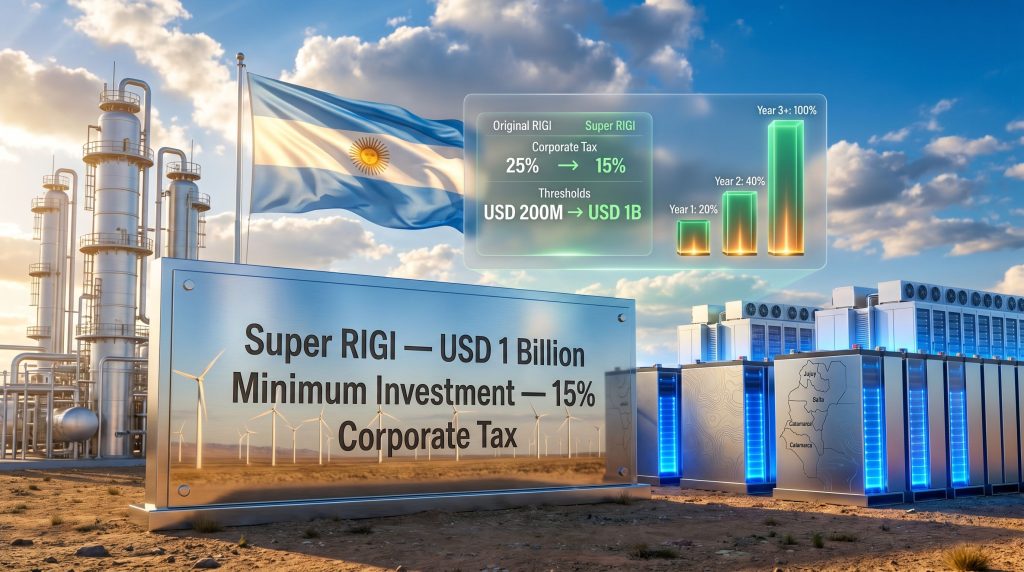
Argentina's original RIGI (Régimen de Incentivo para Grandes Inversiones), established under the Milei administration's broader economic reform agenda, set a USD 200 million minimum investment threshold and offered a 25% corporate income tax rate. The Super RIGI represents a significant escalation in both ambition and generosity.
| Feature | Original RIGI | Super RIGI |
|---|---|---|
| Minimum Investment Threshold | USD 200 million | USD 1 billion |
| Corporate Income Tax Rate | 25% | 15% |
| Export Tariff Elimination | From Year 3 | From Day One of Operations |
| Import Duty Coverage | Capital goods only | Capital goods + production inputs |
| Eligible Projects | Broad sectors | Greenfield-only, non-existent industries |
| Adhesion Deadline | Standard | July 8, 2027 (extendable by 1 year) |
The five-fold increase in the minimum investment threshold immediately narrows the eligible universe to institutional-scale capital. However, it is the greenfield-only mandate that represents the regime's most consequential architectural choice.
Expansions of existing operations, capacity upgrades, and brownfield developments are expressly excluded. Only genuinely new industrial, technological, or strategic infrastructure activities in sectors that do not currently exist at commercial scale within Argentina qualify for the full incentive package. This design prevents established operators from accessing preferential treatment without generating net-new economic activity, positioning the Super RIGI as a structural transformation mechanism rather than a conventional subsidy instrument.
The greenfield restriction signals a deliberate policy intent to catalyse entirely new industrial ecosystems rather than reward incumbents. This represents a materially different posture from most Latin American investment incentive frameworks, which typically allow brownfield investments to qualify.
The Argentina Super RIGI Initial Drivers: Sector-by-Sector Analysis
Green Hydrogen and Green Ammonia
Patagonia's wind corridor ranks among the highest-capacity renewable energy zones on the planet. Wind capacity factors in southern Argentina regularly exceed 50%, a figure that fundamentally changes the economics of green hydrogen production, which requires enormous quantities of cheap, reliable electricity to power electrolysis processes.
Green hydrogen is produced by splitting water molecules using renewable electricity, generating hydrogen without carbon emissions. Green ammonia takes this a step further, combining green hydrogen with nitrogen through the Haber-Bosch process to create a hydrogen carrier molecule that is far easier to transport and store than compressed hydrogen gas.
For European markets seeking to decarbonise their fertiliser supply chains, green ammonia represents a direct substitute for fossil-fuel-derived ammonia, which currently accounts for roughly 1.8% of global carbon dioxide emissions annually. Neither sector exists at industrial scale within Argentina today, making both natural candidates for the Super RIGI's greenfield eligibility criteria.
The Day One export tariff elimination is particularly valuable for these projects given their characteristically long capital recovery timelines, often stretching 15 to 25 years.
Hyperscale Data Centres and Digital Infrastructure
Argentina's combination of renewable energy potential, a relatively skilled technical workforce, and geographic positioning within South America makes it a credible candidate for regional data infrastructure investment. Hyperscale data centre development — the kind operated by major cloud providers requiring investments often exceeding USD 1 billion per facility — aligns naturally with the Super RIGI's minimum threshold.
The Super RIGI investment framework includes an accelerated amortisation schedule that provides meaningful cash flow relief during construction phases when facilities generate no revenue:
- Year 1: 60% of capital expenditure can be amortised
- Year 2: 20% amortisation allowance
- Year 3: Final 20% amortisation allowance
For a USD 1.5 billion hyperscale facility, first-year amortisation alone could shelter up to USD 900 million from taxable income, dramatically improving early-period internal rate of return calculations.
Lithium Battery Manufacturing and EV Supply Chain Integration
Argentina sits within the Lithium Triangle, a geological formation spanning the border regions of Argentina, Bolivia, and Chile that contains an estimated 58% of the world's known lithium reserves. Argentina's share is concentrated in the high-altitude salt flats of Jujuy, Salta, and Catamarca provinces, where Argentina lithium brines are extracted through solar evaporation processes.
The critical distinction the Super RIGI introduces is a downstream processing incentive. Argentina currently exports lithium primarily as lithium carbonate or lithium hydroxide, the raw chemical intermediates used in battery cathode manufacturing. Actual battery cell production has not existed at industrial scale within the country.
Coupling upstream lithium extraction with in-country battery cell manufacturing could fundamentally alter Argentina's position in the global EV supply chain, shifting the country from a raw material exporter toward a value-added industrial economy. This transition is precisely what resource-rich Latin American economies have historically struggled to achieve.
The financial implications are substantial. Lithium carbonate trades at a fraction of the value of finished battery cells. By incentivising greenfield battery manufacturing, the Super RIGI targets the value-capture gap that has historically concentrated profits in Asian battery manufacturers rather than resource-holding nations. Consequently, shifts in the global lithium market are amplifying the strategic urgency of this downstream push.
Advanced Materials, Uranium, and Semiconductor Infrastructure
Beyond the flagship sectors, the Super RIGI's eligible industry list extends to copper refining, uranium processing, semiconductor manufacturing, and artificial intelligence infrastructure. Argentina's domestic nuclear sector, anchored by INVAP's internationally recognised reactor technology, creates a contextual foundation for uranium-related industrial investment that few other Latin American nations can replicate.
The Financial Architecture: How the Tax Incentives Stack
The Super RIGI's financial incentives operate across three dimensions simultaneously, creating a compounding effect that materially improves project economics compared to standard Argentine tax treatment.
Tax Rate Differential
At 15%, the Super RIGI corporate income tax rate sits 10 percentage points below the original RIGI rate of 25% and significantly below Argentina's standard corporate tax rate of 35%. For a qualifying project generating USD 150 million in annual taxable income, the differential versus the original RIGI alone produces approximately USD 15 million in annual tax savings.
Projected across a 20-year project life, this differential — without discounting — represents USD 300 million in cumulative tax relief.
Graduated Currency Liberalisation
Argentina's foreign exchange control history represents the single largest credibility risk for international investors. The Super RIGI addresses this through a structured liberalisation pathway:
| Year of Operations | Export Proceeds Exempt from Repatriation Requirements |
|---|---|
| Year 1 | 20% |
| Year 2 | 40% |
| Year 3 onwards | 100% |
This graduated structure acknowledges Argentina's macroeconomic constraints while providing a credible pathway to full currency freedom. Full liberalisation by Year 3 aligns with the typical timeline for greenfield projects to reach stable export revenue generation.
Import Duty Scope Expansion
Unlike the original RIGI, which limited import duty relief to capital goods, the Super RIGI extends exemptions to production inputs. For green hydrogen projects, this covers imported electrolysers and membrane components. For battery manufacturing, it covers imported cathode materials and electrolyte chemicals.
This distinction reduces ongoing operational costs — not merely initial capital expenditure — improving project economics across the full operational life. In addition, innovations in direct lithium extraction technology may further reduce input costs for battery manufacturing operations established under this framework.
Legislative Timeline and Political Commitment
The Super RIGI legislative bill (Mensaje No. 181/2026) was formally submitted to the Argentine Congress on May 23, 2026. The submission carried signatures from President Javier Milei, Economy Minister Luis Caputo, and Chief of Staff Manuel Adorni, reflecting coordinated executive commitment to the framework. The project adhesion window runs to July 8, 2027, with a one-year extension mechanism built into the legislation.
The Super RIGI fits architecturally within the Milei administration's broader deregulation and fiscal consolidation agenda, complementing macroeconomic stabilisation efforts by targeting investment-led growth in high-export-revenue sectors. Congressional approval, however, is not guaranteed, and amendments during the legislative process could dilute incentive structures.
For further context on Argentina's evolving investment incentive landscape, the RIGI extension framework provides useful background on how the original regime was modified before the Super RIGI was conceived.
Regional Benchmarking: How Argentina Competes for Capital
| Country | Key Investment Incentive | Minimum Threshold | Incentivised Corporate Tax Rate |
|---|---|---|---|
| Argentina (Super RIGI) | Greenfield-only, multi-sector | USD 1 billion | 15% |
| Chile (Large Investment Projects) | Sector-agnostic stability agreements | No fixed minimum | ~27% standard |
| Brazil (REPETRO) | Oil and gas sector-specific | Varies | ~34% standard |
| Colombia (Free Trade Zones) | Geographic-based incentives | Varies | 20% |
Argentina's 15% incentivised corporate rate is among the most competitive in the region for qualifying projects. Chile's stability agreements offer long-term certainty but lack the accelerated amortisation and Day One export tariff elimination features of the Super RIGI.
Brazil's dominant REPETRO framework remains largely confined to the oil and gas sector, leaving clean energy and critical minerals investment without equivalent incentive depth. For comparison, copper market trends across the region illustrate how competing nations are structuring incentives to attract refining and processing capital.
The next major ASX story will hit our subscribers first
Key Risks That Investors Must Weigh
No analysis of the Argentina super RIGI initial drivers is complete without a frank assessment of the risk factors that could constrain outcomes regardless of incentive design quality. The eligibility and sector scope of the Super RIGI remains subject to legislative refinement, adding further uncertainty for prospective investors.
- Policy reversal risk: Argentina has a documented history of retroactively modifying investment frameworks, and the durability of Super RIGI protections across future administrations remains untested
- Infrastructure gaps: Greenfield projects in Patagonia and the Lithium Triangle require significant logistics, water, and energy infrastructure that the regime does not directly fund or guarantee
- Technology readiness: Sectors like advanced semiconductor fabrication and AI infrastructure require industrial ecosystems and supply chains that Argentina does not yet possess
- Global capital competition: Australia, Canada, Chile, and Morocco are all competing for the same pool of green hydrogen and critical minerals investment capital with their own incentive frameworks
- Legislative uncertainty: Congressional modifications could alter the incentive structure before the adhesion window opens to qualifying projects
The Super RIGI's ultimate impact will be determined less by the elegance of its design and more by the consistency of its implementation across electoral cycles and the durability of the macroeconomic environment in which it operates.
Frequently Asked Questions
What are the primary Argentina super RIGI initial drivers?
Green hydrogen production, green ammonia manufacturing, hyperscale data centres, lithium battery manufacturing, electric vehicle supply chain infrastructure, copper refining, uranium processing, artificial intelligence infrastructure, and advanced biotechnology are the designated eligible sectors under the framework.
What is the minimum investment to qualify for the Super RIGI?
Qualifying projects must commit a minimum of USD 1 billion in new capital investment, five times the threshold under Argentina's original RIGI framework.
Can existing Argentine operations access Super RIGI incentives?
No. Only genuinely new greenfield projects in sectors without existing commercial-scale operations within Argentina qualify. Expansions, modernisations, and brownfield developments are expressly excluded regardless of investment size.
How does the Super RIGI address foreign exchange risk?
Through a graduated currency liberalisation schedule: 20% of export proceeds are exempt from repatriation requirements in Year 1, rising to 40% in Year 2 and reaching full 100% exemption from Year 3 onwards.
When was the Super RIGI submitted to Congress?
Legislative Bill Mensaje No. 181/2026 was submitted to the Argentine Congress on May 23, 2026, with a project adhesion window extending to July 8, 2027.
This article is intended for informational purposes only and does not constitute financial or investment advice. Forward-looking statements, projections, and scenario analyses involve inherent uncertainty. Past policy frameworks in Argentina have been subject to modification, and readers should conduct independent due diligence before making investment decisions based on any regulatory or legislative framework discussed herein.
Want to Spot the Next Major Mineral Discovery Before the Broader Market Does?
Argentina's Super RIGI is accelerating investment into lithium, copper, and critical minerals sectors that are reshaping global supply chains — and Discovery Alert's proprietary Discovery IQ model delivers real-time alerts on significant ASX mineral discoveries the moment they are announced, turning complex data across 30-plus commodities into clear, actionable insights. Explore Discovery Alert's discoveries page to see how historic finds have generated substantial returns, and begin a 14-day free trial today to position yourself ahead of the market.