May 14, 2026
Argentina's Copper Renaissance: How Market Forces Reshape Mining Investment
The global copper market faces unprecedented structural deficits as traditional mining regions grapple with declining ore grades and insufficient greenfield development. While established producers like Chile maintain their dominance with 5.3 million tonnes annually, representing nearly 28% of global output, emerging markets present compelling opportunities for strategic resource development. Against this backdrop, South American nations beyond the traditional mining powerhouses are positioning themselves to capture value from the critical minerals transition driving modern economic transformation, with the Mendoza copper project representing a paradigm shift in Argentina's approach to critical minerals development.
Investment patterns in Latin American copper development reveal significant capital deployment toward projects that can deliver meaningful production within compressed timelines. The mathematics of current market conditions favor developments capable of achieving operational status during the peak energy transition period, when demand for electrification metals reaches maximum intensity. Furthermore, this temporal alignment creates favorable conditions for projects that can demonstrate technical feasibility, regulatory compliance, and financial viability within established institutional frameworks.
When big ASX news breaks, our subscribers know first
Market Fundamentals Driving Strategic Positioning
Global copper consumption currently outpaces primary mine production by approximately 4.5 to 5.2 million tonnes annually, creating structural supply gaps filled through secondary recycling and inventory drawdowns. According to the International Copper Study Group, this imbalance reflects insufficient exploration investment in greenfield projects over the past two decades, combined with natural depletion at established operations worldwide. Consequently, copper investment strategies must focus on emerging opportunities in underexplored regions.
Regional production dynamics highlight significant disparities in market positioning. While Chile leads global copper output, Argentina's current production represents less than 0.5% of worldwide totals, positioning the country far below its geological potential within the Andean metallogenic province. This geographic positioning offers strategic advantages through shared geological formations and established cross-border infrastructure networks.
Key Production Comparisons:
| Country | Annual Production (tonnes) | Global Market Share | Infrastructure Advantages |
|---|---|---|---|
| Chile | 5,290,000 | 27-28% | Established port networks |
| Peru | 2,100,000 | 11-12% | Pacific export corridors |
| Argentina | 180,000-190,000 | <0.5% | Cross-border potential |
| Australia | 900,000 | 4-5% | Advanced mining technology |
Current copper prices averaging USD $4.05-4.50 per pound during 2024 reflect sustained demand from electrification sectors, renewable energy infrastructure expansion, and data center development. These price levels support development economics for projects capable of achieving all-in sustaining costs below USD $3.00 per pound, creating favorable conditions for strategically positioned developments.
Economic Transformation Through Strategic Development
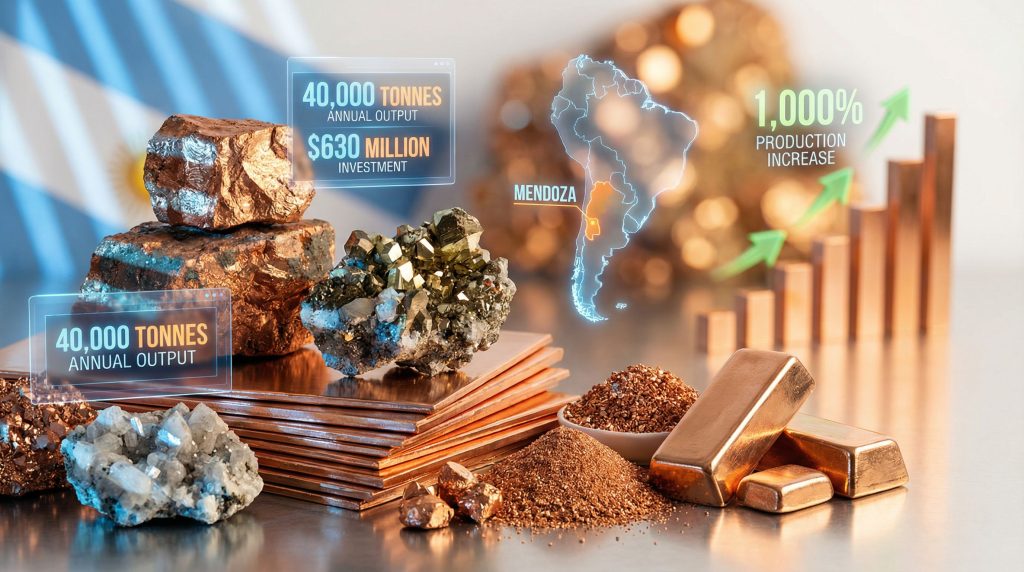
The Mendoza copper project represents a paradigm shift in Argentina's approach to critical minerals development, with committed investment of USD $630 million targeting annual production of 40,000 tonnes of copper concentrates. This scale positions the initiative as potentially transformative for Argentina's mining sector, representing approximately 25-28% of current annual mining investment levels across the country.
Employment generation projections indicate significant regional economic impact, with 3,900 construction positions during development phases and 2,400 operational roles throughout the projected 16-27 year mine life. These employment multipliers extend beyond direct mining operations to encompass transportation networks, service providers, and regional supply chains supporting sustained economic activity.
Project Economic Parameters:
- Capital Investment: USD $630 million total commitment
- Annual Output Target: 40,000 tonnes copper concentrates
- Refined Copper Equivalent: 10,000-14,000 tonnes annually (at 25-35% concentrate grades)
- Capital Intensity: USD $15,750-16,250 per tonne annual capacity
- Construction Timeline: 18-24 months development period
- Target Operational Start: 2027-2028 production ramp-up
The concentrate production model requires clarification regarding market positioning. Unlike refined copper cathodes, concentrates represent intermediate products containing 25-35% copper content requiring additional processing. However, this distinction impacts revenue calculations and market positioning but aligns with established regional processing networks through Chilean port facilities.
How Does This Project Compare to Other Mining Developments?
Furthermore, the project demonstrates how effective mineral exploration for copper can identify world-class deposits in previously underexplored regions. According to Fastmarkets, this would be Argentina's first new copper mine since 1997, highlighting the transformative nature of the development.
Regulatory Framework Innovation and Investment Attraction
Argentina's Regime of Incentive for Large Investments (RIGI) represents the most aggressive fiscal incentive structure in Latin America for greenfield mining development. Launched through Law 27,742 in December 2023, the program offers 30-year tax stability windows with corporate income tax fixed at 17% compared to standard 35% rates.
The regulatory framework addresses historical concerns regarding policy continuity and fiscal predictability that have traditionally deterred large-scale mining investment. RIGI provisions include contractual guarantees binding government entities to maintain specified tax treatments independent of future legislative changes, directly addressing sovereign risk concerns.
RIGI Benefits Analysis:
- Tax Stabilization: 17% corporate rate vs. 35% standard (48% reduction)
- Dividend Withholding: 9% vs. 13% standard rate
- Import Duty Elimination: 0% on equipment and machinery
- Foreign Exchange Flexibility: Dollar-denominated accounts and preferential repatriation terms
- Minimum Investment Threshold: USD $250 million (San Jorge exceeds at USD $630 million)
International comparisons highlight RIGI's competitive positioning. Chile's Project Development Company Law provides 10-year tax stabilization at 27% corporate rates, while Peru's Mining Stability Agreements offer 10-15 year certainty at standard tax levels. Argentina's 30-year commitment at reduced rates creates differentiated appeal for international mining finance markets.
The institutional framework matters significantly for project positioning and public sector coordination. This project will achieve its financing requirements and demonstrates a genuinely new development ready for execution.
These regulatory innovations address specific concerns raised by international investors regarding Argentina's historical approach to foreign investment in extractive sectors. The contractual nature of RIGI agreements provides legal recourse mechanisms and international arbitration provisions strengthening investor protections.
Infrastructure Development and Regional Synergies
Geographic positioning within Mendoza province creates unique opportunities for binational mining corridor development leveraging existing Chile-Argentina trade networks. Annual bilateral trade totaling approximately USD $40 billion includes USD $15-18 billion in mining sector commerce, primarily copper exports via Chilean port facilities.
The project's partnership with Distro Cuyo, Mendoza's primary electrical distribution company, addresses critical infrastructure requirements through dedicated power transmission lines and load management protocols. Power requirements estimated at 40-60 MW represent manageable increments within Mendoza's 3,000-3,500 MW installed capacity, predominantly hydroelectric and thermal generation.
Regional Infrastructure Advantages:
- Port Access: 240 km to Pacific terminals via Los Andes-Valparaíso corridor
- Transportation Options: Road transport (2,400-3,000 tonnes daily capacity) or rail alternatives
- Cross-Border Processing: Established concentrate handling facilities in Chilean ports
- Power Grid Integration: Collaboration with provincial utility for dedicated transmission
- Solar Resource Potential: Mendoza leads Argentina with 350+ days annual sunshine
Transportation logistics favour concentrate trucking to Chilean ports, with estimated handling fees of USD $8-12 per tonne for copper concentrate processing. Alternative rail transport offers lower costs but extended transit times of 30-40 days, requiring evaluation against working capital implications and port storage requirements.
Moreover, the company maintains conversations with neighbouring projects to explore regional synergies in infrastructure sharing, potentially reducing individual project costs while creating positive externalities for adjacent operations. This cluster approach mirrors successful models in Peru's Southern Copper corridor and Chile's northern mining regions.
What Are the Technical Advantages?
The San Jorge project's location within the Frontera Porphyry Copper Belt provides geological continuity with Chile's world-class copper deposits. This metallogenic province extends across the Argentina-Chile border, hosting multiple copper-molybdenum deposits with similar mineralogy and processing characteristics.
Porphyry copper deposits typically yield concentrates through conventional milling processes: mining, crushing, grinding, flotation, and dewatering. The project's basic engineering collaboration with Distro Cuyo encompasses concentrator plant operations designed to process ore through established metallurgical pathways proven across similar regional deposits.
Processing Technology Framework:
- Ore Processing: Conventional porphyry copper milling methodology
- Concentrate Grades: Target 25-35% copper content in final concentrates
- Recovery Rates: Industry standard 85-92% copper recovery through flotation
- Environmental Controls: Advanced water treatment and recycling systems
- Tailings Management: Engineered storage facilities with environmental monitoring
The project obtained its Environmental Impact Assessment (DIA) following extensive public consultation, demonstrating compliance with Argentina's environmental regulatory framework. Community concerns regarding water resource management and agricultural impact require ongoing attention throughout operational phases, potentially influencing operational costs and social licence maintenance.
Financial Engineering and Capital Market Access
International mining finance markets demonstrate sustained appetite for copper projects with established resource bases, environmental approvals, and regulatory certainty. The USD $630 million capital requirement represents manageable scale for traditional project finance structures, strategic partnerships, or innovative ESG-linked funding mechanisms, aligning with comprehensive investment strategies guide principles.
Project finance structures typically involve debt-equity ratios of 60:40 to 70:30 for mining developments, suggesting equity requirements of USD $190-250 million with remaining capital sourced through senior debt facilities. Current copper price environments and RIGI fiscal advantages improve debt service coverage ratios, enhancing bankability for international lenders.
Financing Strategy Components:
- Traditional Project Finance: Senior debt facilities from mining-focused lenders
- Strategic Partnerships: Joint ventures with established mining companies
- ESG-Linked Financing: Green bonds and sustainability-linked loan structures
- Development Finance: Potential participation from multilateral development banks
- Export Credit Facilities: Equipment financing from international suppliers
Management confidence in achieving project financing reflects current market conditions favouring copper developments with near-term production potential. Construction timeline projections of 18-24 months position the project to capture favourable copper market conditions during peak energy transition demand.
What Makes This Project Attractive to Investors?
According to Mining.com, Mendoza's legislature has officially approved the project's environmental impact declaration, removing a key regulatory hurdle. Additionally, the project benefits from current industry evolution trends that favour copper developments in politically stable jurisdictions with modern regulatory frameworks.
The next major ASX story will hit our subscribers first
Market Psychology and International Perception
International investor interest reflects broader recognition of Argentina's evolving institutional framework under current economic management. The country's mining sector transformation signals departure from historical policy uncertainties that previously deterred large-scale foreign investment in extractive sectors.
Canada's mining finance community, concentrated in Toronto's financial district, represents the primary source of international mining capital. The project's presentation during the Prospectors & Developers Association of Canada (PDAC) 2026 conference demonstrates strategic engagement with key decision-makers in global mining finance markets.
International companies demonstrate permanent interest in the project development and potential execution pathways. There is tremendous interest from first-tier companies and potential financiers across both traditional and non-conventional financing schemes.
This institutional engagement occurs amid broader Latin American mining sector repositioning, with regional governments implementing policy frameworks designed to attract international investment in critical minerals development. Argentina's RIGI program represents the most comprehensive approach to addressing historical investor concerns regarding fiscal stability and regulatory predictability.
Global Supply Chain Positioning and Strategic Value
Argentina's entry into meaningful copper production occurs during intensifying international competition for critical mineral resources. Geographic diversification away from traditional suppliers creates strategic value for international buyers seeking supply chain resilience amid geopolitical uncertainties affecting established producing regions.
The project's 40,000 tonnes annual concentrate production would position Argentina at approximately 0.2% of global copper output, modest in absolute terms but potentially significant for regional supply chain integration. This scale provides foundation for sustained sector growth while demonstrating Argentina's capacity to deliver large-scale mining developments.
Competitive Positioning Analysis:
- Geographic Advantage: Proximity to Pacific export markets via established corridors
- Political Stability: Improved regulatory environment supporting foreign investment
- Resource Quality: High-grade ore deposits with favourable metallurgy
- Cost Structure: Competitive production costs relative to established operations
- Timeline Advantage: Near-term production capability during peak demand period
Success in executing this development could catalyse broader international interest across Argentina's mineral-rich Andean provinces, creating demonstration effects that accelerate additional investment in the country's critical minerals portfolio. This multiplier potential extends beyond copper to encompass lithium, gold, and other strategic minerals essential for energy transition technologies.
Economic Transformation Timeline and Implementation
The projected development timeline aligns with global copper market dynamics favouring projects capable of achieving production during the critical 2027-2030 period. This temporal positioning maximises revenue generation potential during anticipated peak demand from electric vehicle adoption, renewable energy expansion, and grid modernisation initiatives.
Critical Implementation Milestones:
- 2025: Definitive Feasibility Study completion and RIGI approval finalisation
- Late 2026: Construction commencement following financing closure
- 2027-2028: Production ramp-up period with initial concentrate shipments
- 2030+: Full operational capacity achievement and sustained production
The 18-24 month construction timeline requires coordination across multiple workstreams including infrastructure development, equipment procurement, workforce training, and environmental compliance systems. Partnership agreements with Distro Cuyo address critical path items related to power infrastructure, while conversations with neighbouring projects explore potential synergies in shared facilities.
Management commitment to achieving late 2026 construction start dates depends on successful completion of definitive feasibility studies, RIGI approval processing, and financing arrangements. This aggressive timeline reflects confidence in project technical parameters and regulatory pathway clarity under current institutional frameworks.
In addition, the project represents a significant advancement in exploring the Argentina copper system potential, demonstrating how systematic exploration and modern mining techniques can unlock previously untapped resources in this mineral-rich region.
The Mendoza copper project embodies Argentina's strategic repositioning within global critical minerals supply chains, representing more than isolated mining development. Success could establish foundations for sustained mining sector growth, economic diversification, and enhanced export competitiveness in an increasingly resource-constrained global economy. International recognition of Argentina's evolving institutional framework, combined with favourable geology and strategic geographic positioning, creates conditions for meaningful transformation in the country's mining sector contributions to national economic development.
Disclaimer: This analysis contains forward-looking statements regarding mining project development, market conditions, and economic projections. Actual results may vary significantly from projections due to commodity price volatility, regulatory changes, technical challenges, financing conditions, and other factors beyond company control. Investment decisions should consider comprehensive risk assessments and professional financial advice.
Ready to Capitalise on the Next Major Copper Discovery?
Discovery Alert's proprietary Discovery IQ model delivers instant notifications on significant ASX mineral discoveries, empowering subscribers to identify actionable copper and critical minerals opportunities ahead of the broader market. Begin your 14-day free trial today and position yourself to capture emerging opportunities as they unfold in real-time across Australian mining markets.