
June 13, 2026
Argentina's Mining Transformation: Strategic Positioning in Global Copper Markets
South America's mineral-rich landscapes have long defined global commodity flows, yet Argentina's copper potential has remained largely dormant for decades. This strategic pause in development represents not merely missed opportunities, but a fundamental repositioning within continental mining hierarchies that extends far beyond individual project economics.
The convergence of technological advancement, regulatory reform, and market demand creates unprecedented conditions for Argentina's emergence as a significant copper producer. Within this macro-economic framework, individual projects become catalysts for broader sectoral transformation, reshaping regional supply chains and investor perceptions across the mining industry.
Understanding Argentina's copper awakening requires examining multiple intersecting forces: global electrification demands, regional competitive dynamics, infrastructure requirements, and the political economy of resource extraction under President Javier Milei Los Azules copper project leadership.
When big ASX news breaks, our subscribers know first
Repositioning Argentina Within Continental Mining Dynamics
Argentina's copper sector entered dormancy following Alumbrera's closure in 2018, effectively removing the country from global production networks. This absence created a unique strategic position where Argentina possessed significant geological resources without the operational complexities that characterise established mining jurisdictions.
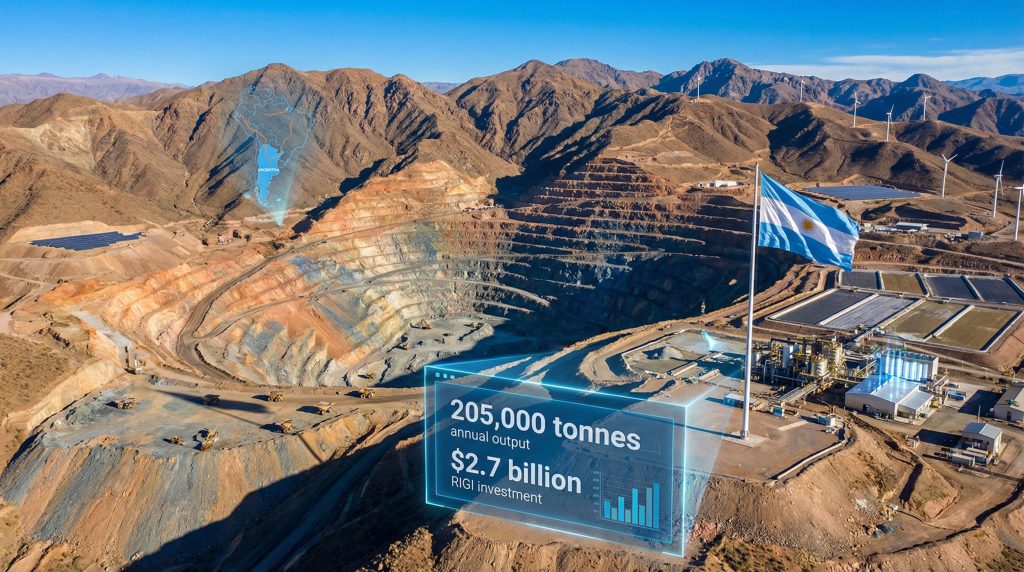
The Los Azules project represents the cornerstone of Argentina's re-entry into copper markets, with production parameters that position it among globally significant developments. The project's feasibility study presents compelling operational metrics across multiple phases:
| Production Phase | Annual Output | Duration | Strategic Significance |
|---|---|---|---|
| Initial Production | 205,000 tonnes | 5 years | Rapid market positioning |
| Sustained Operations | 148,000 tonnes | 17 years | Long-term revenue stability |
| Extended Phase | Variable output | 33 additional years | Multi-generational asset base |
This production profile creates a 55-year operational horizon that fundamentally alters Argentina's position within South American mining networks. Unlike incremental capacity additions in established jurisdictions, Los Azules represents Argentina's transformation from copper importer to significant regional producer.
The project's location in San Juan province at 3,500 metres elevation within the Andean cordillera places it within the same geological formations that have made Chile the world's largest copper producer. This positioning suggests Argentina's potential to leverage similar geological advantages whilst avoiding some of the infrastructure constraints that limit expansion in mature mining regions.
Economic Architecture of Mining Sector Revival
President Javier Milei's administration approved Los Azules for the Régimen de Incentivos para Grandes Inversiones (RIGI) in September 2025, designating the project for benefits under a framework designed to attract large-scale investment. The RIGI approval for $2.7 billion demonstrates the government's strategic commitment to mining sector development as an economic diversification mechanism.
The RIGI framework represents more than traditional investment incentives. It creates institutional infrastructure for managing large-scale resource projects within Argentina's evolving economic model. This regulatory approach positions mining investments within broader strategies for export diversification, fiscal revenue generation, and regional development.
Los Azules already possesses environmental permits, indicating completion of regulatory processes that often create development delays. This administrative advantage, combined with RIGI benefits, creates optimal conditions for project advancement within Argentina's reformed investment climate.
The project's significance extends beyond individual economics to encompass Argentina's broader economic strategy. Furthermore, copper production offers several strategic advantages:
- Hard currency generation: Sustained export revenues supporting balance of payments stability
- Fiscal revenue diversification: Corporate taxes and royalties reducing dependence on traditional revenue sources
- Regional development catalyst: Infrastructure investment and employment creation in San Juan province
- Supply chain integration: Potential synergies with Argentina's existing mining operations and renewable energy development
Infrastructure Challenges and Technological Solutions
Michael Meding, Chief Executive Officer of McEwen Copper, emphasised infrastructure as a fundamental challenge during the IEFA Latam Forum in Buenos Aires. The project faces significant infrastructure requirements typical of high-altitude Andean operations, spanning electrical transmission systems to road construction at extreme elevations.
These infrastructure challenges represent both obstacles and opportunities within Argentina's mining development strategy. Large-scale projects require substantial supporting infrastructure that benefits broader regional development whilst creating bottlenecks that must be strategically addressed.
The project's infrastructure requirements include:
- Power generation and transmission: Electrical infrastructure capable of supporting large-scale mining operations at 3,500 metres elevation
- Transportation networks: Road systems designed for heavy equipment and material transport across challenging terrain
- Water management systems: Efficient water utilisation in water-scarce high-altitude environments
- Communications infrastructure: Reliable connectivity supporting modern mining operations and safety systems
Los Azules' commitment to renewable energy integration represents strategic positioning within evolving ESG requirements for mining operations. This approach aligns with global trends toward sustainable resource extraction whilst potentially reducing operational costs through Argentina's abundant renewable energy resources.
The project utilises heap leaching and solvent extraction-electrowinning technology, offering operational advantages particularly relevant to Argentina's environmental and economic conditions. This technology reduces water consumption compared to traditional flotation methods whilst providing energy efficiency benefits that complement renewable energy integration goals.
Capital Markets Strategy and Investment Positioning
McEwen Copper's planned initial public offering represents a strategic approach to project financing within current capital market conditions. The company targets a $300 million IPO toward the end of 2026, most likely in United States or Canadian markets, as part of a comprehensive $4 billion financing package.
This financing timeline aligns with project development milestones:
- Final Investment Decision: Q4 2026
- Construction commencement: Early 2027
- Operational startup: 2029
- Commercial production: 2030
The IPO strategy reflects market conditions favouring copper investment strategies amid accelerating electrification demands. Investor interest in copper projects has intensified as supply constraints become apparent whilst electric vehicle adoption, renewable energy infrastructure, and grid modernisation drive consumption growth.
McEwen Copper's approach of separating copper assets through dedicated public markets positioning allows investors to gain direct exposure to copper price dynamics without diversification across other commodities. This strategic focus may attract ESG-focused investors given the project's renewable energy commitments and sustainable extraction technology.
The success of this financing approach depends on several critical factors:
- Copper price environment: Current pricing levels supporting project economics and investor returns
- Argentina risk assessment: Market perceptions of political and economic stability under the Milei administration
- ESG credentials: Environmental and social governance standards meeting institutional investor requirements
- Technical execution capabilities: Management team track record and operational expertise demonstration
Regional Competitive Dynamics and Supply Chain Integration
Argentina's entry into large-scale copper production occurs within established South American mining dynamics dominated by Chilean and Peruvian operations. Rather than directly competing with these established producers, Argentina's copper development creates complementary supply chain opportunities and regional supply diversification.
The timing of Los Azules' 2030 production start aligns strategically with accelerating global copper demand driven by multiple megatrends. In addition, the global copper supply forecast suggests sustained market growth that can accommodate new supply sources without necessarily displacing existing production.
These demand drivers include:
- Electric vehicle expansion: Each electric vehicle requires substantially more copper than conventional vehicles, with estimates ranging from 80-180 kilograms per unit
- Renewable energy infrastructure: Wind and solar installations require extensive copper wiring and components
- Grid modernisation: Smart grid deployment and energy storage systems significantly increase copper consumption
- Data center growth: Digital infrastructure expansion creates substantial industrial copper demand
Argentina's copper development may actually strengthen regional supply chains by reducing concentration risks and providing alternative sourcing options for global consumers. The global copper production rankings demonstrate how Argentina's emergence could diversify supply sources.
Regional supply chain integration offers several strategic advantages:
- Logistics optimisation: Shared transportation infrastructure and port facilities
- Technical expertise exchange: Knowledge transfer and best practices sharing across borders
- Processing synergies: Potential for regional refining and value-added manufacturing
- Market diversification: Multiple supply sources reducing single-country dependency risks
The next major ASX story will hit our subscribers first
Long-term Strategic Implications for Argentine Mining
Los Azules represents the beginning rather than the culmination of Argentina's mining sector transformation. The project's success could catalyse broader mining development across multiple commodities and regions, positioning Argentina as a significant global mining jurisdiction.
Several factors support this broader transformation potential:
Geological endowment: Argentina possesses substantial mineral resources across multiple commodities, including lithium, gold, silver, and critical minerals energy transition technologies require.
Regulatory framework evolution: The RIGI programme and associated reforms create institutional infrastructure applicable to diverse mining projects beyond copper.
Regional development strategy: Mining-led development offers economic diversification opportunities for multiple provinces with significant mineral resources.
Infrastructure leverage: Investments in transportation, power, and communications infrastructure for Los Azules create foundation for additional projects.
The project's integration with Argentina's lithium development creates potential synergies within the broader critical minerals sector. Argentina's position within the "Lithium Triangle" combined with copper production capabilities positions the country strategically within supply chains for energy transition technologies.
How Will Los Azules Impact Mineral Exploration Activities?
The success of the Javier Milei Los Azules copper project will likely catalyse increased interest in gold and copper exploration throughout Argentina's mineral-rich provinces. Furthermore, this project serves as a proof of concept for large-scale mining operations under the new regulatory framework.
Market Psychology and Investment Sentiment
Investor sentiment toward Argentine mining reflects broader perceptions of political risk, regulatory stability, and economic predictability under the Milei administration. The RIGI programme's implementation and Los Azules' advancement serve as crucial tests of Argentina's investment climate credibility.
Market psychology around Argentine mining involves several critical elements:
Historical risk perceptions: Previous experiences with policy instability and economic volatility influence current investor attitudes.
Regulatory credibility: RIGI implementation success demonstrates government commitment to investment-friendly policies.
Technical execution: Project development success builds confidence in Argentina's ability to deliver world-class mining operations.
Economic stability: Broader macroeconomic management affects perceptions of long-term investment security.
The convergence of favourable regulatory conditions, market demand, and project readiness creates what Meding described as an alignment of stars for project realisation. This sentiment reflects growing optimism about Argentina's mining potential despite historical challenges.
Geological Advantages and Resource Quality
Los Azules benefits from geological formations consistent with major copper deposits throughout the Andean cordillera. The project's location within proven mineralisation zones suggests potential for resource expansion and additional discoveries.
The high-altitude location presents operational challenges but also offers several advantages:
- Reduced environmental impact: Lower population density and agricultural activity minimise community conflicts
- Resource concentration: Geological processes at high altitudes can create higher-grade mineral concentrations
- Water availability: Proximity to Andean watersheds provides access to water resources despite arid conditions
- Strategic positioning: Location enables efficient access to Pacific coast export infrastructure
The project's geological characteristics position it favourably within global copper supply chains. Heap leaching technology suits the deposit's geological properties whilst providing operational flexibility for varying ore grades and market conditions.
Transformation Through Provincial Development
Los Azules' impact extends beyond copper production to encompass comprehensive provincial transformation in San Juan. Mining-led development creates multiplier effects across multiple economic sectors whilst establishing institutional capabilities for managing large-scale industrial projects.
Michael Meding emphasised that large projects transform provinces in positive ways whilst creating certain bottlenecks requiring strategic attention. This perspective acknowledges both opportunities and challenges inherent in mining-led regional development.
Provincial transformation through Los Azules encompasses:
Human capital development: Technical training and skills development creating capabilities transferable across industries.
Infrastructure modernisation: Transportation, communications, and utility systems supporting broader economic development beyond mining.
Service sector expansion: Supporting industries, logistics services, and professional services creating diverse employment opportunities.
Institutional capacity building: Regulatory, environmental, and administrative capabilities applicable to future development projects.
These transformation dynamics position San Juan province as a potential model for mining-led development throughout Argentina's mineral-rich regions. However, according to Mining Magazine's analysis of Argentina's mining sector under Milei, the government's market-oriented reforms are creating unprecedented opportunities for the mining industry.
Moreover, recent reports from Mining Technology regarding Argentina's approval of McEwen's copper project highlight the significance of the RIGI framework in attracting foreign investment to the sector.
The Javier Milei Los Azules copper project under President Javier Milei's administration represents Argentina's strategic repositioning within global copper markets precisely when supply diversification becomes critical for energy transition success. With production targeted for 2030, the project positions Argentina as a significant new copper producer whilst catalysing broader mining sector development.
The convergence of favourable regulatory frameworks, technological advantages, and market demand creates unprecedented opportunities for Argentina's mining sector transformation. However, successful execution requires managing infrastructure challenges, maintaining political continuity, and delivering on capital market commitments.
Los Azules' success could establish Argentina as a major mining jurisdiction whilst contributing to economic diversification and regional development goals. The project's impact extends beyond copper production to encompass institutional capacity building, infrastructure development, and supply chain integration that supports broader economic transformation under the Milei administration's reform agenda.
Investment decisions should always be based on thorough due diligence and consideration of individual risk tolerance. Mining investments carry inherent risks including commodity price volatility, operational challenges, and regulatory changes.
Seeking Opportunities in Argentina's Copper Renaissance?
Discovery Alert's proprietary Discovery IQ model delivers real-time alerts on significant copper and mineral discoveries across the ASX, empowering subscribers to identify actionable opportunities ahead of the broader market. Begin your 14-day free trial today at Discovery Alert and position yourself to capitalise on the next major mineral discovery before the market catches up.