
June 13, 2026
Engineering Chile's Next Major Copper Export Gateway: The Santo Domingo Port Explained
Large-scale mining projects rarely fail at the orebody. They fail at the infrastructure. Across Latin America's mining history, technically sound deposits have stalled for years, sometimes permanently, because the logistics chain connecting ore to market was never resolved at the engineering level. This reality sits at the heart of understanding why Capstone Copper's ongoing Capstone Santo Domingo port construction studies represent far more than routine planning — they represent the critical path item that will ultimately determine whether a world-class dual-commodity deposit becomes a producing mine.
The Capstone Santo Domingo port construction studies now underway mark a deliberate escalation in the project's engineering maturity, moving from conceptual logistics frameworks into the kind of data-intensive offshore study work that underpins bankable infrastructure design.
When big ASX news breaks, our subscribers know first
The Engineering Logic Behind a Greenfield Coastal Facility
Santo Domingo is not a project that can simply plug into existing port infrastructure. Located in Chile's Atacama Region, the deposit sits inland from a coastline that lacks the wharf capacity, storage configuration, and concentrate handling systems required for a dual-commodity export operation of this scale. Purpose-built marine terminals are the norm for projects of this complexity, not the exception.
The proposed port site at Punta Roca Blanca sits approximately 41 to 43 kilometres north of Caldera, a positioning that reflects a convergence of pipeline routing economics, coastal bathymetry, and land tenure considerations rather than arbitrary site selection. The distance from the mine to the coast dictates the concentrate pipeline corridor, and every kilometre of pipeline has capital and operating cost implications that feed directly back into the project's financial model.
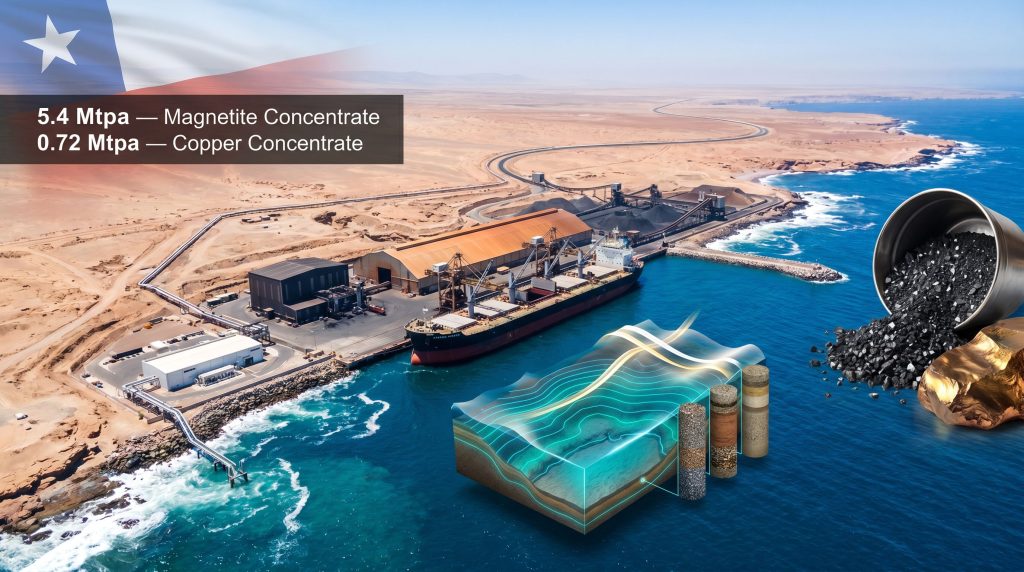
What makes the Santo Domingo port particularly complex from an engineering standpoint is the project's dual-commodity nature. Most copper concentrate export terminals are designed around a single product stream. Santo Domingo must accommodate both copper concentrate at approximately 0.72 million tonnes per annum and magnetite concentrate at up to 5.4 million tonnes per annum — commodities with different physical characteristics, storage requirements, and vessel loading protocols. Adding desalinated water production to the same coastal footprint further layers the engineering challenge.
Why Magnetite Adds Logistical Complexity
Magnetite export is not commonly integrated into copper port terminals, and this distinction carries real engineering significance. Magnetite concentrate for steel production is a high-density, abrasive material that requires dedicated filter plant capacity onshore before stockpiling and vessel loading. The sheer volume differential between the two products is striking: the magnetite stream is roughly seven and a half times larger by mass than the copper concentrate stream, meaning port infrastructure sizing is dominated by the iron ore component even though copper drives the project's primary revenue narrative.
This volume imbalance has direct implications for berth configuration, vessel sizing assumptions, stockpile footprint, and the frequency of vessel calls. Capsize-capable berth design, which appears to be within scope based on the district-scale ambitions attached to this facility, signals that the port planning envelope extends well beyond minimum viable throughput for Santo Domingo alone. Furthermore, the Chile copper outlook adds important context to why infrastructure of this calibre is being prioritised now.
What Offshore Construction Studies Actually Measure
The offshore study phase currently underway is a precondition for virtually every subsequent step in port development. These campaigns generate the foundational data sets without which structural engineers cannot produce credible designs and project lenders will not engage on financing terms.
The four core data streams captured during offshore campaigns are:
- Bathymetric mapping: Continuous seabed depth profiling to establish breakwater placement, berth pocket dredging requirements, and vessel approach channel geometry.
- Geotechnical core sampling: Sub-seabed sediment composition and bearing capacity testing that defines foundation system selection for wharf structures and breakwater armour units.
- Oceanographic data collection: Long-duration recording of wave height, swell direction, tidal range, and current velocity to establish vessel operability windows and downtime probability modelling.
- Sediment transport modelling: Predictive analysis of how construction-phase dredging and permanent infrastructure will modify coastal sediment dynamics — a critical input for both structural design and environmental permitting.
The Relationship Between Geotechnical Data and Capital Cost Certainty
One of the least appreciated aspects of port feasibility work is how profoundly seabed conditions influence contingency allocations in capital cost estimates. In prefeasibility studies, port CAPEX estimates routinely carry contingencies of 20 to 30 percent because geotechnical uncertainty has not been resolved. Once offshore core sampling returns data confirming or challenging design assumptions, that contingency band can tighten considerably, improving the accuracy of the overall project capital estimate and strengthening the case for project finance engagement.
Unexpected seabed conditions — such as the presence of weak superficial sediments where competent rock was assumed — can force fundamental redesigns of breakwater foundations or wharf pile specifications. In extreme cases, such discoveries have added hundreds of millions of dollars to comparable port projects globally. This is precisely why project lenders require completed offshore study results as a prerequisite before committing to term sheet negotiations on major mining infrastructure finance mandates.
Study Phase Timeline: From Data Acquisition to Construction Approval
The pathway from offshore data collection to construction mobilisation involves five sequential but partially overlapping phases:
- Data acquisition: Oceanographic and geotechnical field campaigns, typically spanning 6 to 18 months depending on seasonal weather windows and data quality requirements.
- Engineering integration: Incorporating field results into detailed design iterations and updating capital cost models with reduced uncertainty ranges.
- Permitting: Submission of the coastal infrastructure component of the Environmental Impact Assessment through Chile's Sistema de Evaluación de Impacto Ambiental (SEIA), alongside concurrent DIRECTEMAR and DGA approvals.
- Contractor procurement: EPC or EPCM tender processes for marine civil works, which in Chile's active mining construction market carry their own schedule risk.
- Construction mobilisation: Site establishment, marine plant deployment, and civil works commencement.
The Five Infrastructure Components of the Santo Domingo Port
The proposed facility is engineered as a multi-function export and water supply hub. Its five core components reflect the operational complexity of serving both the export logistics chain and the mine's water supply requirements from a single coastal location.
| Infrastructure Component | Function | Key Specification |
|---|---|---|
| Concentrate pipeline terminal | Receives slurried copper and magnetite from inland pipeline | Dual-product reception and dewatering |
| Magnetite filter plant and stockpile | Processes and stores magnetite for vessel loading | Up to 5.4 Mtpa throughput capacity |
| Copper concentrate storage building | Enclosed storage preventing dust and moisture ingress | Approximately 0.72 Mtpa annual throughput |
| Seawater desalination plant | Reverse osmosis water production for mine operations | BOOT contractor model |
| Brine return and water pipeline | Manages desalination discharge and inland water transport | Marine environmental compliance |
The BOOT Desalination Model: Risk Allocation in Practice
The decision to pursue a Build-Own-Operate-Transfer structure for the desalination component reflects a sophisticated approach to capital allocation that is increasingly common in Chilean mining projects but still not universally understood by outside observers.
Under a BOOT arrangement, a specialist water infrastructure contractor finances, constructs, and operates the desalination facility for a defined contract period — typically 15 to 25 years in comparable Chilean precedents — before transferring asset ownership to the project owner. The mine developer pays a contracted water tariff rather than carrying the full capital cost of desalination infrastructure on its own balance sheet.
"The BOOT model effectively converts a large upfront capital expenditure item into a long-term operating cost, reducing the equity and debt burden at project sanction and improving the project's internal rate of return profile, at the expense of higher per-unit water costs over the life of the contract."
From an ESG and operational resilience standpoint, on-site seawater desalination is increasingly essential for new Atacama region mining projects. Freshwater aquifer access is severely constrained across northern Chile, and regulatory pressure to eliminate or minimise aquifer drawdown for industrial purposes has intensified significantly over the past decade. Desalinated seawater eliminates this constraint entirely, however the energy intensity of reverse osmosis processing adds meaningfully to the project's power demand profile and associated carbon accounting.
Regulatory Architecture for a Chilean Greenfield Port
The permitting pathway for the Santo Domingo port involves multiple Chilean regulatory bodies operating on partially overlapping timelines. Understanding this architecture is essential for interpreting project development progress. In addition, broader copper smelting expansion dynamics across the region are reshaping how regulators approach large-scale mineral export infrastructure.
- DIRECTEMAR (Dirección General del Territorio Marítimo y de Marina Mercante): Maritime authority concession for marine works and vessel operations.
- SEIA (Sistema de Evaluación de Impacto Ambiental): The national environmental review system through which the EIA must be submitted and approved, with typical processing timelines for large-scale mining port projects ranging from 18 to 36 months.
- DGA (Dirección General de Aguas): Water rights allocation for seawater intake volumes associated with the desalination plant.
- Bienes Nacionales: Coastal concession rights over the maritime zone, required before any permanent structure can be constructed seaward of the high water mark.
- SERNAPESCA: Marine biodiversity impact assessment, particularly relevant given the potential ecological sensitivity of the Atacama coastal zone.
Critically, the offshore studies now underway directly feed the environmental baseline data requirements that the SEIA process demands. Without comprehensive oceanographic and ecological survey data, an EIA submission for coastal port infrastructure in Chile will not achieve the technical sufficiency threshold required to progress through formal review. In this sense, offshore studies and environmental permitting are not sequential activities but parallel workstreams that share foundational data.
District-Scale Ambitions: Beyond Single-Mine Throughput
Perhaps the most strategically significant and least discussed dimension of the Santo Domingo port concept is its potential to function as shared regional infrastructure rather than a single-project export terminal. This is a major copper-gold project analogue worth studying for how district-scale infrastructure logic can transform project economics.
Capsize vessel capability in the port design — accommodating vessels typically exceeding 100,000 deadweight tonnes — implies throughput economics that only make sense at volumes substantially above what Santo Domingo alone would generate. The economics of shared port infrastructure in mining districts are compelling: fixed capital costs spread across multiple revenue streams reduce the per-tonne infrastructure charge for each user, improving project economics for all participants.
The Mantoverde copper operation, also held within Capstone's portfolio, represents a logical candidate for port access integration. Mantoverde already produces copper cathode and concentrate, and connectivity to a purpose-built export terminal would offer logistics cost advantages over reliance on the existing port infrastructure at Caldera.
The possibility of a co-investment partner sharing port capital costs adds another dimension to the financial modelling. Mining port co-investment structures in Chile have typically involved one of two approaches: a proportional equity stake in the port entity by a throughput user, or a long-term take-or-pay access agreement. Both structures require resolution before the overall Santo Domingo project finance mandate can be fully defined.
The next major ASX story will hit our subscribers first
Key Risk Factors Shaping the Port Development Timeline
"Three risk categories dominate the schedule outlook for the Santo Domingo port: geotechnical surprises from the offshore study campaign, EIA progression delays, and marine contractor availability in Chile's competitive construction market."
Breaking these down in terms of probability and impact:
- Geotechnical risk is the most technically immediate, with outcomes from the current offshore campaign potentially requiring design modifications before detailed engineering can be finalised.
- Regulatory risk centres on the EIA process, where objections related to marine ecology, coastal community impacts, or cumulative environmental effects from multiple nearby projects could extend the review timeline.
- Construction market risk reflects the sustained activity in Chilean mining construction, where marine contractor availability and construction cost inflation can extend project schedules even after all approvals are secured.
- Financing risk links port construction commencement to project finance closing, meaning that the overall project sanction timeline sets the effective outer boundary for when port construction can begin regardless of how quickly engineering and permitting milestones are achieved.
What Port Study Progress Signals for Project Sanction Readiness
For those monitoring the Santo Domingo project's development trajectory, the commencement of Capstone's offshore Capstone Santo Domingo port construction studies is a meaningful technical milestone — not because it resolves uncertainty, but because it initiates the data collection process that will progressively reduce uncertainty across engineering, environmental, and financial dimensions simultaneously.
The transition from offshore data acquisition to detailed port design represents a material de-risking of the overall project schedule. Each completed study phase narrows the capital cost estimate range, strengthens the EIA evidence base, and gives prospective lenders and co-investors the technical confidence required to advance commercial discussions. Furthermore, understanding current copper market trends underscores why advancing these studies with urgency is commercially rational.
Project sanction for a development of this scale requires the port engineering package to reach a level of definition equivalent to the mine's own processing and infrastructure studies. Consequently, a completed definitive feasibility study across all project components — port included — is the gateway through which serious financing conversations must pass. The offshore study technical report provides a detailed view of how these engineering standards are applied in practice at Santo Domingo. The offshore study phase now underway is the earliest and most foundational step in that process.
Disclaimer: This article contains forward-looking analysis and technical assessments based on publicly available information. It does not constitute financial or investment advice. Project timelines, capital cost estimates, and regulatory outcomes are subject to material uncertainty and may differ from outcomes discussed herein. Readers should conduct their own due diligence before making any investment decisions.
Want To Stay Ahead of Major ASX Mineral Discoveries as They Happen?
Discovery Alert's proprietary Discovery IQ model delivers real-time alerts on significant ASX mineral discoveries, translating complex commodity data into clear, actionable insights for both traders and long-term investors. Explore why historic mineral discoveries have generated substantial market returns — and begin your 14-day free trial today to position yourself ahead of the broader market.