May 21, 2026
Argentina's position in the global energy transition has become increasingly pivotal as Argentinian lithium production surges to meet unprecedented demand from electric vehicle manufacturers and renewable energy storage systems. The country's strategic location within the South American Lithium Triangle, combined with exceptional resource quality and operational scaling capabilities, positions Argentina as a cornerstone supplier for global supply chains. Furthermore, the convergence of technological advancement, geopolitical strategy, and resource scarcity has transformed Argentina's mineral-rich regions from remote extraction sites into the epicenter of 21st-century resource geopolitics.
Strategic Production Scaling and Operational Excellence
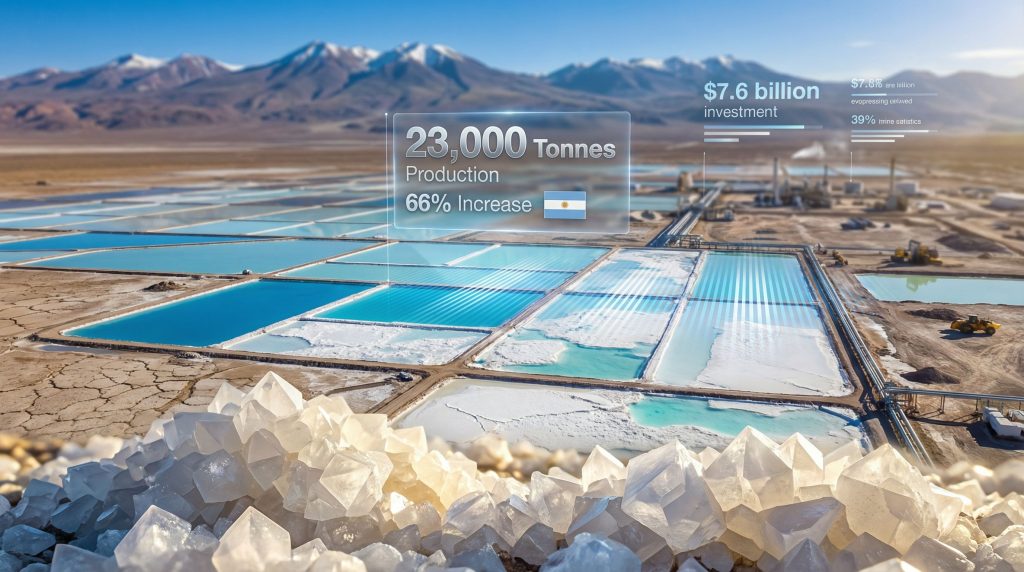
Argentina's lithium sector demonstrated exceptional operational performance in 2025, achieving a remarkable transformation from 13,800 tonnes to 23,000 tonnes of lithium metal production. This 66% increase represents the most vigorous growth rate globally, according to the U.S. Geological Survey's Mineral Commodity Summaries 2026. The production surge reflects successful capacity optimization across Argentina's three primary lithium-producing provinces: Salta, Jujuy, and Catamarca.
The operational scaling success stems from enhanced brine extraction efficiency and processing optimization at existing facilities. Argentina's salt flats, particularly Hombre Muerto and Cauchari-Olaroz, contain lithium-rich brines with concentrations reaching 300-400 mg/L, enabling cost-effective extraction through evaporation-based methods. This natural advantage, combined with improved facility utilization rates, allowed producers to maximize output without proportional capital expenditure increases.
Infrastructure Development and Capital Deployment Patterns
The $7.6 billion capital deployment across Argentina's lithium projects represents a strategic investment in long-term production capacity. In addition, developments in battery-grade lithium refinement have enhanced processing capabilities across the sector. This funding has supported critical infrastructure improvements including:
- Expansion of evaporation pond systems for enhanced brine processing
- Upgrading chemical processing facilities to achieve battery-grade purity standards
- Developing transportation networks linking remote salt flats to export terminals
- Installing water treatment systems to minimize environmental impact
Construction timelines for upcoming facilities indicate that Argentinian lithium production capacity will continue expanding through 2026 and beyond. Rio Tinto's recent announcement to invest $2.5 billion to expand Rincon lithium project capacity to 60,000 tonnes per year exemplifies the scale of international commitment to Argentine operations. The operational ramp-up of existing projects, combined with new facility development, positions the country for sustained growth in global market share.
Processing Efficiency and Technical Optimization
Argentine producers have achieved significant improvements in lithium carbonate recovery rates, typically reaching 60-80% efficiency through modern evaporation systems. This technical performance matches or exceeds recovery rates at competing operations in Chile's Atacama region, while maintaining lower operational costs due to favorable brine chemistry and reduced processing complexity.
The technical advantages of Argentina's deposits include lower magnesium-to-lithium ratios compared to many global competitors, enabling more efficient lithium recovery with reduced chemical processing requirements. Consequently, this natural advantage translates directly into cost competitiveness and production scalability.
When big ASX news breaks, our subscribers know first
Resource Quality and Global Strategic Positioning
Argentina's position within the South American Lithium Triangle creates unprecedented strategic leverage in global supply chains. The Triangle, encompassing Argentina, Chile, and Bolivia, contains 64 million tonnes of lithium resources – six times larger than China's identified reserves. Argentina's 22 million tonne reserve base positions the country as a cornerstone supplier for decades of projected demand growth.
The resource quality differential between Argentine deposits and global alternatives significantly impacts extraction economics and supply chain reliability. However, Argentina lithium brine insights reveal that brine-based extraction in Argentina's salt flats offers multiple advantages over hard-rock mining operations:
| Extraction Method | Recovery Rate | Processing Waste | Environmental Impact | Capital Requirements |
|---|---|---|---|---|
| Argentine Brine | 60-80% | Minimal solid waste | Lower water consumption | Moderate |
| Chilean Brine | 60-75% | Minimal solid waste | Higher water stress | Moderate |
| Australian Hard Rock | ~95% processing efficiency | 95% waste rock | Higher energy intensity | High |
Comparative Analysis of Global Lithium Resources
Argentina's strategic positioning becomes more significant when analyzed against global resource distribution patterns. While China dominates downstream processing with over 60% of global refining capacity, its upstream resource vulnerability creates dependency on South American suppliers. This dynamic has intensified geopolitical competition for supply chain control.
The Lithium Triangle's concentration advantage extends beyond raw tonnage to include extraction cost structures and operational reliability. Argentine producers benefit from established mining infrastructure, favorable regulatory frameworks, and proximity to Pacific shipping routes for Asian market access. Moreover, critical minerals energy security concerns have elevated the importance of securing reliable supply chains from stable jurisdictions.
Geological Advantages and Resource Sustainability
The geological characteristics of Argentina's lithium deposits provide sustainable extraction potential over multi-decade timeframes. Unlike hard-rock deposits that require continuous ore extraction, brine-based resources naturally replenish through groundwater systems, enabling sustained production at consistent rates.
Environmental considerations favor Argentine operations compared to alternative extraction methods. Brine extraction typically requires less water consumption per tonne of lithium produced than hard-rock processing, though regional water table management remains critical for long-term sustainability.
Market Dynamics and Price Recovery Mechanisms
The lithium market experienced a significant inflection point in the second half of 2025, with lithium carbonate prices increasing 11% following an extended period of price depression. This recovery reflects converging demand drivers across multiple sectors, fundamentally altering supply-demand dynamics and pricing structures. Furthermore, ongoing US–China trade war impact continues to influence market dynamics and strategic planning.
Electric vehicle demand from China and Europe provided the primary catalyst for price recovery, supported by accelerating deployment of grid-scale battery storage systems. The 88% battery market absorption rate of global lithium production demonstrates the sector's overwhelming influence on pricing fundamentals.
Demand Driver Analysis and Market Segmentation
The diversification of lithium demand across transportation and stationary storage applications has created more stable pricing foundations compared to historical single-sector dependency. Key demand drivers include:
Transportation Sector Growth:
- Chinese EV market expansion despite approaching saturation thresholds
- European regulatory mandates driving 100% electric fleet transition by 2035
- North American EV adoption acceleration supported by federal incentives
Stationary Storage Market Development:
- Grid-scale battery installations supporting renewable energy integration
- 24-hour energy storage requirements creating baseline lithium demand
- Industrial and residential battery storage system deployment
Strategic Reserve Mechanisms and Price Floor Support
The Project Vault initiative, backed by a $12 billion strategic fund, has fundamentally altered lithium market dynamics by establishing price floor mechanisms for key suppliers. This program guarantees minimum prices for Argentine and Chilean producers while accumulating physical stocks for U.S. strategic reserves.
The mechanism operates through:
- Long-term purchase agreements at predetermined minimum prices
- Physical stock accumulation during periods of market oversupply
- Strategic release protocols during supply shortage scenarios
- Integration with allied nation supply chain security objectives
Supply-Demand Equilibrium and Inventory Management
Market participants have adapted inventory management strategies to accommodate increasing demand volatility and geopolitical supply risks. Producers now maintain higher safety stock levels while battery manufacturers secure longer-term supply agreements to ensure production continuity.
The evolution toward contract-based pricing structures, rather than spot market dependency, has reduced short-term price volatility while providing producers with revenue predictability for capital planning and expansion decisions.
Corporate Control and Market Concentration Analysis
Argentinian lithium production landscape reflects significant corporate concentration among international players, with strategic positioning varying from operational production to exploration-stage development. The market structure demonstrates clear segmentation between established producers and emerging development companies.
| Company/Entity | Strategic Position | Asset Portfolio | Market Impact |
|---|---|---|---|
| Arcadium Lithium | Leading operational producer | Fénix + Sal de Jujuy operations | ~50% of Argentine exports |
| Ganfeng Lithium/EXAR | Chinese strategic integration | Production facilities + 122,432+ hectares | Active production contributor |
| Litica (Pluspetrol) | Largest acreage position | 320,000+ hectares exploration | Development-stage potential |
| Lithium Americas/POSCO | Cauchari-Olaroz operator | Joint venture production | Operational since 2023 |
International Investment Patterns and Strategic Partnerships
Foreign direct investment in Argentine lithium has followed distinct patterns based on acquiring companies' strategic objectives and domestic market requirements. In contrast, Australian lithium tax innovations demonstrate how different jurisdictions are adapting fiscal policies to attract investment:
Chinese Investment Strategy:
- Focus on securing upstream supply for domestic battery production
- Integration of extraction, processing, and manufacturing operations
- Long-term supply agreements supporting Chinese EV market growth
North American Partnerships:
- Joint venture structures with local partners
- Technology transfer and operational expertise sharing
- Alignment with U.S. supply chain security objectives
European Integration Initiatives:
- Direct investment in production capacity
- Environmental sustainability standard implementation
- Supply chain transparency and compliance programs
Operational Scale and Production Capacity Distribution
The concentration of operational capacity among fewer than ten major players creates both efficiency advantages and supply chain vulnerability risks. Arcadium Lithium's dominant position in Argentine exports demonstrates the market impact of successful operational scaling and infrastructure development.
Production capacity distribution reflects the capital-intensive nature of lithium extraction and processing. Successful operations require significant upfront investment in evaporation pond systems, chemical processing facilities, and transportation infrastructure, creating natural barriers to entry for smaller participants.
Environmental Challenges and Operational Sustainability
Argentina's lithium extraction operations face complex environmental and social challenges that require sophisticated management strategies and long-term sustainability planning. Water resource management emerges as the most critical operational consideration, particularly in the arid regions where lithium deposits are concentrated.
Water Resource Management and Ecosystem Impact
Brine extraction operations inherently affect local water table dynamics and ecosystem balance. The Trapiche River depletion case study illustrates the potential for extraction activities to impact regional water availability, requiring comprehensive monitoring and mitigation strategies.
Critical environmental considerations include:
- Groundwater level monitoring and sustainable extraction rate determination
- Brine chemistry management to prevent soil salination
- Wildlife habitat protection in sensitive ecological zones
- Air quality management during evaporation and processing operations
Ground subsidence monitoring has become essential as extraction volumes increase. Operators must balance production optimization with geological stability to ensure long-term operational viability and environmental protection.
Regulatory Compliance and Framework Evolution
Argentina's regulatory framework for lithium extraction continues evolving to address environmental protection requirements while maintaining investment attractiveness. Mining Law No. 24.196 provides the foundational legal structure, including fiscal incentives for mineral development projects.
Key regulatory developments include:
- Enhanced environmental impact assessment protocols
- Community consultation requirements for new project development
- Water use permitting and monitoring requirements
- Indigenous rights recognition and consultation processes
Extractive Industries Transparency Initiative (EITI) compliance demonstrates Argentina's commitment to transparency and accountability in mineral resource management. This framework supports international investment confidence while ensuring domestic stakeholder engagement.
U.S. Strategic Dependency and Supply Chain Security
The United States imports 97% of its external lithium purchases from Argentina and Chile, creating strategic dependency that fundamentally shapes North American energy transition planning. This concentration risk has elevated lithium to critical mineral status, triggering comprehensive supply chain security initiatives.
Project Vault Mechanics and Strategic Reserve Management
Project Vault represents the most significant U.S. strategic mineral reserve initiative since the Cold War, with $12 billion allocated for lithium stockpile development and supplier support. The program operates through multiple mechanisms:
- Minimum price guarantees for qualified suppliers ensuring production viability
- Physical stock accumulation during market oversupply periods
- Strategic release protocols for domestic supply shortage scenarios
- Allied nation integration expanding secure supply chain networks
The initiative directly supports Argentine lithium producers through long-term purchase commitments, providing revenue stability for capacity expansion investments. This mechanism effectively subsidizes South American production while securing U.S. strategic reserves.
Supply Chain Vulnerability Assessment and Mitigation
U.S. strategic planners have identified multiple vulnerability points in lithium supply chains, extending beyond raw material sourcing to processing and manufacturing capabilities. While securing upstream lithium supplies addresses one component, processing capacity concentration in China remains a critical strategic challenge.
Supply chain risk factors include:
- Geographic concentration of lithium resources in three South American countries
- Chinese dominance of lithium processing and battery manufacturing
- Limited domestic processing capacity in North America and Europe
- Transportation chokepoint vulnerability in Pacific shipping routes
The next major ASX story will hit our subscribers first
Battery Technology Competition and Alternative Development
The emergence of sodium-ion battery technology has introduced competitive pressure on lithium demand projections, though technical limitations constrain application scope. While sodium-ion batteries offer cost advantages and abundant raw material availability, energy density limitations significantly impact performance in high-demand applications.
Sodium-Ion vs. Lithium-Ion Performance Comparison
Technical specifications demonstrate clear performance trade-offs between battery technologies:
| Performance Metric | Lithium-Ion | Sodium-Ion | Application Impact |
|---|---|---|---|
| Energy Density | 150-300 Wh/kg | 90-150 Wh/kg | EV range limitations |
| Cycle Life | 1,000-5,000 cycles | 2,000-4,000 cycles | Comparable durability |
| Cost Structure | Higher material costs | Lower material costs | Price-sensitive applications |
| Temperature Performance | Limited cold weather | Better cold weather | Climate-specific advantages |
Strategic Implications for Lithium Demand
Industry experts suggest that Chinese promotion of sodium-ion technology partially reflects strategic positioning to reduce lithium import dependency. However, market adoption patterns indicate that lithium-ion technology maintains decisive advantages for high-performance applications including electric vehicles and grid-scale storage requiring compact, high-energy solutions.
The coexistence of multiple battery technologies will likely segment markets based on performance requirements and cost sensitivity, with lithium maintaining dominance in premium applications requiring maximum energy density and performance reliability.
Production Expansion Scenarios and Capacity Development
Argentinian lithium production trajectory points toward substantial capacity expansion through 2035, with industry projections suggesting potential 340% production increases from current levels. Industry analysis indicates that Argentina is positioning itself to challenge Chile's dominance in South American lithium markets. This growth scenario requires coordinated infrastructure development, capital investment, and operational optimization across multiple producing regions.
Capacity Scaling Requirements and Investment Priorities
Achieving projected production growth requires addressing several infrastructure bottlenecks and operational constraints:
Critical development priorities include:
- Evaporation pond capacity expansion to accommodate increased brine volumes
- Chemical processing facility construction for battery-grade product specification
- Transportation infrastructure development connecting remote operations to export terminals
- Water treatment and environmental management system scaling
Capital allocation strategies must balance immediate production optimization with long-term capacity development to maintain competitive positioning as global demand continues expanding.
Competitive Positioning Analysis
Argentina's expansion potential positions the country to capture increasing global market share from established producers facing resource constraints or higher operational costs. Chilean operations in the Atacama region face water scarcity challenges that limit expansion potential, while Australian hard-rock operations require significantly higher capital investment for equivalent capacity increases.
Argentine competitive advantages include:
- Lower extraction costs compared to hard-rock alternatives
- Abundant reserve base supporting sustained production growth
- Established infrastructure reducing per-unit expansion costs
- Favorable regulatory environment encouraging foreign investment
Economic Impact and Employment Generation
Argentina's lithium sector generates significant economic multiplier effects extending beyond direct extraction operations to supporting industries and regional economic development. The 2,968 direct lithium sector jobs represent only the immediate employment impact, with indirect economic effects supporting thousands of additional positions across transportation, services, and manufacturing sectors.
Regional Economic Development and Community Impact
Lithium operations have transformed remote regions of northern Argentina, bringing modern infrastructure, employment opportunities, and economic development to previously isolated communities. The economic transformation includes:
- Infrastructure development: Road construction, utility expansion, telecommunications improvement
- Local business creation: Service companies, equipment suppliers, logistics providers
- Skills development: Technical training programs, engineering education, operational expertise
- Regional investment: Real estate development, commercial expansion, tourism growth
Export Revenue and Trade Balance Contributions
Lithium exports now represent 20% of Argentina's mining sector export revenue, contributing substantially to foreign currency earnings and trade balance improvement. This export performance provides macroeconomic stability benefits including:
- Foreign currency earnings supporting peso stability
- Tax revenue generation funding public investment projects
- Trade balance improvement reducing external financing requirements
- Economic diversification beyond traditional agricultural exports
The sector's contribution to Argentina's economic resilience has become particularly significant during periods of global economic uncertainty, providing stable export earnings and employment in strategic regions.
Strategic Risk Assessment and Market Outlook
Argentina's lithium sector faces multiple strategic risks that could impact long-term production growth and market positioning. For instance, geopolitical tensions between the United States and China create potential supply chain disruption scenarios, while resource nationalism policies could alter operational frameworks for international investors.
Geopolitical Risk Matrix and Mitigation Strategies
Primary risk factors include:
- U.S.-China trade tensions affecting supply chain relationships
- Resource nationalism policies potentially restricting foreign ownership
- Environmental regulations potentially limiting extraction permits
- Water resource competition with local communities and agriculture
Risk mitigation approaches involve:
- Diversified customer base across multiple geographic markets
- Strategic partnership development with government stakeholders
- Environmental sustainability program implementation
- Community engagement and benefit-sharing initiatives
Market Volatility Management and Strategic Planning
Argentine lithium producers have implemented sophisticated risk management strategies to navigate price volatility and demand uncertainty. Long-term contract structures now account for the majority of production sales, providing revenue stability while maintaining exposure to price appreciation during market recovery periods.
Strategic planning frameworks address:
- Production capacity optimization based on demand forecasting
- Capital allocation flexibility to respond to market conditions
- Technology investment to maintain cost competitiveness
- Partnership development to secure market access and financing
The convergence of technological advancement, geopolitical competition, and environmental sustainability requirements will continue shaping Argentinian lithium production sector development. Success in this dynamic environment requires balancing operational excellence, environmental stewardship, and strategic positioning to capitalise on the global energy transition while managing inherent market and operational risks.
This analysis is based on publicly available information and industry reports. Market projections and strategic assessments involve inherent uncertainty and should not be considered as investment advice. Potential investors should conduct independent due diligence and consult qualified professionals before making investment decisions.
Looking to Capitalise on Lithium Market Opportunities?
Discovery Alert's proprietary Discovery IQ model delivers real-time alerts on significant lithium and critical mineral discoveries across the ASX, instantly empowering subscribers to identify actionable opportunities ahead of the broader market. Understand why major mineral discoveries can lead to substantial returns by exploring historic examples of exceptional outcomes, then begin your 14-day free trial today to position yourself ahead of Argentina's expanding lithium sector and other emerging opportunities.