
May 21, 2026
The Industrial Logic Behind America's Battery Storage Manufacturing Gap
Grid-scale energy storage is undergoing a structural transformation that extends well beyond the renewable energy sector. The convergence of artificial intelligence infrastructure buildout, accelerating renewable capacity additions, and mounting pressure on aging transmission networks has created a demand environment for Ford Energy battery energy storage systems unlike anything seen in previous decades. Against this backdrop, industrial manufacturers with existing battery expertise are recognising a rare strategic window, one where existing capital assets, manufacturing know-how, and supply chain relationships can be redirected toward a market growing faster than traditional EV demand.
Understanding why a company of Ford's scale would pivot toward stationary battery storage requires examining the structural economics of the US grid, the limitations of domestic manufacturing capacity, and the particular advantages that LFP chemistry offers at a moment when supply chain resilience has become a boardroom priority.
When big ASX news breaks, our subscribers know first
Why US Grid Infrastructure Is Creating Unprecedented Storage Demand
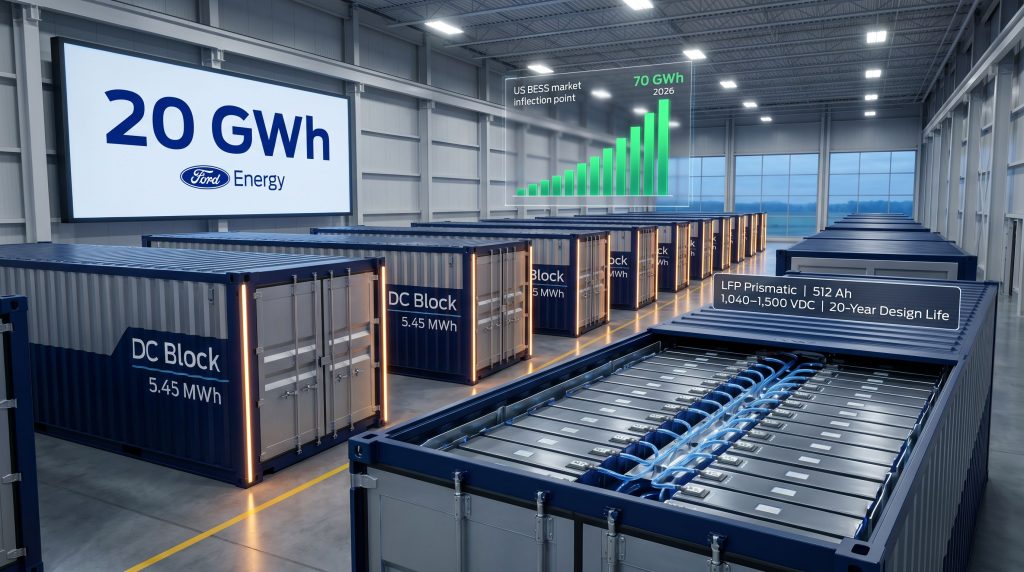
The numbers defining today's storage opportunity are striking. According to the Solar Energy Industries Association, US battery storage expansion is projected to grow by as much as 70 GWh in 2026 alone, a figure that reflects not incremental growth but a genuine market inflection point.
Three distinct demand vectors are converging simultaneously:
- AI data centre power requirements are generating concentrated, high-reliability electricity loads that grid infrastructure was never designed to serve at current scale
- Renewable energy intermittency continues to create structural imbalances between generation and consumption, making storage a technical necessity rather than an optional grid upgrade
- Grid resilience investment is accelerating across both federal and state levels, as weather-related outage events expose the fragility of transmission infrastructure built for a different era
What makes this demand picture particularly significant is its durability. Unlike consumer electronics cycles or EV adoption curves, grid infrastructure spending operates on decade-long planning horizons. Utilities and grid operators committing to storage procurement today are locking in multi-year supply relationships, creating exactly the kind of contracted revenue visibility that makes manufacturing investment defensible.
Repurposing Stranded Capital: The Strategic Logic of the Kentucky Conversion
One of the least-discussed dynamics in the Ford Energy story is the industrial economics of asset conversion versus greenfield development. When Ford announced its US$19.5 billion strategic reset in December 2025, cancelling next-generation large electric truck programmes and pure-electric commercial van development, it was left with a significant question: what to do with manufacturing infrastructure already built and partially operational.
The Glendale, Kentucky facility previously housed two of the three plants operated by BlueOval SK, the joint venture between Ford and SK On established to produce EV batteries. Following the joint venture's dissolution and the subsequent workforce reductions in February 2026, the site represented substantial sunk capital with no near-term EV production mandate.
Converting an existing battery manufacturing facility to stationary storage production eliminates the lead time and capital expenditure associated with greenfield development. In capital-constrained industrial environments, the ability to repurpose existing infrastructure toward a higher-growth adjacent market is a significant competitive advantage that pure-play BESS entrants cannot easily replicate.
The production timeline reflects this asset conversion advantage:
- 2026: Operational transition and conversion commencement at the Glendale site
- 2027: First commercial deliveries from the converted facility
- 2028: EDF Power Solutions framework agreement deliveries commence
- Ongoing: Minimum 20 GWh annual deployment capacity targeted
Ford Energy's Corporate Architecture and Market Segmentation
Ford Energy operates as a wholly owned subsidiary, structured to function with the operational independence necessary to serve energy sector customers while drawing on Ford Motor Company's manufacturing scale and engineering infrastructure.
Lisa Drake, President of Ford Energy, has articulated a manufacturing-led growth philosophy centred on maximising the value embedded in Ford's existing battery production capabilities. Furthermore, the business is deliberately segmented across distinct customer categories rather than pursuing a single-market strategy.
| Segment | Target Customer | Geographic Focus | Product |
|---|---|---|---|
| Utility-Scale BESS | Grid operators, utilities, data centres | US domestic | DC Block containerised systems |
| Residential Storage | Homeowners, small commercial | Michigan footprint | LFP battery cells |
| Industrial/Commercial | Large energy users | US domestic | Customised storage configurations |
This segmentation reflects a deliberate hedging of market exposure. By maintaining parallel product lines across utility-scale and residential applications, Ford Energy reduces its dependence on any single demand category while building breadth of market presence that strengthens long-term competitive positioning.
Inside the DC Block: Technical Architecture and Grid Service Capability
The Ford Energy DC Block is the company's flagship product for utility-scale deployment, engineered as a 20-foot containerised battery energy storage system capable of serving grid operators, industrial facilities, and data centre operators.
Core Technical Specifications
| Specification | Detail |
|---|---|
| Cell Chemistry | Lithium Iron Phosphate (LFP) Prismatic |
| Cell Capacity | 512 Ah |
| Energy Storage Capacity | 5.45 MWh per unit |
| Operating Voltage Range | 1,040 to 1,500 VDC |
| Thermal Management | Integrated liquid cooling |
| Design Service Life | 20 years |
| Discharge Configurations | 2-hour (FE-250) and 4-hour (FE-450) |
Why LFP Chemistry Is the Defining Technical Decision
The selection of lithium iron phosphate prismatic cells at 512 Ah is not merely a product specification — it is a strategic supply chain decision with implications that extend across critical minerals demand and global sourcing markets.
LFP chemistry eliminates cobalt and nickel from the cell formulation entirely. For context, cobalt production remains heavily concentrated in the Democratic Republic of Congo, and nickel supply chains carry significant geopolitical and environmental complexity. By contrast, iron and phosphate, the key mineral inputs for LFP cells, are abundant globally and not subject to the same supply concentration risks.
| Mineral | NMC Chemistry Dependency | LFP Chemistry Dependency | Risk Differential |
|---|---|---|---|
| Cobalt | High | None | Significant reduction |
| Nickel | High | None | Significant reduction |
| Lithium | High | High | Equivalent exposure |
| Iron | Low | High | Low-risk, globally abundant |
| Phosphate | Low | Moderate | Low-risk, widely available |
This chemistry choice positions Ford Energy favourably in an environment where supply chain traceability and battery raw materials sourcing are increasingly subject to scrutiny from utility customers and regulatory frameworks alike.
Liquid Cooling Architecture as a Competitive Differentiator
Integrated liquid cooling in the DC Block addresses one of the most persistent performance constraints in large-format stationary storage: thermal management at high charge and discharge rates. Unlike air-cooled systems that struggle to maintain cell temperature uniformity across large battery arrays, liquid cooling delivers consistent thermal conditions that directly support the 20-year design service life claimed for the system.
For grid operators evaluating total cost of ownership rather than upfront capital cost, a 20-year service life claim is highly significant. Consequently, it shifts the economic comparison from purchase price to lifecycle value, an arena where quality of thermal management is a primary determinant.
Grid Services the DC Block Is Engineered to Deliver
The DC Block's technical architecture supports simultaneous participation across multiple grid service markets:
- Frequency regulation for stabilising grid Hz fluctuations in real time
- Voltage support to maintain network voltage within operational tolerances
- Energy arbitrage capturing value from off-peak to peak price differentials
- Peak load shifting reducing demand charges for large industrial customers
- Demand response enabling participation in utility incentive programmes
- Backup power providing resilience against grid outage events
- Microgrid integration supporting islanded or semi-islanded energy networks
The availability of both 2-hour and 4-hour discharge configurations gives procurement teams flexibility to match system sizing to specific grid service requirements, an important commercial consideration given the diversity of utility customer needs across different US grid regions.
The Domestic Manufacturing Gap and Why It Does It Create Strategic Opportunity?
Perhaps the most underappreciated dimension of the Ford Energy story is the structural context created by US battery cell manufacturing capacity limitations.
Analysis from Wood Mackenzie indicates that US battery cell manufacturing capacity satisfied only approximately 6% of domestic demand in 2025. This gap between domestic production capability and actual consumption represents both a vulnerability for US energy infrastructure and a significant opportunity for domestic producers willing to invest in manufacturing scale.
For utilities and grid operators seeking supply chain resilience and domestic content compliance, the pool of credible US-based BESS manufacturers is extremely thin. Ford Energy's launch into this market, backed by existing manufacturing infrastructure, a credible balance sheet, and established engineering capability, addresses a genuine market need that goes beyond competitive positioning.
Battery price dynamics are also working in Ford Energy's favour. Average global BESS prices have fallen to roughly one-third of their 2020 levels, driven by LFP chemistry optimisation and Asian manufacturing scale. This price deflation accelerates adoption among utilities and data centre operators while creating margin pressure on manufacturers, making domestic content advantages and traceability credentials increasingly important differentiators for US-focused buyers. In addition, the evolving battery recycling outlook is adding further complexity to how manufacturers approach end-of-life planning for large-format stationary systems.
The next major ASX story will hit our subscribers first
The EDF Power Solutions Agreement: Decoding Ford Energy's Commercial Validation
The framework agreement signed between Ford Energy and EDF Power Solutions North America represents the first major public validation of Ford Energy's commercial strategy.
Agreement Structure
| Term | Detail |
|---|---|
| Agreement type | Five-year procurement framework |
| Annual procurement volume | Up to 4 GWh per year |
| Total contracted volume | Up to 20 GWh over full term |
| Delivery commencement | 2028 |
| Counterparty | EDF Power Solutions North America |
Tristan Grimbert, CEO of EDF Power Solutions North America, has publicly indicated that supply chain reliability, product quality, domestic manufacturing commitment, and lifecycle support rigour were the decisive factors in selecting Ford Energy as a supply partner. This framing is commercially instructive: it signals that the utility-scale BESS procurement market is increasingly evaluating suppliers on criteria beyond price per MWh, with traceability and long-term service capability commanding meaningful weight.
For Ford Energy, the EDF agreement serves multiple strategic functions simultaneously. It provides revenue visibility to underpin the Kentucky facility conversion investment, establishes a reference customer with credibility in the North American energy infrastructure market, and creates a template for structuring future offtake agreements with additional utility and data centre counterparties.
Competitive Positioning: Where Ford Energy Sits in the BESS Landscape
| Dimension | Ford Energy | Established BESS Players |
|---|---|---|
| Manufacturing origin | US domestic | Mixed, primarily Asian supply chains |
| Cell chemistry | LFP prismatic | LFP and NMC variants |
| Domestic content advantage | High | Variable |
| Traceability and lifecycle support | Stated priority | Varies by vendor |
| Annual capacity target | 20 GWh | Varies significantly |
| Market entry stage | Pre-commercial (2027 delivery) | Established |
Ford Energy enters a market where established players have significant lead time advantages in customer relationships and operational track records. However, the domestic manufacturing imperative, combined with the 6% domestic capacity satisfaction rate identified by Wood Mackenzie, means the addressable market for a credible US-based manufacturer is large and structurally underserved. The emergence of battery manufacturing alliances across global markets further underscores the competitive dynamics that US-based entrants like Ford Energy must navigate.
Five Milestones That Will Define Ford Energy's Market Trajectory
For industry observers tracking Ford Energy's progress, five critical execution markers will determine whether the company achieves its stated ambitions:
- Kentucky conversion timeline adherence as the primary determinant of whether 2027 first delivery targets hold
- Additional offtake agreement announcements beyond EDF, particularly with data centre operators and independent power producers
- LFP cell sourcing strategy clarity given the structural gap between US domestic manufacturing capacity and consumption
- Michigan residential storage line progress testing whether Ford Energy can successfully serve both utility-scale and consumer segments simultaneously
- Competitive response dynamics from established BESS manufacturers who will face pricing and supply chain pressure as a credible domestic alternative scales
What Ford Energy Signals About Industrial Capital Reallocation
The broader significance of Ford Energy battery energy storage systems extends beyond a single product launch. It represents a template for how large industrial manufacturers with stranded or underutilised battery manufacturing assets might redirect capital toward the fastest-growing segment of the energy transition.
The arithmetic is straightforward: EV demand growth has proven more cyclical and price-sensitive than projected, while grid-scale storage demand is being driven by structural forces — AI infrastructure, renewable integration, and grid resilience — that are far less discretionary. Ford's energy storage strategy is not a retreat from the energy transition for manufacturers already invested in battery production infrastructure. It is, however, a more precise alignment of manufacturing capability with where durable demand growth actually resides.
Disclaimer: This article contains forward-looking statements, market projections, and analytical commentary based on publicly available information. Figures cited from the Solar Energy Industries Association, Wood Mackenzie, and other third parties reflect estimates and forecasts subject to revision. Nothing in this article constitutes financial or investment advice. Readers should conduct independent research and consult qualified advisers before making investment or procurement decisions.
Want To Capitalise on the Critical Minerals Driving the Energy Storage Revolution?
Discovery Alert's proprietary Discovery IQ model delivers real-time alerts on significant ASX mineral discoveries — including the lithium, iron, and phosphate underpinning the explosive growth in battery energy storage systems — instantly empowering subscribers to identify actionable opportunities ahead of the broader market. Explore historic examples of transformative mineral discoveries and their market returns, then begin your 14-day free trial to position yourself at the forefront of the energy transition.