May 21, 2026
The Economics of Extraction: Why Africa's Mineral Wealth Rarely Stays in Africa
For decades, a structural imbalance has defined the relationship between African mineral producers and global commodity markets. Nations sitting atop world-class deposits have consistently exported raw or lightly processed materials, only to watch foreign refiners and manufacturers capture the majority of the economic value embedded in those resources. The pattern is not accidental. It reflects deliberate supply chain architectures built by consuming nations to keep processing capacity offshore and input costs low.
Lithium is the latest mineral to test whether that pattern can be broken. And Zimbabwe, as Africa's largest lithium producer, has positioned itself as the continent's most aggressive challenger to the status quo.
When big ASX news breaks, our subscribers know first
Understanding the Beneficiation Gap: Spodumene Concentrate vs. Lithium Sulfate
To understand why the Zimbabwe lithium export ban matters, it helps to understand what the ban actually targets and why the distinction between product types carries such significant financial weight.
Spodumene extraction produces a mined intermediate product, typically grading between 5% and 6% lithium oxide (Li₂O), produced by crushing and flotation processing of hard rock lithium ore. It is a commodity traded in bulk, subject to the pricing pressures of any undifferentiated raw material.
Lithium sulfate, by contrast, is a refined battery-grade intermediate material produced by converting spodumene through high-temperature acid roasting and chemical processing. It sits one step closer to the cathode materials used in lithium-ion battery cells and commands a substantially higher market price.
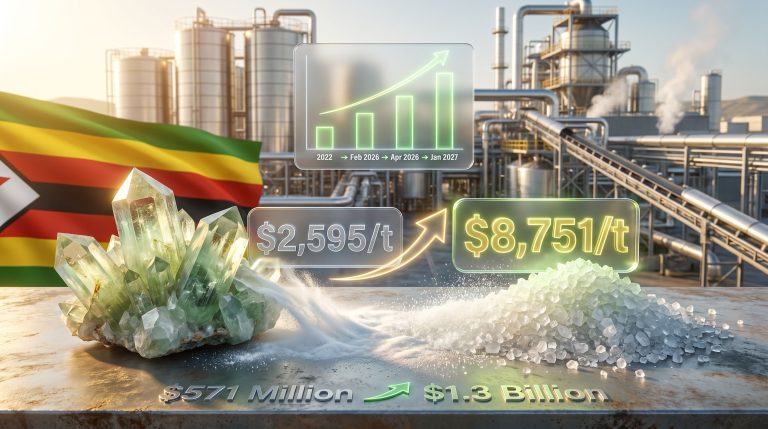
The price differential as of late May 2026 illustrates the stakes clearly:
| Product | Price per Tonne (May 2026, SMM) | Value Premium vs. Spodumene |
|---|---|---|
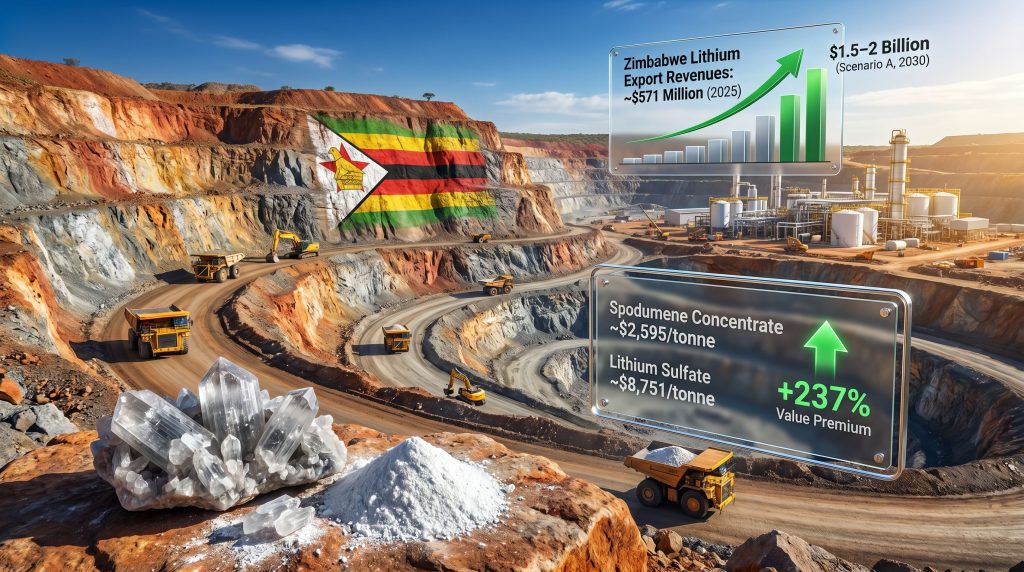
| Spodumene Concentrate | ~$2,595 | Baseline |
| Lithium Sulfate (delivered China) | ~$8,751 | +237% |
At that differential, every tonne of spodumene concentrate Zimbabwe ships instead of lithium sulfate represents approximately $6,156 in foregone export revenue. Multiplied across millions of tonnes annually, the compounding revenue loss at the national level becomes a compelling policy argument in its own right.
What is less commonly understood is that the transport cost structure also favours processed output. Spodumene concentrate is a bulk material shipped in large volumes with relatively low lithium content per tonne of weight. Lithium sulfate contains a higher concentration of extractable lithium value per unit of shipping weight, which directly reduces the logistics cost per unit of lithium delivered. This dynamic was cited by Sinomine Resource as part of the commercial rationale for investing in local Zimbabwean refining capacity rather than continuing to export concentrate to overseas processing facilities.
Three Phases of Escalating Restriction: How the Zimbabwe Lithium Export Ban Evolved
Zimbabwe's current policy position did not emerge overnight. It represents the culmination of a deliberate, multi-stage escalation spanning several years.
Phase One: The 2022 Ore Ban
Zimbabwe's initial legislative move in 2022 prohibited the export of unprocessed lithium ore. This was a meaningful first step, but it left a significant commercial gap. The ban covered raw ore, not spodumene concentrate. Since the majority of Zimbabwe's lithium exports were already in concentrate form rather than raw ore, the practical impact on export volumes was limited. The policy signalled intent without yet forcing a fundamental change in the country's export product mix.
Phase Two: The February 2026 Emergency Halt
The pace of change accelerated sharply on 25 February 2026, when the Zimbabwean government announced an immediate, open-ended prohibition on all raw mineral and lithium concentrate exports. The stated justifications included combating smuggling, preventing under-invoicing of export values, and halting capital leakage from the sector.
The abruptness of the decision drew immediate attention because it bypassed the previously announced transition timeline, which had set a January 2027 deadline for a full concentrate export ban. Jumping that deadline by nearly a year created short-term operational disruption for mining companies with existing shipment commitments, and raised questions about whether transit cargo already en route would be subject to the restriction.
Phase Three: The April 2026 Quota Transition
Recognising that the immediate blanket ban created operational difficulties for companies that had not yet completed refinery construction, the government replaced the February prohibition with a structured quota system in April 2026. This mechanism functions as a compliance bridge: mining companies are permitted to continue exporting a limited volume of concentrate under allocated quotas, with the explicit endpoint being the full export ban confirmed for January 2027.
The quota system is not a reversal of policy direction. It is a managed transition designed to give miners a defined window to commission domestic processing infrastructure before the final restriction takes effect.
Furthermore, as Fast Markets has noted, the three-phase structure mirrors the industrial policy sequence Indonesia used to develop its domestic nickel processing sector, where a progressive tightening of export restrictions ultimately forced billions of dollars in smelter investment while simultaneously triggering World Trade Organization disputes. Zimbabwe appears to be executing a comparable arc, but from a lower existing infrastructure base.
The Refinery Investment Pipeline: Chinese Capital as the Execution Engine
The commercial viability of Zimbabwe's beneficiation strategy rests almost entirely on whether planned refinery projects are completed on schedule. Three major investments are currently at various stages of development:
| Company | Mine | Target Product | Annual Capacity | Estimated Investment | Status (2026) |
|---|---|---|---|---|---|
| Zhejiang Huayou Cobalt | Arcadia | Lithium Sulfate | 50,000 tonnes | Undisclosed | Operational; first exports completed April 2026 |
| Sinomine Resource | Bikita | Lithium Sulfate | 100,000 tonnes | ~$400 million (Bloomberg) | Under development; funded via 5.2B yuan (~$764M) raise |
| Sichuan Yahua | Kamativi | Lithium Sulfate | TBC | Undisclosed | Construction commenced 2026 |
The milestone achieved by Zhejiang Huayou Cobalt at the Arcadia mine carries symbolic significance beyond its production scale. The completion of Africa's first lithium sulfate exports from Zimbabwe in April 2026 demonstrated that the processing pathway is technically viable within the country's existing infrastructure environment. It converts what was previously a government aspiration into a proven operational model.
Sinomine Resource's capital raise deserves particular attention from a market structure perspective. The 5.2 billion yuan (~$764 million) fundraising, announced on May 19, 2026, is a multi-project raise of which the Bikita lithium sulfate refinery is one component. At an estimated project cost of approximately $400 million for a 100,000 tonne per year facility, the Bikita refinery would represent one of the largest single processing investments in Zimbabwe's mining history.
The scale of the commitment reflects a strategic calculation that securing long-term feedstock access through ownership of domestic refining capacity is worth a substantial upfront capital outlay. Sichuan Yahua's construction commencement at the Kamativi mine adds a third processing node to the emerging sector landscape, though capacity and investment figures for that project remain less publicly defined at this stage.
The Processing Capacity Paradox: Zimbabwe's Central Vulnerability
The most underappreciated risk in Zimbabwe's beneficiation strategy is the sequencing problem embedded in the policy design. Zimbabwe has committed to banning concentrate exports before its domestic refining infrastructure has been fully commissioned. This creates a structural window of vulnerability that has no straightforward resolution.
The timeline to build, commission, and certify a lithium sulfate refinery to battery-grade specification is not trivial. From groundbreaking to first commercial export, a facility of this scale and complexity typically requires two to four years under favourable conditions. Environmental permitting, civil construction, equipment procurement, reagent supply chain establishment, and product quality certification each represent potential schedule extension points.
If the Bikita and Kamativi refineries face construction delays that push their commissioning dates beyond January 2027, Zimbabwe risks a scenario where concentrate exports are banned before replacement processing revenue is available. The fiscal consequences of that gap are material, given that lithium export revenues reached approximately $571 million in 2025 and represent a meaningful component of the country's foreign exchange earnings.
Understanding how lithium mining works helps contextualise why this sequencing challenge is so significant — processing infrastructure must be purpose-built and cannot simply be improvised when export deadlines arrive.
Risk Framework: The January 2027 deadline functions as a forcing mechanism designed to accelerate refinery construction by removing the fallback option of continuing concentrate exports. Whether that pressure accelerates completion or simply creates a revenue vacuum depends entirely on whether Chinese capital can be deployed at the pace required.
Revenue Scenarios: What Zimbabwe's Lithium Sector Could Be Worth
The range of plausible outcomes for Zimbabwe's lithium export revenues by 2028 to 2030 spans a wide band, depending on refinery execution speed and lithium price trajectories.
Scenario A: Full Execution (Optimistic Base Case)
- All three major refineries reach nameplate capacity by 2028
- Combined lithium sulfate output exceeds 200,000 tonnes annually
- Annual lithium export revenues potentially reach $1.5 to $2 billion at current price differentials
- Zimbabwe establishes itself as Africa's first meaningful battery materials processing hub
Scenario B: Partial Build-Out (Realistic Base Case)
- One or two refineries reach capacity on schedule; one faces delays
- Zimbabwe captures partial value uplift while retaining some concentrate exports under quota
- Annual revenues grow to $800 million to $1.1 billion, a meaningful improvement below full potential
- The January 2027 deadline is extended or softened to accommodate incomplete infrastructure
Scenario C: Policy Reversal Under Fiscal Pressure (Downside Risk)
- Refinery construction delays create a prolonged revenue shortfall
- Government fiscal pressures force a partial rollback of export restrictions
- Investor confidence in Zimbabwe's policy consistency is damaged
- The country remains partially trapped in the raw materials export model it sought to escape
The difference between the optimistic and downside scenarios is not the policy framework itself. It is the construction execution speed and the government's tolerance for absorbing near-term revenue pain in exchange for longer-term industrial positioning.
The next major ASX story will hit our subscribers first
Global Precedents: How Zimbabwe's Strategy Compares
| Country | Mineral | Restriction Type | Outcome |
|---|---|---|---|
| Indonesia | Nickel | Progressive ore export ban | Triggered $30B+ in domestic smelter investment; WTO dispute with EU |
| Democratic Republic of Congo | Cobalt | Processing requirements | Mixed results; artisanal sector compliance challenges |
| Chile | Lithium | State ownership expansion | Increased government revenue share; slowed some private investment |
| Zimbabwe | Lithium | Phased concentrate export ban | Refinery investment accelerating; short-term supply disruption |
Indonesia's nickel model is the most frequently cited reference point, and for good reason. The progressive tightening of ore export restrictions successfully catalysed tens of billions of dollars in domestic smelter investment and transformed the country from a raw ore exporter into a global nickel processing hub. However, there is a critical structural difference: Indonesia already possessed a meaningful industrial base, established port infrastructure, and a domestic skilled workforce when it implemented its export restrictions. Zimbabwe is constructing its processing sector from a considerably lower starting point, which amplifies both the potential reward and the execution risk.
Stakeholder Impact: Who Wins, Who Absorbs Risk, and Who Watches Closely
Chinese Mining and Processing Companies
Chinese firms occupy a uniquely paradoxical position in this story. They are simultaneously the entities most disrupted by the Zimbabwe lithium export ban in the short term and the most strategically positioned to benefit from it over the medium term. By investing in domestic Zimbabwean refining capacity, companies like Sinomine, Huayou Cobalt, and Sichuan Yahua convert a regulatory constraint into a competitive moat. Owning the processing infrastructure within Zimbabwe provides long-term feedstock security that pure trading relationships cannot replicate.
Global Battery Manufacturers and EV Producers
For battery manufacturers dependent on diversified lithium feedstock sourcing, the near-term impact of tighter Zimbabwean concentrate availability will likely manifest as upward spot price pressure and accelerated procurement from alternative sources in Australia, Chile, and Argentina. The longer-term calculus is more nuanced. A successfully built-out Zimbabwean processing sector could eventually provide a more reliable, processed lithium supply stream for the global lithium market. Whether that scenario materialises depends on refinery commissioning timelines.
Western Governments and Critical Mineral Policy
Zimbabwe's policy trajectory presents a strategic challenge for Western critical mineral diversification programmes. The refinery investment pipeline is almost entirely funded by Chinese capital, meaning that even if Zimbabwe successfully transitions to a processing economy, the value capture will predominantly flow to Chinese corporate interests rather than to a diversified global supply chain.
In addition, given rising critical minerals demand driven by the global energy transition, Western governments seeking genuine supply chain resilience will need to engage Zimbabwe through offtake frameworks, concessional financing mechanisms, and processing partnerships if they wish to maintain any meaningful presence in the country's emerging battery materials sector.
Other African Resource Producers
Perhaps the most consequential long-term implication of Zimbabwe's beneficiation strategy extends beyond the country's own lithium sector. Zimbabwe is functioning as a policy laboratory, and other African lithium, cobalt, and graphite producers are observing the experiment carefully. If the strategy produces the revenue uplift and industrial development that the government projects, expect similar export restriction frameworks to proliferate across the continent.
The collective impact of simultaneous African mineral processing requirements across multiple strategic minerals could fundamentally reshape the economics of global battery supply chains throughout the latter half of this decade. Consequently, direct lithium extraction technologies may also play an increasingly important role in enabling African nations to process lithium domestically at scale.
Frequently Asked Questions: Zimbabwe Lithium Export Ban
What did Zimbabwe ban in February 2026?
The February 25, 2026 announcement prohibited the immediate export of raw minerals and lithium concentrate from Zimbabwe. The ban was broader in scope than the 2022 restriction, which had only covered unprocessed ore rather than spodumene concentrate.
Why did the ban happen before the announced 2027 deadline?
The government accelerated the timeline citing concerns about smuggling, under-invoicing of export values, and the pace of capital leakage from the sector. The abrupt implementation was also a deliberate pressure tactic to force mining companies to accelerate refinery construction rather than relying on the 2027 deadline as a comfortable backstop.
How does the April 2026 quota system work?
The quota system replaced the blanket February ban with a structured transitional mechanism. Mining companies are allocated defined export volumes of concentrate, creating a managed wind-down period before the full export prohibition takes effect in January 2027. Quota allocation is conditioned on compliance with beneficiation investment commitments.
How does lithium sulfate differ from spodumene concentrate?
Spodumene concentrate is an intermediate mining product produced by physical separation of lithium-bearing minerals from host rock. Lithium sulfate is a chemically processed material requiring acid roasting, leaching, and purification steps that convert spodumene into a water-soluble compound suitable for further battery material manufacturing. The processing step is capital intensive and technically demanding, which is precisely why it generates a substantially higher market price and why battery supply chains have historically preferred to locate this conversion capacity in industrially developed economies.
Disclaimer: This article contains forward-looking scenarios and financial projections based on publicly available data as of May 2026. Price figures referenced are sourced from Shanghai Metals Market data. Scenario projections are analytical in nature and do not constitute investment advice. Actual outcomes will depend on lithium market conditions, refinery construction timelines, policy implementation, and macroeconomic factors that may differ materially from assumptions used.
Want To Be First When The Next Major Mineral Discovery Hits The ASX?
Discovery Alert's proprietary Discovery IQ model delivers real-time alerts on significant ASX mineral discoveries — instantly turning complex mineral data into actionable opportunities for both short-term traders and long-term investors. Explore historic discoveries and the substantial returns they generated, then start your 14-day free trial at Discovery Alert to position yourself ahead of the broader market.