August 8, 2026
The Beneficiation Imperative: Why Resource-Rich Nations Are Refusing to Sell Cheap
For decades, a familiar pattern defined the relationship between mineral-rich developing nations and global commodity markets: extract, ship, and receive a fraction of the final product's value. That model is now under sustained pressure. Across sub-Saharan Africa, Southeast Asia, and Latin America, governments are rewriting the rules of mineral trade, insisting that raw material wealth must translate into domestic industrial capacity rather than simply filling foreign processing facilities.
Zimbabwe's evolving stance on lithium exports represents one of the most structurally significant iterations of this shift. As Africa's largest lithium producer, the country sits at the centre of a global battery supply chain debate. The Zimbabwe lithium export ban, and its decision to progressively restrict concentrate exports in favour of compelling domestic refinery construction, offers a detailed case study in how beneficiation policy actually works, where it succeeds, and where it carries substantial execution risk.
When big ASX news breaks, our subscribers know first
Understanding the Regulatory Architecture Behind Zimbabwe's Lithium Export Ban
The Zimbabwe lithium export ban did not arrive fully formed. It evolved through a sequence of policy interventions, each tightening the regulatory perimeter around raw and semi-processed lithium exports. Understanding this sequence is essential for assessing both the government's strategic intent and the practical challenges mining operators now face.
Phase One: The 2022 Ore Export Prohibition
Zimbabwe's initial regulatory action in 2022 targeted the most unprocessed end of the lithium supply chain: raw lithium ore. While symbolically significant as a statement of intent, this first measure left a substantial policy gap intact. Understanding spodumene concentrate basics helps clarify why the intermediate product produced from crushing and processing hard-rock lithium ore continued to flow through export channels without restriction. Operators adapted quickly, ensuring that ore reached a basic concentration threshold before shipment, effectively sidestepping the spirit of the policy while remaining technically compliant.
Phase Two: The February 2026 Immediate Concentrate Ban
The regulatory acceleration came in February 2026, when Zimbabwean authorities issued a directive imposing an immediate prohibition on all raw mineral and lithium concentrate exports. According to reporting by Al Jazeera, the decision was framed around concerns about mineral leakage, malpractice within the export chain, and the structural failure of the existing framework to retain economic value within the country. Critically, the ban extended to minerals already loaded for transit, a detail that signalled genuine enforcement intent rather than a performative policy gesture.
This phase was significant not only for its content but for its timing. Large-scale domestic lithium refinery infrastructure was not yet operational at the moment the ban was imposed, creating a structural mismatch between regulatory ambition and physical processing capacity that continues to define the implementation challenge.
Phase Three: The April 2026 Quota System
Recognising the disruption caused by an abrupt full prohibition, the government introduced a structured quota regime in April 2026. This mechanism functions as a compliance bridge, allowing mining operators to continue limited concentrate exports while they construct or commission domestic processing facilities. The quota system effectively preserves a degree of revenue continuity for operators while maintaining the credible threat of the January 2027 terminal deadline.
| Policy Phase | Date | Mechanism | Target Outcome |
|---|---|---|---|
| Phase 1 | 2022 | Lithium ore export ban | Stop unprocessed ore exports |
| Phase 2 | February 2026 | Immediate concentrate ban | Halt value leakage |
| Phase 3 | April 2026 | Quota transition system | Prepare industry for full ban |
| Phase 4 | January 2027 | Full concentrate export ban | Force domestic processing at scale |
The Price Gap That Makes Beneficiation Economically Rational
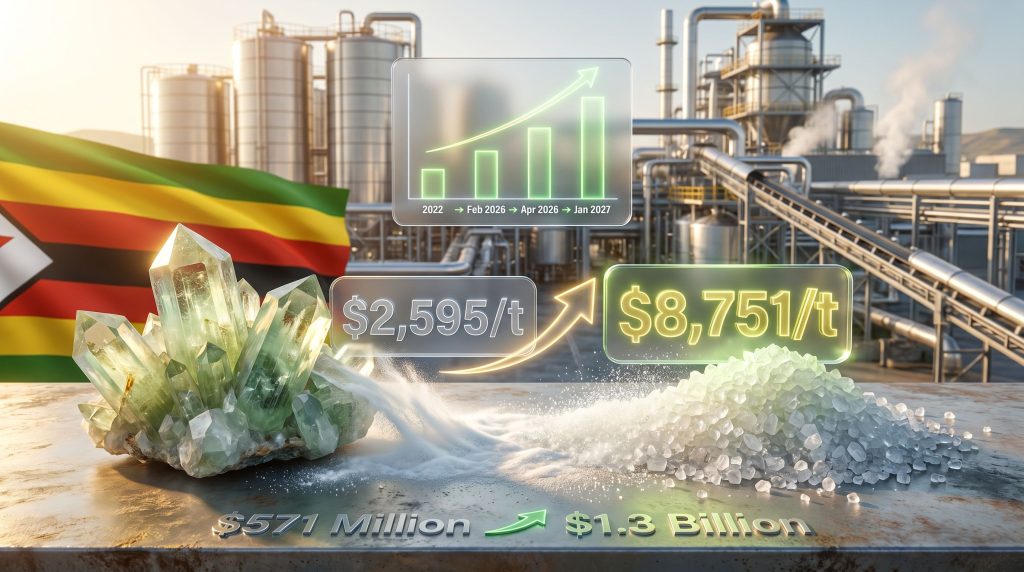
The central economic logic of Zimbabwe's export restriction framework rests on a price differential that is both large and relatively stable across market cycles. As of May 20, 2026, lithium sulfate delivered to China traded at $8,751 per tonne on the Shanghai Metals Market. Spodumene concentrate, the product Zimbabwe's mining sector has historically exported, traded at $2,595 per tonne on the same date, according to Ecofin Agency reporting sourced from Shanghai Metals Market data.
The arithmetic is direct: processing lithium concentrate into lithium sulfate generates approximately 237% more revenue per tonne of lithium exported. For a country that recorded approximately $571 million in lithium export revenues in 2025, the theoretical revenue uplift from shifting even a significant portion of exports to processed product is substantial. Furthermore, the lithium carbonate market continues to demonstrate why downstream processing commands such a significant premium over raw material exports.
"The per-tonne price gap between spodumene concentrate and lithium sulfate is not simply a pricing anomaly. It reflects the entire value chain of battery-grade lithium production. The country that captures the processing margin captures the industrial dividend, not just the resource rent."
What Is Spodumene Concentrate, and Why Does the Form of Lithium Matter?
For readers unfamiliar with the technical structure of lithium supply chains, the distinction between these two product forms carries significant commercial weight:
-
Spodumene concentrate is produced from hard-rock pegmatite ore through a combination of crushing, flotation, and density separation processes. It typically contains between 5% and 6% lithium oxide (Li2O) and is classified as an intermediate feedstock rather than a battery-ready material.
-
Lithium sulfate is a refined chemical intermediate produced by roasting spodumene concentrate in a kiln and leaching the resulting calcine material with sulfuric acid. The output is far closer to the battery-grade lithium carbonate or lithium hydroxide ultimately used in cathode manufacturing.
-
The refinery infrastructure required to convert concentrate into sulfate is capital-intensive, energy-demanding, and technically complex, which is precisely why developing nations have historically lacked this capacity and why Chinese processing companies built a dominant global position in this part of the value chain.
Understanding this technical distinction helps explain why Zimbabwe's export ban focuses specifically on concentrate. Banning ore alone, as the 2022 policy attempted, simply pushed operators to the next processing step while retaining the bulk of value-added refining offshore.
The Three Refineries Reshaping Zimbabwe's Lithium Sector
The practical success of Zimbabwe's beneficiation mandate depends almost entirely on whether three major Chinese-led refinery projects are completed on schedule. Each represents a distinct stage in the country's ambition to become a processed lithium exporter.
Zhejiang Huayou Cobalt: Africa's First Lithium Sulfate Export
Huayou Cobalt's Arcadia mine refinery reached a milestone in April 2026 that Zimbabwe's authorities described as the first lithium sulfate export shipment from any African country. The facility carries an annual production capacity of 50,000 tonnes and serves as the operational proof-of-concept for the broader beneficiation strategy. Its completion ahead of the quota system's introduction gave the Zimbabwean government a credible example to point to when defending the policy to other operators.
Sinomine Resource: The $764 Million Capital Commitment
On May 19, 2026, Sinomine Resource announced plans to raise up to 5.2 billion yuan, equivalent to approximately $764 million, across several projects, with a portion of that capital earmarked for a lithium sulfate processing plant linked to its Bikita mine operations. The planned facility targets an annual output of 100,000 tonnes, double the capacity of Huayou's Arcadia refinery. Bloomberg has reported that the Bikita plant alone could require approximately $400 million in construction expenditure, making it one of the largest single mining infrastructure investments currently planned in Zimbabwe.
Sichuan Yahua: Diversifying the Refinery Pipeline
A third Chinese mining group, Sichuan Yahua, has commenced construction of a lithium sulfate processing facility at the Kamativi mine. While detailed capacity figures for the Kamativi plant have not been publicly confirmed at the level of the other two projects, the entry of a third major operator into Zimbabwe's refinery pipeline signals a broader validation of the country's processing environment among Chinese investors, even amid current lithium price weakness.
| Company | Mine | Refinery Capacity | Status (as of May 2026) |
|---|---|---|---|
| Zhejiang Huayou Cobalt | Arcadia | 50,000 t/year | Operational, first exports completed |
| Sinomine Resource | Bikita | 100,000 t/year (planned) | Funding announced, construction planned |
| Sichuan Yahua | Kamativi | Not publicly confirmed | Under construction |
The Chinese Investment Paradox in Zimbabwe's Lithium Sector
A dynamic that deserves specific analytical attention is the structural paradox embedded in Zimbabwe's export restriction framework. The mining companies most directly affected by the concentrate export ban are Chinese. The companies building the refineries that the ban is designed to incentivise are also Chinese. This is not a coincidence; it reflects a deliberate alignment between Zimbabwe's beneficiation policy and the strategic preferences of Chinese resource companies operating in a tightening global regulatory environment.
Chinese battery supply chain strategy has increasingly shifted away from securing raw material volumes toward controlling mid-stream processing capacity, including the conversion of spodumene into battery-grade chemicals. For companies like Huayou Cobalt, Sinomine, and Yahua, building refineries in Zimbabwe serves a dual purpose: it satisfies host government requirements while simultaneously anchoring processed lithium supply flows back toward Chinese downstream manufacturers. In addition, understanding how lithium mining works at the operational level reveals why Chinese firms are well positioned to deploy refinery expertise in new jurisdictions.
"What appears on the surface as a constraint imposed on Chinese operators is, in several respects, structurally aligned with where Chinese capital in the mining sector was already moving. The export ban accelerated a transition that Zimbabwean and Chinese commercial interests both had reason to support."
This dynamic also raises questions of relevance to Western policymakers and battery supply chain strategists. Zimbabwe's refinery buildout is being funded and constructed by Chinese companies, meaning that even when Zimbabwe successfully shifts to processed lithium exports, the downstream destination for that product is likely to remain within Chinese battery manufacturing ecosystems rather than feeding diversified Western supply chains.
Resource Nationalism Compared: Where Zimbabwe Fits Globally
Zimbabwe's approach to lithium export restrictions does not exist in isolation. It belongs to a growing family of mineral governance interventions by resource-rich developing nations seeking downstream industrial participation.
The most cited precedent is Indonesia's nickel ore export ban, first implemented in 2020. Indonesia successfully leveraged its dominant position in global nickel supply to attract billions of dollars in downstream smelter and battery precursor investment, primarily from Chinese and South Korean companies. The strategy achieved its primary objective of onshoring processing capacity, though it also generated World Trade Organization disputes and produced short-term export revenue losses during the transition period.
Other relevant frameworks include:
-
The Democratic Republic of Congo's evolving processing requirements for cobalt and copper exports, designed to retain more value from its position as the world's dominant cobalt supplier.
-
Chile and the Argentina lithium market ongoing debates about lithium governance within the broader Lithium Triangle policy environment, where both countries are exploring how to structure state participation in lithium processing without deterring private investment.
-
Namibia's proposed restrictions on unprocessed critical mineral exports, signalling that Zimbabwe's approach is part of a continent-wide policy trend rather than an isolated national experiment.
The common thread across these cases is a rejection of the pure commodity export model in favour of what economists term upstream industrial linkages — the construction of processing, refining, and manufacturing capacity that transforms raw material endowments into more complex economic outputs.
The next major ASX story will hit our subscribers first
Key Risks That Could Undermine Zimbabwe's Beneficiation Strategy
The strategic logic of the Zimbabwe lithium export ban is coherent. However, the execution risks are significant and deserve direct examination.
The Timing Gap Between Regulation and Capacity
"The most structurally dangerous vulnerability in any beneficiation mandate is imposing export restrictions before the domestic processing infrastructure required to replace those export flows is actually operational. Zimbabwe entered this zone in February 2026."
With only Huayou's Arcadia facility confirmed as operational at the time of the immediate ban, and Sinomine's Bikita plant and Yahua's Kamativi facility still under development, the February 2026 measure created a period during which export revenues could fall without a compensating increase in processed product income. The quota system introduced in April 2026 partially addresses this gap, but the credibility of the full January 2027 ban depends on whether construction timelines are met.
Capital Execution and Lithium Price Sensitivity
Sinomine's $764 million fundraising has been announced but is not yet fully deployed. Large capital raises in the mining sector carry execution risk, particularly in an environment where lithium prices remain well below their 2022 to 2023 peak levels. The $8,751 per tonne lithium sulfate price, while representing a meaningful premium over concentrate, is substantially lower than the elevated pricing that characterised the lithium market during the electric vehicle investment surge of the prior cycle. Lower prices reduce project internal rates of return and can delay or reduce final investment decisions.
Regulatory Credibility and Investor Confidence
The abrupt shift from a 2027 planned deadline to an immediate February 2026 ban raised questions among some operators about the predictability of Zimbabwe's regulatory environment. For foreign investors evaluating long-horizon mining and processing commitments, policy consistency is a foundational requirement. The quota system introduced in April 2026 partially restores a sense of structured transition. However, the precedent of extending a ban to minerals already in transit introduced a degree of regulatory unpredictability that the government will need to manage carefully in future policy communications.
Furthermore, technologies such as direct lithium extraction may also influence how quickly competing jurisdictions can bring processed lithium to market, adding further urgency to Zimbabwe's timeline for completing its refinery buildout.
Revenue Scenarios: What Zimbabwe's Lithium Sector Could Become
If the three planned refinery projects reach their stated production capacities, Zimbabwe's combined domestic lithium sulfate output could approach 150,000 tonnes annually from the Huayou and Sinomine facilities alone. At the current lithium sulfate price of $8,751 per tonne, that output level implies potential gross revenues exceeding $1.3 billion per year, more than double the $571 million in lithium export revenues recorded in 2025.
This scenario requires several conditions to be met simultaneously:
-
Full and on-schedule completion of refinery construction at Bikita and Kamativi.
-
Sustained investor appetite for Zimbabwean processing assets despite lithium price volatility.
-
Reliable access to power, water, and logistics infrastructure at the required operational scale.
-
Maintenance of regulatory consistency through the January 2027 ban deadline and beyond.
-
Retention of Chinese offtake relationships that provide stable demand for Zimbabwean lithium sulfate production.
The downside scenario, in which refinery delays, price weakness, or capital execution failures converge, risks leaving Zimbabwe with suppressed concentrate export revenues and incomplete processing capacity — precisely the outcome the quota system was designed to prevent.
FAQ: Zimbabwe Lithium Export Ban Explained
What is the Zimbabwe lithium export ban?
Zimbabwe has implemented a phased restriction on lithium exports, beginning with a 2022 ban on raw ore, followed by an immediate ban on lithium concentrates in February 2026, and progressing toward a full export prohibition scheduled for January 2027. The objective is to shift the country's lithium export profile from low-value concentrate to higher-value processed products such as lithium sulfate.
When does the full ban take effect?
January 2027 is the confirmed terminal deadline for concentrate exports. A quota-based transition system introduced in April 2026 is currently managing the interim period.
How much more valuable is lithium sulfate than spodumene concentrate?
As of May 20, 2026, lithium sulfate traded at approximately $8,751 per tonne compared to $2,595 per tonne for spodumene concentrate, a premium of more than 237%.
Which companies are building lithium refineries in Zimbabwe?
Three Chinese mining groups are the primary investors: Zhejiang Huayou Cobalt at the Arcadia mine (50,000 tonnes per year, operational), Sinomine Resource at the Bikita mine (100,000 tonnes per year, planned), and Sichuan Yahua at the Kamativi mine (capacity not yet confirmed, under construction).
What are the main risks to Zimbabwe's strategy?
The primary risks are a structural mismatch between regulatory timelines and processing capacity readiness, capital execution risk for large refinery projects in a low-lithium-price environment, and questions about regulatory predictability following the abrupt February 2026 concentrate ban.
Disclaimer: This article contains forward-looking analysis, scenario projections, and policy assessments based on publicly available information as of May 2026. Commodity prices, investment timelines, and regulatory frameworks are subject to change. Nothing in this article constitutes investment advice. Readers should conduct independent research and consult qualified advisers before making investment decisions.
Want to Track the Next Major Mineral Discovery Before the Market Does?
Discovery Alert's proprietary Discovery IQ model delivers real-time alerts on significant ASX mineral discoveries, transforming complex commodity data across more than 30 resources into a single, actionable gold-equivalent metric — giving both traders and long-term investors an immediate edge. Explore how historic discoveries have generated substantial returns and begin your 14-day free trial today to position yourself ahead of the broader market.