August 3, 2026
The Geology of Confidence: Why Grade, Scale, and Brownfield Infrastructure Are Rarely Found Together
In underground platinum mining, the most durable competitive advantage is not the commodity price cycle, nor the balance sheet strength of the operator. It is geology. Specifically, it is the convergence of high orebody grade, meaningful resource scale, and accessible existing infrastructure. These three variables rarely appear in the same project simultaneously. When they do, the investment logic becomes considerably more compelling than any single metric can convey.
This is the foundational context for understanding why African Rainbow Minerals (ARM) has chosen this moment to commit approximately R15.95 billion across two 100%-owned flagship assets: the ARM Bokoni platinum project and the Nkomati nickel mine restart. The decision is not simply a capital expenditure cycle. It represents a deliberate portfolio rebalancing away from joint-venture-diluted positions toward directly controlled, high-grade operations where ARM manages execution risk, cost discipline, and timeline delivery without a partner layer complicating governance.
The dual-commodity architecture of this capital allocation is itself a risk management strategy. Platinum group metals (PGMs) and nickel do not move in lockstep across commodity cycles, meaning ARM is simultaneously building production capacity in two metals that provide natural revenue diversification at the portfolio level. African Rainbow Minerals' platinum strategy reflects a broader industry shift toward assets where the operator controls the full value chain from extraction to processing.
When big ASX news breaks, our subscribers know first
Bokoni: When Grade Does the Heavy Lifting
Understanding the UG2 Orebody Advantage
The Upper Group 2 (UG2) reef is one of South Africa's most well-understood PGM-bearing geological formations, sitting within the Bushveld Igneous Complex, the world's largest known PGM resource. What distinguishes Bokoni's UG2 position is not simply its presence within this formation, but the specific grade characteristics of the orebody.
Bokoni carries a long-term milled grade of 6.1 grams per tonne (g/t), which compares favourably against many of ARM's existing platinum operations. In underground PGM mining, grade is not merely a quality indicator. It is a direct lever on capital efficiency per recoverable ounce and on margin resilience across price cycles.
Here is why this matters in practical terms:
- Higher grade means more metal extracted per tonne of rock processed, reducing unit cost burden on fixed infrastructure
- Lower-grade operations are typically the first to become uneconomic during commodity price downturns, making grade a structural protection mechanism
- Capital intensity per ounce, one of the most important metrics for long-duration mining projects, compresses as grade rises
- Grade advantage amplifies during periods of input cost inflation, as the higher metal yield per tonne processed offsets rising operational expenditure more effectively
Furthermore, the cut-off grade economics at Bokoni reinforce why this orebody commands attention. ARM's COO Jacques van der Bijl has noted that grade, scale, and existing infrastructure are rarely available together in a single asset. Bokoni's strategic appeal rests precisely on this uncommon combination.
Project Metrics: The Investment Case at a Glance
| Financial Metric | Bokoni Platinum Project |
|---|---|
| Total Project Value (incl. 15% contingency) | R15.2 billion |
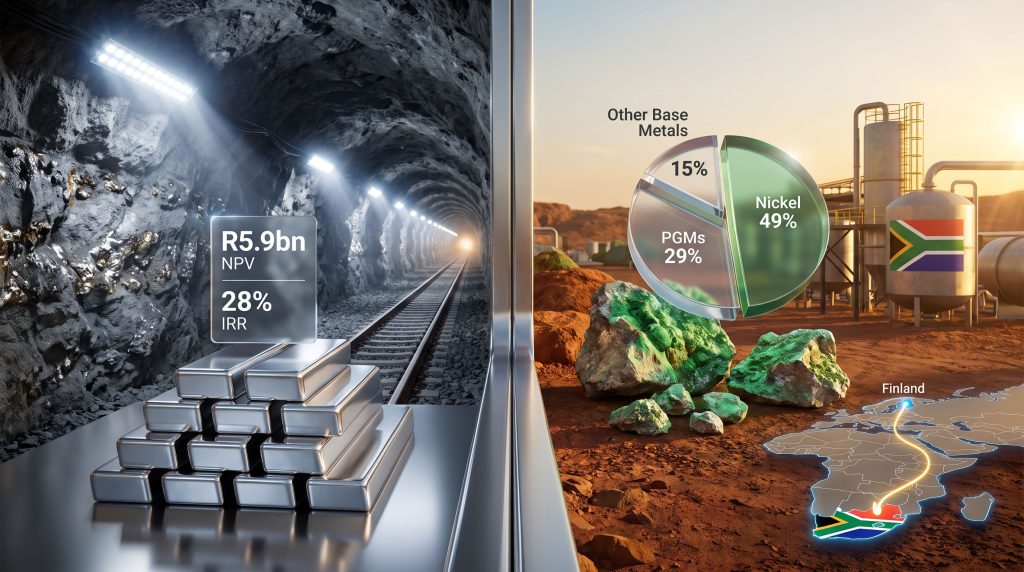
| Post-Tax Net Present Value (NPV) | R5.9 billion |
| Internal Rate of Return (IRR) | 28% |
| Steady-State Annual PGM Output | 350,000 to 400,000 6E ounces |
| Measured Resource (6E) | 31 million ounces |
| Long-Term Milled Grade | 6.1 g/t |
| Current Plan Resource Depletion | 13% of measured and indicated UG2 resource |
| Mine Plan Duration | 19 years |
| First Production Target | H1 FY2028 |
| Full Concentrator Commissioning | H2 FY2030 |
| Steady-State Target | 2032 |
Why 13% Resource Depletion Is the Most Underappreciated Number in This Project
The approved 19-year mine plan at Bokoni depletes only 13% of the measured and indicated UG2 resource base. This single statistic carries significant strategic implications that extend well beyond the current capital cycle.
It means Bokoni is not simply an asset being developed for near-term production. It is a generational resource platform that, under the current plan, leaves the overwhelming majority of its measured geology untouched. Future mine extensions, whether through reserve conversion, exploration success, or expanded throughput approvals, could dramatically extend Bokoni's production horizon well into the second half of the 21st century.
This positions Bokoni not as an incremental production addition but as a cornerstone asset that anchors ARM's platinum division across multiple commodity cycles, providing strategic optionality that is difficult to replicate from a standing start.
The Two-Stage Concentrator Strategy: Execution Sequencing Explained
The approved 180,000 tonne per month processing system is structured in two distinct stages, a sequencing decision that reflects both capital discipline and execution risk management:
- Stage 1 involves the refurbishment of the existing 60,000 tonne per month concentrator already present on site, leveraging brownfield infrastructure to generate early throughput capacity without requiring new construction
- Stage 2 involves the construction of a new 120,000 tonne per month concentrator, with commissioning targeted for 2030, which brings total processing capacity to the approved steady-state level
This staged approach is important for two reasons. First, it reduces the upfront capital exposure by utilising existing plant before committing to the larger new-build. Second, it provides an operational learning period during Stage 1 that can inform construction and commissioning decisions for Stage 2, reducing technical risk on the larger capital item.
The brownfield foundation also means Bokoni enters development with concentrator plant, chrome recovery infrastructure, and established surface facilities already in place. An independently peer-reviewed feasibility study underpins the technical and economic assumptions, providing external validation of the project's execution basis.
Nkomati: South Africa's Only Primary Nickel Producer, Reborn
The Care-and-Maintenance Context and Why the Restart Timing Matters
Nkomati was suspended in 2021 following a sustained period of depressed nickel prices that rendered the operation uneconomic at prevailing cost levels. ARM subsequently assumed full ownership following Nornickel's exit in July 2025, removing joint venture governance complexity and concentrating all operational responsibility within ARM's management structure.
The restart decision in 2026 reflects improved project economics, a defined commercial route to market, and the operational leverage available from more than 30 years of accumulated orebody knowledge at Nkomati. That geological familiarity significantly reduces execution risk relative to any comparable greenfield nickel development. In addition, understanding the nickel market fundamentals is essential context for appreciating why the restart timing aligns with improving global demand signals.
Nkomati Restart: Key Economics
| Financial Metric | Nkomati Nickel Mine Restart |
|---|---|
| Total Restart Capex | R753 million |
| Internal Rate of Return (IRR) | 28.4% |
| Payback Period | 5.3 years |
| Mine Life (Current Plan) | 13 years |
| Average Monthly Mining Rate | 250,000 tonnes |
| First Production Target | H2 FY2027 |
| Plant and Mining Restart Timeline | Within 12 months of approval |
| Operating History | 30+ years |
Nkomati Is Not Simply a Nickel Story
One of the least appreciated aspects of the Nkomati investment case is its revenue diversification profile. The instinct of many investors is to evaluate Nkomati purely as a nickel price proxy, but the commodity revenue breakdown tells a more nuanced story:
| Revenue Source | Projected Contribution |
|---|---|
| Nickel | 49% |
| Platinum Group Metals (PGMs) | 29% |
| Other Base Metals | 15% |
| Additional Commodities | 7% |
With just under half of projected revenue originating from non-nickel sources, the operation carries a structurally diversified earnings profile. The 29% PGM revenue contribution is particularly noteworthy because it creates an unexpected synergy with ARM's broader platinum strategy, meaning Nkomati partially functions as a PGM producer regardless of its primary nickel classification.
The opencast resources at Nkomati include geological zones with different nickel and chromitite characteristics, and the mining plan carries optionality to bring higher-grade ore forward. This scheduling flexibility provides management with additional levers to optimise returns if commodity price conditions shift during the mine life.
The Boliden Offtake and the European Supply Chain Dimension
ARM has entered into a conditional nickel concentrate offtake agreement with Boliden, a European metals company, directing Nkomati's concentrate output toward Boliden's Harjavalta smelter in Finland. The agreement remains subject to ARM board approval, Boliden's responsible sourcing due diligence, and applicable regulatory clearances.
The geopolitical significance of this offtake arrangement should not be understated. European industrial supply chains have been actively seeking non-Russian nickel sources following the disruption of established procurement patterns. A South African brownfield restart, with more than three decades of operating history, represents a credible and responsibly sourced alternative for battery and stainless steel value chains operating under increasing supply chain scrutiny.
The European critical raw materials push has accelerated domestic and allied-nation sourcing diversification across battery-critical metals, including nickel. South Africa's re-entry as the continent's only primary nickel producer consequently arrives at a moment of heightened strategic relevance for European procurement teams.
Comparing the Two Projects as Capital Allocation Vehicles
Side-by-Side Investment Profile
| Dimension | Bokoni (PGMs) | Nkomati (Nickel + PGMs) |
|---|---|---|
| Total Capital Commitment | R15.2 billion | R753 million |
| IRR | 28% | 28.4% |
| Payback Period | NPV-driven (19-year plan) | 5.3 years |
| Post-Tax NPV | R5.9 billion | Not publicly disclosed |
| Mine Life | 19 years | 13 years |
| Primary Revenue Driver | PGMs (UG2 orebody) | Nickel (49%), PGMs (29%) |
| Execution Risk Profile | Medium (new concentrator build included) | Low (brownfield restart) |
| Time to First Production | H1 FY2028 | H2 FY2027 |
| Infrastructure Status | Brownfield with new-build component | Full brownfield restart |
| Strategic Significance | Cornerstone PGM asset | Only primary SA nickel producer |
These two projects function as complementary rather than competing capital allocations. Nkomati's modest R753 million restart capex, combined with its 5.3-year payback and 12-month path to first production, positions it as a near-term cash flow optionality play. Bokoni's larger NPV, longer mine life, and vast unexploited resource base make it the superior long-duration value creation vehicle.
Together, they represent a pairing of near-term capital efficiency with long-term strategic depth, structuring ARM's portfolio to generate cash across different time horizons while diversifying commodity exposure.
Execution Risk: What Could Disrupt the Investment Case?
Bokoni Risk Variables
- New concentrator construction: The 120,000 t/month Stage 2 concentrator is the single largest execution variable, with commissioning not expected until 2030 and steady state not reached until 2032. Construction delays or cost overruns on this component would directly impact the NPV and timeline assumptions.
- PGM price sensitivity: A 19-year mine plan necessarily traverses multiple commodity cycles. The 28% IRR provides a meaningful buffer against price deterioration, but sustained PGM weakness during the critical capital deployment phase would pressure project economics.
- Independent peer review mitigant: The project has undergone rigorous independent peer-reviewed feasibility assessment, providing external validation of both technical assumptions and economic modelling.
Nkomati Risk Variables
- Conditional offtake: The Boliden agreement remains subject to multiple approval conditions. If any condition fails to be satisfied, the commercial pathway requires re-establishment before the restart economics remain intact.
- Nickel price concentration: Despite the diversified revenue profile, nickel still represents 49% of projected income. A sustained nickel price decline below the project's break-even threshold would pressure the 5.3-year payback assumption.
- Care-and-maintenance legacy risks: Plant refurbishment following a multi-year suspension carries inherent technical uncertainty around equipment condition, tailings storage facility rehabilitation quality, and operational recommissioning timelines.
What These Projects Mean for South Africa's Critical Minerals Position
South Africa accounts for approximately 70% to 75% of global platinum production, according to the World Platinum Investment Council. Bokoni's ramp-up to 350,000 to 400,000 6E ounces per year adds meaningful incremental supply at a time when several South African PGM producers have been restructuring and rationalising output in response to cost pressures and lower palladium prices.
Nkomati's restart simultaneously re-establishes South Africa as the only primary nickel producer on the African continent, a designation with growing strategic relevance as global supply chains reassess sourcing concentration risks. The critical minerals demand growth trajectory across battery technologies and green energy infrastructure makes both projects particularly well-timed from a demand-side perspective.
Both projects are also framed explicitly within ARM's community value creation mandate. ARM CEO Phillip Tobias has stated that these investments will generate lasting value for host communities through job creation, economic development opportunities, and sustainable infrastructure contribution over their respective mine lives. Social licence to operate in South Africa's regulatory environment increasingly depends on the credibility of these community commitments, making the social dimension a material risk variable alongside the technical and commodity factors.
ARM's management confidence in execution rests explicitly on its track record as a hands-on operator across its joint venture portfolio, a distinction that matters significantly for investors evaluating delivery risk on large-scale capital programmes in South Africa's operating environment.
The next major ASX story will hit our subscribers first
Frequently Asked Questions
What is the ARM Bokoni platinum project?
Bokoni is a 100%-owned ARM brownfield PGM development in South Africa targeting 350,000 to 400,000 6E ounces annually at steady state from a high-grade UG2 orebody with a 31-million-ounce measured resource base and a 19-year approved mine plan.
When does Bokoni reach production?
First ore production is targeted for H1 FY2028, with the new 120,000 t/month concentrator commissioned in H2 FY2030 and full steady-state production expected by 2032.
Why was Nkomati shut down and why is it restarting now?
Nkomati was placed on care and maintenance in 2021 due to unfavourable nickel prices. The 2026 restart is supported by improved economics, ARM's assumption of full ownership following Nornickel's exit in July 2025, and a conditional offtake agreement with Boliden securing a defined commercial route to market.
How does Nkomati reduce nickel price risk?
Nkomati's revenue is split across nickel (49%), PGMs (29%), and other base metals (15%), meaning approximately half of total projected revenue is independent of the nickel price, providing structural earnings resilience.
What is ARM's combined capital commitment across both projects?
ARM's total commitment across the Bokoni platinum project (R15.2 billion) and the Nkomati nickel mine restart (R753 million) amounts to approximately R15.95 billion, representing one of the company's most significant capital deployment cycles in recent history.
Disclaimer: This article contains forward-looking statements, financial projections, and IRR assumptions drawn from company disclosures and investor conference communications. All such figures are subject to commodity price movements, regulatory approvals, and execution risks. This article does not constitute financial advice. Investors should conduct independent due diligence before making any investment decisions.
Want to Spot the Next Major Mineral Discovery Before the Market Does?
Discovery Alert's proprietary Discovery IQ model scans ASX announcements in real time, delivering instant alerts on significant mineral discoveries across platinum, nickel, and more than 30 other commodities — turning complex geological data into clear, actionable investment insights. Explore historic discoveries and their returns to understand the opportunity, then begin your 14-day free trial at Discovery Alert to position yourself ahead of the broader market.