June 20, 2026
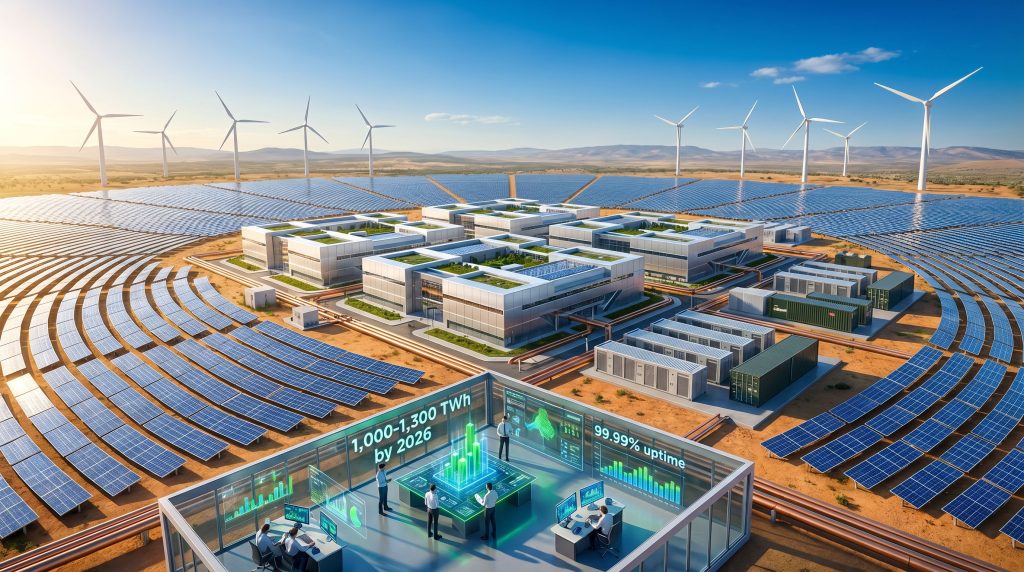
The intersection of artificial intelligence and sustainable energy represents one of the most significant infrastructure challenges of the modern technological era. As computational workloads evolve from traditional data processing to intensive machine learning operations, the development of green power for AI data centres has become critical for supporting this technological revolution whilst maintaining environmental sustainability commitments.
The Critical Infrastructure Challenge Facing AI Development
Modern artificial intelligence operations demand unprecedented levels of consistent, high-quality electrical power that traditional utility grids struggle to provide. The computational intensity of training large language models and running inference at scale creates energy transition challenges that dwarf conventional enterprise computing needs.
Quantifying AI's Massive Energy Appetite
The scale of energy consumption in AI data centres represents a paradigm shift in how we think about computational infrastructure. Training a single large language model can consume electricity equivalent to powering thousands of homes for an entire year. This energy intensity stems from the parallel processing requirements of neural networks, which demand sustained high-performance computing across thousands of specialised processors simultaneously.
Key Performance Indicators:
• GPU clusters in modern AI facilities require 40-80 kW per rack compared to 5-15 kW for traditional servers
• Training cycles can run continuously for weeks or months without interruption
• Inference serving requires predictable power delivery with minimal voltage fluctuation
• Cooling systems consume an additional 30-50% of total facility power requirements
The reliability requirements for AI workloads exceed those of traditional computing environments because model training represents significant financial investment that cannot tolerate power interruptions. A single outage during a multi-week training run can result in millions of dollars in lost computational progress.
Grid Infrastructure Limitations in Technology Corridors
Traditional electrical grid infrastructure faces multiple constraints when supporting large-scale AI data centre deployments. Peak demand periods create bottlenecks that threaten operational continuity, while transmission losses reduce efficiency in power-hungry facilities.
Infrastructure Constraints:
• Transmission capacity limitations in key technology regions
• Aging grid infrastructure unable to handle concentrated high-density loads
• Seasonal demand variations affecting power quality and pricing
• Interconnection delays for new high-capacity electrical connections
Many technology companies have discovered that their expansion plans exceed local grid capacity. Consequently, they must either limit facility size or invest in grid infrastructure upgrades that can take years to complete.
When big ASX news breaks, our subscribers know first
Renewable Technologies Enabling Reliable AI Operations
The transition to green power for AI data centres requires renewable energy technologies that can match the reliability and power quality demands of intensive computational workloads. Unlike traditional intermittent renewable applications, AI facilities need consistent baseload-equivalent power delivery.
Solar-Plus-Storage: The Foundation for AI-Grade Power
Photovoltaic systems paired with battery storage have emerged as the primary renewable technology for AI data centre applications. The predictable generation patterns of solar installations enable capacity planning that aligns with computational workload scheduling, addressing critical minerals and energy security requirements.
Technical Implementation Specifications:
| Component | Specification | Application |
|---|---|---|
| Solar Arrays | 4.5 MW per million sq ft facility | Rooftop and ground-mount installations |
| Battery Storage | 4-8 hour duration coverage | Grid-forming inverters for power quality |
| Land Requirements | 5 acres per MW solar capacity | Utility-scale installations |
| Annual Output | 7,000+ MWh large deployments | Hyperscale facility power supply |
The modular nature of solar-plus-storage systems allows for phased deployment that matches data centre expansion timelines. Furthermore, this scalability provides operational flexibility whilst maintaining cost-effective capacity utilisation ratios.
Advanced Energy Storage for Grid Independence
Battery storage systems for AI data centres require capabilities beyond traditional backup power applications. Grid-forming inverters enable microgrid operation during utility outages whilst providing frequency regulation services that generate additional revenue streams.
Critical Storage Capabilities:
• Lithium-ion systems with rapid response times under 100 milliseconds
• Grid-forming capabilities for islanded operation during outages
• Frequency regulation services providing ancillary revenue
• Thermal management systems preventing battery degradation
The financial performance of storage systems improves when facilities participate in grid services markets. This creates multiple value streams that enhance project economics beyond simple backup power provision.
Corporate Energy Procurement Strategies in the AI Era
Major technology companies have developed sophisticated approaches to securing renewable energy for their AI operations that extend far beyond traditional utility procurement models. These strategies often involve direct investment in generation infrastructure and long-term partnerships with renewable energy developers.
Hyperscaler Renewable Energy Leadership
Global technology leaders have committed billions of dollars to renewable energy procurement specifically targeting AI data centre requirements. These investments demonstrate the strategic importance of energy security for competitive advantage in artificial intelligence capabilities.
Recent industry analysis from the International Energy Agency indicates that technology giants are willing to pay premium prices for guaranteed green power capacity dedicated to AI operations. This market dynamic creates opportunities for renewable energy developers to secure long-term contracts with creditworthy counterparties.
Corporate Procurement Models:
• Direct ownership of generation assets for energy security
• Power purchase agreements (PPAs) with 15-25 year terms
• Co-location partnerships reducing transmission losses
• Regional energy hubs serving multiple facility clusters
Innovation in Energy Partnership Structures
Technology companies are pioneering new partnership models that align renewable energy transformations with their specific operational requirements. These arrangements often include performance guarantees and operational flexibility provisions not found in traditional utility contracts.
Strategic Partnership Elements:
| Partnership Type | Structure | Benefits |
|---|---|---|
| Direct Investment | Equity ownership in generation assets | Energy cost control and asset appreciation |
| Build-Transfer Agreements | Developer builds, transfers ownership | Reduced development risk and timeline |
| Dedicated Capacity Contracts | Reserved generation capacity | Guaranteed availability during peak demand |
| Grid Services Partnerships | Shared revenue from storage services | Additional income streams and grid stability |
These innovative structures reflect the critical importance of energy reliability for AI operations. Moreover, they demonstrate the willingness of technology companies to invest in energy infrastructure as a core business capability.
Economic Value Creation Through Renewable Integration
The financial benefits of renewable energy integration in AI data centres extend beyond simple electricity cost reduction, creating multiple value streams that traditional grid power cannot provide. These economic advantages become more pronounced as facilities scale and operational experience accumulates.
Direct Cost Reduction Mechanisms
Renewable energy systems deliver immediate cost savings through elimination of utility demand charges and reduced exposure to volatile electricity market pricing. Long-term power purchase agreements provide cost predictability that supports financial planning for multi-year AI development programs.
Quantified Cost Benefits:
• Long-term PPA pricing typically 30-50% below retail grid rates
• Demand charge elimination through on-site generation during peak periods
• Reduced transmission and distribution fees for locally generated power
• Power capping technologies reducing peak demand charges by 15-25%
Revenue Enhancement Through Grid Services
Battery storage systems at AI data centres can generate revenue by providing services to the electrical grid during periods when computational demand is lower. These grid services create additional income streams that improve overall project economics.
Grid Services Revenue Opportunities:
| Service Type | Revenue Mechanism | Typical Payment |
|---|---|---|
| Frequency Regulation | Real-time grid balancing | $15-40/kW-month |
| Demand Response | Load reduction during peaks | $50-200/MWh |
| Capacity Markets | Availability during stress periods | $100-300/kW-year |
| Voltage Support | Reactive power provision | $5-15/kVar-month |
The ability to monetise storage capacity during non-peak computational periods creates a unique advantage for AI data centres. In addition, this capability differentiates them from traditional facilities with constant power demand.
Microgrid Architecture for AI Energy Independence
Microgrid technology enables AI data centres to operate independently from traditional utility infrastructure whilst maintaining the power quality and reliability required for intensive computational workloads. These systems combine multiple generation sources with intelligent control systems that optimise energy delivery.
Integrated Generation and Control Systems
Modern microgrid architectures for AI facilities incorporate diverse generation sources with sophisticated energy management software that predicts computational load patterns and optimises energy dispatch accordingly.
Core System Components:
• On-site solar installations with tracking systems for maximum generation
• Grid-forming battery inverters providing voltage and frequency control
• Energy management software with machine learning load prediction
• Automated load shedding capabilities protecting critical computational systems
Operational Reliability Improvements
Microgrid systems achieve reliability levels that exceed utility grid performance through redundant generation sources and intelligent load management. The ability to island from the utility grid during disturbances ensures computational continuity during external power system events.
Performance Benefits:
| Reliability Metric | Microgrid Performance | Traditional Grid |
|---|---|---|
| Annual Uptime | 99.99%+ | 99.9% |
| Outage Duration | < 4 minutes average | 15-60 minutes |
| Voltage Stability | ±2% regulation | ±5% variation |
| Frequency Control | ±0.1 Hz | ±0.5 Hz |
The superior power quality provided by microgrid systems reduces the risk of computational errors and hardware damage that can occur during grid disturbances.
Energy Efficiency Foundations for Green AI
Energy efficiency measures provide the foundation that makes renewable power integration economically viable by reducing total power requirements. Advanced cooling technologies and computational optimisation strategies significantly reduce the renewable energy capacity needed to support AI operations.
Revolutionary Cooling Technologies
Liquid cooling systems represent a fundamental shift in data centre thermal management, enabling higher computational density whilst reducing energy consumption. Direct-to-chip cooling eliminates the inefficiencies of air-based systems and enables waste heat recovery for productive applications.
Advanced Cooling Implementations:
• Direct-to-chip cooling reducing total facility energy consumption by 20-30%
• Waste heat recovery systems providing facility heating and hot water
• Immersion cooling enabling server density increases of 3-5x
• AI-optimised HVAC with machine learning load prediction
Computational Efficiency Optimisation
Software and hardware optimisation strategies reduce the computational resources required for AI workloads, directly decreasing power consumption without sacrificing performance. These efficiency gains compound with renewable energy integration to maximise environmental benefits.
Efficiency Strategies:
| Optimisation Type | Implementation | Power Reduction |
|---|---|---|
| Model Compression | Pruning and quantisation | 40-60% |
| Purpose-Built Chips | AI-specific processors | 50%+ vs general CPUs |
| Edge Computing | Distributed processing | 30-50% facility load |
| Memory Optimisation | Reduced data movement | 15-25% system power |
The combination of hardware efficiency improvements and renewable energy integration creates a multiplicative effect in reducing the carbon intensity of AI operations.
The next major ASX story will hit our subscribers first
Next-Generation Energy Technologies for Baseload AI Power
Emerging energy technologies promise to address the baseload power challenge that has limited renewable energy adoption in mission-critical AI applications. Enhanced geothermal systems and small modular reactors offer continuous generation capabilities that complement solar and wind resources.
Enhanced Geothermal Systems for 24/7 Generation
Next-generation geothermal technology utilises closed-loop systems that can access geothermal resources without traditional water extraction requirements. These systems provide consistent baseload power that matches AI workload patterns whilst requiring minimal land footprint.
Enhanced Geothermal Specifications:
• Operating temperatures of 150-200°C for optimal efficiency
• Capacity factors exceeding 90% for consistent power output
• 30+ year operational lifespan with minimal maintenance requirements
• Modular deployment suitable for data centre co-location
The reliability and consistency of enhanced geothermal systems make them particularly suitable for AI data centre applications where power interruptions can result in significant computational losses.
Small Modular Nuclear Reactor Potential
Small modular reactor technology offers the potential for carbon-free baseload power with deployment timelines that align with AI infrastructure expansion plans. Standardised designs and factory construction reduce both costs and regulatory approval timeframes.
SMR Deployment Considerations:
| Factor | Current Status | Timeline |
|---|---|---|
| First Commercial Units | Development phase | 2028-2030 |
| Cost Competitiveness | Approaching renewables + storage | 2030+ |
| Regulatory Approval | Expedited review processes | 2-3 years |
| Construction Timeline | Modular factory build | 12-18 months |
The long-term price stability of nuclear fuel provides hedging against renewable energy price volatility whilst delivering carbon-free baseload power for energy-intensive AI operations.
Investment Landscape in Green AI Power Infrastructure
The convergence of AI growth and renewable energy creates diverse investment opportunities spanning technology development, infrastructure deployment, and operational services. These investment themes attract capital from both traditional energy investors and technology-focused funds, particularly in battery metals investment sectors.
Infrastructure Development Investment Themes
Renewable energy infrastructure serving AI data centres requires specialised technical capabilities and financing structures that differ from traditional utility-scale projects. The creditworthiness of technology company off-takers enables attractive financing terms for developers.
Primary Investment Categories:
• Utility-scale solar and wind projects with data centre power purchase agreements
• Energy storage systems providing both backup power and grid services
• Transmission infrastructure connecting renewable resources to demand centres
• Advanced cooling technology manufacturers serving AI facility requirements
Technology Innovation Investment Opportunities
Early-stage technology companies developing solutions for AI data centre energy management attract significant venture capital investment. These companies often focus on software platforms that optimise energy consumption and generation across diverse renewable sources.
Innovation Investment Areas:
| Technology Sector | Focus Areas | Market Opportunity |
|---|---|---|
| Advanced Batteries | Duration and cost reduction | $50B+ by 2030 |
| Power Electronics | Grid integration efficiency | $25B+ by 2028 |
| Energy Management | AI optimisation software | $15B+ by 2027 |
| Cooling Technology | Liquid cooling systems | $10B+ by 2026 |
The rapid growth in AI infrastructure spending creates substantial market opportunities for companies developing specialised energy technologies. Furthermore, innovations in sustainable battery recycling are creating additional value chains.
Regulatory Frameworks Accelerating Green AI Development
Government policies at multiple levels create financial incentives and regulatory requirements that accelerate renewable energy adoption in AI data centre operations. These frameworks provide risk reduction and cost advantages that improve project economics.
Federal Tax Incentive Structures
Investment and production tax credits provide significant financial support for renewable energy projects serving AI data centres. Recent policy changes have extended credit availability and added bonus incentives for domestic manufacturing and disadvantaged community development.
Key Federal Incentives:
• 30% Investment Tax Credit for solar installations through 2032
• Production Tax Credits for wind power at competitive rates
• 10% Investment Tax Credit for qualified battery storage systems
• Bonus credits for domestic content and community benefit projects
State and Local Support Programs
State renewable portfolio standards and local economic development incentives create additional financial benefits for green power for AI data centres projects. These programs often include fast-track permitting processes that reduce development timelines.
State-Level Support Mechanisms:
| Program Type | Implementation | Benefits |
|---|---|---|
| Renewable Portfolio Standards | Mandatory utility procurement | Guaranteed market demand |
| Property Tax Abatements | Reduced facility taxation | 50-80% tax reduction |
| Sales Tax Exemptions | Equipment purchase savings | 5-10% project cost reduction |
| Fast-Track Permitting | Expedited approval processes | 6-12 month timeline reduction |
The combination of federal incentives and state-level programs can reduce the total cost of renewable energy projects by 40-50%, significantly improving investment returns.
Future Trajectories for Green-Powered AI Infrastructure
The evolution toward fully renewable-powered AI operations will reshape both technology and energy industries over the next decade. Market forces and technological advancement are accelerating adoption timelines beyond initial projections, as detailed in Australia's renewable energy transition plans.
Technology Convergence and Integration Trends
The integration of energy and computing systems is creating new architectural approaches that optimise both computational performance and energy efficiency. Co-designed systems that consider energy generation alongside computational requirements represent the next phase of AI infrastructure evolution.
Emerging Integration Approaches:
• Integrated energy-computing systems with thermal optimisation
• AI algorithms managing renewable energy systems in real-time
• Predictive maintenance extending equipment operational lifespan
• Dynamic load balancing across distributed computing and energy resources
Market Evolution and Capacity Projections
Industry analysis indicates substantial growth in renewable energy capacity dedicated specifically to AI data centre applications. This growth reflects both increasing AI computational demand and improving economics of renewable energy technologies.
Market Development Projections:
| Metric | Current Status | 2030 Projection | 2035 Projection |
|---|---|---|---|
| Dedicated Renewable Capacity | 50+ GW | 200+ GW | 500+ GW |
| Cumulative Investment | $100B | $500B | $1T+ |
| Geographic Distribution | 3 major regions | 8 major regions | Global deployment |
| Carbon Intensity Reduction | Baseline | 30% reduction | 50% reduction |
The competitive advantage gained through reliable green power access is driving technology companies to secure renewable energy capacity years in advance of operational requirements. However, the successful deployment of green power for AI data centres requires continued innovation in both energy storage and grid integration technologies.
Disclaimer: This article contains forward-looking statements and projections based on current market conditions and technological trends. Actual outcomes may vary significantly due to regulatory changes, technological developments, and market dynamics. Investment in renewable energy and technology infrastructure involves substantial risks, including market volatility, regulatory uncertainty, and technological obsolescence. Readers should conduct independent research and consult qualified professionals before making investment decisions.
Want to Capitalise on the Green Energy Revolution?
Discovery Alert's proprietary Discovery IQ model delivers real-time alerts on significant renewable energy and battery metals discoveries across the ASX, empowering subscribers to identify actionable opportunities as the green power transformation accelerates. Stay ahead of the market by monitoring Discovery Alert's discoveries page showcasing historic examples of exceptional returns, and begin your 14-day free trial today to position yourself at the forefront of this rapidly evolving sector.