May 26, 2026
The minerals industry stands at the threshold of a fundamental transformation, with artificial intelligence in mineral exploration reshaping how exploration teams identify, evaluate, and develop mineral deposits across the globe. This shift represents more than incremental improvement; it signals a complete reimagining of geological discovery methodologies that have remained largely unchanged for decades.
Machine learning algorithms now process vast datasets that would overwhelm traditional analysis methods, while advanced sensors capture geological signatures at unprecedented resolution. The convergence of satellite technology, ground-based instrumentation, and predictive analytics creates new possibilities for discovering deposits in previously overlooked regions.
Understanding Contemporary AI Integration in Mineral Discovery
Artificial intelligence in mineral exploration has evolved from experimental applications to operational deployment across major mining companies and junior explorers alike. Recent industry research reveals that 77 percent of exploration professionals now incorporate AI tools into their workflows, with 56 percent using these technologies occasionally and 21 percent deploying them regularly in their operations.
However, adoption patterns remain inconsistent across the sector. Budget constraints limit access to advanced AI platforms, particularly affecting junior exploration companies that lack the capital resources of major mining corporations. Many organisations struggle to quantify return on investment metrics, making it challenging to justify expenditure on sophisticated machine learning systems.
Key Adoption Barriers Include:
- Budget limitations preventing platform acquisition
- Unclear ROI metrics for technology investment
- Skills gaps in data science capabilities
- Scepticism about AI model interpretability
- Integration challenges with legacy geological software
The geological community maintains particular caution regarding AI implementation. Traditional exploration methods rely heavily on experienced geological interpretation, and many professionals express concern about the "black box" nature of advanced algorithms. This resistance reflects deeper questions about how machine learning models arrive at their recommendations and whether these systems can replicate the nuanced understanding that experienced geologists bring to exploration decisions.
Despite these challenges, industry surveys indicate that most professionals recognise AI's potential for accelerating decision-making and improving operational efficiency. The technology shows particular promise in processing large-scale datasets that would require months or years to analyse through conventional approaches.
When big ASX news breaks, our subscribers know first
Exploration Phases Experiencing Maximum AI Impact
Regional Target Generation and Prospectivity Assessment
Early-stage exploration benefits significantly from AI's ability to synthesise diverse geological datasets. Machine learning algorithms can process regional-scale geological, geochemical, and geophysical information simultaneously, identifying patterns that might escape traditional analysis methods.
Prospectivity mapping represents one of the most mature AI applications in exploration. These systems integrate multiple data layers including geological maps, stream sediment geochemistry, airborne magnetic surveys, and satellite imagery to generate probability maps highlighting areas with elevated mineral potential.
Advanced satellite imagery analysis enables exploration teams to detect mineral signatures across vast territories without extensive ground-based surveys. Multi-spectral and hyperspectral sensors can identify alteration minerals, structural features, and geochemical anomalies that indicate subsurface mineralisation.
Statistical modelling approaches help identify unexplored zones within well-studied regions. By analysing the geological characteristics of known deposits, AI in drilling systems can predict where similar deposits might occur in areas that have received limited exploration attention.
Geophysical Data Processing and Subsurface Interpretation
Modern geophysical surveys generate enormous volumes of data that challenge traditional processing methods. AI excels at extracting meaningful patterns from these complex datasets, particularly when integrating multiple survey types simultaneously.
Furthermore, 3D geological modelling benefits from machine learning approaches that can process ambient noise tomography data alongside traditional geophysical measurements. These techniques provide detailed images of subsurface structure to depths of several kilometres, revealing geological features that control mineralisation patterns.
Neural networks prove particularly effective at integrating electromagnetic, magnetic, and gravitational survey data. Traditional approaches often analyse these datasets separately, but AI systems can identify subtle correlations between different geophysical responses that indicate mineral deposits.
Real-time drill target optimisation represents an emerging application where AI systems continuously update geological models as new data becomes available. This adaptive approach allows exploration teams to modify drilling programmes based on evolving understanding of subsurface geology.
Drill Program Enhancement and Resource Characterisation
Supervised learning models demonstrate strong performance in lithology classification and ore grade estimation. These systems train on historical drill data to predict rock types and metal grades at undrilled locations, helping optimise drill hole spacing and target selection.
Reinforcement learning applications show promise for drill sequence planning and resource allocation. These approaches can evaluate thousands of potential drilling scenarios to identify strategies that maximise information gain while minimising costs.
Predictive analytics help reduce exploration expenditure through more efficient drill programmes. In addition, drill results interpretation systems can reduce the number of drill holes required to define a resource by accurately predicting which areas are most likely to contain economic mineralisation.
AI Technologies Driving Innovation in Geological Discovery
Machine Learning Methodologies in Current Use
| AI Technique | Primary Application | Data Requirements | Implementation Benefits |
|---|---|---|---|
| Supervised Learning | Grade prediction, rock classification | Historical drill data, assay results | Enhanced targeting accuracy |
| Unsupervised Learning | Pattern recognition, anomaly detection | Raw geophysical datasets | Discovery of unknown geological signatures |
| Deep Learning | Hyperspectral image analysis | High-resolution spectral data | Accelerated mineral identification |
| Reinforcement Learning | Drill optimisation, resource planning | Historical exploration outcomes | Improved cost efficiency |
Supervised learning approaches require extensive labelled datasets for training but provide interpretable results that geologists can validate against their understanding of local geology. These methods work particularly well for grade prediction and lithology classification where sufficient historical data exists.
Unsupervised learning techniques excel at discovering hidden patterns in geological datasets. These approaches can identify previously unknown relationships between different geological parameters, potentially revealing new exploration targets or deposit types.
Deep learning networks demonstrate exceptional capability in hyperspectral image analysis, processing hundreds of spectral bands simultaneously to identify mineral signatures. These systems can achieve mineral identification speeds that surpass human analysis by orders of magnitude.
Remote Sensing and Advanced Imaging Capabilities
Modern remote sensing platforms provide unprecedented geological information without requiring ground access. Centimetre-scale resolution mapping using UAV-mounted hyperspectral sensors enables detailed mineral identification across entire exploration properties.
Integration of Copernicus satellite data with commercial imaging platforms creates comprehensive regional datasets for AI analysis. These systems provide regular updates on surface conditions, vegetation patterns, and geological features that may indicate subsurface mineralisation.
Self-supervised learning models reduce the dependence on ground truth validation by learning geological patterns directly from satellite imagery. This approach enables rapid assessment of frontier exploration regions where limited ground-based data exists.
Major Mining Company Implementation Strategies
Large-Scale Operational Deployments
Major mining corporations are integrating AI technologies across their exploration portfolios, combining cloud computing resources with advanced data acquisition systems. These implementations typically involve partnerships with technology providers to develop customised solutions for specific geological environments.
Real-time 3D subsurface imaging systems provide continuous updates on geological structure as exploration programmes progress. These platforms can process data from multiple sources simultaneously, creating comprehensive models that guide exploration decision-making.
Environmental monitoring integration represents an emerging trend where artificial intelligence in mineral exploration systems combine exploration targeting with environmental impact assessment. This approach helps identify deposits that can be developed with minimal environmental disruption.
Technology Partnership Ecosystems
Specialised AI platforms designed specifically for geological interpretation are gaining adoption across the industry. These systems focus on mining-specific applications rather than adapting general-purpose AI tools to geological problems.
Academic-industry collaborations are developing interpretable AI models that maintain transparency in their decision-making processes. These efforts address geological community concerns about "black box" algorithms by creating systems that can explain their reasoning.
Cross-industry knowledge transfer from oil and gas AI applications provides valuable insights for mineral exploration. The petroleum industry's longer experience with AI-assisted exploration offers proven methodologies that can be adapted to mineral discovery challenges.
Quantifying the Benefits of AI-Enhanced Exploration
Performance Improvements and Efficiency Gains
Industry experience suggests that AI implementation can significantly improve exploration efficiency across multiple metrics. Organisations report faster decision-making processes and improved operational efficiency as the primary near-term benefits of AI adoption.
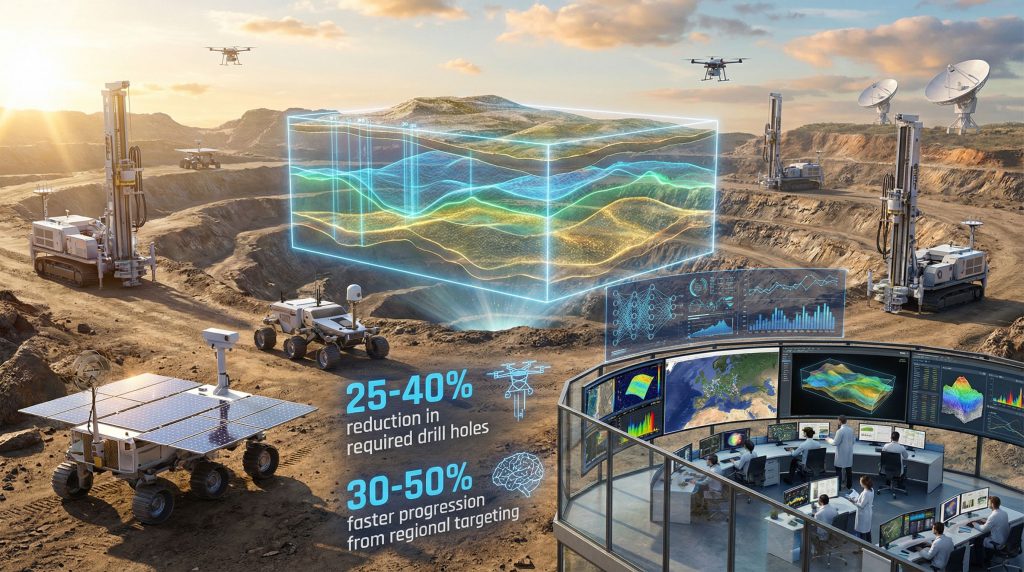
Cost optimisation represents a major driver for AI adoption, with exploration programmes potentially reducing expenditure per successful discovery through more accurate targeting. Enhanced targeting accuracy reduces the number of drill holes required to evaluate prospects.
Time compression in exploration workflows enables faster progression from regional targeting to drill-ready prospects. AI systems can process complex datasets in hours rather than months, accelerating project advancement.
Consequently, environmental impact reduction occurs through precision targeting that minimises surface disturbance. More accurate prediction of mineralisation locations reduces the exploration footprint required to evaluate properties.
Risk Management and Decision Support
Uncertainty quantification in resource estimation models provides more robust assessments of project risk and value. AI systems can generate probabilistic estimates that better reflect the inherent uncertainty in geological interpretation.
Enhanced due diligence capabilities support more informed exploration investment decisions. However, data-driven mining analysis can rapidly evaluate large numbers of prospects, identifying those with the highest probability of success.
Integration of geological, environmental, and social risk factors creates comprehensive project assessments. This holistic approach helps identify potential challenges before they impact exploration programmes.
Barriers to Widespread AI Adoption in Exploration
Technical and Data Challenges
Data quality inconsistencies across historical exploration datasets create significant barriers to AI implementation. Many exploration companies maintain decades of geological information in varying formats and quality standards, making it difficult to create robust training datasets for machine learning models.
Limited availability of labelled training data in frontier exploration regions restricts AI deployment in some of the most prospective areas. Machine learning models require extensive historical data to achieve reliable performance, which may not exist in unexplored territories.
Integration difficulties between legacy geological software and modern AI platforms create technical barriers. Many exploration teams use specialised geological software that doesn't interface easily with contemporary AI tools.
Organisational and Cultural Resistance
Skills gap challenges in data science capabilities represent a significant barrier within traditional exploration teams. Most geologists and exploration professionals lack the specialised training required to implement and interpret machine learning models effectively.
Trust and interpretability concerns regarding AI model outputs persist throughout the geological community. Many professionals remain sceptical about recommendations generated by systems they cannot fully understand or validate.
For instance, regulatory uncertainty around AI-assisted resource classification and reporting standards creates additional hesitation. Professional standards and regulatory frameworks have not fully adapted to incorporate AI-generated geological interpretations.
The next major ASX story will hit our subscribers first
High-Potential AI Applications in Future Exploration
Critical Mineral Targeting and Strategic Resources
AI shows exceptional promise for identifying deposits of battery metals, rare earth elements, and other strategic materials. These deposits often display subtle geological signatures that benefit from AI's pattern recognition capabilities.
Integration of real-time environmental monitoring with exploration decision-making enables more sustainable exploration approaches. AI systems can optimise exploration programmes to minimise environmental impact while maintaining discovery effectiveness.
Autonomous exploration systems combining robotics, AI, and remote sensing technologies represent the future of exploration in remote or hazardous environments. These systems could operate continuously without human intervention in challenging locations.
Emerging Research Frontiers
Multi-scale data fusion represents an active research area combining satellite, UAV, ground-based, and subsurface datasets into comprehensive geological models. This approach promises more complete understanding of geological systems controlling mineralisation.
Development of interpretable AI models maintains geological reasoning transparency while providing advanced analytical capabilities. Furthermore, these systems address community concerns about "black box" algorithms by explaining their decision-making processes.
End-to-end digital exploration platforms support adaptive, continuous exploration campaigns that evolve based on new data acquisition. These systems represent a fundamental shift from traditional campaign-based exploration to continuous optimisation approaches.
Investment Implications and Market Dynamics
Technology Valuation and Competitive Advantages
Technology moat evaluation becomes critical when assessing companies with proprietary AI exploration platforms. The value of these systems depends on their accuracy, ease of use, and integration with existing geological workflows.
Data quality and exclusivity represent significant competitive advantages in AI-driven exploration. Companies with access to high-quality, proprietary geological datasets can develop more effective AI systems than competitors using publicly available information.
Integration capabilities with existing mining industry workflows determine the commercial success of AI exploration platforms. Systems that seamlessly interface with established geological software demonstrate higher adoption rates.
Market Evolution and Growth Potential
Scalability advantages of AI-enhanced exploration create opportunities for companies that can deploy these technologies across multiple projects simultaneously. This operational leverage can significantly improve exploration economics.
Partnership opportunities between technology providers and established mining companies offer pathways for rapid market expansion. These collaborations combine technological innovation with operational expertise and market access.
Regulatory compliance considerations for AI-assisted resource reporting require careful evaluation. Companies operating in multiple jurisdictions must ensure their AI systems meet varying professional standards and regulatory requirements.
The democratisation of exploration capabilities through AI-powered platforms accessible to junior mining companies could reshape industry competitive dynamics. Smaller companies may gain access to analytical capabilities previously available only to major mining corporations, particularly when considering the mineral exploration importance for strategic metals discovery.
Investment Consideration: While AI presents significant opportunities in mineral exploration, investors should carefully evaluate the technical capabilities, market positioning, and regulatory compliance of companies deploying these technologies. The sector remains in early adoption phases, with both significant potential rewards and implementation risks.
In conclusion, artificial intelligence in mineral exploration represents a paradigm shift that promises to revolutionise geological discovery. As the industry continues to embrace these technologies, companies that successfully integrate AI-powered exploration tools while addressing cultural and technical barriers will likely gain significant competitive advantages in the evolving exploration landscape.
Ready to Capitalise on AI-Driven Mineral Discoveries?
Discovery Alert's proprietary Discovery IQ model delivers real-time alerts on significant ASX mineral discoveries, instantly empowering subscribers to identify actionable opportunities ahead of the broader market. Begin your 30-day free trial at Discovery Alert today and secure your market-leading advantage in this AI-transformed exploration landscape.