
June 10, 2026
India's Onshore Gas Sector Is Rewriting Its Own Rules
For most of the past two decades, India's domestic natural gas narrative has been dominated by offshore megaprojects, LNG import terminals, and the persistent structural gap between what the country produces and what it consumes. Onshore exploration, particularly across Rajasthan's sedimentary basins, has often been treated as secondary to the deeper, higher-profile plays that command capital and attention. That framing is quietly but decisively changing.
The Oil India natural gas discovery in Rajasthan's Dandewala field, confirmed in May 2026, is not a headline-grabbing deepwater find. It is something arguably more interesting: a shallow-zone discovery inside an already-active asset, produced through disciplined subsurface re-evaluation rather than frontier exploration. Understanding why that matters requires stepping back from the individual well result and examining the geological, strategic, and operational context that makes this find more consequential than its initial flow rate might suggest.
When big ASX news breaks, our subscribers know first
Rajasthan's Two Basins and Why They Behave Differently
Western Rajasthan hosts two geologically distinct hydrocarbon provinces that have followed very different development trajectories.
The Barmer-Sanchore Basin has been the dominant crude oil engine, with 38 oil and gas fields discovered across the basin reflecting decades of cumulative exploration effort. Cairn-Vedanta's operations here established Rajasthan as a meaningful crude contributor to India's onshore production mix. The basin's Palaeocene and Eocene-age reservoirs are well characterised, and the commercial infrastructure required for oil handling is largely in place.
The Jaisalmer Basin, by contrast, has always been primarily a gas province. Intensive exploration campaigns have identified a proven gas endowment of 10.8 billion cubic metres of natural gas across the basin, and production from these fields feeds local power generation infrastructure across the state. It is in this basin that the Dandewala field sits, and it is here that the exploration logic for shallow-zone targets is most compelling.
What makes Jaisalmer geologically distinctive is its position within the broader Indus Basin stratigraphy, a sedimentary system that extends across the India-Pakistan border. The shared geological heritage of this basin means that stratigraphic trapping mechanisms proven on one side have direct analogues on the other, a point well understood by exploration geologists working the region but rarely discussed in broader coverage of Indian gas production.
The Shahgarh Precedent: Why Shallow Stratigraphic Plays Deserve More Attention
One data point that provides important context for the Dandewala discovery is Focus Energy's earlier find in the RJ-ON/6 block at Shahgarh, where reported flow rates reached 15 million standard cubic feet per day (mmscf/d). That result demonstrated that the Indian portion of the Indus Basin is capable of hosting substantial stratigraphic gas accumulations at relatively accessible depths. The Dandewala Sanu Formation discovery follows the same geological reasoning, confirming that shallow, structurally controlled gas in this basin is not an anomaly but a repeatable exploration concept.
The Shahgarh discovery established a geological template for stratigraphic gas trapping in western Rajasthan's shallower formations. The Dandewala find now extends that template into an entirely different operator's acreage, suggesting the play has basin-wide applicability.
Breaking Down the Dandewala Discovery: Technical Parameters
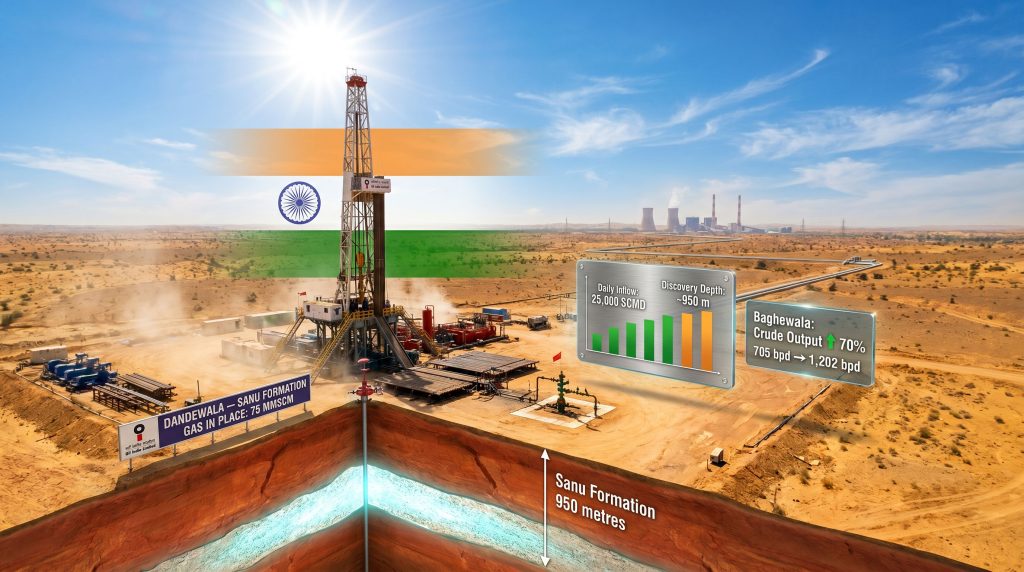
The Oil India natural gas discovery in Rajasthan centres on a well drilled into the Sanu Formation within the Dandewala nominated block. The Sanu Formation is a shallower sedimentary interval that had not previously been confirmed as gas-bearing within this specific field, making the confirmation of gas presence a genuinely new data point rather than an incremental addition to a known accumulation.
Key technical parameters of the discovery are summarised below:
| Parameter | Dandewala Discovery | Contextual Benchmark |
|---|---|---|
| Target Formation | Sanu Formation | First confirmed gas in this zone at Dandewala |
| Discovery Depth | ~950 metres | Shallow profile; lower drilling cost |
| Initial Inflow Rate | 25,000 SCMD | Pre-production well test |
| Preliminary GIP Estimate | ~75 MMSCM | Based on structural mapping and petrophysics |
| Estimation Methods | Structural control, petrophysical evaluation, subsurface analysis | Standard industry appraisal toolkit |
| Nearest Comparable (OIL) | Bakhritibba DSF Block | Initial output: 67,200 SCMD |
The 950-metre discovery depth is particularly noteworthy from a capital efficiency perspective. Shallower wells cost significantly less to drill than conventional deep targets, which means the economic threshold for commercial viability is correspondingly lower. In a basin where numerous smaller accumulations have historically been stranded due to sub-commercial economics under older fiscal frameworks, shallower targets offer a pathway to monetisation that deeper plays cannot match on a cost-per-unit basis.
Understanding Gas in Place Versus Recoverable Reserves
A critical distinction for anyone interpreting the 75 MMSCM gas-in-place (GIP) figure is the difference between GIP and recoverable reserves. Gas in place represents the total estimated volume of gas within the reservoir before any extraction occurs. It is a geological estimate, not a production target.
Recoverable reserves are what remains after accounting for:
- Reservoir permeability and the practical limits of gas flow to the wellbore
- Recovery efficiency factors specific to the formation's rock and fluid properties
- Surface processing and infrastructure constraints
- Economic thresholds under the applicable fiscal and regulatory framework
Typical gas recovery factors for onshore reservoirs in India range broadly depending on reservoir quality, but the GIP figure should be understood as a ceiling that appraisal drilling and reservoir characterisation will progressively revise downward to a recoverable volume estimate. The 75 MMSCM figure is therefore a starting point, not a conclusion.
Oil India's Missed Opportunities Framework: A Strategy, Not a Slogan
The Dandewala discovery did not happen by accident. It is the direct output of an explicit exploration philosophy that Oil India has applied across its Rajasthan portfolio: the deliberate re-examination of existing licensed acreage using modern analytical tools to identify hydrocarbon pay zones that earlier drilling campaigns either missed, bypassed, or did not evaluate with sufficient technical rigour.
This approach has several structural advantages over greenfield exploration:
- Existing seismic data: Prior acquisition campaigns have already characterised the subsurface, reducing the cost and time required for new interpretation
- Established well infrastructure: Nearby producing wells provide surface facilities that can be adapted or extended rather than built from scratch
- Known geological context: Operators understand the local stratigraphic sequence and can make more targeted decisions about which formations warrant re-evaluation
- Lower regulatory complexity: Nominated blocks already operating under established approvals face a less complex path to appraisal activity compared to new licence applications
Baghewala: The Proof Point That Makes Dandewala Credible
The most compelling evidence that this strategy delivers real outcomes is Oil India's Baghewala field, also located in Rajasthan. Through the application of enhanced recovery techniques and targeted subsurface interventions, crude oil output at Baghewala rose from 705 barrels per day to 1,202 barrels per day, representing a production increase of approximately 70% from a field that could easily have been managed as a declining legacy asset.
The structural parallel between Baghewala and Dandewala is direct: both assets reflect a deliberate choice to invest technical effort into existing acreage rather than pursuing new exploration licences. The difference is that Baghewala demonstrated this in crude oil terms, while Dandewala now extends the same logic into natural gas production.
When a state-owned operator consistently extracts new value from assets that the industry had effectively written off as mature, it signals a genuine shift in operational philosophy rather than opportunistic one-off results.
From Discovery to Production: The Development Pathway
Converting the Dandewala gas discovery into commercial production requires moving through a structured sequence of technical and regulatory steps. This process typically unfolds over multiple years and involves progressively greater capital commitment at each stage.
- Appraisal drilling: Additional wells are drilled to test the lateral extent and vertical continuity of the Sanu Formation gas accumulation across the Dandewala field structure
- Reservoir characterisation: Petrophysical data from appraisal wells is integrated with seismic interpretation to build a 3D reservoir model that refines the GIP estimate and calculates recoverable volumes
- Field development plan preparation: Engineers design the surface infrastructure required for gas gathering, compression, and offtake, drawing on lessons from comparable small-field developments in the basin
- Regulatory submission: The field development plan is submitted to the Directorate General of Hydrocarbons (DGH) for review and approval before commercial production can commence
- Infrastructure construction and commissioning: Wells are connected to processing facilities and then linked to local distribution networks or power generation consumers
- Production ramp-up: Output is scaled from initial levels using operational experience accumulated at comparable assets such as the Bakhritibba DSF block
India's Gas Import Dependency and Why Every Domestic Barrel Matters
India's natural gas demand has grown substantially over the past decade, driven by industrial consumption, city gas distribution network expansion, and fertiliser sector requirements. Domestic production has not kept pace with this demand growth, creating a persistent supply gap that is filled primarily through liquefied natural gas (LNG) imports, priced in US dollars and therefore directly exposed to global commodity price volatility and foreign exchange risk.
Furthermore, the LNG import tax structure in India adds another layer of cost complexity for businesses reliant on imported gas, making domestic discoveries like Dandewala all the more strategically valuable. Even a modest onshore find like this contributes to reducing exposure at a regional level. Gas produced from the Jaisalmer basin feeds local power infrastructure in Rajasthan, reducing the volume of gas that must be transported via inter-state pipelines from coastal LNG import terminals.
The cost savings from reduced pipeline transportation and import substitution, while difficult to quantify precisely from a single field, are structurally significant when aggregated across multiple producing assets in the basin. In addition, monitoring natural gas price trends remains essential context for evaluating the commercial case for accelerating domestic production from assets such as Dandewala.
The DSF Policy Framework: Faster Paths from Discovery to Revenue
India's Discovered Small Field (DSF) policy was specifically designed to address the problem of accumulations that are too small to justify development under conventional fiscal terms but cumulatively represent a meaningful domestic resource. The framework offers more favourable revenue-sharing terms to incentivise operators to bring these fields into production rather than leaving them as stranded discoveries.
| Policy Mechanism | Core Purpose | Relevance to Rajasthan |
|---|---|---|
| DSF Block Auctions | Fast-track monetisation of sub-commercial finds | Bakhritibba DSF block already producing at 67,200 SCMD |
| HELP Framework | Revenue-sharing to attract private and foreign capital | Applicable to new block awards across the basin |
| Nominated Block Operations | State operators manage legacy acreage efficiently | Dandewala operates under this model |
| Enhanced Recovery Incentives | Boost production from technically mature fields | Applied at Baghewala with a 70% output increase |
The Dandewala Sanu Formation discovery is not itself a DSF block, but the successful confirmation of gas in this shallower zone creates a template for structuring future appraisal targets within DSF-compatible frameworks, particularly if multiple Sanu Formation accumulations are identified across the broader Dandewala structure or adjacent areas.
The next major ASX story will hit our subscribers first
Rajasthan's Multi-Operator Gas Landscape
Understanding the Oil India natural gas discovery in Rajasthan requires situating it within the broader competitive and operational landscape of the basin, where multiple operators are pursuing different resource types and development strategies simultaneously. Consequently, the global resource landscape provides useful comparative context for assessing how India's onshore sector positions itself against international peers.
- Oil India operates the Dandewala nominated block and the Bakhritibba DSF block, with the Baghewala crude recovery programme running in parallel
- ONGC maintains a long-standing presence across both the Barmer-Sanchore and Jaisalmer basins, with a portfolio spanning both oil and gas targets
- Cairn-Vedanta dominates crude oil production in the Barmer basin but has historically been less focused on gas monetisation in the state
- Focus Energy's Shahgarh discovery in the RJ-ON/6 block, with reported flow rates of 15 mmscf/d, remains one of the most significant stratigraphic gas finds in the region and continues to serve as a geological reference point for analogous targets
This multi-operator environment creates a basin-level knowledge base that benefits all participants, as each new discovery contributes data points that refine the understanding of which formations and structural positions are most prospective across the region.
What the Sanu Formation Discovery Signals for Future Exploration
In petroleum geology, a play-opening discovery is one that confirms a previously unproven exploration concept across a defined geological framework, effectively creating a replicable template for evaluating additional targets within the same formation and area. The Dandewala Sanu Formation find qualifies as exactly this type of result.
Prior to this well, the Sanu Formation within the Dandewala field had not been established as a gas-bearing interval. That absence of confirmed gas presence meant the formation was effectively invisible to standard exploration prioritisation frameworks, which tend to direct capital toward proven or analogue-proven intervals. With gas now confirmed, the exploration logic changes in two important ways:
- Intra-field: Additional Sanu Formation targets within the Dandewala structure can now be evaluated against a confirmed geological framework rather than a theoretical one
- Regional: Operators holding acreage in adjacent blocks where the Sanu Formation is present will likely re-examine their own subsurface datasets to identify analogous structural positions
The commercial significance of a play-opening discovery often exceeds its standalone resource estimate. A single confirmed well de-risks an entire population of analogous targets that previously carried exploration-stage uncertainty.
This multiplicative effect is what gives the Dandewala discovery strategic weight beyond its 75 MMSCM preliminary GIP figure. If appraisal drilling confirms lateral continuity of the accumulation, the recoverable resource base could expand materially. However, the broader implications extend further still: the global LNG supply outlook and shifting import dynamics make every incremental domestic gas confirmation in India more commercially relevant than it would have been a decade ago. Furthermore, reviewing the commodity outlook 2025 reinforces just how pivotal energy transition pressures are in elevating the strategic value of onshore gas assets like those in Rajasthan.
Frequently Asked Questions
What exactly did Oil India discover at Dandewala?
Oil India confirmed the presence of natural gas in the Sanu Formation, a shallower sedimentary interval within its Dandewala nominated block in Rajasthan. The discovery well recorded an average daily inflow of 25,000 standard cubic metres of gas from approximately 950 metres depth, with preliminary structural and petrophysical analysis indicating a gas-in-place volume of around 75 million standard cubic metres.
Why is the Sanu Formation discovery significant if the gas-in-place volume is relatively modest?
The significance lies in the exploration concept being validated rather than the volume alone. This is the first confirmed gas presence in the Sanu Formation at Dandewala, which means the discovery opens a new play within an already-active field and creates a geological framework for evaluating additional targets. The GIP estimate is also preliminary and subject to upward revision as appraisal drilling provides more data.
How does gas in place differ from what can actually be produced?
Gas in place is the total estimated volume within the reservoir. Recoverable gas is a subset of that figure, reduced by reservoir permeability limits, recovery efficiency factors, and economic constraints. The 75 MMSCM figure represents the upper boundary of what exists in the ground, not a production forecast.
What regulatory process must Oil India follow before production can begin?
Following appraisal drilling and reservoir modelling, Oil India must prepare and submit a field development plan for review by the Directorate General of Hydrocarbons. Regulatory clearance is required before commercial production infrastructure can be commissioned.
How does this discovery relate to India's broader energy security objectives?
Every increment of domestic natural gas production reduces India's dependence on dollar-denominated LNG imports, which carry both commodity price risk and foreign exchange cost. Gas produced in Rajasthan also serves local power generation consumers directly, reducing pipeline transportation costs and improving regional supply resilience.
Readers seeking further context on India's onshore oil and gas sector can access ongoing coverage through ET EnergyWorld's oil and gas section at energy.economictimes.indiatimes.com.
This article contains forward-looking assessments based on preliminary exploration data and publicly available information. Gas-in-place estimates and production projections are subject to revision following appraisal drilling and reservoir characterisation. Nothing in this article constitutes financial or investment advice.
Want to Stay Ahead of Significant Mineral Discoveries the Moment They Hit the ASX?
Discovery Alert's proprietary Discovery IQ model scans ASX announcements in real time, delivering instant alerts on high-potential discoveries across more than 30 commodities — explore historic examples of exceptional discovery returns to understand the scale of opportunity, then begin a 14-day free trial at Discovery Alert to position yourself ahead of the broader market.