May 20, 2026
The Hidden Geology Powering the Next Critical Minerals Revolution
Rare earth elements are not, strictly speaking, rare. They are present in the earth's crust at concentrations comparable to many commonplace industrial metals. What makes them scarce is not their geological abundance but the extraordinary difficulty of concentrating, extracting, and refining them to usable purity. This technical complexity is precisely why the global critical minerals market has calcified into a structure that Western industrial planners increasingly describe as untenable: a world where one nation controls the majority of both production and processing, and where the environmental cost of feeding that system grows harder to justify with each passing year.
The emerging field of geothermal mineral recovery is not merely an incremental improvement on existing extraction methods. It represents a fundamentally different question being asked of the earth's geology, and Ascension geothermal critical mineral recovery funding is one of the clearest signals yet that this alternative approach is attracting serious scientific, commercial, and institutional validation.
When big ASX news breaks, our subscribers know first
Why the Conventional Critical Minerals Model Is Running Out of Road
The dominant model for rare earth element production has operated on a straightforward logic for decades: find mineralised rock, excavate it at scale, process it through energy-intensive chemical separation, and accept the environmental consequences as a cost of doing business. China's ascent to controlling approximately 61% of global rare earth production and an estimated 90% of all processing capacity was built on this model, executed with a combination of low-cost labour, industrial scale, and a regulatory environment that tolerated environmental externalities other jurisdictions could not.
The consequences of this concentration are now embedded in every sector that depends on critical minerals demand:
| Application Sector | Key Critical Minerals | Supply Risk Classification |
|---|---|---|
| Electric Vehicles | Lithium, Cobalt, Neodymium | High |
| Wind Turbines | Dysprosium, Terbium, Neodymium | High |
| Defence & Aerospace | REEs, Tungsten, Titanium | Critical |
| Semiconductor Manufacturing | Gallium, Germanium, Indium | Very High |
| Grid-Scale Energy Storage | Lithium, Manganese, Nickel | High |
What makes the current moment distinct from earlier periods of supply anxiety is the scale of demand acceleration. The International Energy Agency has repeatedly documented that clean energy technology deployment requires exponentially more critical minerals than the fossil fuel systems they replace. A single offshore wind turbine can contain up to 600kg of rare earth elements in its permanent magnets alone. At projected deployment rates, that demand cannot be met by simply opening more conventional mines faster, and certainly not without a reckoning about what those mines cost the environment.
The energy transition minerals paradox is now well-established in policy circles: the minerals required to decarbonise industrial economies are currently extracted through some of the most carbon-intensive, habitat-destructive industrial processes in existence. Solving that contradiction is not peripheral to the clean energy agenda. It is central to it.
The Processing Chokepoint That Mining Alone Cannot Solve
A critical insight that often gets lost in discussions about supply chain diversification is the distinction between mining and processing. Western governments and mining companies have invested heavily in identifying and developing new rare earth mineral deposits outside of China. However, even where new mines successfully produce ore concentrate, that material typically needs to flow through Chinese processing infrastructure before it becomes a usable industrial input.
This processing dominance is arguably more strategically significant than mining dominance. It means that even a well-capitalised Western mining industry remains structurally dependent on Chinese refining capacity for the downstream stages of mineral production. Technologies that reduce or eliminate the need for surface processing, by recovering minerals in a more directly usable form underground, therefore address a vulnerability that simply digging more holes cannot resolve. The rare earth processing challenges associated with this chokepoint represent one of the most urgent structural problems in global industrial supply chains.
Ascension: Oxford Geoscience Meets Industrial Strategy
Founded by Professor Jonathan Blundy and Professor Mike Kendall of the University of Oxford, alongside entrepreneur Motoaki Sumi, Ascension emerged from frontier geoscience research into how volcanic systems concentrate, mobilise, and deposit critical minerals. Both Blundy and Kendall are established figures in Earth sciences, with research backgrounds spanning igneous petrology, seismology, and volcanic system dynamics. Their academic work provides the scientific foundation for Ascension's core technology thesis: that volcanic geology contains accessible critical mineral resources that conventional extraction methods have never been designed to reach.
The company is classified as a climate technology product manufacturer, placing it at a deliberate intersection of geoscience, environmental performance, and industrial materials supply. This positioning reflects a broader truth about the critical minerals challenge: solutions that cannot credibly claim environmental improvement over existing methods will face growing resistance from both regulatory frameworks and institutional investors with ESG mandates.
What Volcanic Glass Actually Is, and Why It Matters
The geological mechanism underpinning Ascension's approach centres on volcanic glass, a material formed when lava cools rapidly enough to prevent the formation of crystalline mineral structures. The most widely recognised form is obsidian, but volcanic glass occurs across a broad spectrum of geological settings wherever rapid cooling interrupts the crystallisation process.
Several properties of volcanic glass make it scientifically interesting as a critical mineral feedstock:
- Its amorphous molecular structure means that elements incorporated during the cooling process are held in a disordered lattice rather than locked into stable crystalline bonds, potentially making them more chemically accessible to extraction solutions
- Volcanic glass deposits are geographically distributed across tectonically active zones including Iceland, New Zealand, Japan, the western United States, parts of the UK, and numerous other jurisdictions outside of Chinese territory
- As a material, volcanic glass has no established large-scale industrial supply chain for critical mineral extraction, meaning there is no existing competitive market or extraction premium applied to it as a mineral feedstock
- Certain volcanic systems are known to concentrate rare earth elements and other critical minerals through hydrothermal processes, where geothermally heated fluids carry dissolved metals through permeable rock and deposit them in concentrated zones
This last point is particularly significant. Hydrothermal ore deposit formation is one of the most studied mechanisms in economic geology. What Ascension appears to be doing, based on available information, is working with rather than against this natural process, using residual geothermal heat to assist in the mobilisation and recovery of minerals that volcanic systems have already partially concentrated.
The Selective Recovery Programme: A Different Technical Logic
Conventional ore processing operates on a bulk logic: extract large volumes of mineralised rock, crush and mill it to fine particle sizes, and then apply chemical separation to isolate target minerals from the surrounding waste material. This generates enormous volumes of tailings, requires substantial surface infrastructure, and produces significant quantities of processing chemicals that must be managed and disposed of.
Ascension's Selective Recovery programme inverts this logic by targeting minerals at the point of extraction rather than at the surface. Furthermore, the step-by-step operational concept works as follows:
- Geological Characterisation – Identify volcanic rock systems and geothermal zones with elevated critical mineral concentrations using geophysical and geochemical mapping
- Subsurface Access – Establish access to target geological formations without open-cut excavation or surface blasting
- Geothermal Heat Utilisation – Leverage naturally occurring underground thermal energy to assist in mineral mobilisation from volcanic glass matrices
- Targeted Solution Chemistry – Apply environmentally compatible solution chemistries formulated to selectively dissolve and capture specific target metals rather than bulk mineralisation
- Solution Recovery – Bring mineral-laden solutions to surface for concentration and refinement, with significantly reduced solid waste generation compared to conventional processing
- Field Validation – Demonstrate recovery rates, mineral selectivity, and environmental performance at operational rather than laboratory scale
The selectivity dimension is a genuine technical differentiator. In volcanic systems that host multiple co-occurring critical minerals, the ability to selectively target specific elements reduces processing complexity and could improve economic yield per tonne of material processed. This is particularly relevant for rare earth element deposits, where individual REEs often occur together. Separating individual elements from mixed concentrates is one of the most technically demanding stages of conventional processing, and these direct extraction technologies may offer a compelling alternative pathway.
Anatomy of the £1.7M Funding Round
The structure of Ascension's most recent capital raise reflects the blended public-private financing architecture that has become characteristic of deep-tech climate technology companies at the pre-commercial validation stage.
| Funding Source | Amount (GBP) | Approximate USD | Instrument Type |
|---|---|---|---|
| Innovate UK Growth Catalyst Grant | £670,490 | ~US$909,137 | Public Grant |
| UK Innovation & Science Seed Fund (UKI2S) | £1,000,000 | ~US$1,355,000 | Matched Investment |
| Oxford Science Enterprises | Undisclosed | Undisclosed | Co-Investment |
| East X | Undisclosed | Undisclosed | Co-Investment |
| Total Disclosed Round | £1.7M | ~US$2.3M | Combined |
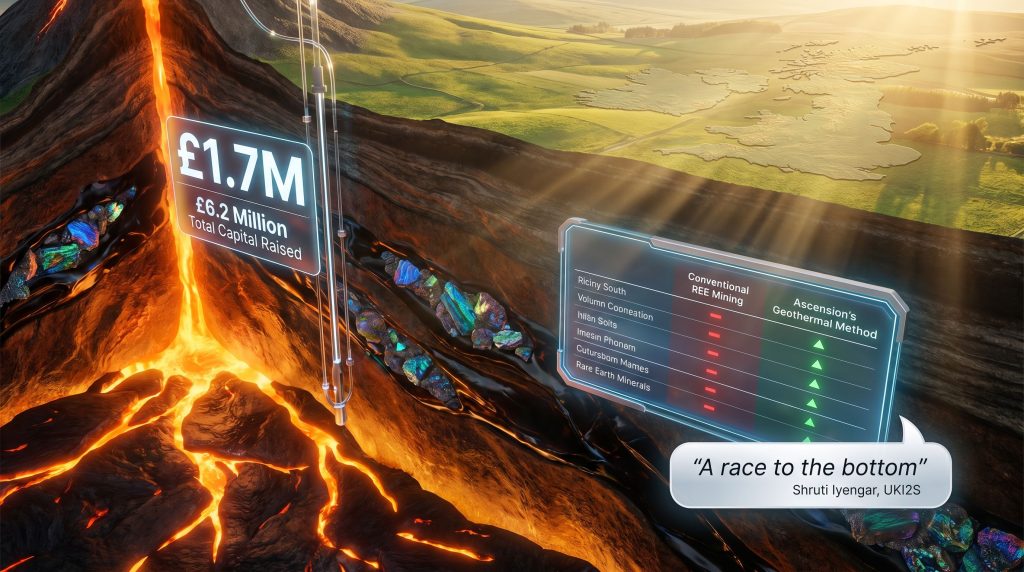
| Total Capital Raised to Date | £6.2M | ~US$8.4M | Cumulative |
The Innovate UK Growth Catalyst grant of £670,490 is a non-dilutive public grant designed to support high-potential deep-tech companies at critical development inflection points. Grant funding at this stage is particularly valuable because it does not require equity issuance, preserving the company's capitalisation structure ahead of larger institutional rounds.
The £1,000,000 matched investment from UKI2S, managed by Future Planet Capital, operates differently. As a matched investment vehicle, UKI2S typically co-invests alongside private capital, meaning the presence of private co-investors from Oxford Science Enterprises and East X was a condition of UKI2S participation. This structure is designed to ensure that public capital is deployed into ventures where the private market has independently validated the investment case.
Shruti Iyengar, Investment Director at UKI2S, has described critical mineral supply as one of the central chokepoints of the energy transition, arguing that competing for the same finite deposits constitutes a race to the bottom. She has indicated that Ascension's scientific novelty and the depth of its founding team across frontier geoscience and commercial execution were primary factors in the investment decision, alongside the strategic opportunity to build meaningful sovereign self-sufficiency in critical materials within the UK.
This framing from the lead institutional investor is significant. It positions the investment not merely as a bet on a specific technology, but as a strategic response to a structural supply chain vulnerability. That framing aligns Ascension's value proposition with national industrial policy priorities rather than presenting it purely as an environmental improvement story. Reporting from Mining Technology has further contextualised the significance of this funding within the broader critical minerals landscape.
What the Innovate UK Selection Signals
Innovate UK's Growth Catalyst programme is competitive and selective. The programme targets companies that demonstrate both technological novelty and a credible path to commercial scale. Ascension's inclusion indicates that peer reviewers within the programme assessed its underlying geoscience and recovery technology as sufficiently advanced and differentiated to merit public support.
It is important to note, however, that grant selection reflects programme criteria and does not constitute a government designation of Ascension's technology as a strategic national asset, nor does it provide accelerated permitting, preferential regulatory treatment, or guaranteed procurement commitments. The grant supports R&D acceleration specifically, and commercial outcomes remain dependent on the company's ability to validate its technology at field scale.
The US DOE Signal: Policy Validation From a Second Jurisdiction
One of the more significant contextual developments for Ascension's technology thesis came from the United States. On 7 April 2026, the US Department of Energy's Office of Critical Minerals and Energy Innovation announced a Critical Minerals and Materials Accelerator Notice of Funding Opportunity, allocating up to US$69 million for industry-led pilot programmes in critical mineral extraction and processing.
Within this NOFO, sub-topic 3C specifically targets exploration and characterisation of critical materials and rare earth elements from volcanic-hosted geothermal systems. This framing is directly congruent with Ascension's technological approach.
While the US DOE NOFO is targeted at US-based partnerships and does not represent funding for or endorsement of Ascension specifically, its existence carries important implications:
- It confirms that government-level scientific and strategic assessment in the United States has identified volcanic-hosted geothermal systems as a credible critical mineral recovery pathway
- It indicates that the US is prepared to commit significant public capital to developing this technology category, which validates the market thesis underpinning Ascension's UK-focused work
- It creates the conditions for potential transatlantic collaboration as the technology matures, given aligned strategic interests among Western allies
- It suggests that Ascension's early positioning in this technology space could become more commercially valuable as the broader category receives greater institutional attention
The convergence of UK public funding through Innovate UK and US federal investment signals through the DOE NOFO, both arriving within the same period and both specifically targeting geothermal mineral recovery, indicates a meaningful degree of Western policy alignment around this technology class.
Comparing Extraction Approaches: Where Geothermal Recovery Changes the Equation
Understanding Ascension's potential requires placing its methodology in direct comparison with both conventional mining and other emerging extraction approaches.
| Dimension | Conventional REE Mining | Ascension's Geothermal Method |
|---|---|---|
| Primary Energy Input | Grid electricity and fossil fuels | Naturally occurring geothermal heat |
| Surface Disturbance | Extensive open-cut or underground blasting | Minimal, non-excavative subsurface access |
| Chemical Processing | High-temperature acid leaching at surface | Environmentally compatible solutions applied underground |
| Feedstock Source | Geographically concentrated, actively contested deposits | Globally distributed volcanic geology |
| Waste Generation | Large tailings volumes requiring long-term management | Substantially reduced solid waste |
| Processing Infrastructure | Large centralised surface facilities | Potentially distributed, smaller-scale operations |
| Competitive Feedstock Landscape | Actively traded, geopolitically contested | Untapped, no established commodity market |
The distributed processing implication deserves particular attention. One of the structural advantages of Ascension's model, if it achieves commercial validation, is that it could support smaller-scale, geographically dispersed recovery operations rather than requiring the enormous centralised infrastructure that characterises conventional rare earth processing. This matters because large centralised processing facilities represent the segment of the supply chain where Chinese industrial dominance is most entrenched and most difficult for Western nations to replicate quickly. Consequently, understanding the full scope of rare earth supply chains is essential for appreciating why this distributed model carries such strategic weight.
The ESG Investment Dimension
Beyond the strategic supply chain argument, Ascension's model addresses a growing tension within institutional investment. Environmental, social, and governance frameworks have increasingly focused scrutiny on the upstream supply chains of clean energy technologies. The irony of financing solar panels and electric vehicles while accepting severe environmental damage in the mineral extraction that makes them possible has not gone unnoticed by institutional investors managing sustainability mandates.
Technologies that can demonstrate materially lower environmental footprints than conventional alternatives, and do so with credible field-level data rather than modelled projections, are likely to attract premium valuations from ESG-focused investors as the critical minerals sector matures. Ascension's pending field validation programme is therefore not only a technical milestone but an investment narrative milestone. Coverage from Mining Magazine has highlighted similar observations about the broader commercial significance of this approach.
The next major ASX story will hit our subscribers first
What Field Validation Will Determine
Ascension is currently advancing its Selective Recovery programme toward field validation trials, the stage at which laboratory-demonstrated concepts must be proven to work at operationally meaningful scales and in real geological conditions rather than controlled laboratory environments.
This is the highest-risk phase for any extraction technology company. Laboratory results do not always translate to field performance for several reasons:
- Geological heterogeneity means that real rock formations vary in ways that laboratory samples cannot fully capture
- Solution chemistry behaviour at scale and depth may differ from bench-scale observations
- Geothermal system dynamics are complex and variable, requiring operational adaptability that fixed laboratory conditions do not test
- Recovery rates and selectivity must be demonstrated to be economically viable, not merely technically feasible
The £1.7M funding round is specifically designed to progress through this validation phase. The outcome of field trials will determine whether Ascension geothermal critical mineral recovery funding translates into the significantly larger capital commitments required for commercial-scale deployment.
Motoaki Sumi has articulated the company's central thesis in terms of working with natural geothermal systems as a fundamental alternative to the prevailing model of accepting environmental damage as an unavoidable cost of critical mineral production. He has emphasised that the Selective Recovery programme and its technological development represent the core mechanism through which the company intends to demonstrate this alternative is commercially viable.
Frequently Asked Questions
What is Ascension's geothermal critical mineral recovery technology?
Ascension has developed a subsurface mineral recovery system that uses naturally occurring geothermal heat to extract critical minerals, including rare earth elements, directly from volcanic rock deposits. The approach avoids surface excavation and high-temperature chemical processing, reducing environmental impact relative to conventional extraction methods.
How much funding has Ascension raised in total?
As of April 2026, Ascension has raised a total of £6.2 million (approximately US$8.4 million), including its most recent round of £1.7 million (approximately US$2.3 million) from Innovate UK, UKI2S managed by Future Planet Capital, Oxford Science Enterprises, and East X.
Who founded Ascension?
Ascension was founded by Professor Jonathan Blundy and Professor Mike Kendall of the University of Oxford, alongside entrepreneur Motoaki Sumi. It operates as an Oxford University spinout company.
What is volcanic glass and why is it relevant to critical mineral recovery?
Volcanic glass forms when lava cools rapidly, preventing crystalline mineral structures from developing. Its amorphous molecular structure means that incorporated critical minerals may be more chemically accessible than in conventional crystalline ore deposits. Volcanic glass is globally distributed across tectonically active regions and has no established supply chain as a critical mineral feedstock, meaning it carries no extraction premium or competitive market pressure.
How does Ascension's approach address China's processing monopoly?
By recovering minerals in solution form underground and reducing dependence on large centralised surface refining infrastructure, Ascension's model targets the downstream processing chokepoint where Chinese industrial dominance is most concentrated. Distributed geothermal recovery operations could support critical mineral supply within friendly jurisdictions without requiring replication of China's large-scale refining capacity.
Does Ascension have US government backing?
Ascension has not announced any US government funding or partnership. The US Department of Energy's April 2026 NOFO for volcanic-hosted geothermal mineral systems indicates policy-level recognition of the technology category in the United States, but this does not constitute project-specific support for Ascension geothermal critical mineral recovery funding.
Key Takeaways for Investors and Industry Observers
- £1.7M secured through a blended public-private structure validates both the scientific credibility and the commercial logic of Ascension's approach
- Total capital of £6.2M positions the company at a credible pre-commercial stage, with field validation trials as the next critical milestone
- The Selective Recovery programme represents a structurally distinct extraction methodology, targeting minerals underground rather than processing bulk ore at surface
- Volcanic glass as a feedstock offers global geological distribution, no commodity market competition, and potentially favourable extraction chemistry
- The US DOE's US$69M NOFO for volcanic-hosted geothermal mineral systems provides independent policy-level validation that this technology category is receiving serious Western government attention
- Ascension's model directly addresses both the environmental paradox of clean energy mineral supply and the processing chokepoint that Western supply chain diversification efforts have so far failed to solve
- Field validation outcomes will be the decisive determinant of whether Ascension geothermal critical mineral recovery funding can attract the institutional capital required for commercial deployment at scale
This article contains forward-looking statements and assessments based on publicly available information. It does not constitute financial advice. Investors should conduct independent due diligence before making any investment decisions related to companies or technologies discussed herein. Technology performance at field scale cannot be guaranteed based on laboratory or early-stage results.
Want to Stay Ahead of the Next Critical Minerals Discovery on the ASX?
Discovery Alert's proprietary Discovery IQ model delivers real-time alerts the moment significant mineral discoveries — including critical and rare earth elements — are announced on the ASX, turning complex geological data into clear, actionable investment insights. Explore historic examples of major mineral discoveries and their market returns, then start your 14-day free trial at Discovery Alert to position yourself ahead of the market before the next breakthrough emerges.