May 14, 2026
The Governance Gap at the Heart of Southeast Asia's Resource Boom
The global energy transition has fundamentally rewritten the economic importance of Southeast Asia. Beneath the region's tropical landscapes and shallow coastal waters lie some of the planet's most strategically significant mineral deposits. Yet resource abundance alone does not translate into sustainable development outcomes. Across much of the world's mining history, the distance between extraction and genuine community benefit has been measured not in kilometres but in institutional quality. That distance is exactly what the ASEAN sustainable mining study tour in Australia is helping a growing number of ASEAN governments close.
The mechanics of how a mining sector matures from raw extraction toward responsible governance involve far more than regulatory drafting. They require functioning inspection systems, enforceable community consultation frameworks, mine rehabilitation financing mechanisms, and a culture of transparency between operators and the communities in which they work. These capacities take decades to build organically. However, they can also be transferred, adapted, and accelerated through structured international knowledge exchange. This is precisely the logic underpinning the broader partnership architecture growing around this initiative.
When big ASX news breaks, our subscribers know first
ASEAN's Mineral Endowment: Extraordinary Resources, Evolving Governance
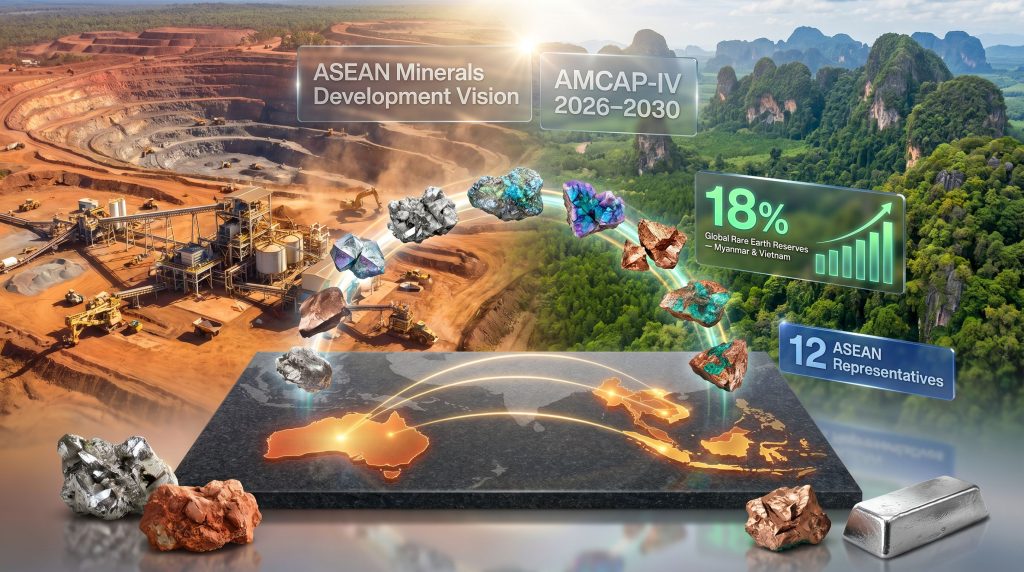
The eleven nations comprising ASEAN collectively form one of the world's most mineral-rich regional groupings. The scale of the endowment is striking: Indonesia holds the position of the world's leading nickel producer at a time when critical minerals demand is accelerating sharply alongside electric vehicle manufacturing growth. Myanmar and Vietnam together account for approximately 18% of global rare earth reserves, according to research published by UNICRI in April 2025, placing the sub-region at the centre of international critical mineral supply chain discussions.
Beyond these headline commodities, ASEAN member states hold significant reserves of bauxite, copper, tin, gold, and a range of other industrial minerals. The strategic weight of these deposits is compounded by global geopolitics. As competition intensifies among the United States, China, and the European Union to secure critical mineral supply chains for defence, energy technology, and advanced manufacturing, ASEAN's resource-rich members occupy a position of growing leverage.
For international buyers and financiers, however, leverage increasingly comes with conditions. Responsible sourcing credentials, auditable environmental standards, and demonstrable community benefit mechanisms are no longer optional extras in procurement decisions. They are baseline requirements for accessing capital from multilateral development institutions and sophisticated international investors.
This creates a clear incentive structure for ASEAN governments: building governance quality is not simply a domestic policy objective but a prerequisite for full participation in the international critical minerals economy. Furthermore, Australia's critical minerals sector provides a compelling case study in how this balance can be achieved.
The Policy Architecture Taking Shape
Recognising this imperative, ASEAN made a landmark collective commitment in late 2025 by formally adopting its Minerals Development Vision (AMDV), which acknowledges both the opportunities for the region in satisfying growing global demand for critical minerals and the obligation to supply them sustainably. This vision is operationalised through the ASEAN Minerals Cooperation Action Plan (AMCAP-IV, 2026-2030), which sets concrete regional targets and defines cooperation mechanisms between member states.
Both instruments rest on the ASEAN Principles for Sustainable Minerals Development, which establish a normative baseline from which each member state is expected to develop or reform its own policy frameworks. Together, these three policy instruments represent something genuinely significant: a regional pivot from extraction volume as the primary metric of success toward institutional quality as a parallel measure of the sector's health.
What makes this policy evolution particularly notable is its origins. The ASEAN Minerals Development Vision and the Principles for Sustainable Minerals Development were first proposed by researchers at the University of Queensland's Sustainable Minerals Institute in 2021 and 2022. The pathway from academic recommendation to adopted regional policy in under five years is a meaningful indicator of both institutional effectiveness and regional appetite for evidence-based governance reform.
What the ASEAN Sustainable Mining Study Tour in Australia Actually Involves
The ASEAN sustainable mining study tour in Australia is a structured, multi-day professional development program that takes senior government officials and mining sector representatives out of conference rooms and into operational mining environments. A recent iteration of the program ran for six days, accommodating 12 ASEAN participants alongside five additional representatives from Sweden and the United Kingdom, creating an international learning cohort with diverse regulatory reference points.
The program is led by researchers from the University of Queensland's Sustainable Minerals Institute (SMI), operating through its Global Centre for Mineral Security (GCMS). More than a dozen UQ staff and affiliate personnel with expertise spanning geology, environmental science, community development, and minerals policy contribute to program delivery. The result is not a generalised mining industry briefing but a carefully constructed exposure to integrated, end-to-end mining value chain governance.
What Participants Experience Across Six Days
The study tour combines site visits with expert-led thematic sessions, providing participants with both observational and analytical frameworks. Across the program, participants engage with:
- Operational mining sites where biodiversity management practices are applied across active extraction and post-disturbance landscapes
- Mineral processing facilities demonstrating the integration of environmental management systems with production operations
- Port and logistics infrastructure as a component of sustainable mineral export chains
- Expert sessions on mining governance, covering regulatory inspection regimes, compliance monitoring, and enforcement mechanisms
- Community relations frameworks that structure ongoing dialogue between resource companies and host communities
- Mine closure and rehabilitation planning, including financial assurance systems and progressive rehabilitation requirements
The deliberate sequencing of site visits before thematic sessions is pedagogically significant. Participants observe practices in context before analysing the institutional frameworks that produce them, creating a learning dynamic that is difficult to replicate in purely classroom-based settings.
Why Australia Serves as the Reference Model
Australia's position as a host for this kind of governance learning is not accidental. The country has developed, over several decades, a mining regulatory environment that includes independent statutory oversight bodies, mandatory financial assurance requirements for mine reclamation, multi-stage environmental impact assessment processes with structured public consultation components, and well-developed frameworks for negotiated community benefit agreements. These are not theoretical standards but operational systems with documented track records.
Ian Satchwell, Adjunct Professor at GCMS, has observed that ASEAN member states are specifically seeking evidence of how abstract sustainability principles become concrete policy frameworks, regulatory systems, institutional arrangements, and operational practices. This demand for applied, real-world case studies explains why desk-based technical assistance alone cannot fulfil the capacity-building need that study tours address.
Australia's geographic proximity to ASEAN, its established bilateral development partnerships, and its position as a major minerals producer with deep sector expertise collectively make it a logical and credible reference model for the region. The CSIRO's Critical Minerals Hub further reinforces Australia's role in showcasing globally recognised standards of mineral sector governance.
Comparing Governance Systems: Australia and the Emerging ASEAN Framework
Understanding the value of the study tour requires understanding the governance gap it is designed to help bridge. The following comparison illustrates where key differences currently exist between Australia's established mining governance model and the frameworks that ASEAN member states are in the process of building.
| Governance Dimension | Australian Model | Emerging ASEAN Approach |
|---|---|---|
| Regulatory Inspection | Independent statutory bodies with structured audit cycles | Developing; significant variation across member states |
| Mine Closure and Rehabilitation | Mandatory financial assurance and progressive rehabilitation requirements | Nascent frameworks being strengthened following AMDV adoption |
| Environmental Impact Assessment | Multi-stage EIA with public consultation at each phase | Inconsistent application across jurisdictions |
| Community Benefit Sharing | Negotiated agreements and royalty distribution mechanisms | Early-stage in most member states |
| Occupational Health and Safety | World-standard OHS legislation with active enforcement | Significant variation; identified as a capacity-building priority |
| Tenure and Royalty Systems | Transparent, codified frameworks providing investor certainty | Reform underway in several member states |
The pattern visible in this comparison is instructive. ASEAN is not starting from zero. Most member states have existing legislative frameworks and regulatory bodies. The challenge is one of consistency, enforcement capacity, and institutional maturity rather than the complete absence of governance architecture.
Why Institutional Transfer Matters More Than Technology Transfer
A critical insight from participant feedback is that the study tour's highest-value contribution is institutional rather than technological. One senior official from a major ASEAN minerals-producing nation indicated that the monitoring and inspection techniques observed during site visits would be directly applied to strengthen regulatory oversight in their home country. The emphasis was not on acquiring new equipment or software but on understanding how inspection systems are organised, resourced, and enforced.
Dr Paul Rogers of GCMS, who continues to engage with ASEAN through a World Bank-supported project, has noted that the SMI team's contribution is distinguished by its coverage of the entire mining value chain, from exploration and extraction through to mineral processing and mine closure. This integrated perspective is precisely what enables the kind of systems-level governance transfer that ASEAN is seeking, as opposed to point-in-time technical assistance focused on a single operational phase.
The recognition among participants that transparency and communication between mining operators and host communities is foundational to sustainable mineral development outcomes reflects a broader shift in how governance quality is being defined in the region. Social licence to operate is increasingly understood not as a reputational consideration but as an operational prerequisite.
The Research-to-Policy Pipeline: How UQ's Work Shaped ASEAN's Frameworks
One of the most analytically interesting dimensions of Australia's engagement with ASEAN on minerals governance is the documented pathway from academic research to adopted regional policy. The University of Queensland's SMI has been engaged with ASEAN minerals cooperation mechanisms since 2020, establishing what has become one of the longest-running academic-to-policy partnerships in Southeast Asia's extractive sector.
The timeline of policy influence is worth examining in detail:
- 2020-2021: SMI researchers begin systematic engagement with ASEAN cooperation mechanisms, conducting diagnostic assessments of governance gaps across member states
- 2021-2022: The SMI research team develops and submits a suite of recommendations for strengthening regional minerals cooperation, including proposed frameworks for sustainable development principles
- 2023-2024: ASEAN member states engage in regional consultation processes to negotiate and refine these frameworks, adapting recommendations to diverse national contexts
- Late 2025: ASEAN formally adopts the Minerals Development Vision and the accompanying AMCAP-IV Cooperation Action Plan, both of which directly reflect the earlier SMI recommendations
- 2026 onwards: Study tours and capacity-building programs operationalise the policy frameworks, translating formal commitments into practitioner-level capability
Dr Rogers has noted the significance of seeing work conducted years earlier now actively shaping the development of a sustainable future for ASEAN's mining sector. This satisfaction is warranted not merely as professional validation but as evidence of a research-to-policy model that functions effectively across jurisdictional and institutional boundaries.
The partnership has been sustained through a combination of UQ's institutional commitment and alignment with World Bank project funding, providing continuity that transcends the political cycles that often disrupt long-term development partnerships.
Australia's Broader Knowledge Exchange Network: ASEAN in Regional Context
The ASEAN sustainable mining study tour in Australia sits within a larger strategic architecture of Australian-led mining governance knowledge exchange. The scale and geographic diversity of these programs positions Australia not simply as a minerals exporter but as a global reference point for sector governance.
| Program | Region | Year | Scale |
|---|---|---|---|
| Australia Awards Africa Mining Governance Short Course | Africa | Early 2025 | 25 participants, 20 countries |
| Mineral Security Masterclass and Work Placements | Malawi and Fiji | 2025 | GCMS-delivered, multi-country |
| ASEAN Sustainable Mining Study Tour | Southeast Asia | 2026 | 12 ASEAN + 5 international participants |
| SEAG2G Mining Sector Study Tour Panel | Southeast Asia | 2026-2028 | Approximately 10 delegations anticipated |
The Australian Department of Foreign Affairs and Trade has formalised this agenda through the Southeast Asia Growth to Governance (SEAG2G) program, which includes a dedicated panel for mining sector study tours. Approximately ten delegations from Southeast Asia are expected to participate in Australian-hosted mining study tours between February 2026 and January 2028, with priority learning themes covering occupational health and safety, mine closure and land rehabilitation, environmental protection frameworks, royalty and taxation models, and mineral tenure systems.
Country-Level Demand Signals Across ASEAN
Demand for governance knowledge exchange is not uniform across ASEAN. In addition, several countries present particularly clear cases:
- Vietnam, holding a globally significant share of rare earth reserves, faces mounting pressure from international buyers and financiers to demonstrate responsible sourcing credentials before accessing premium markets
- Indonesia, as the world's leading nickel producer, is under continuous scrutiny regarding processing standards, environmental compliance, and labour practices as its nickel sector scales to meet battery supply chain demand
- Cambodia, with a growing gold sector, has sought direct engagement with Australian extraction and regulatory models, recognising that investor confidence requires demonstrable governance quality
These country-level signals reinforce the systemic nature of the governance capacity gap across the region and underscore why structured programs like the study tour operate across a demand environment that is both broad and deepening.
The next major ASX story will hit our subscribers first
Key Sustainability Themes Driving the Reform Agenda
Biodiversity Protection Across the Mining Lifecycle
Mining operations across Southeast Asia frequently intersect with ecosystems of global significance, including tropical forest systems in Borneo and Sumatra, marine environments in the Coral Triangle, and freshwater catchments feeding some of Asia's largest rivers. The environmental stakes of poorly managed extraction are therefore extremely high.
Australian practice in biodiversity offset frameworks and progressive rehabilitation provides directly applicable models for ASEAN jurisdictions that are developing or updating environmental legislation. Site visits to operational Australian mines allow study tour participants to observe how biodiversity commitments are operationalised at the project level, providing tangible evidence that production and environmental protection are not inherently incompatible objectives. Furthermore, the concept of natural capital in mining is gaining traction as a framework for quantifying and protecting ecosystem value alongside productive output.
Social Licence to Operate as a Governance Concept
The concept of social licence to operate refers to the ongoing acceptance by affected communities of a mining project's presence and activities. It is distinct from regulatory approval and cannot be obtained through legal compliance alone. It requires active, ongoing engagement, genuine benefit sharing, accessible grievance mechanisms, and demonstrated responsiveness to community concerns.
Australian models of negotiated community benefit agreements, local procurement requirements, and structured grievance processes are being studied as frameworks adaptable to ASEAN contexts. The explicit embedding of inclusive growth outcomes within the ASEAN Minerals Development Vision signals that this concept has now achieved regional policy recognition.
Mine Closure Planning and Financial Assurance
Mine closure represents one of the most persistently underfunded and under-governed aspects of mining project management globally. When closure planning is deferred until the end of a project's operational life, the financial and environmental liabilities that accumulate can exceed any operator's capacity to remediate them.
Australia's system of mandatory financial assurance, which requires mining companies to set aside rehabilitation funds before operations commence and maintain them progressively throughout the project life, addresses this problem through structural financial engineering rather than regulatory enforcement alone. Progressive rehabilitation requirements, which mandate ongoing land restoration during the operational phase rather than deferring all remediation to closure, are a particularly high-priority knowledge transfer theme for ASEAN regulators who are designing or reforming closure frameworks.
The Strategic Outlook: Building Durable Governance at Regional Scale
Study tours are high-impact but inherently limited in their reach. Senior officials who attend a six-day program return home with new frameworks and direct observations, but institutional change at scale requires more than individual learning. The next phase of Australia-ASEAN cooperation in mining governance is likely to involve in-country technical assistance programs, regulatory twinning arrangements between Australian and ASEAN agencies, and embedded advisory roles within member state mining ministries.
Digital knowledge exchange platforms and remote advisory services are emerging as complementary mechanisms, extending the reach of Australian expertise beyond the logistical constraints of in-person program delivery. The World Bank's continued co-funding of ASEAN minerals governance work provides an institutional framework within which scaled investment in these complementary tools can be justified.
The ultimate measure of program effectiveness is not participation rates or satisfaction scores. It is observable regulatory change in home country jurisdictions. The indicators to track include new inspection protocols adopted, financial assurance systems introduced for rehabilitation, community consultation requirements legislated, and environmental monitoring frameworks updated. Long-term tracking of these outcomes across successive study tour cohorts will determine whether Australia's investment in knowledge exchange translates into durable improvements in how Southeast Asia's extraordinary mineral wealth is governed.
As Adjunct Professor Satchwell has articulated, ASEAN nations are actively seeking assessment and diagnostic tools alongside practical capacity-building within their own countries. Meeting that demand is not merely an act of international goodwill. It is a strategically significant contribution to the governance quality of a region whose mineral endowments are becoming increasingly central to mining decarbonisation and the broader global energy transition.
Frequently Asked Questions
What is the ASEAN sustainable mining study tour in Australia?
The ASEAN sustainable mining study tour in Australia is a structured professional development program that brings senior government officials and mining sector representatives from ASEAN member states to Australia to observe and learn from Australian best practices in mining governance, environmental management, community engagement, and mine rehabilitation. Recent programs have run for approximately six days and included visits to operational mining, processing, and port facilities alongside expert-led thematic sessions.
Which institution leads the program?
The University of Queensland's Sustainable Minerals Institute (SMI), through its Global Centre for Mineral Security (GCMS), has been the primary academic leader in delivering ASEAN mining capacity-building programs since 2020. The Australian government's Department of Foreign Affairs and Trade also funds structured programs through mechanisms including the SEAG2G initiative. Interested parties can explore upcoming SMI tour events directly through the institute's website.
How did Australian research influence ASEAN's minerals policy frameworks?
Recommendations developed by the UQ SMI research team between 2021 and 2022 directly informed the development of the ASEAN Minerals Development Vision and the ASEAN Principles for Sustainable Minerals Development, both formally adopted in 2025. This is a documented case of academic research shaping binding regional policy frameworks across a compressed five-year timeline.
What topics do participants focus on during study tours?
Core learning themes include regulatory inspection and monitoring systems, occupational health and safety frameworks, mine closure and rehabilitation planning, biodiversity management practices, community relations and benefit sharing models, environmental impact assessment processes, and royalty and mineral tenure system design.
Why is Australia used as the reference model for ASEAN mining governance?
Australia offers a combination of operational mining scale, mature regulatory architecture, and documented track records in environmental rehabilitation and community engagement that is difficult to find in a single jurisdiction anywhere else in the world. Its geographic proximity to ASEAN, established development partnerships, and end-to-end expertise across the mining value chain make it a natural and credible benchmark for the region's governance reform efforts.
How many future ASEAN study tours are planned?
Approximately ten delegations from Southeast Asia are expected to participate in Australian-hosted mining study tours between February 2026 and January 2028 under the Australian government's SEAG2G program, indicating sustained institutional commitment to this knowledge exchange model over the medium term.
Disclaimer: This article is intended for informational and educational purposes only. References to policy frameworks, program statistics, and institutional activities are drawn from publicly available sources and should not be construed as investment advice. Forecasts and projections regarding program outcomes, governance improvements, or market developments involve inherent uncertainty. Readers should consult primary sources including the ASEAN Secretariat, the University of Queensland's Sustainable Minerals Institute at smi.uq.edu.au, and the Australian DFAT SEAG2G program documentation for the most current and authoritative information.
Want to Stay Ahead of Significant ASX Mineral Discoveries in the Critical Minerals Sector?
As Southeast Asia's governance frameworks mature and critical mineral supply chains attract growing international capital, the race to identify high-potential discoveries early has never been more consequential — Discovery Alert's proprietary Discovery IQ model delivers real-time alerts on significant ASX mineral discoveries, instantly translating complex data across 30-plus commodities into actionable insights for investors at every level. Explore historic examples of major mineral discoveries and their extraordinary returns, then begin your 14-day free trial to position yourself ahead of the market.